Sunday, September 23, 2012

Aurora and More: April 17, 1897


Aurora. 
Dawn. 
Death. 
Bodies. 

The Aurora crash story tells of a mystery airship that appeared about dawn on April 17, 1897, came in low, buzzed the town square and then continued north, toward Judge Proctor's farm. As the story goes, after it wrecked into a windmill, the Martian pilot's body was found and given a burial in the town's Masonic Cemetery.

Art: "Aurora, Texas Airship Encounter - 1897," 
at top, by Jeff Westover of Swamp Gas Graphics.

There is something bizarrely unreal about the Century 16 shooting after midnight at The Dark Knight Rises: A Fire Will Rise showing in Aurora, Colorado.
Something actually truly unreal did happen in Aurora, Texas, in 1897. It is unreal because it apparently never did occur. But it survives, culturally, in a significant fashion.


But, first, the legend of Aurora developed from a real news item:


"A Windmill Demolishes It," by S. E. Haydon, The Dallas Morning News, April 19, 1897, p. 5:

Aurora, Wise Co., Tex., April 17. - (To The News) - About 6 o'clock this morning the early risers of Aurora were astonished at the sudden appearance of the airship which has been sailing around the country.
It was traveling due north and much nearer the earth than before. Evidently some of the machinery was out of order, for it was making a speed of only ten or twelve miles an hour and gradually settling toward the earth. It sailed directly over the public square, and when it reached the north part of town collided with the tower of Judge Proctor's windmill, and went into pieces with a terrific explosion, scattering debris over several acres of ground, wrecking the windmill and water tank and destroying the judge's flower garden.
The pilot of the ship is supposed to have been the only one aboard and, while his remains were badly disfigured, enough of the original has been picked up to show that he was not an inhabitant of this world.
Mr. T.J. Weems, the United States signal service officer at this place, and an authority on astronomy, gives it as his opinion that the pilot was a native of the planet Mars.
Papers found on his person - evidently the record of his travels - are written in some unknown hieroglyphics, and can not be deciphered.
This ship was too badly wrecked to form any conclusion as to its construction or motive power. It was built of an unknown metal, resembling somewhat a mixture of aluminum and silver, and it must have weighed several tons.
The town is full of people to-day who are viewing the wreck and gathering specimens of strange metal from the debris. The pilot's funeral will take place at noon to-morrow.  S. E. HAYDON
Remember, Aurora means "dawn."

Most of the airship stories of the 1890s are what are called "journalistic hoaxes," so I asked my friend, famed ufologist author Jerry Clark if the Aurora case fit into that category.

Jerry emailed me in return with his continued opinion on this report: "The Aurora 'case' is not exactly a newspaper hoax, if one defines such as something cooked up in the editorial office. It was a practical joke written up by an Aurora correspondent. There is no evidence that anybody at the time thought it was anything else. All the excitement erupted decades later when excitable people ignorant of the cultural and journalistic context of the tall tale managed to get themselves wound up over nothing. At certain levels of ufology, no hoax ever dies, if it's even acknowledged as one."

Talking about the Aurora, Texas airship crash of 1897, Kevin Randle struck a similar tone to Clark's, in his "Aurora, Texas - A Story That Won't Die":

A large number of people, including Hayden Hewes of the now defunct International UFO Bureau, Jim Marrs, who had most recently suggested the story was real, and even Walt Andrus, the former International Director of the Mutual UFO Network (MUFON) at various times journeyed to Aurora in search of the truth. They all reported they found a strange grave marker in the Aurora cemetery, they found strange metal with metal detectors, and they gathered reports from long time Aurora residents who remembered the story, remembered seeing the airship, or remembered parents talking about the crash. There was also discussion of government attempts to suppress the data. To them, that made the story of the crash real.
The problem here is that I beat most of these people to Aurora by several years to conduct my own investigation. I talked to some of those same longtime residents who told me in the early 1970s that nothing had happened. I talked to the historians at the Wise County Historical Society (Aurora is in Wise County) who told me that it hadn’t happened, though they wish it had. I learned that T.J. Weems, the famed Signal Corps officer was, in fact, the local blacksmith. I learned that Judge Proctor didn’t have a windmill, or rather that was what was said then. Now they suggest that he had two windmills. I wandered the grave yard, which isn’t all that large (something just over 800 graves) and found no marker with strange symbols carved on it, though there are those who suggest a crude headstone with a rough airship on it had been there at the time. I found nothing to support the tale and went away believing, based on my own research and interviews, this to be another of the airship hoaxes. ~ Kevin Randle

If you go to Aurora and see this headstone, it's not real....it is a marker at the supposed site of the "spaceman's" grave. The original headstone was "supposedly" stolen, and that's if there was a headstone. ~ Source.
 

The marker at the cemetery in Aurora notes the Airship story, as well as the site's links to Freemasonry and some interesting name game items:
For many years, this community burial ground was known as Masonic Cemetery. Beauchamp, his wife Caroline (1829-1915), and others in their family. An epidemic which struck the village in 1891 added hundreds of graves to the plot. Called "Spotted Fever" by the settlers, the disease is now thought to be a form of meningitis. Located in Aurora Cemetery is the gravestone of the infant Nellie Burris (1891-1893) with its often-quoted epitaph: "As I was so soon done, I don't know why I was begun."
This site is also well-known because of the legend that a spaceship crashed nearby in 1897 and the pilot, killed in the crash, was buried here. Struck by epidemic and crop failure and bypassed by the railroad, the original town of Aurora almost disappeared, but the cemetery remains in use with over 800 graves. Veterans of the Civil War, World Wars I and II, and the Korean and Vietnam conflicts are interred here.
The joke is on me, for I did not know I would find myself here. My late maternal grandmother's first name is Nellie, and my late paternal grandmother's maiden name is Burris.

Dawn and Death. Masons and Martians. Grandmothers and Auroras.


The lexilink name game that really hit me was the one involving the name "Oates" at both Aurora, Texas, and Aurora, Colorado.

When the case was "rediscovered" in the 1960s, the search for evidence involved looking for parts of the airship said to have been thrown into Judge Proctor's farm's well. But the quest was made difficult. 
Brawley Oates...purchased Judge Proctor's property around 1945. Oates cleaned out the debris from the well in order to use it as a water source, but later developed an extremely severe case of arthritis, which he claimed to be the result of contaminated water from the wreckage dumped into the well. As a result, Oates sealed up the well with a concrete slab and placed an outbuilding atop the slab. (According to writing on the slab, this was done in 1957.) ~ Source.
* * *
Tim Oates, nephew of Brawley Oates and the now-owner of the property with the sealed well where the UFO wreckage was purportedly buried, allowed the [UFO Hunters] investigators to unseal the well, in order to examine it for possible debris. Water was taken from the well which tested normal except for large amounts of aluminum present; the well had no significant contents. It was stated in the episode that any large pieces of metal had been removed from the well by a past owner of the property. Further, the remains of a windmill base were found near the well site, which refuted [Etta] Pegues' statements (from the 1979 Time magazine article) that Judge Proctor never had a windmill on his property. ~ Source.
"No case ever dies, no matter how many times it is exposed as a hoax." ~ Kevin Randle.

But the tale endures. The legend abides. The name game lives on.

Today, you can go to Aurora, Texas, and find the exact site of the old Proctor farm. It is the Oates gas station.

Fast forward to the Aurora shootings in Colorado. The first face of The Dark Knight Rises "massacre" presented by the media to America was that of Aurora Police Chief Daniel Oates.

Aurora Police Chief Daniel Oates talks to media at the Aurora Mall where 12 people were killed and 52 injured at a shooting at the Century 16 movie theatre in Aurora, Colorado, on Friday, July 20, 2012. 
San Antonio Express-News Photo: Ed Andrieski.

Chief Oates at a later news conference.


++++


The Aurora Encounter is a 1986 American science fiction film directed by Jim McCullough Sr., written by Melody Brooke and Jim McCullough, Jr., and starring Jack Elam, Peter Brown, Carol Bagdasarian and Dottie West. Mickey Hayes, in a case bordering on exploitation, suffered from progeria, an extremely rare genetic disease of childhood characterized by dramatic, premature aging. Hayes with only makeup for his ears, played the "Aurora Spaceman." Hayes lived in Gregg County, Texas; he died on June 30, 1992, at the age of 20.

Also, the well-known Charles B. Pierce played the "Preacher" in Aurora Encounter. Pierce, an independent filmmaker whose inexpensively made documentary-style drama The Legend of Boggy Creek influenced the hit film The Blair Witch Project decades later, died at age 71, on March 5, 2010, in Dover, Tennessee. Pierce was involved with many B-movies, and was the initial concept screenwriter for the 1983 film Sudden Impact, the first "Dirty Harry" film, starring Clint Eastwood.
Sudden Impact, which made $67.6 million in the USA, is best remembered for Harry's catchphrase, "Go ahead, make my day." In 2005, it was voted in a poll by the American Film Institute as the sixth most memorable line in cinema history. United States President Ronald Reagan used the "make my day" line in a March 1985 speech threatening to veto legislation raising taxes. When campaigning for office as mayor of Carmel-by-the-Sea, California in 1986, Eastwood used bumper stickers entitled "Go Ahead — Make Me Mayor." ~ Source.
For more on Pierce, see The Beast of Boggy Creek: The True Story of the Fouke Monster (NY: Anomalist Books, 2012).


***

On September 17, 2012, Dangerous Minds published
by British writer Thomas McGrath. To learn more about 
this Twilight Language blog, please read it.

Jetsons: 50 Years of the Video Phone


Today is the 50th anniversary of the first broadcast of The Jetsons.

The show first aired, beginning on Sunday night, September 23, 1962, on ABC.


As I recently mentioned here when talking about predictions, one of the notable forecasting successes viewed on The Jetsons was of the video chat. For more of the other "futuristic technologies that exist today," as Matt Houghton writes regarding the show, see his "6 Current Technologies The Jetsons Predicted."

The Jetsons was quite early in their predictions, as well as rather persistent. Video chat is used frequently in every episode I watched. Clearly, with webcams and Skype, as well as the iPhone 4′s new FaceTime, this has quite clearly come true.

As to the "morning mask," well, there are a few Jokers out there who would say it does prevail, after all.


Saturday, September 22, 2012

Post-Aurora Lexilinking


By the pricking of my thumbs, 
Something wicked this way comes. 
~ William Shakespeare, Macbeth.

You know what I've noticed? Nobody panics when things go "according to plan." Even if the plan is horrifying! If, tomorrow, I tell the press that, like, a gang banger will get shot, or a truckload of soldiers will be blown up, nobody panics, because it's all "part of the plan." But when I say that one little old mayor will die, well then everyone loses their minds! Introduce a little anarchy. Upset the established order, and everything becomes chaos. I'm an agent of chaos. Oh, and you know the thing about chaos? It's fair!
~ The Joker, in The Dark Knight (2008), written by Jonathan Nolan & Christopher Nolan, story by Christopher Nolan & David S. Goyer, characters created by Bob Kane.

There are many ways to read the Joker's statement.

It is with some simplicity that academic thoughts may consider this summer's mass shootings as distractions from facing deeper societial issues. Harvard student Heather L. Pickerell did write, recently, comparing the 52 wounded and 12 killed in Aurora on July 20th with Iraqi causalities: "Did you know that 82 people were killed and 180 wounded by car bombs in Iraq on the same day as the shootings?"

While tragic and unfortunate, of course, she misses part of the bigger picture herself.


Wars, warzone deaths, systematic civil war causalities, and inner city gang shootings have become background noise in a culture that does experience violence closer to home in raw moments of stark realities. But in a broader context, before the latest homegrown wave of shootings dies down (sincerely, no pun intended), many other people will die, many others will be scarred, emotionally and physically, for life. Mass violence deaths, whether in Aurora, Columbine, and VA Tech, or in lesser remembered locations like Oak Creek, Bailey, and Nickel Mines, are as real, week to week, as the deaths in Afghanistan, Iraq, and Syria.

Believe it or not, the major difference is that the human psyche appears to consider it more understandable, even more rational, to conceptualize the loss of lives in national, regional, and turf wars. It is less within our frames of reference to figure out what is happening within the landscape of the human mind that leads to mass shootings. But both are equally awful.

Part of the rationale for a deeper examination of the copycat effect, an investigation of the behavior contagion among mass killers and spree shooters, has been to find a key to opening that door or window to the comprehension of things like the summer of shootings we have just experienced.

Often, it requires thinking outside the box. Therefore, one avenue of pursuit I have traveled down is seriously noting if lexilinking could be a factor. Let me explain.

First, what is "lexilinking" (for those of you who have never heard the word before)?


Several writers, like myself, began using "lexi-links" or "lexilinks" within articles we wrote for Fortean Times and other publications in the 1970s. 

Bob Rickard reminded me that "lexilink" was coined by Anthony J. Bell in his article, "Lexi-Links: Nature's Play on Words" in Fortean Times 17 (August 1976), pages 5-7.

Bell specifically looked at a new concept, lexilinks, and defined them this way:


Bell examined the "frequency of certain words" to attempt to decode what might be happening. He found that the "phenomenon of link-words" in articles and books is often "mirrored by link-words of events in the physical world." These incidents were, he surmised, related to "various violent events and no doubt have some sort of sociological significance," as he penned in that initial 1976 contribution.

Anthony J. Bell, who penned his letters with a northern English cadence, turned out to be a mysterious figure himself, with a mysterious name (see Bell). He ended up quietly appearing in Fortean Times twice after that. Bell wrote only one other article which developed the theme of puns and lexilinks in "Precession of the Gracious - Fallout of the Damned," in Fortean Times 20 (February 1977), on pages 14-17. He also sent in a brief letter on crop circles, which appeared in Fortean Times 58 (July 1991), in which he accurately predicted that crop circles would increase in complexity from their early simple designs.

Editor Bob Rickard wrote me in September 2012 that after the 1991 letter, at Fortean Times, "We never heard from him again."

Lexilink, as a word, has not actually entered any formal dictionaries. Wikipedia, indirectly, has apparently (in the past?) defined it vaguely this way: "A lexilink is a lexical link. This can be based on etymology, translations from other languages, and Anglicizations and other similar transformations."

Venturing into making some debunking comments related to "lexilinks," we then find this: "Lexilinks can be ascribed to coincidence, hoaxes, and some kind of conspiracy."

Not exactly a well-formed definition, it has vanished from the formal Wikipedia site, but the attempt lives on at Academic Kids.

Lexilinks are used in the twilight language analysis of events, frequently. Let's look at the Summer of the Gun's lexilinks, discovered in conjunction with the Aurora and post-Aurora world of 2012. Finding them brings up the usual questions. 

Are the coincidences found in the lexilinking being mined after Colorado's Aurora red dawn event, in some inexplicable way, part of the copycat effect? In other words, do what we are discovering synchromystically, as "coincidences" and "synchronicities," are variables in these cases that serve as cosmic triggers or programmed stimuli to the individuals involved? Do the shooters suddenly sense they are engaged in some form of theater reinforced by the lexilinking they find themselves in the midst of? Do the "coincidential" lexilinks act as risk factors pushing them over the edge?

The lexilinks found in the Aurora case and the shootings and related incidents that followed have been rather mind-blowing. The visual copycat effect experienced through repeating imagery of colorfully-haired Jokers and body-armored Banes is easier to understand. But the appearance of names in the stories, one linked to the other, is more difficult for the human brain to compute.

Take, for example, the visual linking that may have been overlooked, even though I mentioned it briefly before. The first verbal and written reports of the shooter - before any photographs were published of James Eagan Holmes - told of the Aurora killer having a goatee (even though this apparently did not turn out to be true, we are told). For example, moviegoer Corbin Dates, 23, who was sitting in the second row for the midnight premiere of The Dark Knight Rises, told television news reporters of a man sporting a goatee who, before the film started, answered a cell phone call, then got up and propped open an emergency exit door.

Guess what "look" appeared over and over in the first wave of Aurora copycats? Yes, most of these copycats had scruffy beards and goatees:


Let's look, therefore, beyond the visual, at a few of the specific word lexilinks that have popped up related to the Aurora events. (BTW, this rendering is not comprehensive, but it shows some highlights. Please pass along more, via comments, below.)

During the spring of 2012, the area around Denver, Colorado was swept by wildfires.

The political news was filled with presidential candidate Mitt Romney's Bain (= bones, death, white) Capital involvements.

Excitement was building on the horizon for the release of The Dark Knight Rises: A Fire Will Rise, a film by Christopher Nolan starring Christian Bale as Batman/Bruce Wayne and Tom Hardy as the super-villian Bane (= bones, death, white).

At the July 20, 2012, midnight showing of The Dark Knight Rises in Century 16's Theater 9, a man dressed in a gas mask, body armor, and with automatic weapons - dressed as Bane - opened fire on the movie audience in Colorado (= red), in Aurora (= dawn). The suspect then takes off his Bane costume to reveal himself to have orange hair, and declared himself, "I am the Joker."

The suspect was arrested. His name is James Eagan (= fiery) Holmes. He killed 12, and wounded 52 others.

Several copycat incidents occurred, some reflecting the Aurora incident, alluded to being Jokers or Banes.

For example, one of them on July 31, 2012, resulted the arrest of Thomas Michael Casper for a report of loud music ended up taking Casper making repeated references to "the Joker" and the Colorado theater shooting, telling police he understood the shooter's motives and would embark on his own rampage. The lexilink that became quite obvious was that this incident occurred in Eagan, Minnesota, a town with the same middle name as James Eagan Holmes, the Aurora suspect.

The Sikh Temple shooting took place on August 4, 2012, at Oak Creek, Wisconsin, resulting in seven dead, including the shooter Wade Michael Page (who lived on Holmes Avenue in nearby Cuhady, Wisconsin) and use to live in Littleton, Colorado (location of Columbine). Page, it has been pointed out, is the squire of a knight, and Wade Michael Page, as a neo-Nazi envisioned himself a Dark Knight. On July 20, 2012, a misidentification occurred when another James Holmes living in Littleton, Colorado had his Facebook page flooded with comments.

On the night of September 4, 2012, a gunman shot and killed one person during the Parti Québécois victory rally in Montreal, Quebe, Canada. Guards whisked PQ leader Pauline Marois off the stage as handlers informed the partisan crowd there had been gunfire and an arson fire had been set in the back of the Metropolis concert venue.

The suspect arrested was named Richard Henry Bain, and he owned Les Activités Rick Activities, a fishing camp on Lake Wade in La Conception, near the resort of Mont-Tremblant.

Richard Henry Bain, above, and Bane, the villian, below.

On September 5, 2012, police arrested a man wearing "Joker" makeup at a Florida movie theater after someone reported the man acting suspiciously, the Melbourne Police Department said. When police arrived at the Premiere Theatre, they found 21-year-old Christopher Alex Sides with his face painted like the Joker from the Batman movies and his hair dyed pink (or orange in some lighting). What was soon discovered was his intriguing address.


CHRISTOPHER ALEX SIDES W/M DOB: 05/07/91 ARREST DATE: 09/05/12 ARRESTING AGENCY: BCSO FAILURE TO APPEAR (Booking Photograph)

An earlier arrest is part of the recent public record: "Christopher Alex Sides, 19, of 1802 Aurora Park Circle, Melbourne, was charged April 17 with felony violation of conditional pre-trial release." "Police Report - Melbourne, Brevard County Sheriff's Office," Hometown News, April 29, 2011.

That's right. Sides lived in a trailer at the Aurora Park.


Enough for now. The lexilinks abound.

Oh yes, be alert next summer.

The new Superman film, Man of Steel, is due to be released on June 14, 2013 (Flag Day in the USA).
Oral tradition passed on through multiple generations holds that on June 14, 1908, Theodore Roosevelt was dining outside Philadelphia, when he noticed a man wiping his nose with what he thought was the American Flag. In outrage, Roosevelt picked up a small wooden rod and began to whip the man for "defacing the symbol of America." After about five or six strong whacks, he noticed that the man was not wiping his nose with a flag, but with a blue handkerchief with white stars. Upon realization of this, he apologized to the man, but hit him once more for making him "riled up with national pride." Source.
Man of Steel covertly staged part of their film pre-production and production work from a trailer near the International House of Pancakes, the IHOP, in Aurora, Illinois (pictured), at Orchard Road and Interstate 88, on July 27, 2012.

The production company did some filming later in August 2012, in Illinois, in Plano (the same name of a town in Texas directly associated with waves of suicide clusters and suburban heroin overdoses).


Man of Steel is from Warner Brothers, as are the three The Dark Knight films. The fear of the Superman curse appears to be a cause for concern among a few Warner executives. The hex has haunted Superman films and television programs for decades.

The Dark Knight trilogy's Christopher Nolan produced and cowrote (with David S. Goyer) Man of Steel, which is the first part of an 8-hour long trilogy. The director is
Zack Snyder, whose films, Dawn of the Dead (2004), 300 (2007), Watchmen (2009), and Sucker Punch (2011), are well-known for their graphic-novel-like violence.


American trailer: Kevin Costner narrates.


International trailer: Russell Crowe narrates.


Friday, September 21, 2012

Theaters and Theater Suspect On Fire


All things, oh priests, are on fire
The eye is on fire; 
Forms are on fire; 
Eye-consciousness is on fire; 
Impressions received by the eye are on fire.
~ Buddha - Hindu Prince Gautama Siddharta, 
founder of Buddhism, 563-483 B.C.


Fires have been traditionally associated with equinoxes. This year's September equinox, also known as the autumnal equinox in the northern hemisphere, will be on September 22, 2012. To be exact, this will occur at September 22, 2012, 14:49 GMT.

Intriguingly, after a week of the "World on Fire" allegedly caused by a film, the fires have moved onto and into theaters:
At least one person has died as demonstrations against an anti-Islam video erupt across Pakistan, a day after protesters tried to storm the US embassy in the capital, Islamabad.
Angry demonstrators set fire to two cinemas in the northwestern city of Peshawar, police and witnesses said on Friday, as the country began a day of protests.
One protester was wounded when a cinema guard opened fire as crowds armed with clubs and bamboo poles converged on the Firdaus picture house, "smashing it up and setting furniture ablaze," according to Gohar Ali, a police officer.
Witnesses said a separate rampaging crowd stormed the Shama cinema, notorious locally for showing films considered to be pornographic.
Aljazeera, 21 September 2012.

Protestors attacked Capri, Nishat and Prince cinemas in Karachi, as they marched on the main M.A. Jinnah road in the city’s downtown area.
According to DawnNews, Capri and Nishat cinemas were partially damaged while Prince cinema was set afire by violent mobs.
~ DawnNews, 21 September 2012.

Meanwhile, yesterday, September 20, 2012, during the newest hearing for alleged Aurora movie theater shooter James Eagan (= fiery) Holmes, he showed his new look.

Let's see the visual evolution we have been given by the media and/or the courts.

The first view of the suspect was in his initial open court arraignment.


Then there was the release later the same day of the "booking" photograph, which may have been taken some time after he was arrested on July 20, 2012 up through when he was arraigned, days later. His beard growth appears contemporary with the court appearance growth.

The Internet soon was awash with recently "old" photos of Holmes, with the red/orange fluffy hair style and similar beard growth.


The Joker is historically shown with green hair, but examples were found of orange-haired ones too, which may have served as Holmes' copycat source.


Now comes the closed court hearing of September 20, 2012, two months later, with new drawings and a new photograph of James Eagan Holmes. 

Who do the eyes remind you of?


Humm?


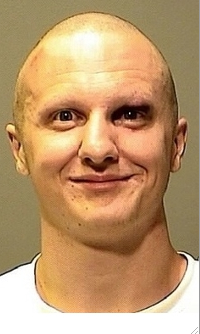
The booking photograph (above) is of Jared Lee Loughner, the confessed shooter of the January 8, 2011, Tucson, Arizona, incident. That event killed six people, including Chief U.S. District Court Judge John Roll, as well as a 9-year-old girl, Christina-Taylor Green, the granddaughter of former Chicago Cubs manager Dallas Green. The shooting also left 14 others wounded, including some critically, like U.S. Representative Gabrielle Giffords (Democrat, Arizona-House 8th).

Booking photographs are funny things. Some questions have been raised about whether or not the first image widely distributed of Loughner (above and on the right, below) has been altered. See here for a larger discussion of that issue. A later "original" photograph of Loughner (below, left) has since been released.


Some photoshopping of the Loughner (below) has been clearly labeled as such.


++++++++
Other recent fire news, as compiled by DRN, and shared:


Rare ‘fire devil’ caught on film (9/19) (Filmed on 9/11)