At 103 years of age, Douglas was able to see his acting genius acknowledged by being, while he was alive, No. 17 on the American Film Institute's list of the greatest male screen legends of classic Hollywood cinema, and the highest-ranked living person on the list. Douglas received three Academy Award nominations, an Oscar for Lifetime Achievement, and the Presidential Medal of Freedom (from President Jimmy Carter in 1981).


Charts credited to Alex Fulton, who worked on predicting Douglas' possible passage earlier.
Kirk Douglas' beginning career was entwined with that of Stanley Kubrick (July 26, 1928 - March 7, 1999).

In 1955, Douglas established Bryna Productions, which began producing films as varied as Paths of Glory (1957) and Spartacus (1960). In those two films, he collaborated with the then-relatively-unknown director Stanley Kubrick taking lead roles in both films. Douglas has been praised for helping to break the Hollywood blacklist by having Dalton Trumbo write Spartacus with an official on-screen credit, although this has been disputed by others.

While Paths of Glory did not do well at the box office, it has since become one of the great anti-war films, and one of early films by director Stanley Kubrick. Douglas, a fluent French speaker, plays a sympathetic French officer during World War I who tries to save three soldiers from the firing squad. Biographer Vincent LoBrutto describes Douglas's "seething but controlled portrayal exploding with the passion of his convictions at the injustice leveled at his men."

Before production of Paths of Glory began, Douglas and Kubrick had to work out some major issues, one of which was Kubrick's rewriting the screenplay without informing Douglas first. It led to their first major argument: "I called Stanley to my room ... I hit the ceiling. I called him every four-letter word I could think of ... 'I got the money, based on that [original] script. Not this shit!' I threw the script across the room. 'We're going back to the original script, or we're not making the picture.' Stanley never blinked an eye. We shot the original script. I think the movie is a classic, one of the most important pictures—possibly the most important picture—Stanley Kubrick has ever made."


The film, shot in Munich, from January 1957, follows a French army unit ordered on an impossible mission, and follows with a war trial of three soldiers, arbitrarily chosen, for misconduct. Dax is assigned to defend the men at Court Martial. For the battle scene, Kubrick meticulously lined up six cameras one after the other along the boundary of no-man's land, with each camera capturing a specific field and numbered, and gave each of the hundreds of extras a number for the zone in which they would die. Kubrick himself operated an Arriflex camera for the battle, zooming in on Douglas. Paths of Glory became Kubrick's first significant commercial success, and established him as an up-and-coming young filmmaker. Critics praised the film's unsentimental, spare, and unvarnished combat scenes and its raw, black-and-white cinematography.


Bosley Crowther of The New York Times wrote: "The close, hard eye of Mr Kubrick's sullen camera bores directly into the minds of scheming men and into the hearts of patient, frightened soldiers who have to accept orders to die."

Despite the praise, the Christmas release date was criticized, and the subject was a controversial one in Europe. The film was banned in France until 1976 for its "unflattering" depiction of the French military, and was censored by the Swiss Army until 1970.

In February 1959, Kubrick received a phone call from Kirk Douglas asking him to direct Spartacus (1960), based on the true life story of the historical figure Spartacus and the events of the Third Servile War. Douglas had acquired the rights to the novel by Howard Fast and blacklisted screenwriter Dalton Trumbo began penning the script. It was produced by Douglas, who raised the $12 million dollars production costs, and also starred as the rebellious Thracian slave Spartacus. He cast Laurence Olivier as his foe, the Roman general and politician Marcus Licinius Crassus.

Douglas hired Kubrick for a reported fee of $150,000 to take over direction soon after he fired director Anthony Mann. Douglas eplaced Mann early on with Stanley Kubrick, with whom he previously collaborated in Paths of Glory. Kubrick had, at 31, already directed four feature films, and this became his largest by far, with a cast of over 10,000 and a budget of $6 million. At the time, this was the most expensive film ever made in America, and Kubrick became the youngest director in Hollywood history to make an epic.

It was the first time that Kubrick filmed using the anamorphic 35mm horizontal Super Technirama process to achieve ultra-high definition, which allowed him to capture large panoramic scenes, including one with 8,000 trained soldiers from Spain representing the Roman army. Disputes broke out during the filming. Kubrick complained about not having full creative control over the artistic aspects, insisting on improvising extensively during the production. Kubrick and Douglas were also at odds over the script, with Kubrick angering Douglas when he cut all but two of his lines from the opening 30 minutes.

Despite the on-set troubles, Spartacus took $14.6 million at the box office in its first run. The film established Kubrick as a major director, receiving six Academy Award nominations and winning four; it ultimately convinced him that if so much could be made of such a problematic production, he could achieve anything. Spartacus also marked the end of the working relationship between Kubrick and Douglas.


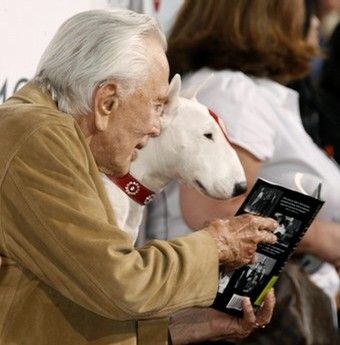
Kirk Douglas barely survived a helicopter crash in February 1991 and then suffered a stroke in 1996.
Douglas married twice, first to Diana Dill, on November 2, 1943; they divorced in 1951. The couple had two sons, actor Michael Douglas and producer Joel Douglas.

Afterwards, in Paris, he met producer Anne Buydens (born Hannelore Marx; April 23, 1919, Hanover, Germany) while acting on location in Lust for Life. She originally fled from Germany to escape Nazism and survived by putting her multilingual skills to work at a film studio, doing translations for subtitles. They married on May 29, 1954. In 2014, they celebrated their 60th wedding anniversary at the Greystone Mansion in Beverly Hills. They had two sons, Peter, a producer, and Eric, an actor who died on July 6, 2004, from an overdose of alcohol and drugs.


+++
A missed role...

In the midst of many memorable ones...


+++
With absolutely no proof at all, Kirk Douglas's legacy has been smeared by stories of him being the alleged source of rape rumors. Just to be complete, this rumor is added here.


The dark rumor about Kirk Douglas and Natalie Wood has never been proven, despite such passages as this one reproduced below. It seems clear, it is likely it is not true.

But there will always be a lingering doubt. As being reported on social media, however, Kirk Douglas did not die on Natalie Wood's birthday (which is actually July 20, 1938). If he had, it might have meant something for the unconscious works in strange ways.


+++
A missed role...

In the midst of many memorable ones...


+++
With absolutely no proof at all, Kirk Douglas's legacy has been smeared by stories of him being the alleged source of rape rumors. Just to be complete, this rumor is added here.


The dark rumor about Kirk Douglas and Natalie Wood has never been proven, despite such passages as this one reproduced below. It seems clear, it is likely it is not true.

But there will always be a lingering doubt. As being reported on social media, however, Kirk Douglas did not die on Natalie Wood's birthday (which is actually July 20, 1938). If he had, it might have meant something for the unconscious works in strange ways.
Kirk Douglas broke the "Black List," and should be recalled for that. May he and his legacy rest in peace.