Showing posts with label 23rd. Show all posts

Thursday, June 06, 2013

Collapsed Philadelphia Building Next to Mütter Museum


Newsflash!

The building collapse occurred immediatley next to the world-famous Mütter Museum at 19 South 22nd Street. The Mütter Museum in Rittenhouse (ritten, Germanic origin, ride + hausen, house) Square neighborhood offers a vast collection of medical and anatomical oddities. The medical museum located in the Center City area of Philadelphia contains a collection of medical oddities, anatomical and pathological specimens, wax models, and antique medical equipment.

Above, on the right, is the Mütter Museum. To the left, in white, is the building that collapsed.

America's finest museum of medical history, the Mütter displays its beautifully preserved collections of anatomical specimens, models, and medical instruments in a 19th century "cabinet museum" setting. The goal of the Museum is to help the public understand the mysteries and beauty of the human body while appreciating the history of diagnosis and treatment of disease.
The Collection began as a donation from Dr. Thomas Dent Mütter, who was determined to improve and reform medical education. The donation stipulated that the College had to hire a Curator, maintain and expand the collection, fund annual lectures and erect a brick building to house the collection. Since 1858, the College has held true to its promise to Dr. Mütter. Today the museum enjoys steadily rising international popularity. Mutter Museum website. 


The building and area, before the collapse. The Mütter is immediately down 22nd Street.

Posted, as it was happening...


Emergency crews are at the scene of a building collapse in Philadelphia, and the fire commissioner says as many as eight to 10 people are believed to be trapped in the rubble.
The accident happened at 10:45 a.m. Wednesday, June 5, 2013.

A building on the block had been under construction.
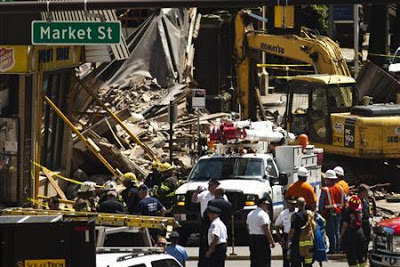


The collapse happened at a building at 22nd and Market Street in Center City. The building was reportedly being demolished at the time of the collapse.


Debris came through the roof of a Salvation Army thrift store on the corner.
+++
Later...
Thirteen people were rescued from the building by firefighters.

One man and five women are dead after a building collapsed in downtown Philadelphia.
The collapse at 2140 Market Street happened around 10:40 a.m. when a four-story building came down on top of a two-story building, which housed a Salvation Army Thrift Store. Early reports from Philadelphia Police indicate that the collapse may have been the result of an industrial accident, as construction crews were working on the nearby structure.
***
Mayor Nutter said the woman who died was 35 years old and that her family didn't want any more information about her to be discussed publicly. Sources close to the investigation say the woman was a cashier at the thrift store and that Wednesday was her first day on the job. Source.
+++
According to the demolition permit from Philadelphia's Licenses and Inspections, that building was a four-story structure. The demolition contractor is Griffin-Campbell Construction.

H/T to anon for Mütter link.

Thursday, April 09, 2009

Passover 1865: Lincoln Assassination

Events out of context often float adrift in time. April 14, 1865 has become important as the day that John Wilkes Booth shot Abraham Lincoln. For Americans of the Jewish faith, it was also Passover.

I share the following snippet to revisit how it felt during these under-discussed moments of the War Between the States.

Chapters in American Jewish History

Of Civil Seders in the Civil War

For American Jewry during the Civil War, the Passover story was especially powerful. Northern soldiers saw clear parallels between the Union freeing the South's slaves and Moses leading the ancient Hebrews out of Egypt. However, creating a seder during in a war zone requires flexibility and creativity.

In 1862, the Jewish Messenger published an account by J. A. Joel of the 23rd Ohio Volunteer Regiment of a seder celebrated by Union soldiers in Fayette, West Virginia. Joel and 20 other Jewish soldiers were granted leave to observe Passover. A soldier home on leave in Cincinnati shipped matzot and hagaddot to his colleagues. Joel wrote:

We . . . sen[t] parties to forage in the country [for Passover food] while a party stayed to build a log hut for the services. . . We obtained two kegs of cider, a lamb, several chickens and some eggs. Horseradish or parsley we could not obtain, but in lieu we found a weed whose bitterness, I apprehend, exceeded anything our forefathers "enjoyed.?"?

We had the lamb, but did not know what part was to represent it at the table; but Yankee ingenuity prevailed, and it was decided to cook the whole and put it on the table, then we could dine off it, and be sure we got the right part.

The necessaries for the choroutzes we could not obtain, so we got a brick which, rather hard to digest, reminded us, by looking at it, for what purpose it was intended.


Yankee ingenuity indeed! Historian Bertram Korn observes, "It must have been quite a sight: these twenty men gathered together in a crude and hastily-built log hut, their weapons at their side, prepared as in Egypt-land for all manner of danger, singing the words of praise and faith in the ancient language of Israel."

The seder proceeded smoothly until the eating of the bitter herbs. Joel recounted:

We all had a large portion of the herb ready to eat at the moment I said the blessing; each [ate] his portion, when horrors! What a scene ensued . . . The herb was very bitter and very fiery like Cayenne pepper, and excited our thirst to such a degree that we forgot the law authorizing us to drink only four cups, and . . . we drank up all the cider. Those that drank more freely became excited and one thought he was Moses, another Aaron, and one had the audacity to call himself a Pharaoh. The consequence was a skirmish, with nobody hurt, only Moses, Aaron and Pharaoh had to be carried to the camp, and there left in the arms of Morpheus.


More problematic was the situation of Union soldiers who, unable to form their own seders, were forced to "fraternize" with local Jews. Myer Levy of Philadelphia, for example, was in a Virginia town one Passover late in the war when he saw a young boy sitting on his front steps eating a piece of matzo. According to Korn, when Levy "asked the boy for a piece, the child fled indoors, shouting at the top of his lungs, "Mother, there's a damn Yankee Jew outside!" The boy's mother invited Levy to seder that night. One wonders how the Virginian family and the Yankee soldier each interpreted the hagadah portions describing the evils of bondage.

On the eve of the fifth day of Passover (April 14), 1865, Abraham Lincoln was shot and died of his wounds in the early morning of April 15th, which had already been scheduled as a national day of prayer to mark the end of the Civil War. Jews across the land were gathering in synagogues to give thanks. When news of Lincoln's death arrived, Korn notes, the synagogue altars were quickly draped in black and, instead of Passover melodies, the congregations chanted Yom Kippur hymns. Rabbis set aside their sermons and wept openly at their pulpits, as did their congregants. Lincoln had been protective of American Jewry, overturning General Grant's infamous General Order #11 expelling Jews from the Department of the Tennessee and supporting legislation allowing Jewish chaplains to serve in the military. The Jewish Record drew the analogy between Lincoln not having lived to see the reconciliation of North and South and Moses dying on Mount Pisgah before he saw the Israelites enter the Promised Land.

When no American armed forces are in combat anywhere in the world, it is easy to forget how difficult it can be for Jewish soldiers to serve their country while maintaining the traditions that beautify Judaism. Nevertheless, for Jewish Union soldiers fighting between 1861 and 1865 to free others from slavery, the Passover parallels must have made each seder particularly sweet and meaningful.