The twilight language explores hidden meanings and synchromystic connections via onomatology (study of names) and toponymy (study of place names). This blog further investigates "name games" and "number coincidences" found in news and history. Examinations are also found in my book The Copycat Effect (NY: Simon and Schuster, 2004).
Police are investigating a crash and reports of a shooting Monday, March 30, 2015, morning at Fort Meade, Maryland.
A spokeswoman at Fort Meade says two people were injured, one killed, as they attempted to ram a gate to the National Security Agency.
The two men were dressed as women. They were said to have attempted to "penetrate" (it was is in quotes in the description of them attempting to breach) the gate.
Aerial video showed multiple vehicles involved in a crash on the connector road from Route 295 to Fort Meade. Also shown was an emergency responder being loaded into an ambulance.
On September 19, 2014, a man with a knife was able to jump a fence, get past the U.S. Secret Service and enter an unlocked door of the White House before he was caught. That incident and others prompted a review of security procedures as well as staff changes at the top of the agency. This individual was one of three who attempted to reach the White House, with the two other intrusions happening on September 11 and October 22, 2014.
In October 2013, a woman, Miriam Carey, with her 1-year-old daughter in her car rammed a gate outside the White House, then sped to the U.S. Capitol, where police twice opened fire on her car. She was killed after getting past a security barrier on the Capitol grounds. Her family has said she suffered from mental issues and panicked when she saw police with guns and had not meant to breach the security barriers.
Fort George G. Meade is a United States Army installation that includes the Defense Information School, the Defense Media Activity, the United States Army Field Band, and the headquarters of United States Cyber Command, the National Security Agency, the Defense Courier Service, and Defense Information Systems Agency headquarters. It is named for George G. Meade, a general from the U.S. Civil War, who served as commander of the Army of the Potomac. The fort's smaller census-designated place includes support facilities such as schools, housing, and the offices of the Military Intelligence Civilian Excepted Career Program (MICECP).
George Gordon Meade (December 31, 1815 – November 6, 1872) was a career United States Army officer and civil engineer involved in the coastal construction of several lighthouses. He fought with distinction in the Second Seminole War and the Mexican-American War. During the American Civil War he served as a Union general, rising from command of a brigade to the Army of the Potomac. He is best known for defeating Confederate General Robert E. Lee at the Battle of Gettysburg in 1863.
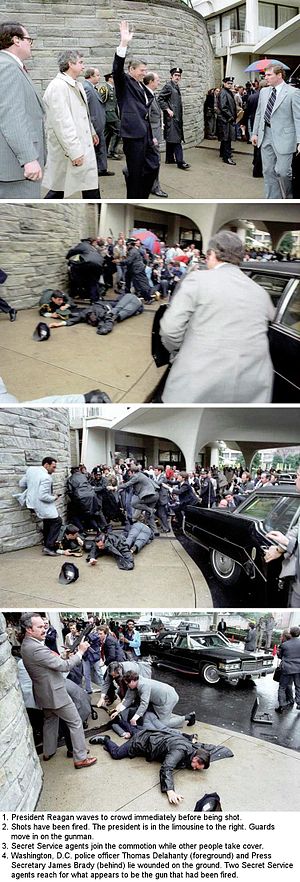
This date is the anniversary on March 30, 1981, when U.S. President Ronald Reagan was shot in the chest outside the Washington, D.C., Hilton Hotel by John Hinckley, Jr. Hinckley stood near the umbrella being held by a camera crew filming the president.
Reagan's press secretary James Brady, Washington police officer Thomas Delahanty, and Secret Service agent Timothy McCarthy were struck by gunfire from the would-be assassin.
George W. Ashburn (born 1814) was a Georgia politician assassinated on March 30, 1868, by the Ku Klux Klan in Columbus, Georgia for his pro-African-American sentiments. He was the first murder victim of the Klan in Georgia.
On the night of March 30, 1868, Ashburn participated at a huge gathering of blacks and Republicans at Temperance Hall in Columbus, Georgia. One of the featured speakers was Henry McNeal Turner. Just after midnight, Ashburn was murdered at a house on the corner of 13th and 1st street by a group of five well-dressed men wearing masks.
During the time of Ashburn’s murder Georgia was still under the military governorship of General George Meade (the victor of Gettysburg), of the Third Military District. As soon as he heard of the murder, Meade implemented martial law in Columbus, removing the mayor from office, and ordering the immediate arrest of all suspects.
In an incident occurring on January 28, and uploaded on February 1, 2015, a Chinese woman with an umbrella is making the rounds of YouTube. She takes on three guys who are being disruptive at a Chinese restaurant. Said to be real and not fictional, it has been highlighted in the media, of late, such as here.
Let's look at a few other umbrella people.
First up, some scenes from a short Errol Morris documentary that takes a skeptical view of the reports of a mystery man, the so-called "Umbrella Man" at Dealey Plaza, Dallas, Texas, at the site of the John F. Kennedy assassination, November 22, 1963.
Josiah Thompson, author of Six Seconds In Dallas, considers the following by John Updike:
In December 1967 John Updike was writing “Talk of the Town” for The New Yorker. And he spent most of that “Talk of the Town” column talking about the “umbrella man.” He said that his learning of the existence of the umbrella man made him speculate that in historical research there may be a dimension similar to the quantum dimension in physical reality. If you put any event under a microscope you will find a whole dimension of completely weird, incredible things going on. It’s as if there’s the macro level of historical research where things sort of obey natural laws and the usual things happen and unusual things don’t happen. And then there’s this other level where everything is really weird.
On December 5, 2011, Russ Baker wrote well-articulated rebuttal to the above short video, entitled "JFK Umbrella Man—More Doubts."
NEVILLE CHAMBERLAIN
As you’ll recall, the New York Times’ preferred explanation for why a man opened an umbrella on a sunny day, just as JFK’s limousine passed—and just as the bullets poured into the car— was an entirely benign one. Strange, but benign.
Recap: Fifteen years after the assassination, as the special House Select Committee on Assassinations was taking the first serious look at the death of JFK (and others), a man came forward to identify himself as the so-called “Umbrella Man” and to explain his bizarre behavior.
The man, Steven Louie Witt, said that, no, it was not someone signaling the shooters, and no, it had nothing at all to do with the assassination. Instead, he said, it was a message against appeasement of enemies. He hoped to signal his disapproval of what he considered JFK’s forbearance of America’s enemies.
How to signal that? Here’s where it gets complicated. Witt claimed he held up the umbrella as an icon symbolizing the treachery of Neville Chamberlain, the 1930s British prime minister. Chamberlain, who tried to preserve peace with Hitler by ceding him a part of Czechoslovakia (the Sudetenland), became a reviled symbol of appeasement. The self-described Umbrella Man said that he had been identifying appeasement with Chamberlain’s trademark umbrella. The connection to JFK came via his father, Joseph P. Kennedy, ambassador to Britain at the time and an anti-war isolationist.
Only a very unusual 15-year-old American (Witt’s approximate age in 1938) would have strong feelings about a British prime minister’s behavior, and still harbor those feelings a quarter century later. It is even harder to accept that he could believe JFK, himself a young man in 1938, might “get” the message somehow via the umbrella.
Even if we are to accept that Witt really was the man pumping the umbrella on the Grassy Knoll, and even if he was cognizant of Chamberlain, and even if he did think he could get a message to JFK via the Chamberlain affair, we still have a big problem with this claim.
According to John Simkin, a retired British history teacher and textbook author who runs the historical website Spartacus Educational, the umbrella was never the symbol of Chamberlain that the “umbrella man” claimed it was.
“In Britain, there was never any association with an umbrella at all,” Simkin told me. “Everyone had umbrellas and bowlers in those days.” According to Simkin, the only proper symbol for Chamberlain and appeasement was a piece of paper. That was the document he held aloft, with Hitler’s signature to the so-called Munich Agreement—in which Hitler agreed not to seek any further territorial gains in Europe—as Chamberlain famously declared that he had secured “peace in our time.” (In this old newsreel, you can see Chamberlain hold aloft that document.)
Simkin finds the New York Times video’s assertion that the purpose of opening the umbrella and pumping it in the air to signal Munich simply laughable.
More likely, it was exactly what it appeared to be: a method of signaling shooters, perhaps that JFK had been hit, perhaps that he still seemed to be alive, perhaps to keep shooting. Although it was a sunny day, it had rained the night before, and there was a wind, so it would not have been operationally illogical to move forward with using an umbrella. The fact that the New York Times and the establishment in general have never considered the umbrella worthy of real, serious inquiry, tells us that if the umbrella waspart of a plot, it was not so bad a choice.
RIO GRANDE BUILDING
In the last article, I mentioned that Witt, the self-proclaimed “Umbrella Man,” worked for Rio Grande National Life Insurance in the Rio Grande building. I mentioned that the same building housed the Immigration office frequented by Lee Harvey Oswald, and the local office of the highly negligent Secret Service. I mentioned that Rio Grande wrote a lot of insurance for the military. And, separately, I noted the strong military intelligence connections to key figures connected with 11/22/63.
One thing I did not mention, but should have, was that Military Intelligence itself had offices in that Rio Grande building.
Now, all of that could be coincidence. But there’s a reason certain entities signed leases with particular landlords and not others—especially so in Dallas circa 1963 (more on this in Family of Secrets.) Source.
The real danger of a video like the one about the Umbrella Man is that it encourages people to stop questioning, stop investigating. Just laugh it all off. As many would say, "There’s no trouble here in the land of the free, the home of the brave. Nothing to see here, folks, move along, move along."
Next up,
9/7/1978 (American style)
The Bulgarian umbrella is the name of an umbrella with a hidden pneumatic mechanism which injected a small poisonous pellet containing ricin. The weapon has a hollowed stalk into which the pellet neatly sits.
Such an umbrella was allegedly used in the assassination of the Bulgarian dissident writer Georgi Markov on September 7, 1978 (the birthday of the Bulgarian State Council chairman Todor Zhivkov who had often been the target of Georgi Markov's criticism) on Waterloo Bridge in London, (Markov died three days later) and also allegedly used in the failed assassination attempt against the Bulgarian dissident journalist Vladimir Kostov the same year [on August 26, 1978] in the Paris Métro. The poison used in both cases was ricin. Both assassination attempts are believed to have been organized by the Bulgarian Secret Service of the time of the Cold War with the assistance of the KGB. Source.
This is a replica of the umbrella - modified to fire a tiny pellet filled with poison - used by the KGB in 1978 to assassinate dissident Georgi Markov.
Then,
3/30/1981 (American style)
On March 21, 1981, Ronald Reagan, the new President of the United States, visited Ford's Theatre in Washington, D.C. with his wife Nancy for a fundraising event. He recalled, "I looked up at the presidential box above the stage where Abe Lincoln had been sitting the night he was shot and felt a curious sensation... I thought that even with all the Secret Service protection we now had, it was probably still possible for someone who had enough determination to get close enough to a president to shoot him."
On March 30, 1981, only 69 days into the new administration, Ronald Reagan, his press secretary James Brady, Washington police officer Thomas Delahanty, and Secret Service agent Timothy McCarthy were struck by gunfire from would-be assassin John Hinckley, Jr., outside the Washington Hilton Hotel. Although "close to death" upon arrival at George Washington University Hospital, Reagan was stabilized in the emergency room, then underwent emergency exploratory surgery. He recovered and was released from the hospital on April 11, becoming the first serving U.S. President to survive being shot in an assassination attempt.
Brady died August 4, 2014.
Hinkeley's face is visible in this photo, to the left of the NBC umbrella sheltering the NBC camera crew, who would soon film the attempted assassination of Reagan.
4/11/1981 (American style)
April 11, 1981: US President Ronald Reagan smiles and waves as he stands under an umbrella with First Lady Nancy Reagan after leaving George Washington Hospital, Washington, DC. The president recovered from an attempted assassination attempt by John Hinckley. Several secret service agents stand in the background. (Photo by Ronald Reagan Library). Source.
Moving along, back to the future...
5/2011
5/9/2012
An assassin armed with a poisoned-tipped umbrella is being hunted by police after killing a man - in a case bearing chilling echoes of the murder of a Bulgarian dissident on London’s Waterloo Bridge.
The 40-year-old German man died of mercury poisoning after being jabbed in the buttocks by a mystery attacker carrying the modified weapon.
The unnamed victim told police he was attacked by a slim stranger who had a sticking plaster on his face before falling into a coma.
He died on Wednesday [May 9, 2012] almost a year after the hit in Hannover, Germany. Source.
++++
1/26/2015
Robyn Rihanna Fenty (born February 20, 1988) is seen here on January 26, 2015, two days after Rihanna announced a new song via Twitter, "FourFiveSeconds," with Kanye West and Paul McCartney. The song will be performed by the three at the 2015 Grammys, the 57th, on February 8, 2015.
+++
Support my work by simply clicking on the following button to give $5, $10, $50, $100, whatever you can send...thank you.
Today, March 30, 2012, the President of the United States will be in my town of Portland, Maine. He is greeting a large crowd at the Southern Maine College College, and having a fundraising dinner at the Portland Museum of Art. I won't be able to see him, but I wish him well. My best goes out to him, and to the men and women of the United States Secret Service who have the job of protecting President Barack Obama today. Their service to our country, mostly under the radar, is great.
March 30th
On March 30, 1979, Airey Neave, a British Member of Parliament, was killed by a car bomb as he exited the Palace of Westminster. The Irish National Liberation Army claimed responsibility. This date is also the anniversary in 1981, of the wounding of President Ronald Reagan. On Thursday, March 30, 2006, at around 21:45, a Palestinian suicide bomber, disguised as an Orthodox Jewish hitchhiker and wearing hidden explosives attached to his body, boarded an Israeli vehicle. The suicide bomber blew himself up near the entrance to the Israeli settlement Kedumim near the gas station outside of the village. The blast killed four Israeli (three inside the car and another person who was near the vehicle).
I would expect awareness among law enforcement personnel would be heightened on a day like today. Copycats and behavior contagion are a problem, and protection agencies must realize that.
Assassination Attempt Against Ronald Reagan
On March 21, 1981, Ronald Reagan, the new President of the United States, visited Ford's Theatre in Washington, D.C. with his wife Nancy for a fundraising event. He recalled, "I looked up at the presidential box above the stage where Abe Lincoln had been sitting the night he was shot and felt a curious sensation... I thought that even with all the Secret Service protection we now had, it was probably still possible for someone who had enough determination to get close enough to a president to shoot him."
The Reagan assassination attempt occurred on Monday, March 30, 1981, just 69 days into the presidency of Ronald Reagan. While leaving a speaking engagement at the Washington Hilton Hotel in Washington, D.C., President Reagan and three others were shot and wounded by John Hinckley, Jr.
Curse of Tippecanoe
The name Curse of Tippecanoe (also known as Tecumseh's Curse, the Presidential Curse, Zero-Year Curse, the Twenty-Year Curse, or the Twenty-Year Presidential Jinx) is used to describe the regular death in office of presidents elected in years divisible by twenty, from William Henry Harrison (elected in 1840) through John Kennedy (1960). Ronald Reagan, elected in 1980, was shot and survived; George Walker Bush (2000) survived an attempt on his life unharmed.
The curse, first widely noted in a Ripley's Believe It or Not book published in 1931, began with the death of William Henry Harrison, who died in 1841 after having been elected in 1840. For the next 120 years, presidents elected during years ending in a zero (occurring every 20 years) ultimately died while serving in office, from Harrison to John F. Kennedy (elected 1960, died 1963).
The name "Curse of Tippecanoe" derives from the 1811 battle. As governor of the Indiana Territory, William Harrison used questionable tactics in the negotiation of the 1809 Treaty of Fort Wayne with Native Americans, in which they ceded large tracts of land to the U.S. government. The treaty further angered the Shawnee leader Tecumseh (shown above), and brought government soldiers and Native Americans to the brink of war in a period known as Tecumseh's War. Tecumseh and his brother organized a group of Indian tribes designed to resist the westward expansion of the United States. In 1811, Tecumseh's forces, led by his brother, attacked Harrison's army in the Battle of Tippecanoe, earning Harrison fame and the nickname "Old Tippecanoe." Harrison strengthened his reputation even more by defeating the British at the Battle of the Thames during the War of 1812. In a fictional account of the aftermath of the battle, Tecumseh's brother Tenskwatawa, known as the Prophet, supposedly set a curse against Harrison and future White House occupants who became president during years with the same end number as Harrison. This fictional account is the basis of the curse legend.
After the observation by Ripley, talk of the curse resurfaced as the next cursed election year approached. A similar oddities cartoon feature, Strange as it Seems by John Hix, appeared prior to Election Day 1940, with "CURSE OVER THE WHITE HOUSE!" A list, running from "1840 - Harrison" to "1920 - Harding" was followed by the ominous "1940 - ??????" and the note that "In the last 100 years, Every U.S. President Elected at 20-Year Intervals Has Died In Office!" Ed Koterba, author of a syndicated column called Assignment Washington, referred to the subject again in 1960.
As 1980 approached, the curse was sufficiently well-known, and Americans wondered whether the winner of that election would follow the pattern. The Library of Congress conducted a study in the summer of 1980 about the origin of the tale, and concluded that "although the story has been well-known for years, there are no documented sources and no published mentions of it". Running for re-election in 1980, President Jimmy Carter was asked about the curse at a campaign stop in Dayton on October 2 of that year. Taking questions from the crowd, Carter replied, "I'm not afraid. If I knew it was going to happen, I would go ahead and be President and do the best I could, for the last day I could."
The Curse Misfires
The election of Ronald Reagan in 1980 was not followed by his death in office, despite being seriously wounded in an assassination attempt within months of his inauguration. Days after Reagan survived the shooting, columnist Jack Anderson wrote "Reagan and the Eerie Zero Factor" and noted that the 40th president had either disproved the superstition, or had nine lives. Reagan, the oldest man to be elected President, also survived treatment for colon cancer while in office. He left office on January 20, 1989, and ultimately died of Alzheimer's Disease on June 5, 2004, at the age of 93.
Reagan's would-be assassin, John Hinckley, Jr., was found by a jury to be insane, but there was no evidence that he was motivated by a belief in the curse. Moreover, every president from Richard Nixon to George W. Bush faced at least one assassination attempt.
Like the presidents who had died in office, Reagan was succeeded in office by his vice president, George H. W. Bush, which was historically unusual given that Bush was the first incumbent vice president in 152 years to assume the presidency by direct election. The last incumbent vice president to win election had been Martin Van Buren, William Henry Harrison's immediate predecessor in office.
The next president in the line of the curse, George W. Bush in 2000, was unharmed in an assassination attempt in 2005 and finished out his final term on January 20, 2009.
The only president who died in office without being elected in a "cursed" year was Zachary Taylor, who was elected in 1848 and died in 1850. Fayette Factor, Nevertheless
The Battle of Tippecanoe was fought on November 7, 1811, near present-day Lafayette, Indiana between United States forces led by Governor William Henry Harrison of the Indiana Territory and Native American warriors associated with the Shawnee leader Tecumseh. Tecumseh and his brother Tenskwatawa (popularly known as "The Prophet") were leaders of a confederacy of Native Americans from various tribes that opposed US expansion into Native territory. As tensions and violence increased, Governor Harrison marched with an army of about 1,000 men to disperse the confederacy's headquarters at Prophetstown, near the confluence of the Tippecanoe and Wabash Rivers. Due to the links to Lafayette, Indiana, William Henry Harrison's beginning of the “20 year presidential death curse,” and the involvement of Tecumseh/Tenskwatawa, this date and site have much to do with the “Fayette Factor.”