Showing posts with label Symbolism. Show all posts

Saturday, June 20, 2020

The Allegorical Assault on Albert Pike


The last most significant demonstration on Juneteenth, June 19, 2020, was the toppling and symbolic burning of the Albert Pike statue in Washington D.C.


I foresaw this coming. I am not a conspiracy theorist. I am a predictor of human behavior based on social insights and psychological science.

A few in the synchromystic and cryptopolitical fields were able to forecast where the demonstrations might go. Michael Hoffman tweeted about the Pike monument six days ago. He was on-target. Although, according to Adam Parfrey's and Craig Heimbichner's Ritual America, Hoffman may have overstated Pike's "Satanism," as it has much to do with Pike's plagiarism. Hoffman and I disagree about some fundamentals but I listen to intelligent people, even with different bias than mine. We all have them.


Parfrey and Heimbichner did make the point in their book, however, that the usual Masonic pushback against the questioning of Pike's hidden leadership in establishing the Ku Klux Klan is weakened by the fact Pike's daughter shared a photograph of her father in a prominent position of authority for a book on the subject. Also, the KKK was set up, in essence, as a Lodge of Freemasonry, and Pike's involvement in creating it was covert but clear.


The Founders of the KKK. That's Pike in the central position.

Pike did not mince words in his support of slavery and of his negative feelings towards "negroes."

+++


Bill Grimstad and I have written about Albert Pike since 1978. I corresponded with Grimstad as recently as June 18, 2020, wondering aloud about the D.C. statue's probable removal.

Pike Name Game

Albert Pike was a failed Confederate general, a manipulator of Native peoples, pro-slavery, pro-Indian removal, and a supporter of his Native soldiers under his command scalping Union soldiers. There is little that was redeeming in his nature.


Pike went on to be to be elected Sovereign Grand Commander of the Scottish Rite's Southern Jurisdiction in 1859. One theory is that the Civil War may have begun as a battle between the northern & southern branches of Freemasonry ~ with the Scottish Rite being the "southern branch."

The Rebirth of Pan: Hidden Faces of the American Earth Spirit straightforwardly speaks to the "Pike Name Game."


The Pike section of this book, a difficult tome to find in libraries or via booksellers, begins with these words:

"Pike is a name only slightly less charged with strange significance than Fayette across our land."


© William Grimstad, with permission.


Grimstad is to be credited, besides noting Fayette, with alerting his readers to the "names like Bell, Beall and variants, Crowley, Francis, Grafton, Grubb, Magee/McGee, Mason, McKinney, Montpelier, Parsons, Pike, Shelby, Vernon, Watson/Watt, Williams/Williamson."

In Mysterious America, I talked of the “Name Game” or “Power” monikers of significance: Devil, Fayette, Lafayette, La/Fayetteville, Lagrange, Decatur, Pike, Wetzel, Reeves/Reed, Watts/Watkins/Watson, Bell, Mason/Macon, Parsons, Pike, Vernon, Logan, Shelby, and Warren. Also, I looked at Coleman via Coalman, the Perceivers, of course.

Pike is an English name for one who lived by a hill with a sharp point, from Old English pic “point,” “hill.” Also (1) a predatory fish; (2) a sharp pointed weapon; and (3) short for turnpike.  Pike as a boy's name is of English origin, and the meaning of Pike is "a spear.”

The harmonic naming of the United States of America, from Lafayette locations to Pike places, from Washington wonders to Decatur destinations, are part of Masonic America. The rest of the nation is beginning to be alert to the hidden meaning on the land.


How Quickly It Fell

It appeared various off-the-wall claims were afloat that the Masons were protecting D.C.'s Albert Pike statue. Or that Democratic leaders were looking to take down Confederate statues, but were ignoring the Pike memorial.

Instead, when the time came, events moved quickly.


Friday night, in Judiciary Square, exactly 13 blocks from the Capitol building, a crowd of 80-100 gathered steps away from the D.C. police headquarters, at 11:00 p.m., in front of the Albert Pike statue. Within 15 minutes, the monument was pulled off its pedestal and was on the ground. Demonstrators doused it with lighter fluid, and set it on fire. But since the statue is made of mostly bronze, the flames were more allegorical than damaging. Video.


June 20, 2020


National Mall and Memorial Parks, National Park Service (the caretakers of the Washington Monument, Lincoln Memorial, National Mall sites & more) confirmed to Fox5-DC, they have a truck at the site to remove the toppled Albert Pike statue by 3rd & D Streets NW. It will go to one of their maintenance facilities.


Before June 19, 2020.
Brigadier General Albert Pike was a public artwork in Washington, D.C. honoring Albert Pike (1809–1891), a senior officer of the Confederate States Army as well as a poet, lawyer, soldier, and influential figure in the Scottish Rite of freemasonry. The memorial was sited near the corner of 3rd and D Streets NW in the Judiciary Square neighborhood. The memorial's two bronze figures were sculpted by Gaetano Trentanove, an Italian-American artist responsible for another Washington, D.C. sculptural landmark, the Daniel Webster Memorial. The dedication ceremony in 1901 was attended by thousands of Masons who marched in a celebratory parade.


In 2009, the chapter, "The Double-Headed Phoenix" by Loren Coleman appeared in An Illustrated Guide to The Lost Symbol. (See here.)


The Pike memorial was the only outdoor sculpture in Washington, D.C. honoring a Confederate general. Though Pike was depicted as a Mason, not a soldier, the memorial often stirred controversy. The memorial was one of 18 Civil War monuments in Washington, D.C., which were collectively listed on the National Register of Historic Places in 1978. The memorial was owned and maintained by the National Park Service, a federal agency of the Interior Department.
The monument was toppled and burned by protesters on the night of June 19, 2020, as protests continued in response to the killing of George Floyd. Wikipedia. 


Pike's memorial has often stirred controversy throughout its history, beginning with the GAR's lobbying efforts against its erection to protesters arguing it honors a traitor and racist. Starting in the 1990s, there was renewed interest in removing the statue. In late 1992, members of the LaRouche movement, including civil rights activist and Lyndon LaRouche's vice presidential candidate James Bevel, began a series of protests demanding the memorial be removed, citing Pike's alleged links with the KKK. During one such event, LaRouche supporters draped Pike's statue with a KKK pointed hat and gown. Source.

The Future

A realistic view of this one week will see that great cultural change is occurring. The racist underpinning of everything from college football chants ("Gator Bait") to pancake brand names (Aunt Jemima), from Confederate statues to colonial monuments, are toppling in the wake of these events.

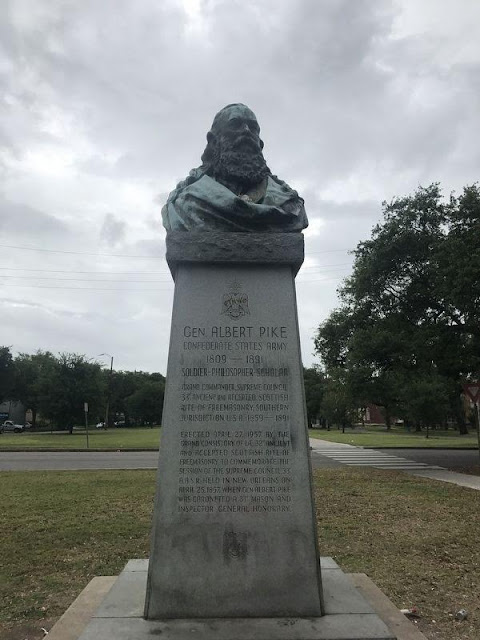
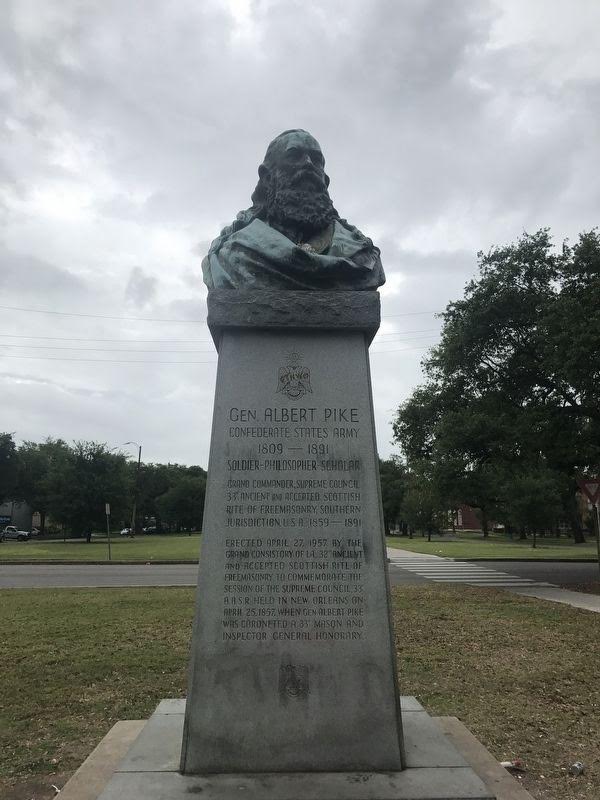
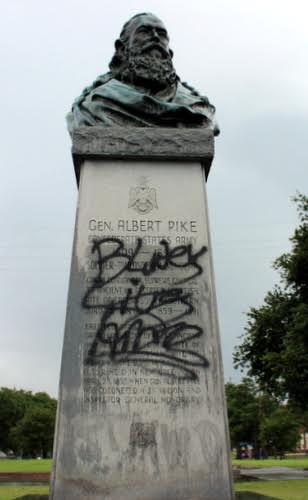
Look for the removal of other Confederate Brigadier General and Freemason Albert Pike’s monuments sitting outside in New York and mid-city New Orleans, but it is doubtful that any of his busts inside Masonic temples around the country will be disturbed (on private property).

Black lives matter. And as people look more closely at Pike's history in the future, perhaps, folks will figure out that Native lives matter too. Pike did not really care about America's indigenous peoples any more than he cared about Black ones.




See also:


Friday, July 22, 2011

Norway: 7.22.11 Breivik Attacks

More Updates: Copycat violence?
(1) Six killed, four wounded in Grand Prairie, Texas, roller rink shooting, July 23, 2011;

(2) Ten shot at La Raza car show, in Kent, 20 miles from Seattle, July 23, 2011.

(3) A total of seven people were injured also in the Seattle area, early Sunday, July 24, 2011, including two in critical condition, after a gunman opened fire at a casino. According to KIRO-TV, the shooting happened at about 1:30 a.m. local time Sunday at the Muckleshoot Casino in Auburn, a city some 20 miles south of Seattle.


And now this strange new incident:
(4) New Norwegian Killing


by craig on July 25, 2011
Last night two masked men in military uniform shot dead a 27 year old man in his home in Sandnes, Norway. Nowhere in the mainstream media can I [craig] find anybody wondering whether this is related to the massacre in Norway the day before – even though both were killings with guns, (very rare in Norway), and either this guy really was assassinated by soldiers, or both were carried out in false uniform. Have I [craig] turned into a crazed conspiracy theorist, or is this lack of curiosity a little bit strange?

News Alert on Monday, July 25th: The total death toll in Friday's bomb blast and shootings in Norway has been revised downward from 93 to 76, police say.
Police now say eight people died in the bombing in Oslo, up one from the earlier death toll. Authorities revised downward the number of dead in the shooting on Utoya island from 86 to 68. Police say they are still searching the island for possible victims.


++++
Original posting (with updates in numbers) about the July 22, 2011, events:


Early on Friday, a person dressed as a policeman fired shots at Norway's Labour Party Youth Camp, injuring and killing several people, Norwegian state broadcaster NRK reported. There were about 700 people at the camp, NRK said. (Update: The death toll for the shootings at the camp plus the bombings was set at 93 and/or 94 on Monday before the revision downward.)


Word of the attack came after a giant explosion rocked government buildings in Oslo, Norway. NRK reported that people were confirmed dead. (The number of dead is seven for those killed in the Oslo blast.)


Several buildings were badly damaged, witnesses said, and the city was reeling. The cause of the blast remained unknown for some time, as no one claimed responsibility.


Anders Behring Breivik is the suspect, shown here wearing a Masonic apron and outfit. Is Breivik a Freemason? Indeed, it appears so. According to Norwegian newspapers, a Facebook page ascribed to Breivik showed him as a person interested in bodybuilding, conservative politics and freemasonry. Another new photograph and information has associated him with a Knights Templar group.


By late on Friday, Anders Behring Breivik, a 32-year-old ethnic Norwegian man, tall and blonde, was in custody, officials said, after two attacks earlier in the day that killed scores of people -- attacks police said are linked. The first attack occurred when a massive bomb erupted in the heart of Oslo; the second occurred at the ruling Labour Party's youth camp on an island outside the capital.

At least seven people were killed in Oslo, and at first only 10 were reported killed on Utoya Island (this is now said to be around 91 dead), officials said. A Labour Party member said panic broke out at the camp, with people climbing trees and jumping in a lake to avoid the gunfire.

The acting national police chief said the gun used was an automatic weapon and that undetonated explosives were found on the island after the attack.

National police chief Sveinung Sponheim told NRK that the suspected gunman's Internet postings "suggest that he has some political traits directed toward the right, and anti-Muslim views, but whether that was a motivation for the actual act remains to be seen."

Andersen said the suspect posted on websites with Christian fundamentalist tendencies. He did not describe the websites in any more details.

A police official said the suspect appears to have acted alone in both attacks, and that "it seems like this is not linked to any international terrorist organizations at all." The official spoke on condition of anonymity because that information had not been officially released by Norway's police.

"It seems it's not Islamic-terror related," the official said. "This seems like a madman's work."


But was there a message in the madness? "He is clear on the point that he wants to explain himself," police official Roger Andresen told reporters Saturday.


It is to be noted that the terrorist attack in New York was on 9/11, the one in Madrid on 3/11, and the Mumbai events on 7/11.


I have written extensively in The Copycat Effect (NY: Simon and Schuster, 2004) of the symbolism of dates in these acts and other underlying "messages" found in such twilight language, of course. 


The incidents in Oslo, Norway, occurred on 7/22/11, or, in European style, on 22/7/11.  Twenty-two, of course, is 11 x 2.

SMiles Lewis passes along the following confirming quote made sometime after my book appeared, about the July 11, 2006, Mumbai attacks: "The date of the attack, the 11th, may be only a coincidence, but it won't be ignored as investigators try to figure out who was behind today's deadly commuter train attacks in India. The 11th has now been chosen as an attack date in New York, Madrid and Mumbai. 'There's a lot of symbolism involved when terrorists choose their targets and the dates of their attacks,' said Jack Cloonan, a former FBI agent on the bin Laden squad who now works as an ABC News consultant."

What might be the deeper significance of today's attacks?


See the developing comments section below, for links to the historical King David Hotel attack of July 22th, and for more on the Masonic background of the suspected shooter.


Also, as I wrote about before and during the Virginia Tech shooting, there appears to be an unconscious or conscious attempt on the part of shooters to be the one with the highest "body count." 


Is this incident now the largest single shooter attack with the greatest number of young people killed in a youth-oriented setting? Obviously, the number killed has been higher in bombings and in military or terrorist operations with teams of killers, but isn't this the highest number of youth killed by one person in a single event, sadly?


Part Two:  See here for news of the Mexican Knights Templar group connection.

Thursday, January 13, 2011

Mona Lisa's Twilight Language


According to the Associated Press, a researcher has found symbols in Mona Lisa:

Letters, numbers claimed found in the painting

Forget her smile. An Italian researcher says the key to solving the
enigmas of "Mona Lisa'" lies in her eyes.


Silvano Vinceti claims he has found the letter "S'' in the woman's
left eye, the letter "L'' in her right eye, and the number "72" under
the arched bridge in the backdrop of Leonardo da Vinci's famous
painting. According to the researcher, the symbols open up new leads
to identifying the model, dating the painting, and attesting to
Leonardo's interest in religion and mysticism.


This is just the latest theory about a painting that has never ceased
to intrigue scholars, art lovers and casual viewers alike. Others have
claimed the painting is really the portrait of a man, or a
self-portrait, while speculation over the reason for the model's
famously enigmatic smile have ranged from pregnancy to mourning.

Some Leonardo scholars have expressed doubt over the new findings or
their significance, with one calling them "unsubstantial."

The newly found symbols are not visible to the naked eye. Vinceti said
Wednesday they are "very small, painted with a tiny brush and
subjected to the wear and tear of time."

Vinceti has not studied the painting directly at the Louvre Museum,
where it is on display. He said his research was based on
high-definition scanned images from the Lumiere Technology in Paris,
which specializes in digitizing artworks. Back in Italy, a Rome
laboratory digitally excluded reflexes and other colors in the eyes in
order to isolate the letters and make them stand out, Vinceti said.

The number "72" was recently found hidden in an arch of the bridge to
the right of the model, he told The Associated Press.

Tradition holds that the "Mona Lisa" is a painting of Lisa Gherardini,
wife of Florentine merchant Francesco del Giocondo, and that Leonardo
started painting it in 1503.

But Vinceti said the "S'' might refer to a woman in the Sforza dynasty
that ruled Milan. Leonardo spent time there between 1482-1499 and then
between 1506-1507, Vinceti said, which might change the date of when
the painting was begun.

Vinceti said the letter on the painting is drawn in the same way
Leonardo did in his writings. The letter "L'' is for Leonardo, he
said.

Vinceti and his group of historians and researchers are currently
studying documents and making cross-references about Leonardo's
movements and possible models. He said they expect to come up with a
name for the model within weeks.

The number "72," Vinceti argues, is found in the Kabbalah, a form of
Jewish mysticism, and in Christianity. Even when considered
separately, "7'' is full of symbolic associations in both Judaism and
Christianity, for example to the creation of the world, and the number
"2'' may be a reference to the duality of male and female, said
Vinceti.

The researcher said he remains open to other interpretations, but
insisted that the "Mona Lisa" was more than just a painting for
Leonardo ó it was a "cultural will" of sorts.

"Leonardo did nothing by chance," said Vinceti. "He wanted to leave
his final thoughts on his view of the universe."

Vinceti is the same researcher who has recently said he located
Caravaggio's remains. He also sought to dig up Leonardo's body in
France to conduct carbon and DNA testing.

Alessandro Vezzosi, the director of a museum dedicated to Leonardo in
his Tuscan hometown of Vinci, was skeptical.

Vezzosi argued that multiple sources prove that the painting depicts a
woman from Florence, saying the purported new symbols are insufficient
to counter that evidence.

Claudio Strinati, an art historian and an official with the Italian
Culture Ministry, said Leonardo's passion for the Kabbalah is well
known. But he doesn't believe that Leonardo wanted to attach any
symbolic meaning to the letters and numbers, otherwise he would have
left better clues.

"Over the past decades there have been so many interpretations I don't
even remember them all," Strinati told the AP. "We all think the (Mona
Lisa) is this constant source of mystery. The truth is, when you set
your mind to finding a secret, you can demonstrate whatever you want."