Slumdog Millionaire reopened in American theaters on March 20, 2009. It's time to take a look at one thread in the film and where it leads us.
An intriguing
undermentioned synchromystic element of the award-winning film
Slumdog Millionaire is its references throughout to
The Three Musketeers (
Les Trois Mousquetaires, 1844).
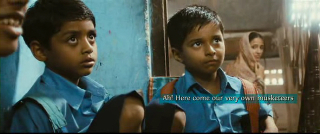
The movie's hero Jamal refers to his brother Salim and himself as Athos and Porthos, and the female of his attention Latika as the third Musketeer. The book is shown in flashbacks of the orphanage's classroom and in importance to the ending sequence regarding the last question asked on "So You Want To Be A Millionaire?"
The Three Musketeers (
Les Trois Mousquetaires) is a novel by Alexandre Dumas,
père (French for "father", akin to 'Senior' in English). It recounts the adventures of a young man named d'Artagnan after he leaves home to become a musketeer. d'Artagnan is not one of the musketeers of the title; those are his friends Athos, Porthos, and Aramis—inseparable friends who live by the motto "one for all, all for one" ("un pour tous, tous pour un").

The director Danny Boyle does not really deal with the overt or covert appearance of the novel, in the movie or even in his interviews about the film.
The New America Media interviewed Boyle, and he gave the following rather classic non-answer to the question of the book in his motion picture.
+++
New America Media: But would slum kids in India really read "The Three Musketeers"?
Danny Boyle: We had to work around that. We originally decided to do the whole film in English. But when I got there and started auditioning, it was clear that the little kids don't really speak English. I immediately thought, 'We have to do it in Hindi.' So the kids speak in Hindi in the beginning, and I remember ringing the studio, telling them, 'Oh, by the way, the beginning of the film is going to be in Hindi.' And they were just horrified. They thought subtitles. And all I said was, 'I promise you the subtitles will make the film even more exciting.' And they bought it, fortunately. It's true someone from his background would probably not have that much English but he's a smart kid, and he picks stuff up quickly and he remembers it. That makes his dream come true - the things he remembers.
+++
Did you hear a clear response in any of that?
Why didn't he answer this inquiry about
The Three Musketeers?
Perhaps Danny Boyle only likes to share visually? He, after all, was the director for two intriguing episodes of Inspector Morse ("Masonic Mysteries" and "Cherubim and Seraphim"). In "Masonic Mysteries," Morse himself becomes the prime suspect when his lady friend is murdered at a dress rehearsal of Mozart's
The Magic Flute.
By the time Boyle got to
Slumdog, he would have already been quite familiar with the multiple layers of Masonic symbolism in literature, music, and art.
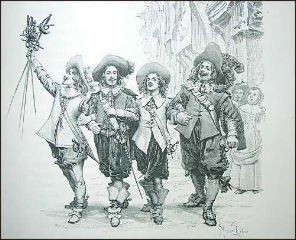 The Three Musketeers
 is a tale of friendship by a Freemason.
The author of
The Three Musketeers was born Dumas Davy de la Pailleterie (July 24, 1802 – December 5, 1870) ~ known simply as Alexandre Dumas. He became known as a French writer, best known for his numerous historical novels of high adventure, which have made him one of the most widely read French authors in the world. Many of the Dumas novels, including
The Count of Monte Cristo,
The Three Musketeers,
Twenty Years After, and
The Vicomte de Bragelonne were serialized and this extended his popularity. His novels were simple but multilayered. For example, his
The Knight of Sainte-Hermine, his last novel, was a swashbuckling tale containing a key scene of the Battle of Trafalgar, which explains the death of the British admiral Horatio Nelson.
One of the background elements of some significance to Dumas was his Masonic twilight clues in his stories.
Freemasonry is subtly written about by Freemason Brother Alexandre Dumas,
père, within his books:
The Count of Monte Cristo.
"Edmond had become as skilled in navigating the coastal waters as he had once been on the open sea. He got to know all the smugglers around the Mediterranean and learned the Masonic signs that these semi-pirates used to recognize one another." Chap. xxii, p. 189.
"But Andrea, turning around towards them, winked, put his tongue in his cheek and gave a clicking of the lips that meant a host of things to these bandits, who fell silent. These were masonic signs that Caderousse had shown him, and the hooligans recognized one of their own." Chap. cvii, p. 994.
"'More or less. We sailors are like freemasons, we recognize one another by certain signs.'" Chap. xxxi, p. 266. Penguin Classics Edition, 1103 pages, translated by Robin Buss (c) 1996, ISBN 0-14-044615-X
The Countess de Charny.
A chapter describes the advancement of three freemasons into the Illuminati of Cagliostro. [AQC xciii 4]
Philadelphia : T. B. Peterson, [1858.]. 8o.
Joseph Balsamo, or the Memoirs of a Physician.
Also deals with Cagliostro. [AQC xciii 4; xxxii 94]
London : Ward, Locke & Co., London, [1846-48]. 340p : ill ; 28cm
In 1848, Alexander Dumas wrote his
The Count Of Monte Cristo. The Count is the Jesuit General. Monte=Mount, Cristo=Christ. The Count of the Mount of Christ. Alexander Dumas was talking about the Jesuit General getting vengeance when the Jesuits were suppressed, and many of them were consigned to an island, three hours sailing, West, off the coast of Portugal. And so, when the Jesuits finally regained their power, they punished all of the monarchs of Europe who had suppressed them, drove them from their thrones, including the Knights of Malta from Malta, using Napoleon. And Alexander Dumas, who fought for the Italian patriots in 1848, to free Rome from the temporal power of the Pope, wrote many books and one of the books was to expose this, and that was
The Count Of Monte Cristo.
Little remembered today, Dumas was discriminated against due to his race. Dumas is included in the 2002 book by Joseph Cox,
Great Black Men of Masonry. Despite Alexandre Dumas' success, despite his Freemasonry and aristocratic connections, his being of mixed-race would affect him all his life. In 1843 he wrote a short novel,
Georges, that addressed some of the issues of race and the effects of colonialism. He once remarked to a man who insulted him about his mixed-race background: "My father was a mulatto, my grandfather was a Negro, and my great grandfather a monkey. You see, Sir, my family starts where yours ends."
Buried where he had been born, Alexandre Dumas remained in the cemetery at Villers-Cotterêts until November 30, 2002. Under orders of the French President, Jacques Chirac, his body was exhumed, and in a televised ceremony his new coffin, draped in a blue-velvet cloth, and flanked by four Republican Guards (costumed as the Musketeers - Athos, Porthos, Aramis, and D'Artagnan) was transported in a solemn procession to the Panthéon of Paris, the great mausoleum, where French luminaries are interred. In his speech President Chirac said:
"With you, we were D'Artagnan, Monte Cristo, or Balsamo, riding along the roads of France, touring battlefields, visiting palaces and castles — with you, we dream."
In that speech President Chirac acknowledged the racism that had existed, saying that a wrong had now been righted, with Alexandre Dumas enshrined alongside fellow authors Victor Hugo and Emile Zola.
The underlying theme of Freemasonry, so part of
The Three Musketeers ("three" is one of the most powerful of numbers in Masonic symbolism), is seeded into
Slumdog Millionaire.
Salman Rushdie, in his essay on film adaptations, "A Fine Pickle," argues that the plot of Swarup's novel,
Q & A, is "a patently ridiculous conceit, the kind of fantasy writing that gives fantasy writing a bad name. It is a plot device faithfully preserved by the film-makers, and lies at the heart of the weirdly renamed
Slumdog Millionaire. As a result the film, too, beggars belief."
Rushdie also questions director Danny Boyle's admission that he made the film in part because he was unfamiliar with India, asking, "I imagined an Indian film director making a movie about New York low-life and saying that he had done so because he knew nothing about New York and had indeed never been there. He would have been torn limb from limb by critical opinion. But for a first world director to say that about the third world is considered praiseworthy, an indication of his artistic daring. The double standards of post-colonial attitudes have not yet wholly faded away."
“The movie piles impossibility on impossibility,” the famous novelist Salman Rushdie said in a lecture Sunday, February 22, 2009 evening at Emory University (the night that
Slumdog Millionaire won so many Oscar at the Academy Awards).
(Perhaps it is his enormous ego, but, frankly, sometimes Rushdie seems rather out of touch and misses the bigger picture to make his sociopolitical point, don't you think?)
"The literary motif lurking here is that of the three musketeers, a book the boys fail to study properly at school, and the only book we ever see them look at. Even so, Jamal doesn’t know, when asked on the (television show) "Who Wants to Be a Millionaire?", who the third musketeer is. He manages to guess right, a move which in turn prefigures the happy ending, but also hides part of its pathos. All too often there are only two musketeers, and we can’t save the third. Indeed, this cruel logic appears to apply even when we can save the third," wrote Michael Wood in the
London Review of Books, At the Movies.
India, Freemasonry, and films are old friends, and here again "The Three Musketeers" serves as an entry point for a peek.
There is one version of "The Three Musketeers" that is a story by Rudyard Kipling. The tale introduces his three fictional British soldiers serving in India in the later nineteenth century: Privates Mulvaney, Ortheris and Learoyd. These appear in many early stories; Kipling's second collection is called
Soldiers Three (1888). "The Three Musketeers" was first published in the
Civil and Military Gazette on March 11, 1887, and in book form in
Plain Tales from the Hills, 1888. The ability to answer the question, "Who is the Third Musketeer?" is an element of the plot of Kipling's story, just as it was in
Slumdog Millionaire.
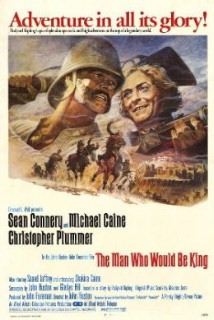
Kipling was a very overt Freemason, and his story "The Man Who Would Be King" (1888) is a tale of other fellow Freemasons. It is about two British adventurers in British India, who become kings of Kafiristan, a remote part of Afghanistan. The greatest
Masonic film of all time is the adaption of this book. "In the pantheon of Masonic films, there can only be one king - and this is it," wrote
Mr. Black. I could not agree more.
Director John Huston made this feature film in 1975,
The Man Who Would Be King, starring Sean Connery and Michael Caine as the protagonists and Christopher Plummer as Kipling. The book and the movie share a plot also involving Alexander the Great, forms of Masonic ritual, images of Masonic symbols, and knowledge of Masonic secrets that serve as keys to the initial success of Kipling's Masonic heroes.
One film that has been made, full of synchromystic symbolism that is entwined with "The Three Musketeers," even though they never are overtly merged, is
The Ninth Gate. It is a 1999 film based on the novel
The Club Dumas by Arturo Pérez-Reverte. Spanning several genres,
The Ninth Gate is a mix of Satanic mystery, iconic thriller, and neo-noir, and additionally portrays facets of the rare book business. The film was co-written and directed by Roman Polanski (
Rosemary's Baby), and stars Johnny Depp as Dean Corso, a rare-book dealer hired by a book collector (Frank Langella) to validate a copy of
The Nine Gates of the Kingdom of Shadows, a book by 17th century author Aristide Torchia.
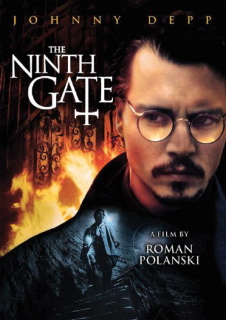
Johnny Depp, I consider, so linked to so many twilight language movies, the list overwhelms. But what is so incredible about this specific movie is how rich it is but how very ignored it has been. One of the biggest elements little known to casual viewers of this film is that
The Three Musketeers was originally part of this story. The source novel
The Club Dumas contains numerous literary references and a subplot concerning Corso’s investigation into the original manuscript for a chapter of
The Three Musketeers. Polanski and Brownjohn jettisoned these elements and focused on one particular plot line: Corso’s pursuit of the authentic copy of
The Nine Gates to make it more of a Lucifer-friendly movie, in the tradition of
Rosemary's Baby. The symbolism or complex nature of
The Three Musketeers appears to have been lost on Polanski.
There is one date in
The Ninth Gate that seems unmentioned but serves as a background temporal pivotal point of attention.
The Nine Gates of the Kingdom of Shadows, a book by 17th century author Aristide Torchia is said to have developed a cult that annually recalls the anniversary of the burning at the stake of Torchia. In this created fiction, that date is given (in the book, but not noted in the movie) as February 17, 1666. Aristide Torchia is a fictional character from
The Club Dumas, the 1993 novel by Arturo Pérez-Reverte. But Torchia is clearly based on the real life of Giordano Bruno, burned as a heretic on February 17, 1600.
Giordano Bruno was an Italian philosopher best-known as a proponent of the infinity of the universe. In addition to his cosmological writings, he also wrote extensive works on the art of memory, a loosely-organized group of mnemonic techniques and principles. He is often considered an early martyr for modern scientific ideas, in part because he was burned at the stake as a heretic by the Roman Inquisition. Frances Yates's books suggest that Bruno was deeply influenced by magical views of the universe inherited from Arab astrological magic, Neoplatonism and Renaissance Hermeticism. Other recent studies of Bruno have focused on his qualitative approach to mathematics and his application of the spatial paradigms of geometry to language.
Under Bruno's view of the universe, the Sun was simply one more star, and the stars all suns, each with its own planets. Bruno saw a solar system of a sun/star with planets as the fundamental unit of the universe. His view was holistic before it was cool to be holistic.
Symbolism was more overt in films like
The Man Who Would Be King in 1975 and
The Ninth Gate in 1999, of course. But that doesn't mean that iconic imagery is still not to be found in those of the 21st Century. Sometimes you have to look harder at what is hidden in plain sight.
Slumdog Millionaire is merely one point along the circle, which you can begin to measure anywhere.