Sunday, February 22, 2009

Death During The Oscars


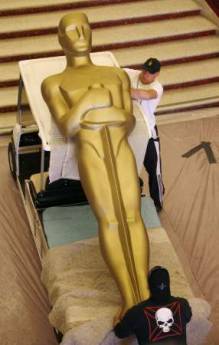
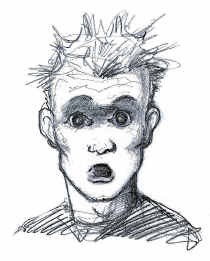
Doesn't it seem appropriate, for most of the day on the Drudge Report, that an image of a man with a death skull on his sweatshirt is what the world sees as it anticipates the Academy Awards?

Whereas The Dark Knight was easily 2008's most successful and popular film, you will only see Heath Ledger surviving the late year surge of reflective critical praise for Slumdog Millionaire, in the wake of the Mumbai attacks. As the happy beat of Bollywood is celebrated during the Oscars, few in the television audience will ponder how blindness is delivered to one child in the movie or suicide is depicted there either.

2515011147_4756ffd160_m.jpg

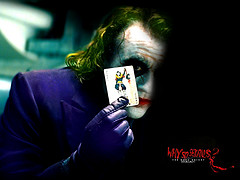
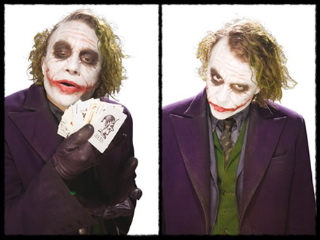
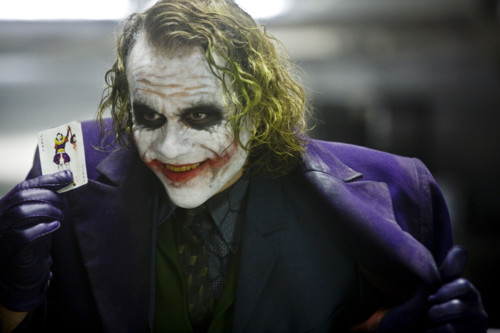
The man holding the card of a decapitated head wins. Ledger will be given the "Best Supporting Actor" award.


Movies mask or mirror the madness of the realities of the world. And we live in a time in which the news swirling around us is full of death, needless to say. Have you noticed the script unfolding for future films?

On February 10, 2009, a 5-year-old boy was beheaded in Virginia Beach, Virginia (well-known for Edgar Cayce, of course).

Joseph Hagerman III, a 33-year-old (of course) Virginia Beach resident, was charged with murdering his 5-year-old son Joshua in the family's home on Sugar Creek Drive. Police spokeswoman Margie Long said the state medical examiner had ruled the cause of death was decapitation.

Hagerman also faces felonious assault charges stemming from the wounds his wife suffered while attempting to protect their son. After the attack, Hagerman waited outside the residence for police to arrive.

Meanwhile, police in Louisiana report a man died after he fell off a Mardi Gras parade float and it hit him, last night, February 21, 2009. It happened after a parade in the Cajun town of Carencro (CARE-en-crow), about 130 miles west of New Orleans.

Lafayette (of course) Parish Sheriff's Lt. Craig Stansbury says the 23-year-old (of course) was hit as the float drove away from the parade route. Police didn't release his name because they hadn't notified his family.

Crowds in cities and towns across Louisiana are jamming parade routes this weekend as part of celebrations leading up to Mardi Gras, or Fat Tuesday, just before Ash Wednesday ushers in Lent.

There is more but you get the picture. Or, perhaps, you'll watch the movie.

thedarkknight1.jpg

Thanks to Ben Fairhall, Todd Campbell, Richard Hendricks, SMiles, Chris Knowles, and William Thuther for various pieces of the puzzle, and Matt Drudge too.

Oscar Update: Febuary 23, 2009
"But my liveliest interest is not so much in things, as in relations of things. I have spent much time thinking about the alleged pseudo-relations that are called coincidences. What if some of them should not be coincidence?" ~ Charles Fort

Heath Ledger did win the Oscar for "Best Supporting Actor."

The Oscar's tribute footage of all who had died in the last year ran by rather quickly and wasn't exactly too visual or visible. Here's the complete list.

Cyd Charisse
Bernie Mac
Bud Stone (executive)
Ollie Johnston (animator)
Van Johnson
J. Paul Huntsman (sound)
Michael Crichton
Nina Foch
Pat Hingle
Harold Pinter
Charles H. Joffe (producer)
Kon Ichikawa (director)
Charles H. Schneer (producer)
Abby Mann (screenwriter)
Roy Scheider
David Watkin (director of photography)
Robert Mulligan (director)
Evelyn Keyes
Richard Widmark
Claude Berri (director)
Maila Nurmi (Vampira)
Isaac Hayes
Leonard Rosenman (composer)
Ricardo Montalban
Manny Farber (film critic)
Robert DoQui
Jules Dassin (director)
Paul Scofield
John Michael Hayes (screenwriter)
Warren Cowan (publicist)
Joseph M. Caracciolo (producer)
Stan Winston (special effects)
Ned Tanen (producer, executive)
James Whitmore
Charlton Heston
Anthony Minghella (director, producer)
Sydney Pollack
Paul Newman

Some people commenting online at lists or forums, while not surprised to see Eyes Wide Shut actor Sydney Pollack in the tribute tape, were shocked to note Maila Nurmi (Vampira) there.

But the entire program had several subtle twilight themes. There was a covert vampire subtheme, as well as Masonic and 007 ("James Bond") ones. Hugh Jackman, the show's host, has played "Van Helsing," and Twilight actor Robert Pattinson presented an award. Also, Frost/Nixon's Frank Langella, who figured in various audience-interactive skits, is, along with Christopher Lee and Richard Roxburgh, one of the few actors to play both "Dracula" and "Sherlock Holmes." (Robert Downey, Jr., plays "Sherlock Holmes" next.)

There were 007s abounding. Daniel Craig (current 007, 2006-) was a live host, for design and fashion, and dressed elegantly in his "James Bond" role. Pierce Brosnan (007, 1995-2001) was visible on several clips, and Sean Connery (007, 1962-1983) was on tape, in the review of past "Best Supporting Actor" winners (he won for The Untouchables, 1987).

One measures a circle, beginning anywhere, said old Charlie Fort.

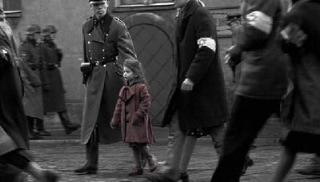
There was lots happening, symbolically, of course, but I was struck, near the end, in the midst of the montage of "Best Pictures" from 2008 mixed in with clips from "Best Pictures" from the past, right there was the little girl in the red dress from Schindler's List, as the ultimate bow to twilight language. The moment seemed so reflective of Don't Look Now (and In Bruges too), especially since Steven Spielberg was in charge of that final segment.


Mondo Cane...it's a dog's world.

See also Chris Knowles' running "live" commentary that was written during the Oscars, and the over 200 comments at his blog, which are well-worth reading. Knowles has much to say about his mild obsession with red dresses seen throughout the night. Not like there's anything wrong with that. :-)

Friday, February 20, 2009

Lennon-Chapman-King

Stephen King has to deal with some scary things. Having a person media-stalk you and claim you killed John Lennon may be one of the more bizarre on-going events of his life.


Adam Gorightly's Untamed Dimensions today points to a new incident involving Steve Lightfoot, the man who goes around stating that "the guy who shot Lennon was actually Stephen King and not Mark David Chapman."

My sympathies to fellow Mainer Stephen King who must put up with such insanity in these crazy times.


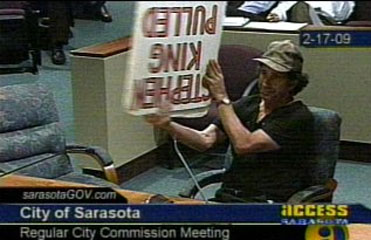
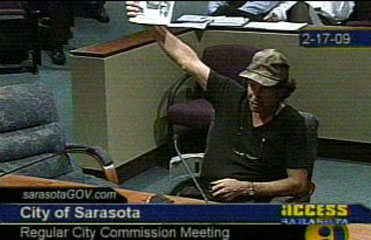
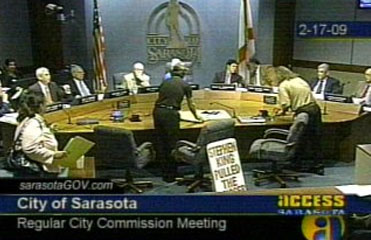
Some excitement [occurred] at the Sarasota City Commission meeting Tuesday [February 17, 2009], when a California man spoke out about who he thinks really killed John Lennon.

During public comment, a man with signs who identified himself as Steve Lightfoot, took a seat in front of commissioners saying he wanted to expose the truth. He then went on to allege that part-time Casey Key resident and author Stephen King was the person that killed John Lennon.

"I'm from California. I'm known by 10% of Florida. I'm known by 50% of California. I'm the man exposing the truth about John Lennon's murder. Stephen King, Casey Key resident, shot John Lennon. He's not suing me...my van says it all over the place," said Lightfoot. He claimed that "Stephen King is the worst criminal the state of Florida has ever harbored."

Sarasota mayor Lou Ann Palmer told the man that comments at the meeting must be reserved for city business. "This does not relate to the city of Sarasota," said Mayor Palmer. Casey Key is under Sarasota County jurisdiction.

The mayor summoned Police Chief Peter Abbott, who escorted the man and his signs peacefully out of the chamber to the sound of chuckles from people attending the meeting.ABC-7, Sarasota, Florida


Here are the basic facts:


John Winston Lennon (October 9, 1940 – December 8, 1980), age 40

Mark David Chapman (born May 10, 1953 - ), age 27

Stephen Edwin King (born September 21, 1947 - ), age 33

Stephen King was rather busy in 1980, being a celebrity himself.

The movie based on Stephen King's The Shining was released in 1980. Stephen King's 1980 novel, Firestarter, had an initial print-run in trade hardcover of 100,000 copies. He was becoming a well-known author. By 1980, people were seeking out Stephen King's autographs.

What people should be aware of is that a run-in with King is not an idle matter. The cosmos has a way of catching up with individuals who cross paths with King.

As you may recall, in 1999, on June 19, at about 4:30 p.m., King was walking on the shoulder of Route 5, in Center Lovell, Maine, when he had such a run-in.

Driver Bryan Smith, distracted by an unrestrained dog moving in the back of his minivan, hit King, who landed in a depression in the ground about 14 feet from the pavement of Route 5. According to Oxford County Sheriff deputy Matt Baker, King was struck from behind and some witnesses said the driver was not speeding or reckless. King's website, however, says King was walking facing traffic.

* * * [King's injuries were extensive.]

Earlier that year, King had finished most of From a Buick 8, a novel in which a character dies after getting struck by a car. Of the similarities, King says that he tries "not to make too much of it."

King's lawyer and two others purchased Smith's van for $1,500, reportedly to prevent it from appearing on eBay. The van was later crushed at a junkyard after King had severely beaten it with a baseball bat. King later mentioned during an interview with Fresh Air's Terry Gross that he wanted to completely destroy the vehicle himself with a sledgehammer.Source


Suicide and synchronicity then come to haunt this story.

On September 21, 2000, Smith was discovered dead in his trailer in Brownfield, Maine. Coincidentally, September 21 is also Stephen King's birthday (he turned 53 that day). The cause of Smith's death was listed as an accidental overdose of the painkiller fentanyl, according to toxicology reports. Smith had suffered from a back injury and might have been prescribed the painkiller not long before his death.

* * *

Stephen King publicly responded, stating, "I was very sorry to hear of the passing of Bryan Smith. The death of a 43-year-old man can only be termed untimely."

Bryan Smith is a character in the Dark Tower series. King incorporated his accident into the final novel. Roland Deschain and his three companions – John "Jake" Chambers, Oy, the semi-sentient billy-bumbler, and a housewife named Irene Tassenbaum – try to stop King from being struck by the van.

Although many elements, such as the presence of the gunslinger, the boy, and the woman, are fictionalized, the injuries King suffered and conversations King and Smith had while awaiting medical personnel are based on actual conversations, although they are changed slightly from the way King presented them in On Writing. However, two rottweilers are present in the van, and in real life only one, Bullet, had been. This may be a deliberate author's error, meant to preserve the sense of multiple planes of reality.

Portions of King's miniseries Kingdom Hospital are also based on the accident, though most of the plot is derived from the Danish miniseries The Kingdom. In King's version, one of the main characters, Peter Rickman, is hit by a van driven by a man who is distracted by a dog in the back of the vehicle. In the miniseries, Kingdom Hospital is located in Lewiston, Maine, the real location of Central Maine Medical Center, the hospital where King spent most of his recovery time. In another parallel to the real accident, a later scene in the first episode of the miniseries shows the driver who hit Rickman taking unidentified pills by the mouthful out of a bottle. However, the driver in the story is younger than Smith was at the time of the accident. He is also a musician who makes techno/electronica during his spare time.

Source


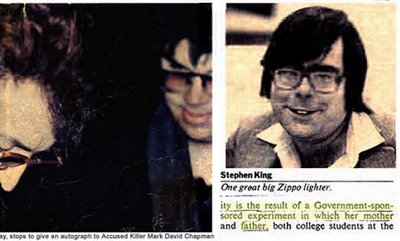
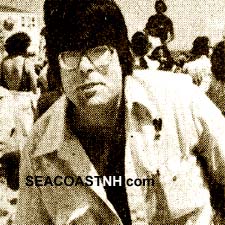
Here's a photo of Stephen King in 1980.


From "When Stephen King Was King," by J. Dennis Robinson, SeacoastNH, about 1980, when King was 34. Go to their site to find a bigger photo of King in 1980.

Psychologically speaking, King looks like he was in a totally different place than Chapman in 1980.

I hope Steve Lightfoot gets some help before his demons drive him to do things none of us need to read about in the future.

Tuesday, February 17, 2009

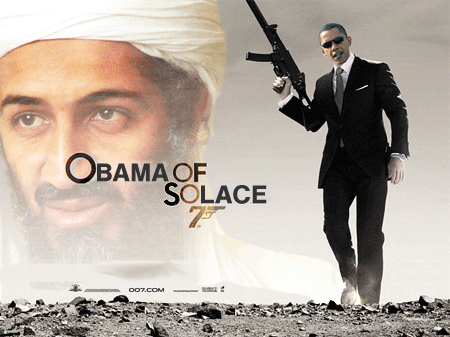
Obama and Bond, James Bond


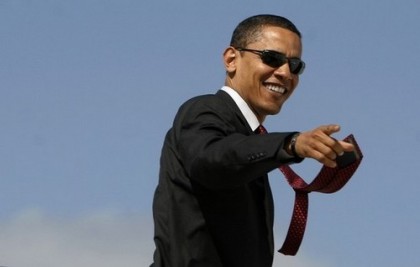
I understand President Obama is going to Denver today to worship the Sun God Ra, to sign the stimulus package. Chris Knowles, at the Secret Sun, points out that it is "a very strange venue to do so."

Hey, no conspiracy here, supposedly. The White House announced that the President is there because of the alternative green energy collector on the roof of the Denver Museum of Nature & Science. The DMNS has a roof-mounted solar photovoltaic system, consisting of 465 solar panels split between roofs on the southeast and southwest wings of the Museum. That's the reason, overtly. But maybe there's a covert reason?

While there, perhaps President Obama will address the need to fund conservation efforts on behalf of Sasquatch due to the declining pika populations?


Let us not forget that the museum Zoology Department's Aaron Spriggs gave a full-scale cryptozoology presentation, entitled “Birders, Bigfoot and Bond, James Bond,” on April 1st, 2008 at the DMNS. Cryptozoology and spies. Need we say more.


I'll be watching to see what he really says and does today.

Monday, February 16, 2009

Lafayette's Dogs

President's Day seems to be a good moment to talk about presidential dogs this year, as the topic is of some importance to the media mindset of late. President Obama's interest in obtaining a new White House dog for his children has created a widespread positive copycat effect, a meme of interest. Did you know Lafayette would turn up in this history too?


The first dogs were a direct result of gifts from the individual who seems to be there in much of the "name game" found in lexilinking mentioned as recently as yesterday here, the Marquis de Lafayette.

The Revolutionary War was fought from 1775 to 1783, and George Washington served as the first President of the United States of America, from 1789 to 1797. Washington got a shipment of foxhounds from England in 1770 and then in 1785, Washington received from Lafayette a shipment of French foxhounds.

Washington had an intense interest in breeding a fierce breed of American dog, and thus, Marquis de Lafayette, Washington’s French friend and ally during the Revolutionary War, sent him seven massive hounds. The French hounds were reportedly so fierce Washington assigned a servant to monitor their meals because they tore each other apart fighting over their food.

Washington's groups of dogs were bred to produce the American foxhound breed. He had over thirty dogs. One was named Vulcan.

One of Washington’s hounds, Vulcan, black and so big a young boy could ride him like a pony, had powerful jaws and an insatiable appetite. It seems he had a taste for Virginia hams. A story is told of Vulcan sneaking into the Washington’s Mount Vernon kitchen, snatching a succulent ham, and running “straight to the kennels with it locked in his great jaws.” Mistress Martha was miffed, but the event delighted Master George.

It is commonly held belief that the Marquis de Lafayette also gifted George Washington with a French basset hound, bringing the basset for the first time to America, but no historical evidence is available to support that claim.Source


Then, along came President Jefferson Thomas, from 1801 through 1809. When Jefferson was earlier the minister to France, he became an admirer of the breed called briard, and his pet “Buzzy” caused Jefferson to have several puppies.


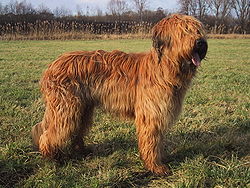
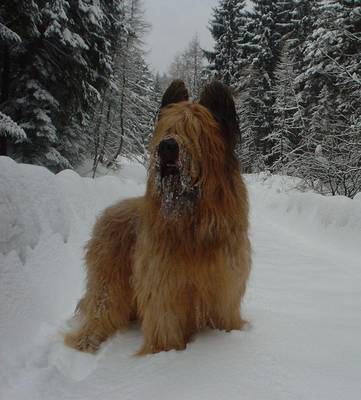
The briard is a very old breed of French working dog. Depicted in 8th-century tapestries and mentioned in records of the 12th century; the breed is accurately described in the 14th and 16th centuries. In early times, Briards were used to defend their charges against wolves and poachers, but the dividing up of the land and the increase in population which followed the French Revolution gradually transformed their work into the more peaceful tasks of herding the flocks, keeping the sheep within the unfenced boundaries of the pastures, and guarding their masters' property, according to the American Kennel Club.

The Marquis de Lafayette allegedly sent two purebred briards to President Thomas Jefferson to help protect Jefferson's flock of sheep.


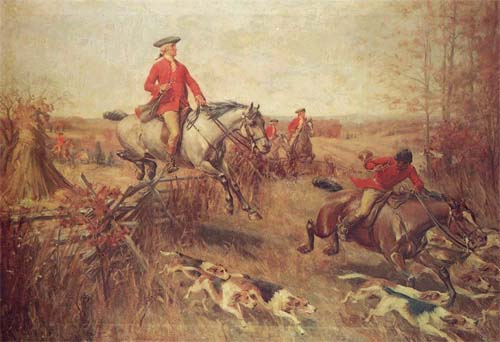
George Washington fox hunting in Virginia, shown with some of his famously American-bred foxhounds.

Also, there's the matter of the "Super Mules":

Shortly after America's independency, President George Washington imported the first mammoth jack (a male donkey) stock into the country. Because the existing Jack donkeys in the New World at the time lacked the size and strength he sought to produce quality work mules, he imported donkeys from Spain and France, some standing over 1.63 m tall.

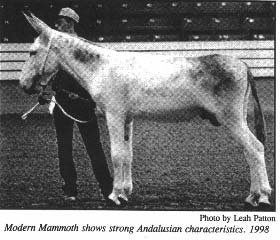
One of the donkeys Washington received from the Marquis de Lafayette, named "Knight of Malta," stood 1.43 m and thus was regarded as a great disappointment. Viewing this donkey as unfit for producing mules, Washington instead bred Knight of Malta to his jennys and, in doing so, created an American line of Mammoth Jacks (a breed name that includes both males and females).

Saturday, February 14, 2009

Valentine's Decapitation

The world commemorates this Saturday, February 14, 2009, as Saint Valentine’s Day.

This date is celebrated worldwide to mark the deeds of bishop Valentine in Terni City in Italy during the second half of the third century, who officiated the marriage of young couples in secret to help them avoid joining the Roman legions.

When the Roman Emperor Claudius II, known as Claudius Gothicus, was made aware of these hidden marriage celebrations, he commanded the decapitation of Bishop Valentine, allegedly, on 14 February 270 BC.

Specifically, helping Christians at the time was considered a crime. Nevertheless, when first imprisoned, Claudius took a liking to his prisoner -- until Valentinus tried to convert the Emperor -- whereupon the priest was condemned to death. Valentinus was beaten with clubs and stoned; when that did not kill him, he was beheaded outside the Flaminian Gate.

In 498 BC, Pope Gelasius canonized him due to his dedication to the faith and love.

Many of the current legends that characterize Saint Valentine were invented in the fourteenth century in England, notably by Geoffrey Chaucer and his circle, when the feast day of February 14 first became associated with romantic love. Some historians feel the holiday may have been created as an attempt to supersede the pagan holiday of Lupercalia.

But there is little that is romantic about some histories linked to this day, depending upon your own personal experiences, of course. For example, my grandmother, Nellie Gray, was the victim of a murder-suicide on Valentine's Day, 1940.

I have a section of The Copycat Effect about Valentine's Day, parts of which are quoted here.

It will be recalled that this is the one year anniversary of the NIU campus shootings.

++++
Update:

A few hours before the air crash near Buffalo, NY, there was a decapitation there.

Orchard Park police are investigating a particularly gruesome killing, the beheading of a woman, after her husband — an influential member of the local Muslim community — reported her death to police Thursday.

Police identified the victim as Aasiya Z. Hassan, 37. Detectives have charged her husband, Muzzammil Hassan, 44, with second-degree murder.

"He came to the police station at 6:20 p.m. [Thursday] and told us that she was dead," Orchard Park Police Chief Andrew Benz said late this morning.

Muzzammil Hassan told police that his wife was at his business, Bridges TV, on Thorn Avenue in the village. Officers went to that location and discovered her body.

Muzzammil Hassan is the founder and chief executive officer of Bridges TV, which he launched in 2004, amid hopes that it would help portray Muslims in a more positive light.

The killing apparently occurred some time late Thursday afternoon. Detectives still are looking for the murder weapon.

"Obviously, this is the worst form of domestic violence possible," Erie County District Attorney Frank A. Sedita III said today.

Authorities say Aasiya Hassan recently had filed for divorce from her husband.

"She had an order of protection that had him out of the home as of Friday the 6th [of February]," Benz said.

Muzzammil Hassan was arraigned before Village Justice Deborah Chimes and sent to the Erie County Holding Center.


Thanks to Anon.

Wednesday, February 11, 2009

Car Chase Mania

At least five in two weeks. Media guidelines thrown in the trash. News broadcasts ditched to give more wall-to-wall coverage. Yes, I'm talking about copycat car chases.

"At least five police pursuits of a fleeing suspect have taken place in the Los Angeles area over the past two weeks - and stations are once again finding the allure of speeding cars and flashing lights irresistible," notes Variety in their February 10th issue.

Los Angeles, California has more than its fair share of car chases, which many stations have been attempting to show less of during 2008. But then few of the chases involve a Bentley, and more are being covered since the start of 2009, again. For three hours on Monday night, February 9th, the driver of the $100,000-plus Bentley with Illinois plates kept some viewers TiVo working overtime as the chase made its way through the valley.

The Los Angeles Times reports, "Police suspected the man was armed and had been 'very, very careful' not to confront him during the pursuit that traversed Los Angeles County along the Hollywood Freeway and Interstates 5, 10 and 405, said Officer Karen Smith of the media relations office."

But it all started badly, and ended in a suicide.

According to the USA Today, "The shooting occurred about an hour and a half after the suspect had finally stopped the car near the scene of an earlier alleged assault with a deadly weapon against his girlfriend."

Variety captured the earlier media hysteria:

With visions of O.J. Simpson dancing in their eyes, the stations almost giddily hinted that the driver was a 'significant figure' who had recently battered his galpal. R&B artist Chris Brown had just been accused the night before of allegedly beating his girlfriend, the singer Rihanna....

As the erroneous word spread that Brown was behind the wheel, a media circus converged in North Hollywood, where the Bentley driver finally stopped his vehicle and embarked on a standoff with police. The parallel to Simpson's 1994 White Bronco chase were eerily similar: A slow-moving car. Throngs of bystanders gathering to watch. And in a 2009 twist, an even bigger throng of paparazzi and website videographers, capturing it all on the ground.

There was just one problem: That wasn't Chris Brown in the car. Not even close. Even as word finally began to spread that it wasn't Brown (believed to be first noted by KNBC, at least according to blogs also monitoring the coverage), some stations appeared to still hold out hope that there was still a celeb behind the wheel.

When the stations finally managed to broadcast a shot of the suspect - and it was apparent that Brown wasn't pulling an O.J. - at least one station, KCBS/KCAL, announced that callers had identified the driver as Miami-based DJ/radio personality DJ Khaled.


The man was later identified as a businessman, the owner of a luxury car company, of Pakistani origins. The Los Angeles Times noted the driver who shot himself was a man named Mustafa Mustafa.

The above specific incident was the initial reason for why I was invited to appear live, by phone, on Wednesday, February 11, 2009, to discuss The Copycat Effect. This occurred shortly after 8 PM PT (11 PM ET) on the "Kennedy and Suits" show, KFI AM 640, Los Angeles. It was directly related to the string of car chases in LA, the murder-suicide copycat wave there, the Santa Claus killer, and we even talked of school shootings too. Earlier in the day, I was interviewed for a forthcoming article in Obit Mag, regarding the economical murder-suicides that are getting more and more attention from the media.


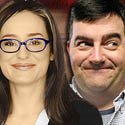
Kennedy, on the left, is well-known for her VJ days at MTV and as the former host of "Friend or Foe?" Suits is Bryan Suits. All highways lead to Los Angeles and Hollywood?

Monday, February 09, 2009

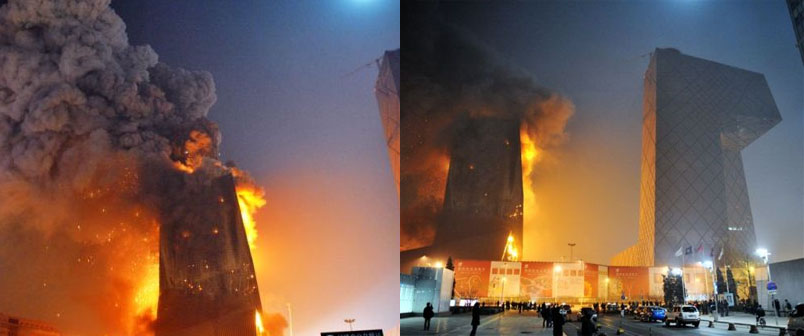
Mandarin Oriental Hotel Burns


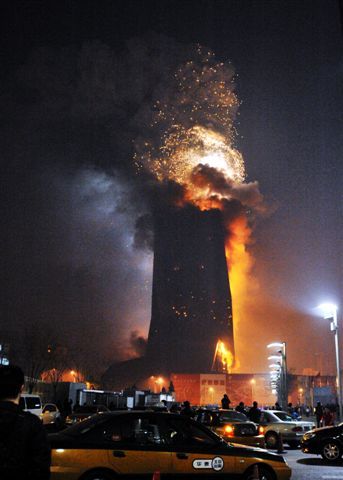
The burning shell of an unfinished, 44-story luxury hotel lit the night sky over downtown Beijing on Monday after being showered with sparks from fireworks set off during China's biggest holiday.

The hotel and the television tower were designed by Netherlands architects Rem Koolhaas and Ole Scheeren for the firm OMA. Both were nearing the end of construction.

The north wing building of the new CCTV tower appeared to be on fire, in downtown Beijing, China, Monday, February 9, 2009. Police have conducted traffic control around the scene (YouTube).


The Wicker Man Burns," I noted recently here. Now there are fires in Australia and this big one in China.

Please note the locations in the news associated with these fires and from the Ring of Fire: Mt. Redoubt is set to erupt in Alaska, Mt. Disappointment is the focus of the fires in Australia, Mt. Asama and Mount Sakurajima in Japan (erupted on Feb. 2nd), Karymsky Volcano on the Russian peninsula of Kamchatka (also erupted on Feb. 2nd), and this site in China burned on Feb. 9.

Beijing's CCTV headquarters, the Rem Koolhaas building, is a major fire risk. Fireworks, from the last day of New Years celebrations at the site, could be the cause. Right now it's the Lantern Festival, the 15th day of the first month of the New Year on the Chinese calendar.


The China Central Television headquarters is a 6.45 million square foot complex that involves twin leaning towers connected by two massive sections in midair. It's an amazing feat of engineering, but everyone in Beijing is now worried that it might collapse if the building directly next to it, right now said to be the incompleted Mandarin Oriental hotel, isn't put out quickly (Gizmodo).


Update via notes from Xinhua: China Central Television (CCTV) itself was responsible for Monday night's massive fire that caused one death and seven injuries in its new headquarters complex in eastern Beijing, the city's fire control authorities said Tuesday, Feb. 10.

CCTV hired staff from a fireworks company to ignite several hundred large festive firecrackers in an open space outside one of its nearly-completed buildings, said Luo Yuan, spokesman and deputy chief of Beijing Fire Control Bureau.

The 30-storey building, about 200 meters from the iconic CCTV tower, houses the luxury Mandarin Oriental Hotel, a television studio and an electronic data processing center.

CCTV's four camcorders recorded the fireworks display and the entire ignition process.

A man, who claimed to be former employee of Beijing Urban Construction Group, said he saw people on watch on top of CCTV's main tower with a hose when the firecrackers were set off.

"But I didn't see any on guard on top of the building that caught fire," he told Xinhua reporters at the fire site Monday night.

Beijing Urban Construction Group is prime contractor for the building that caught fire, while the iconic main tower, which many locals jokingly called "the giant shorts", was contracted to another company.

The fire broke out at 8:27 p.m. Monday and was put out at 2 a.m.

++
Wednesday, February 11, 2009.

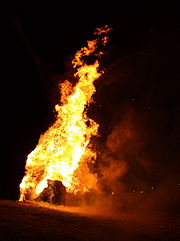
Todd Campbell has passed along the news that a Korean Fire Festival fire spread out of control, killed 4, and injured 70 on Monday, February 09, 2009.

The accident happened when organizers set fire to reed-like plants at the top of Hwawang mountain in southeastern South Korea on Monday night as part of the full moon festival, said Park Joong-soo, an officer at Gyeongnam Provincial Police Agency.
The blaze, fanned by sudden winds, spread over firebreaks, forcing spectators to flee. Four of them, who were on top of a large rock to get a better view of the festival, fell about 10 yards to their deaths while trying to dodge the fire, according to Park.

It is a South Korean tradition to set fire to grass along rice fields on the night of the first full moon of the Lunar New Year in the belief that it helps bring good harvests and drives out evil spirits, though it is no longer widely practiced.

This year's first full moon on the lunar calendar fell on Monday. South Koreans celebrated the start of the Lunar New Year on Jan. 26.

The county government in Changnyeong, about 162 miles southeast of Seoul, has organized the fire festival about once every two years since 1995.

China: The final death toll for the Chinese fire at the CCTV tower complex has been announced by Xinhua. One firefighter died in the rescue after inhaling excessive toxic fumes and seven others, including six firemen and a worker in the building were injured.

Saturday, February 07, 2009

De Gelder's Divine Dove

Early this morning in England, Robert Rickard, the founder and former editor of Fortean Times, tossed and turned. He struggled to wake up and get warm. He drifted in and out of sleep, and then, he later told me, something "popped into" his mind.

He got up and wrote me:

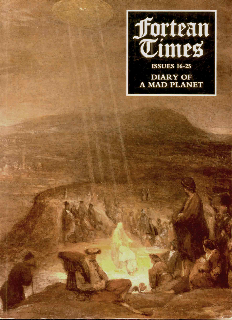
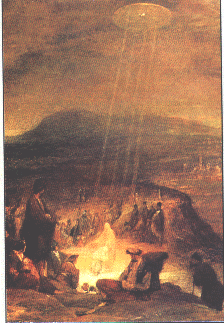
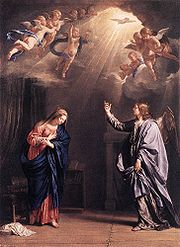
"For some strange reason I woke up with a UFO link to the Dendermonde case. On the cover of the FT compilation Diary of a Mad Planet (FT issues 16-25), we featured a painting of what looks like a UFO hovering over a crowd surrounding St John baptising Jesus. The UFO is in fact a Divine Dove with an elliptical halo, but four beams of light shine down from it onto the scene below. The painting is by Aert de Gelder."

The cover of the compilation is shown here:


The "Dendermonde case" is code for the event involving the daycare nursery killer, Kim de Gelder, the Dendermonde Joker. (I've web logged several recent entries about the subject, for example, here, here, here, here, and here.)

Rickard pointed out to me that the image is now seen throughout the Internet, often in relationship to it being "ancient proof" for UFOs. I notice, for example, that the image is sometimes flipped, incorrectly (see below), thus changing its symbolism.


Rickard further shared that FT had permission, in 1991, from the owner, Fitzwilliam Museum, Cambridge, to use it. He wasn't so sure that today all the sites showing it have the Fitzwilliam's permission.

The painting is The Baptism of Christ, c. 1710, by Aert de Gelder (1645-1727), which was given to the Fitzwilliam Museum by Lord Alwym Compton, Bishop of Ely, in 1905. Apparently the previous owner, Marianne, the Countess of Alford, had bequeathed it to the donor in 1888. It is oil on canvas, 48.3 x 37.1 cm.

Aert de Gelder (Oct 26, 1645, Dordrecht – Aug 27, 1727, Dordrecht) was one of Rembrandt’s last pupils while in Amsterdam, studying in his studio from 1661 to 1663. The general consensus is that de Gelder was not only one of the most talented of Rembrandt’s pupils, but also one of his most devoted followers, for he was the only Dutch artist to paint in the tradition of Rembrandt's late style, into the 18th century.

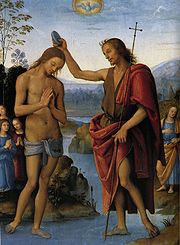
The subject of de Gelder's painting, John the Baptist died around 30 A.D. The prophet is most remembered having headed a baptism movement at the Jordan River in expectation of a divine apocalypse that would restore occupied Israel. Christians, Jews, and Muslims regard John as a prophet, as do Bahá'ís and Mandaeans.

The painting that flashed into Rickard's mind this morning depicts John's baptism of Jesus in the River Jordan. The dove overhead in de Gelder's painting is the disputed UFO/dove.

Christian scholars and writers for hundreds of years have used the dove as a symbol of the Holy Spirit. This symbolism was inspired by the Bibical account of Christ's baptism (Luke 3, 21-22). The dove, as a symbol of the Holy Spirit, may be seen in churches, on priestly vestments, on altars, tabernacles, sacred utensils, and in many religious paintings.

June 24th & Beheadings

Needless to say, among Forteans, the feast day of John the Baptist's birth (June 24) is a major milestone in anomalistic history. The Knights Templars displayed the “Mysterious Head” at Poitiers on June 24, 1308. The "modern age of flying saucers" began on June 24th, 1947. I and many others have written much about St. John's Day, June 24th. (See a list of anomalistic events associated with this date, here.)

The overlapping decapitation symbolism to various events such as the recent VA Tech beheading can be rather directly viewed, via metaphor, in the beheading of John the Baptist, a significant event that is often also painted.

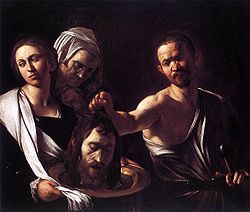
The biblical account portrays the beheading of Saint John the Baptist by Herod Antipas. On Herod's birthday, Herodias' daughter (traditionally named Salome) danced before the king and his guests. Her dancing pleased Herod so much that in his altered state of consciousness he promised to give her anything she desired, up to half of his kingdom. When the daughter asked her mother what she should request, she was told to ask for the head of John the Baptist on a platter. Although Herod was appalled by the request, he reluctantly agreed and had John executed in the prison.


Salome With the Head of John the Baptist (London), by Caravaggio, c. 1607.

The beheading date is generally given as August 29th. The Roman Catholic Church celebrates the feast on August 29 as the "Martyrdom of St. John the Baptist" in the ordinary form and as "The Beheading of Saint John the Baptist" in the extraordinary form, or traditional Latin Mass. The Church of England and many other national provinces of the Anglican Communion celebrate the feast on August 29. In the Church of England, the day is referred to as "The Beheading of John the Baptist."

The Divine Dove

Aert de Gelder's "Divine Dove" is a frequent motif in religious paintings, and is, as noted, an earthly representation of the "Holy Spirit."


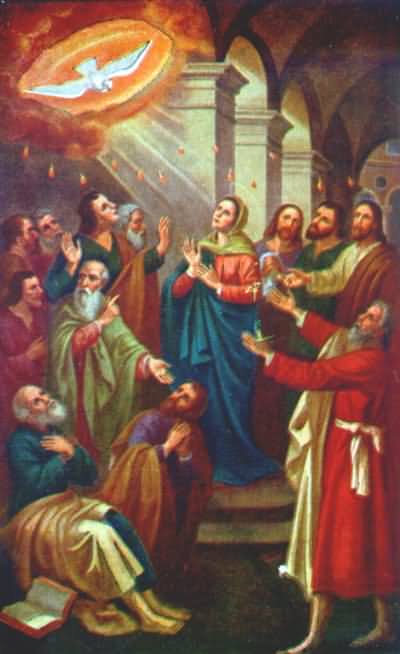
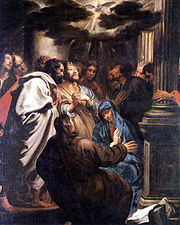
In this painting, The Descent of the Holy Ghost, the disk form is similar to what is shown in de Gelder's art.

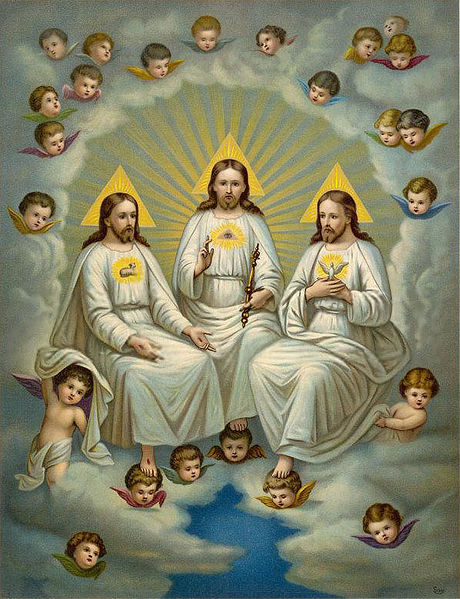
Sometimes, however, the Divine Dove is shown as part of the Trinity of Signs.


Fridolin Leiber (1853–1912) painted an example in his The Holy Trinity. Note that the iconography of "triplets" may not be accepted by all modern Christian groups. (The Holy Trinity is more usually depicted with God the Father as an elder, God the Son as Jesus Christ, and the Holy Spirit as a Divine Dove.) The persons of the trinity are identified by symbols on their chests: The Son has a lamb (agnus dei), the Father an Eye of Providence, and the Spirit a dove.

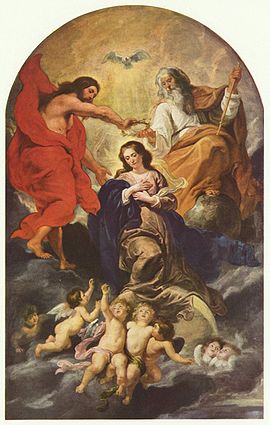
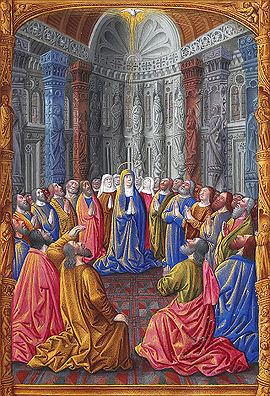
But in general, the "Holy Spirit" as a dove is painted above the religious figures in the scene, as can be viewed in the following several examples (which may be identified and keyed from this reference, "Holy Spirit").


Doves, UFOs and Loch Ness

One could say that metaphoric UFO landings were re-enacted routinely within religious settings.

In medieval times the figure of a dove was widely used to enact in a dramatic way the descent of the Holy Spirit on Pentecost Sunday. When the priest had arrived at the sequence, he sang the first words in a loud and solemn voice: 'Veni Sancte Spiritus' (Come, Holy Ghost). Immediately there arose in the church a sound 'as of a violent wind blowing' (Acts 2, 2). This noise was produced in some countries, like France, by the blowing of trumpets; in others by the choirboys, who hissed, hummed, pressed windbags, and rattled the benches. All eyes turned toward the ceiling of the church where from an opening called the 'Holy Ghost Hole' there appeared a disc the size of a cart wheel, which slowly descended in horizontal position, swinging in ever-widening circles. Upon a blue background, broken by bundles of golden rays, it bore on its underside the figure of a white dove. Source


I want to note that the Loch Ness Monster can be added into this mix too.

The "dove" is found in a fairly common word and its many forms: Columba, Columbia (!), Columbine (!).


St. Columba, a warrior saint, has become the living "dove," for in Old Irish, he is known as Colum Cille (meaning "Dove of the Church"). It is said Clan Robertson are heirs of Columba, and to some extent, Clan MacKinnon too.

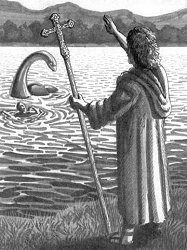
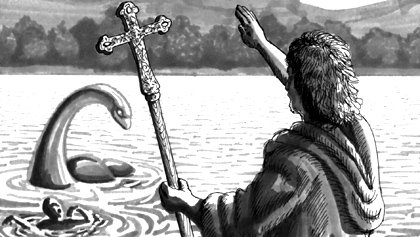
Art by Bill Rebsamen.


On August 22, in 565 AD, St. Columba came across a group of Picts who were burying a man killed by a monster that today is linked to the Loch Ness Monster. St. Columba supposedly brought the man back to life. In another version, he is said to have saved the man while the man was being attacked, driving away the monster with the sign of the cross.


Several St. Columbas have been recorded, all having been beheaded.

St. Columba of Sens suffered towards the end of the third century, probably under the Emperor Aurelian. She is said to have been beheaded in 273, near a fountain called d'Azon; and the tradition is that her body was left by her murderers on the ground, until it was buried by a man called Aubertus, in thanksgiving for his restoration to sight on his invoking her.

St. Columba the Virgin is a female saint with dedications in Cornwall and other Celtic regions. She probably lived in the 6th century. She became a Christian when the Holy Ghost appeared to her in the form of a dove. The Latin word for dove is 'columba'. She was beheaded by a pagan prince she refused to marry.

The Celtic saints of St. Columba of France and St. Columba of Spain have similar legends in that they were all maidens who were pursued and killed by pagans. All suffer decapitation where springs or wells then miraculously gushed forth from the spot, as was said to have happened with St Columba the Virgin too.

St. Columba of Cordova was a Spanish nun who was martyred by being beheaded by the Moors, at the monastery of Tabanos in 853.

St. Columba Kim Hyo-im (1813-1839) was a native of Pam-som, Korea. As the persecution of Korea’s Catholics continued, Columba and her younger sister (Saint) Agnes were brought before a pagan police commissioner. Upon refusing to apostatize, Columba was tortured in various ways. Only about five days after this ordeal, her wounds inexplicably healed so completely that her captors attributed the apparent miracle to an evil spirit. On September 26, Columba was beheaded for her faith, three and a half weeks after her sister Agnes had suffered the same fate.

^ ^ ^

"On the instant when a picture of the dove, or even the shadow of the suspended bird, was pierced by a sword, the dove itself was beheaded, although it had not been disturbed....This experiment, called 'Theophrastus Paracelsus,' recalls an old superstition, namely, that evil can be wrought by a spoken incantation." - The Old and The New Magic by Henry Ridgely Evans

Friday, February 06, 2009

Suicidal Dwarfs, Jokers And All That

A subtle pivotal point in the case unfolding in Dendermonde hit me soon after the authorities had searched through the little old Flemish streets and then took Kim de Gelder into custody. The revelation, not too surprisingly, came to me that the entire scenario had literally unfolded like a film.


The events of the Joker killer who came calling at the "Fabeltjesland" (fairyland) crèche (daycare) took a twist into the phantasmagoria between reality and cinema at one specific temporal spot in the news.

Perhaps you caught it too?

The police arrested the assumed killer, who worn makeup like Heath Ledger's Joker from The Dark Knight (Gelder = Ledger). Then they placed him in custody in Bruges.

What? A joker kills kids in a daycare nursery named "Fabeltjesland" and the authorities take the supposed baby killer to the "fairytale-like" city of Bruges.


My stream-of-consciousness flowed roaring along much like the rumblings heard in the River Dender. Hairy waters, indeed.

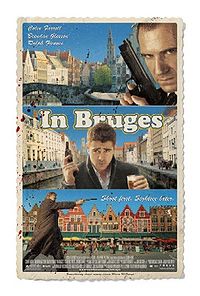
The 2008 movie In Bruges served as a flashpoint, instantly, for me. I had to re-visit this cinematic masterpiece.


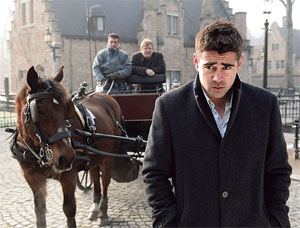
The film stars Colin Farrell (as Ray), and he won the 2008 Golden Globe Award for Best Actor in a Musical or Comedy for his role. Brendan Gleeson, who was also nominated, is Farrell's hitman partner (as Ken) in hiding, with Ralph Fiennes (Harry Waters, yes, pay attention throughout this film) as their mobster boss.

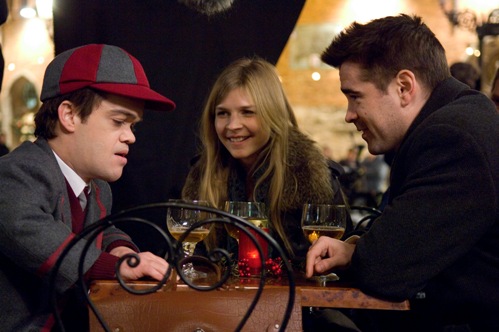
Ray's quick girlfriend, Chloë (Claacémence Poaacésy) and the little person movie-within-the-movie actor, Jimmy (Jordan Prentice), are important too. The film takes place, needless to say, within the Belgian city of Bruges, which is perhaps the film's other most significant character.

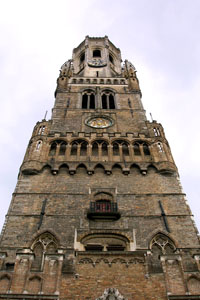
Belfry, the belltower (!), in Bruges.

For anyone who has watched In Bruges, in depth, you will appreciate the various levels that screenwriter Martin McDonagh has embedded into this film. He both wrote and directed it, so he seems to have known what he wanted us to see. I think there's even more there too. Obviously, the man is a genius, which has already been proven from his plays. For filmgoers and critics, his full-length movie screenwriting and directing debut may be appreciated more and more, with each repeated viewing.


But before I mention some symbolic items of note within In Bruges, let me bring your attention to the film's biographical overlap with Heath Ledger. The film's acclaimed Anglo-Irish playwright Martin McDonagh is the brother of John Michael McDonagh. The two lads use to have writing contests of their own making.

Paul Byrnes' powerful Australian review of In Bruges shares biographical insights.

"Martin McDonagh is living proof of the power of Australian television soaps. That is what he watched every day during the year of intense writing that produced his first six plays," writes Byrnes in The Sydney Morning Herald.

One can reflect with wonder on parts of people's biographies.

Byrnes continues: "McDonagh is the London-born son of Irish parents. They went back to the west of Ireland when he was 16 (about 1986). He and his brother stayed in London, visiting their parents during the summers. In London the two brothers lived mostly on the dole, challenging each other to writing competitions. They would watch Australian soaps in the morning, then go to separate rooms to write for the rest of the day."

What resulted was rather remarkable. Martin produced two trilogies: the Leenane trilogy, and the Aran Islands trilogy. His brother, John Michael McDonagh, today, we know, adapted Robert Drewe's book for the later film version of Ned Kelly.

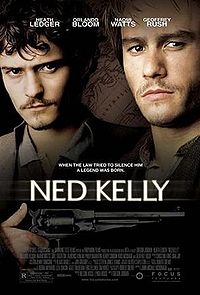
Ned Kelly is an Australian film directed by Gregor Jordan. The movie portrays the life of Ned Kelly who was a well-known bushranger in Australia, and is mainly based on Robert Drewe’s book Our Sunshine.

And who starred as Ned Kelly in that film? The poster tells the story, doesn't it? Or your memory of that film may? The answer is Heath Ledger. There, in one short leap we are back to Ledger, and the whole continuing synchrometaphor that is In Bruges.


More from Byrnes: "McDonagh is a huge fan of Nic Roeg's classic 1973 film Don't Look Now, which was set in Venice. That film was about a couple grieving after the death of a child; in a strange kind of way, that's also the subject of In Bruges."

(Colin Farrell's been "here" before, so to speak. The Irish feature film Intermission, starring Colm Meaney and Colin Farrell, references Don't Look Now's chase of a small figure in a red coat several times in that film.)

In Bruges's homage to Don't Look Now is a thread in the film in various ways, like the hints, now and then, of a child jumping in the square, dressed in red, or in the movie's final chase scene among the canals, old buildings, and such. McDonagh even writes it into the dialogue.

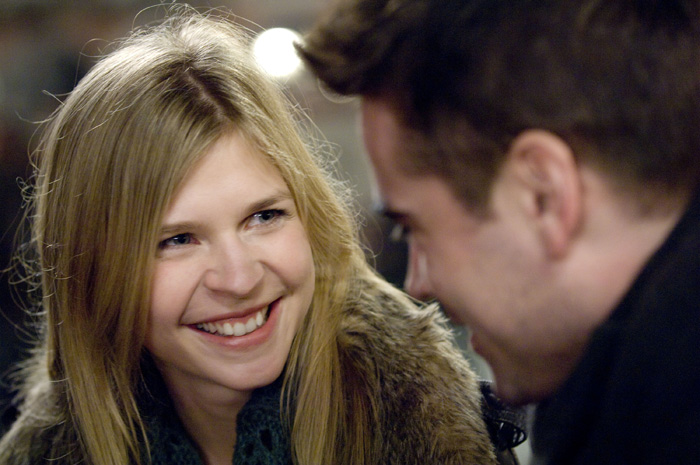
There's a scene when Ray is meeting Chloë, for the first time. Chloë says the Belgian film that is shooting there is like "Nic Roeg's Don't Look Now."

The film-within-a-film is said to have dream sequences, and the costumed fairies, trolls, and all are shown. Jimmy is one of the characters being filmed in that Don't Look Now-like motion picture or "Euro-trash," as his character calls it. (For recent links I've made between The Wicker Man and Don't Look Now, click here.)

McDonagh is hiding most all of this in plain sight.

And here, now, sitting literally, in Bruges today is Kim de Gelder, admitted killer of children in a fairyland daycare in Belgium.

In Bruges has a scene showing the two lead characters visiting an art museum. Byrnes comments on this, as has a lot of movie critics. "The second primary influence is a painting - The Last Judgement by Hieronymus Bosch. The two men look at it in a museum, musing on the meaning of hell and purgatory," notes Byrnes.

But does anyone notice what painting the film shows right before The Last Judgement at the Groeninge Museum? It is one with the vivid scenes of at least two decapitations. Kim de Gelder's killing of a boy and a girl, plus their caregiver, in Dendermonde was proceeded, in reality, by the decapitation at Virginia Tech. The Commonwealth of Virginia beheading also served as a harmonic link to the last wave of killings that occurred in the fall of 2006 at Dawson College (by Kimveer Gill) and the Amish school (among others), seemingly ending in the spring of 2007 at VA Tech.

In Bruges, at its core, it is about the killing of the "little boy," a phrase often stated that serves as a sort of framing around the entire tale. Reality and fantasy, the news and movie fiction, merge back and forth with In Bruges. And sitting in Bruges was Kim de Gelder after the fairytale daycare killings.

Ken: [looking at a surreal Bosch painting] It's Judgment Day, you know?
Ray: No. What's that then?
Ken: Well, it's, you know, the final day on Earth, when mankind will be judged for the crimes they've committed and that.
Ray: Oh. And see who gets into heaven and who gets into hell and all that.
Ken: Yeah. And what's the other place?
Ray: Purgatory.
Ken: Purgatory... what's that?
Ray: Purgatory's kind of like the in-betweeny one. You weren't really shit, but you weren't all that great either. Like Tottenham.
[pause]
Ray: Do you believe in all that stuff, Ken?
Ken: About Tottenham?

What about Tottenham?

The down and out north London location may be a sort of Purgatory to folks there, and certainly in history it is known for a notable mirror of this movie.

The Tottenham Outrage was the name given to an armed robbery and double murder in Tottenham, north London on January 23, 1909. Two Latvian anarchists, both armed with pistols, stole the wages as they were being delivered to Schnurmann's Rubber Company on Chestnut Road, almost literally across the street from the Tottenham Police Station.

In their attempts to get away the two robbers, Paul Hefeld and Jacob Lepidus (or Lapidus), started a chase and shooting spree that resulted in two deaths, police officer William Tyler and a 10-year-old boy named Ralph Joscelyne.

The robbers fired more than 400 bullets as they were being pursued along a river bank, through a marshy area, and among old buildings. When they were cornered, they turned the guns on themselves, dying by suicide.

The "Outrage," whether Martin McDonagh knew it or not, sounds an awfully lot like In Bruges. Finally, in a moment of one can start a circle, beginning anyway, the Tottenham Outrage events were commemorated long ago in a silent film.

Clearly, McDonagh knows and loves film.

In Bruges, Farrell's character is out of the hotel room, and Gleeson's Ken is watching a small television, that is playing Touch of Evil (1958). (The civil rights classic was written, directed and co-starred Orson Welles.) What is shown is the famed three-minute long continuous opening take at the beginning of Touch of Evil, where a bomb is placed in a car. During this In Bruges scene, Harry (Ralph Fiennes) has a long conversation with Ken (Brendan Gleeson) about the fairytale that is Bruges, murders, and suicides. Surreal.

The film travels into darkness and back in the fairyland and the so-called "shithole" of Bruges, depending on your point of view. Murder, yes, is there, but more subtly and yet overtly is suicide.

The use of "little people" in the dialogue and in character in the movie is brilliantly strategic, actually. This basically turns on a copycat effect/suicide cluster discussion that Ray seems to be having mostly as an internal dialogue, which he externalizes with Jimmy and Chloë.
===
Ray: A lot of midgets tend to kill themselves. A disproportionate amount, actually. Hervé Villechaize off of "Fantasy Island." I think somebody from the Time Bandits did. I suppose they must get really sad about like... being really little and that... people looking at them, laughing at them, calling them names. You know, "short arse". There's another famous midget. I miss him but I can't remember. It's not the R2D2 man; no, he's still going. I hope your midget doesn't kill himself. Your dream sequence will be fucked.

Chloë: He doesn't like being called a midget. He prefers dwarf.

Ray: This is exactly my point! People going around calling you a midget when you want to be called a dwarf. Of course you're going to blow your head off.
===
Ray is talking of a certain level of reality here, at least in terms of the elementary facts, but not in terms of the motivations, perhaps, which may have more to do with his own projections.


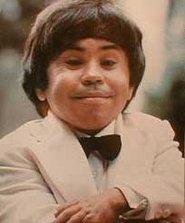
Hervé Jean-Pierre Villechaize (April 23, 1943 - September 4, 1993; pictured above) was a French actor who achieved worldwide recognition for his role as Mr. Roarke’s assistant, Tattoo, in the television series "Fantasy Island" (1978 - 1984). He was also well known for playing the evil henchman Nick Nack in the James Bond film The Man with the Golden Gun.

In the early morning hours of September 4, 1993, Hervé shot himself at his home in the Los Angeles area, and died later that day as a result of his injuries.

Is there a little person actor in Time Bandits who has died by suicide, as Ray mentions? Yes, actually, there is.

Time Bandits is a 1981 fantasy film, produced and directed by Terry Gilliam. It starred several little people or dwarfs.


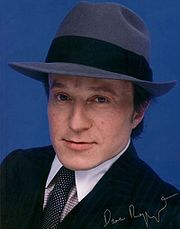
David Rappaport (above) played "Randall" in Time Bandits. David Stephen Rappaport (November 23, 1951 – May 2, 1990) was an English actor, one of the better known dwarf actors in television and film. At one point in his life, he became a resident of the squatter “nation” of Frestonia, acting as Foreign Minister under the name David Rappaport-Bramley - all inhabitants adopted the surname "Bramley," so in case the Greater London Council were to succeed in an eviction, they would have to rehouse them as one family.

On May 2, 1990, Rappaport died by suicide, shooting himself in the chest at a park in the San Fernando Valley, California, with a .38 calibre revolver he had bought 15 days earlier. His body was returned to the UK, and he was buried in a Jewish cemetery in Waltham Abbey, Essex.

Just before his death, he had been cast and began filming for the role of Kivas Fajo in the "Star Trek: The Next Generation" episode “The Most Toys.” Scenes he had completed were later discarded, when actor Saul Rubinek was hurriedly brought in by producers to replace Rappaport and complete the episode. Rappaport’s death and the accident which left Jack Purvis, his co-star, a quadriplegic were the main reasons why Terry Gilliam decided to shelve the intended sequel to Time Bandits, as their characters were two of the most heavily featured in the film.


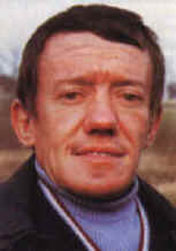
Ray, during his dwarf suicide monologue In Bruges, mentions the actor who played R2-D2, as still being around. Indeed, Kenneth "Kenny" Baker (born August 24, 1934; above) is still alive. The British dwarf actor and occasional musician, known as the "man inside R2-D2" in the popular Star Wars film series, was also in Time Bandits.

A third suicide victim is alluded to, but the person's name can't be remembered by Ray.

Perhaps this was a play on "never forget the 5th of December," the date the third dwarf killed himself?


Michael Gilden (above) was an American actor (with dwarfism) born September 22, 1962, in Los Angeles, California, who died on December 5th, in Los Angeles, California.

Gilden, a familiar face in recent years, performed in a variety of television series and film including, “NCIS,” “Charmed,” “CSI: Crime Scene Investigation,” “Family Law,” “Cybill,” as well as a role as an Ewok in the film Star Wars Episode VI: Return of the Jedi. In Pulp Fiction, Gilden played the Phillip Morris Page at Jack Rabbit Slims.

Besides being an actor, Gilden was also a stock broker.

He married the now-famous short-stature actress Meredith Eaton ("Family Law," "Boston Legal") on May 20, 2001. He had a previous marriage to a woman named Elena Fondacaro, Verne Troyer's manager. Gilden and Eaton remained together until his death in a suicide by hanging (credit: Emps) at his Los Angeles home on December 5, 2006.

Little people are just people and don't seem to kill themselves at a higher rate than the general population. But In Bruges is merely a movie, right? And the dialogue was placed in the mouth of a murderer. One measures a circle, beginning anywhere, correct?

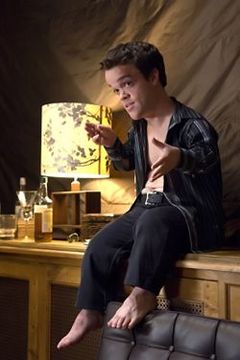
The humor-filled, balanced, horse-tranquilizing dwarf in In Bruges is Jordan Prentice (born January 30, 1973; pictured at the top of this posting), a Canadian actor. When he was 13, he began his film acting when he played Howard the Duck, in the movie of the same name. Perhaps it is fitting that Prentice (playing "Martin") also most recently starred in Weirdsville (2007). Part of the plot is about dumping a body in the basement of a drive-in movie theater where a satanic cult performs ritual sacrifices.

[Upon seeing Martin, the dwarf mall security guard]
Treena: That's so cute!
Martin: Something funny?
Treena: [talking in a little kid's voice] Hi! Who are you supposed to be? You're like the little chief of police of Munchkin Land or something!
Martin: [sarcastically] A Wizard of Oz joke. That's very original. I never hear those.

If we find ourselves going further into Oz (an alternative name for Heath Ledger's Australia, I must note), then we shall be going down that yellow brick road for some time. Enough for us to have visited Bruges today.


Children being killed, dwarfs, suicides, fairy tales, chase scenes through cobblestoned narrow streets, little people in hoods, canals, masks, and a confessed killer sitting in Bruges. What is real and fantasy, film or breaking news?

It all merges into a mind-boggling vortex that would make even a seasoned psychiatric professional question someone telling him these events were actual versus the creations of merely magical thinking.


Wiki-sources, regarding various short-stature actors mentioned: