Showing posts with label CIA. Show all posts

Sunday, April 27, 2014

Mike Ruppert, 63, Dies of Suicide

"The path you're supposed to follow is the only one that's left open in front of you." ~ Michael C. Ruppert


Right before John Judge died, another so-called "conspiracy theorist" died.

Michael Ruppert was found dead in Napa County at home just outside of the Calistoga, California city limits on April 13, 2014. Ruppert reportedly died of a single self-inflicted gunshot wound to the head. This has been confirmed by close friend and property owner/landlord Jack Martin. Martin is the man who found Ruppert's body.

The Napa Valley Register reports,
Nationally known author Michael Ruppert died Sunday [April 13, 2014] of an apparent self-inflicted gunshot wound in Calistoga where he had lived for a few months on a friend’s property. He was 63.
A former Los Angeles Police Department officer who later became a political activist, Ruppert was found dead Sunday on a property in the 1100 block of Tubbs Lane, where he had been staying in a trailer for a few months, according to information from the Napa County Sheriff’s Office and business partner Wesley T. Miller of Lake Oswego, Ore.
Ruppert’s writing delved into a number of political issues, including peak oil, climate change, 9/11, public corruption and the Central Intelligence Agency.
“It’s been hard to stop crying the last couple of days,” Miller said from Oregon.
Napa County Sheriff’s Capt. Doug Pike said deputies were sent to Tubbs Lane after the property owner asked for a welfare check at 8:49 p.m. Sunday. Ruppert was found dead from an apparent self-inflicted gunshot wound, he said.
Miller said his friend shot himself after taping his last show for Progressive Radio Network, an Internet radio station. According to the radio station’s website, Ruppert hosted “The Lifeboat Hour.”
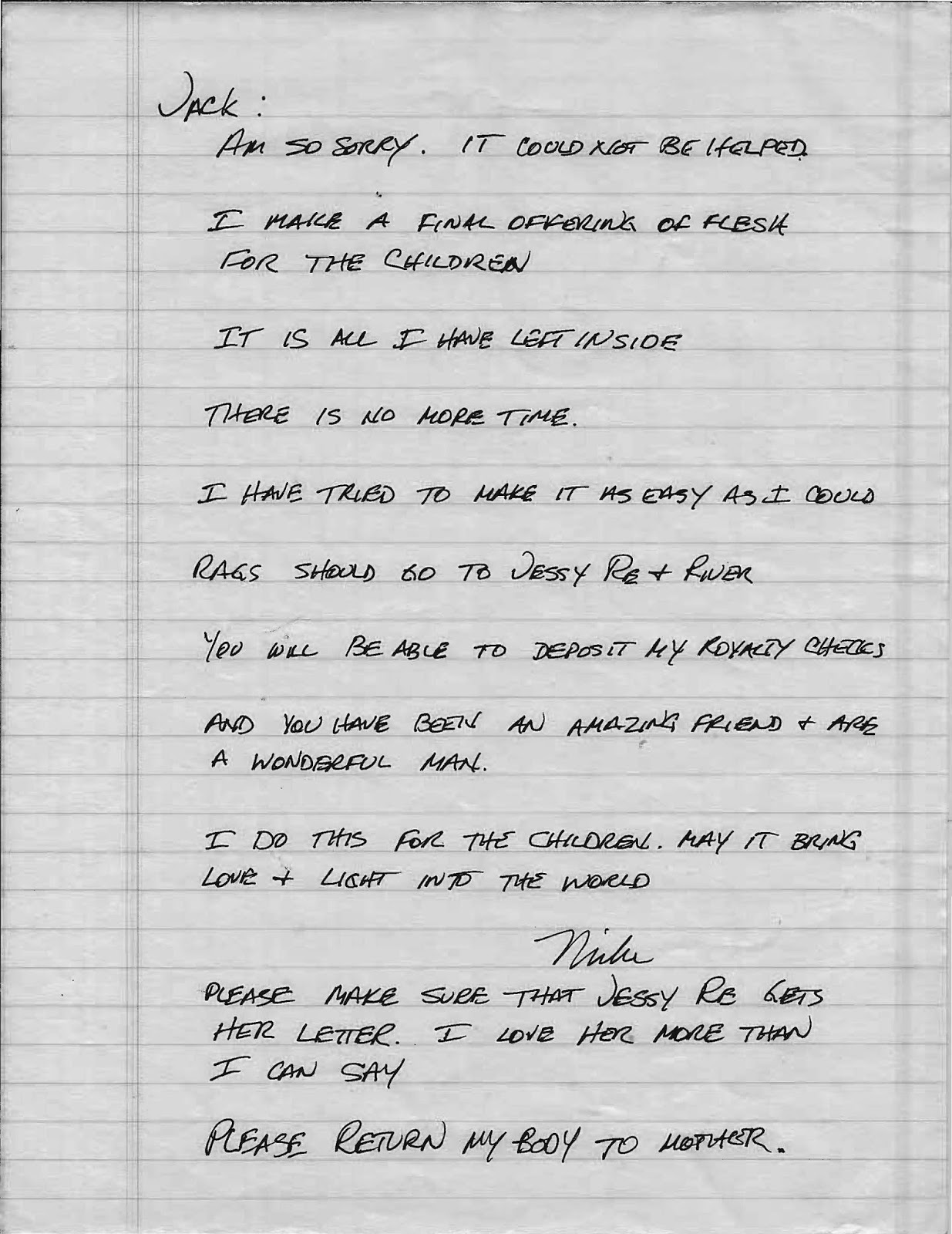
Miller posted his friend’s suicide note on Collapse Network, a news site Miller co-founded with Ruppert in 2010.
Ruppert had moved to Calistoga after leaving Colorado where he resided for 1 1/2 year, Miller said. A longtime Californian, he had also lived in Sebastopol.
Photos: Michael Ruppert and his dog Rags.


Collapse Network leaves little doubt about suicide being the cause of Ruppert's death.


Ruppert's suicidal note to his friend, Jack Martin.


Generally, Ruppert was "described as a conspiracy theorist by numerous mainstream media outlets."
Michael C. Ruppert (February 3, 1951 – April 13, 2014) was an American author, a former Los Angeles Police Department officer, investigative journalist, political activist and peak oil awareness advocate.
Until 2006, he published and edited From The Wilderness, a newsletter and website covering a range of topics including international politics, the C.I.A., peak oil, civil liberties, drugs, economics, corruption and the nature of the 9/11 conspiracy. He served as president of Collapse Network, Inc until he resigned in May 2012, when he gave 35 percent of his 55 percent share back to the company's founders. He hosted The Lifeboat Hour on Progressive Radio Network until 2014.
Ruppert was the author of Crossing The Rubicon: The Decline of the American Empire at the End of the Age of Oil. He was the subject of the 2009 documentary film Collapse, which was based on his book A Presidential Energy Policy and received the New York Times' "critics pick". In 2014, VICE featured Ruppert in a 4-part series titled Apocalypse, Man. Source.

It is to be noted that Michael Ruppert's life was entangled with that of "Dark Alliance" newspaper journalist Gary Webb. On December 10, 2004, Webb was found dead from two gunshot wounds to the head. Sacramento County coroner Robert Lyons ruled that it was suicide, noting that a suicide note was found at the scene.

Ruppert, like Judge, had worked with Representative Cynthia McKinney. For example, Michael Ruppert was a participant in the Citizens Commission on 9/11, an all day event in New York City, on September 9, 2004, chaired by Rep. McKinney. This forum highlighted most of the best investigators and commentators on 9/11 issues, including Ruppert, John Judge, Barrie Zwicker, Michael Springman, Indira Singh, Jenna Orkin, Nicholas Levis and others.

Sunday, October 13, 2013

Tulsa: Five Injured in Hmong New Year Shooting and Two Killed at Former Dragon's Lair


There was a shooting in Tulsa, Oklahoma, on the evening of October 12, 2012. You may hear little about it, as it happened among a closed ethnic group. This time of year is in the midst of the traditional three days of in-house Hmong New Year rituals, which are followed in some communities by seven days of "outside" activities.

A man walked in and opened fire at one such Hmong New Year's celebration in Tulsa, Oklahoma, on October 12th, Saturday night, injuring five people of the 400 there, local police said.
Authorities don't know what caused the man to begin shooting inside the Green Country Event Center, near Highway 169, at 12000 East 31st Street.

Two Hmong celebrating (between 30-60) were hit in the upper body, while the other three were struck in the arm and leg, said Tulsa Police Captain Mike Williams. One person probably will lose the use of the lower leg.

Nhia Vang, 75, told reporters that the gunman opened fire six feet away from him after a toast. One bullet went through his shirt, but he was uninjured – although the police took the garment as evidence, the Tulsa World reported.

One suspect was said to be firing from a car, with another driving. A passenger was observed changing clothes, then throwing his hoodie and a gun from the car.

Police believe the passenger, 19-year-old Ming Mee, was the shooter. Both he and the driver, 21-year-old Boon Mee, were arrested. A 40-caliber semi-automatic handgun was recovered.

The Hmong (seen in traditional dress above, in Vietnam, 2004) are an Asian ethnic group from the mountainous regions of China, Vietnam, Laos, and Thailand. American soldiers would characterize them as the "hill people" of the Vietnam War, and understand them to be loyal allies.

This memorial, in honor of Hmong service, is in front of the Fresno County Court House, in downtown Fresno, California. (Photograph credit: Prayitno.)

As CNN noted in reporting the Tulsa shooting, "The Hmongs are an Asian ethnic group. There are an estimated 210,000 Hmongs scattered across the united States. They were an important U.S. ally during the Vietnam War. Many fled the Communist government when combat ended."

In the 1960s and 1970s, many Hmong were secretly recruited by the American CIA to fight against communism during the Vietnam War. After American armed forces pulled out of Vietnam, a communist regime took over in Laos, and ordered the prosecution and re-education of all those who had fought against its cause during the war. Whilst many Hmong are still left in Laos, Thailand, Vietnam, Myanmar, and China (which houses one of the biggest Hmong populations in the world, 5 million), since 1975 many Hmong have fled Laos in fear of persecution, coming to the USA, as well as other Western countries.

This Hmong shooting comes in the wake of the Vietnam-styled self-immolation of Vietnam vet John Constantino on the National Mall in Washington D.C., which took place on the October 4th anniversary of the beginning of the US bombing of Cambodia.


Elsewhere in Tulsa, another multiple shooting occurred on Saturday, October 12th, due to a fight at a night spot (Reverb, above, formerly the Dragon's Lair, below). 


(Dragon exists in Hmong folktales and many Hmong believe dragon actually exists. There are two types of dragons according to the Hmong elders: the River Dragon and Land Dragon. River Dragon are considered the evil one while Land Dragon are considered a luck if you see them. There is absolutely no known link between the Hmong New Year shooting and the former Dragon's Lair shooting. The synch is merely being pointed out.)

Two men shot at Reverb were pronounced dead following the late night incident that left two others injured. According to a police report, a fight broke out in the parking lot of the after hours club around 3 a.m. near 5500 E. 11th Street.

A 21-year-old Marrico McGuire was transported to a Tulsa hospital and was later pronounced dead at the hospital as a result of his injuries. A second unidentified victim has since died. This individual's name online has been reported to be "Dave Muse."

Additional temporal note:  The Chicago Marathon occurs on Sunday, 10-13-13, the first major American marathon since the Boston Marathon bombing almost exactly 6 months ago. Reportedly, security is extremely heightened at that event.

Sunday, February 24, 2013

Oscars and Argo? CIA and Bigfoot?


A post on Twitter signed by Sec of State's Skull and Bonesman John Kerry wished the Oscar contender Argo luck from his official State Department account. Kerry said:
"Good luck @BenAffleck and #Argo at the Oscars. Nice seeing @StateDept & our Foreign Service on the big screen.-JK".


Do you recall the ties between Argo and covert activities?

Will the CIA movie Argo, which has won many awards during the last few weeks, get some Oscars tonight?

I alerted you to the buried twilight language of this film, even with its links to Aurora, Colorado, back on October 12, 2012. See here.

There are other strange dots about this movie that can be connected to other realms, too. See here.

Let's see where this goes.

+++
February 26, 2013. I called it. Argo won the best picture Oscar.


Tuesday, January 22, 2013

A Pope Kills Three


Three are dead in a courthouse shooting in the Philippines. Above is a photograph of the shooter's gun found at the scene.

The official Philippines News Agency (PNA) has reported that a gunman identified as John Pope "went berserk" at the courthouse in the city of Cebu, Philippines, on Tuesday, January 22, 2013.

John Pope, a Canadian national, entered the Palace of Justice at about 8:10 a.m. clad in jogging pants, long white shirt and with a body bag.
He was body-frisked and his bag was inspected.
Pope went directly to MTC Branch 6 as he has a scheduled hearing for malicious mischief case.
According to Prosecutor Noel A. Cellona, Pope greeted him when they met at the stair near the court room.
Cellona noticed nothing unusual in Pope.
Before the start of the hearing, Cellona heard two successive gun bursts.
He saw the complainant Dr. Rene F. Rafols and private prosecutor Juvian Achas lying dead on the ground.
After shooting the victims, Pope went out of the court room and proceeded to MTC Branch 1 opposite the building about 50 meters away.
While walking towards the lobby of MTC Branch 1, Pope met Prosecutor Ma. Theresa C. Casino, the public prosecutor handling his grave threat case.
Casino was point blank shot and was hit in her neck. She was immediately rushed to the hospital and is now in critical condition.
Pope was found dead at the stair of the ground floor with gun shot at the head.
He allegedly shot himself, according to PNP SOCO-7.
Recovered from Pope is a 6-shot 357 revolver with four bullets spent. He was declared dead and his body was brought by the PNP SOCO-7 in Cebu City. (PNA)
Facing a criminal case in the courts, the gunman fatally shot the complainant in the case, who was a doctor, and the doctor's lawyer. The gunman also took his own life.

The scene at the courthouse on January 22, 2013.

According to the website of the City of Cebu, the name Cebu came from the word “Sebu,” meaning "animal fat."

The Supreme Court has now tightened security measures on all courts nationwide following the incident in the Palace Hall of Justice in Cebu where three people were killed including a lawyer, doctor and the gunman.

Other violence has swept through the Philippines in recent gun violence. Earlier this month, a gunman went from house to house in a town near the capital, Manila, killing at least 9 people. On New Year's Eve, a 7-year-old girl died after being shot in the head amid celebratory gunfire.

The country's Firearms and Explosives Office says there were 1.2 million registered firearms in the Philippines as of last year. Also, the office estimates there were 600,000 unlicensed firearms in circulation nationwide.

American John Popes

The name Pope is from the Latin: papa; from Greek: πάππας (pappas), a child's word for father. The familiar terms "Pop" and "Pops" for "father" are derivatives.
The name of the Cebu courthouse shooter, Canadian John Pope, is one that has a prosaic sound in America, in relationship to the military and spying, in reality and in fiction. This appears to be related to the founding nature of the Pope family in US History.

Some insights into the linkages of a Kentuckian named John Pope (February 1770 – July 12, 1845), U.S. politician, senator for Kentucky (served as President pro tempore of the Senate during the Eleventh Congress), and governor of Arkansas Territory, gives a notion of the Pope power family. 

Pope practiced law in Washington, Shelby, and Fayette County, Kentucky. This John Pope was married to the sister-in-law of President John Quincy Adams. He was also the brother of Nathaniel Pope, a prominent figure in early Illinois Territory, and the uncle to both John Pope, Union General in the Civil War and Daniel Pope Cook, another prominent politician in the early history of the state of Illinois.

The Kentucky's John Pope's uncle was John Pope (March 16, 1822 – September 23, 1892), who was a career United States Army officer and Union general in the American Civil War. He had a brief but successful career in the Western Theater, but he is best known for his defeat at the Second Battle of Bull Run (Second Manassas) in the East.

Another John Pope (December 17, 1798 – January 14, 1876) was an officer in the United States Navy during the American Civil War. Born in Sandwich, Massachusetts, Pope was appointed midshipman from Maine, May 30, 1816. Prior to the Civil War, he served in the Mediterranean, West Indian, Brazil, African and East India Squadrons.

From July 1 to October 24, 1861, he was attached to the Gulf Squadron commanding Richmond. He participated in the search for CSS Sumter in the West Indies while on his way to join the Gulf Blockading Squadron, assisted in the blockade of the passes of the Mississippi River and took part in the engagement with Confederate States’ vessels at the Head of Passes October 12, 1861. He died January 14, 1876, in Dorchester, Massachusetts.

Fictional John Popes


John Pope is a fictional astronaut character in James A. Michener's 1985 novel Space. One of the main figures in the book is this John Pope. Small town Pope is swept from naval warfare in the Pacific, through air combat in the Korean War and his test pilot life at "Pax River," to his astronaut selection and training.

Another character in this book, according to this summary, is "a highly intelligent but cynical cult leader calling himself Leopold Strabismus who exploits first the UFO craze and then an anti-scientific creationist agenda to increase his fortune...The novel closes with Pope retired from NASA and a respected professor of astronomy, his wife Penny in the Senate, and [aeronautical engineer Stanley] Mott consulting on 'Grand Tour' unmanned missions to the outer solar system. The two men finally attending a NASA workshop discussing the possibility of extraterrestrial life, at which Strabismus privately drops the creationist/fundamentalist persona he has adopted and joins in the intellectual debate on the inevitability of life elsewhere in the Universe."


Also in 1985, in the fiction movie Agent On Ice, the lead character, ex-agent John Pope (Tom Ormeny) was unwittingly involved in a deadly conspiracy, and in the film, the Mafia, the police, and the C.I.A. all want him.

A Real Pope Spy

The name "Pope" is one that some remember from CIA flights over 50 years ago in Asia.


Allen Pope, 1960, Indonesia, shot down flying a B-26 bomber in Indonesia in May 1958, flying for the CIA in support of Indonesian rebels and against the Government of Indonesia. Sentenced to death, the US brokered his release, but he spent four years in an Indonesian jail. Source.

Friday, October 12, 2012

Argo, Aurora, and AARGAU


The mainstream media groups have seemingly moved on from mass shootings that began with the Colorado Aurora (red dawn) event at a movie theater on July 20, 2012, to the American embassy violence of September 11, 2012.  But were some of these events foreshadowed by a science fiction visionary?
The Shah’s Exile and Khomeini’s Return, 1979. Artist: Hasan Isma’ilzadah.

Americans don't forget, and many this week are reminded of Tehran, Iran, November 4, 1979, when the U.S. embassy was taken over and then Americans were held hostages for 444 days, until January 20, 1981.


Synchronicity emerges, and recent events in Egypt and Libya are going to soon merge with and be mirrored in a movie about those times. Believe it or not, comic book genius Jack Kirby and a familiar location are part of the true story upon which the film is based.

That's right...

"Jack Kirby, the visionary madman who unwittingly changed the face of popular culture," as Christopher Loring Knowles characterizes him on his blog Secret Sun.
The way all of this is going to unfold is through the movie Argo, an American political intrigue film based on Tony Mendez's account of the rescue of six U.S. diplomats from Tehran, Iran during the 1979 Iran hostage crisis. Filming began in September 2011, and the movie is scheduled to be released October 12, 2012.
The governments of the United States and Canada partnered to rescue six U.S. foreign service members who had evaded the hostage-taking at the takeover of the American embassy in Iran by staying in the home of the Canadian Ambassador. The governments were able to convince Iran that the six hostages were members of a film crew who were scouting the area for a movie titled Argo. The CIA's fake production company used real designs by comics legend Jack Kirby and Barry Ira Geller's screenplay for the upcoming film Lord of Light. Using John Chambers' idea for the caper, Mendez admitted stealing designs and screenplay from Geller's film production. Armed with professional designs and screenplay, the hostages were successfully able to escape the country under their fake identities, notes Wikipedia.


Knowles talks of this incident in 2008, on his blog, when he says, in part:

...Kirby was hired to do design work for one of those post-Star Wars pipe dreams- a major motion picture based on Roger Zelzany's 1967 novel, Lord of Light.
Drawing on the same themes Kirby mastered with The Eternals and The New Gods, Lord of Light played directly into Kirby's greatest strengths as a designer and visionary. Kirby was also contracted to make designs for a multi-million dollar theme park, whose preposterous untenability boggles the mind. Sadly and predictably, the project ran a[g]round after a producer made off with the seed money for the project.
Here's where I began to freak out, a bit, as I was researching this today, in Loring's and others accounts. The designs for Jack Kirby's Science Fiction Land theme park were an important part of the cover story to convince the Iranians this was all authentic. Most of the time people don't mention where this theme park was suppose to be in the general accounts about Argo.

But digging deeper, I discovered it was in Aurora, Colorado!

Jack Kirby (August 28, 1917 – February 6, 1994), born Jacob Kurtzberg, was a visionary.

This has been a banner year for "The King of Comics," 
with The Avengers and Prometheus (heavily based on 
his 70s epic The Eternals) cleaning up at the box office.

Okay, Knowles may be obsessed with Kirby. After all, CLK's written 85 (!) blog postings about the guy. But there's a good reason why he is.

Knowles also mentions another person of note:
One of the artisans signed on to bring Lord of Light to life was Planet of the Apes makeup maestro John Chambers, who doubled as a disguise maker for the CIA. A fellow agent contacted him, looking for an abandoned script to use to coax the newly-installed Iranian mullahs into signing on to a film project. The Iranians needed money and were looking to set up business deals to keep the revolution afloat. The CIA in turn was looking to sneak some hostages out of the country, and needed ideas. One enterprising agent was looking to cozy up to the mullahs by pitching a film project to them. In those days, Hollywood's eldritch power could soften the most hard-bitten theocrats.
John Chambers? Yes, John Chambers. I was involved with the investigations about whether or not Chambers was behind some famous and infamous Bigfoot stories. I also wrote his obituary, which was picked up by various mainstream outlets.


I penned the following about Chambers:

John Chambers, who once created a Bigfoot carnival prop and was rumored to be behind the Patterson-Gimlin Bigfoot footage, died of diabetes complications, 25 August 2001, at the Motion Picture and Television Fund retirement home in Woodland Hills. He was 78.
***
During his 30-year career, Chambers worked on several movies and television shows, including TV's The Outer Limits, The Munsters, Lost in Space and Mission Impossible. Chambers was responsible for putting the pointy ears on Star Trek's Mr. Spock. His makeup and prosthetics film credits included National Lampoon's Class Reunion (1982), Halloween II (1981), The Island of Dr. Moreau (1977), SSSSSSS (1973), Battle for the Planet of the Apes (1973), Superbeast (1972), Conquest of the Planet of the Apes (1972), Slaughterhouse-Five (1972), Escape from the Planet of the Apes (1971), Beneath the Planet of the Apes (1970), Planet of the Apes (1968), The List of Adrian Messenger (1963), and Showdown at Boot Hill (1958).
***
Chambers' first of only a few acting appearances was in a 1971 movie about a California Bigfoot that terrorized co-eds. The film, Schlock was directed by John Landis, who also played the film's very thin Bigfoot. Chambers played the National Guard Captain in the film. Chambers' student, Rick Baker, who one day would create Harry in Harry and the Hendersons, did the makeup and created the Bigfoot in Schlock.
So why Chambers? He was also an old CIA subcontractor. John Chambers was "given the highest civilian award from the CIA for his help with numerous transformations. Some of his work can be seen at the International Spy Museum in Washington D.C. He also set up the cover story of a film crew planning to shoot a science fiction film in Iran for his special effects colleague Tony Mendez in order to rescue some American embassy personnel who escaped capture by the Iranian militants in November 1979," mentions his Wikipedia entry.


Knowles points out that Wired delved into the Iranian episode further, in depth:
[Barry] Geller imagined a Colorado theme park based on Kirby's set designs that would be called Science Fiction Land; it would include a 300-foot-tall Ferris wheel, voice-operated mag-lev cars, a "planetary control room" staffed by robots, and a heated dome almost twice as tall as the Empire State Building.
Geller had announced his grand plan in November at a press conference attended by Jack Kirby, former football star and prospective cast member Rosey Grier, and several people dressed like visitors from the future. Shortly thereafter, Geller's second-in-command was arrested for embezzling production funds, and the Lord of Light film project evaporated. Since Chambers had been hired by Geller to do makeup for the film, he still had the script and drawings at his house. The story, a tale of Hindu-inspired mystical science fiction, took place on a colonized planet. Iran's landscape could provide many of the rugged settings required by the script.
He (Mendez) removed the cover and gave the script a new name, Argo — like the vessel used by Jason on his daring voyage across the world to retrieve the Golden Fleece.

Joshuah Bearman in Wired, April 24, 2007, tells more details of the story in "How the CIA Used a Fake Sci-Fi Flick to Rescue Americans from Tehran." Here are some selections from that piece:
***

To build his cover, Mendez put $10,000 into his briefcase and flew to Los Angeles. He called his friend John Chambers, the veteran makeup artist who had won a 1969 Academy Award for Planet of the Apes and also happened to be one of Mendez’s longtime CIA collaborators. Chambers brought in a special effects colleague, Bob Sidell. They all met in mid-January and Mendez briefed the pair on the situation and his scheme. Chambers and Sidell thought about the hostages they were seeing each night on television and quickly declared they were in.
In just four days, Mendez, Chambers, and Sidell created a fake Hollywood production company. They designed business cards and concocted identities for the six members of the location-scouting party, including all their former credits. The production company’s offices would be set up in a suite at Sunset Gower Studios on what was formerly the Columbia lot, in a space vacated by Michael Douglas after he finished The China Syndrome.
All they needed now was a film — and Chambers had the perfect script. Months before, he had received a call from a would-be producer named Barry Geller. Geller had purchased the rights to Roger Zelazny’s science fiction novel, Lord of Light, written his own treatment, raised a few million dollars in starting capital from wealthy investors, and hired Jack Kirby, the famous comic book artist who cocreated X-Men, to do concept drawings. Along the way, Geller imagined a Colorado theme park based on Kirby’s set designs that would be called Science Fiction Land; it would include a 300-foot-tall Ferris wheel, voice-operated mag-lev cars, a “planetary control room” staffed by robots, and a heated dome almost twice as tall as the Empire State Building. Geller had announced his grand plan in November at a press conference attended by Jack Kirby, former football star and prospective cast member Rosey Grier, and several people dressed like visitors from the future. Shortly thereafter, Geller’s second-in-command was arrested for embezzling production funds, and the Lord of Light film project evaporated.
Since Chambers had been hired by Geller to do makeup for the film, he still had the script and drawings at his house. The story, a tale of Hindu-inspired mystical science fiction, took place on a colonized planet. Iran’s landscape could provide many of the rugged settings required by the script. A famous underground bazaar in Tehran even matched one of the necessary locations. “This is perfect,” Mendez said. He removed the cover and gave the script a new name, Argo — like the vessel used by Jason on his daring voyage across the world to retrieve the Golden Fleece.
[Finally, the plot was put in place, the cover stories worked at the airport, and the time to catch the flight was upon them....]
A mechanical problem caused a delay, and the Revolutionary Guards were starting to turn their attention to foreign passengers.
Mendez disappeared. He had a contact at the airport and went to check on the flight status. No sooner had he learned that the delay would be short than they heard the announcement: “Swissair flight 363, ready for immediate departure.” As they boarded the plane from the windy tarmac, Anders noticed the word AARGAU was printed across the fuselage — the name of the Swiss region where the plane originated was strangely similar to that of their cover story. He punched Mendez’s arm and said, “You guys arrange everything, don’t you?”


What we see here is even a synchromystic link within their story. Argo-Aargau shows up in this story. The Swissair name was because of a section of the country. Aargau is one of the more northerly cantons of Switzerland. It comprises the lower course of the river Aare, which is why the canton is called Aar-gau. In the 17th century, Jews were banished from Switzerland. However, a few families were permitted to live in two villages, Endingen and Lengnau, in Aargau which became the Jewish ghetto in Switzerland.

Aargau shows up in the Star Wars universe as a planet in the Zug system of the Core Worlds region, not far from Coruscant and the Corellian Run. It was run by and served as the headquarters for the Bank of Aargau, which was part of the InterGalactic Banking Clan.

Not everyone is going to be happy with Argo, however. Some few important people - like Jack Kirby and Barry Geller - have suffered in the 2012 film:
The elimination of the true role Barry Ira Geller's Lord of Light film project and its Jack Kirby production designs played in the real-life caper may cost the film several million Kirby/Zelazny-fan tickets! What a lost opportunity! And for what? affleck was stuck on the film being all about him in the leading role and wanted the rights to mine and Jack Kirby's work for nothing. When I and maybe the Kirby Estate said no, how about a few shekels, he just cut us out! Is that a financially a responsible executive decision?
The plan to use a desert-based SCIFI movie as the very basis to get the six Americans out of Iran was totally John Chambers' idea, based upon his recent employment for my film production, Lord of Light; it was John's standing in the film industry (Oscar winner, etc.) -- not Tony Mendez's (affleck's character) -- who up to that point was totally unfamiliar with film business infrastructure (his own admission). Chambers did everything out of patriotism to our country and deserves the credit for this caper he has never publicly received. 
The choice of the name Argo is intriguing. In Greek mythology, the Argo (in Greek: Ἀργώ, meaning 'swift') was the ship on which Jason and the Argonauts sailed from Iolcos to retrieve the Golden Fleece. It was named after its builder, Argus.


But that Kirby's Science Fiction Land was to be at Aurora, Colorado, results in another coincidence, the location of a famed mine near there: The Argo Tunnel. This site was originally called the Newhouse Tunnel (after Salt Lake City mining magnate Samuel Newhouse). It is a 4.16 miles mine drainage and access tunnel with its portal at Idaho Springs, Colorado, not really too far from Aurora. The tunnel intersected nearly all the major gold mines between Idaho Springs and Central City, and is the longest such drainage tunnel in the Central City-Idaho Springs mining district.

There is a documentary in the works about Geller and his attempts to film Lord of Light and the plans for the huge SciFi theme park called ScienceFictionLand, by award-winning documentary director Judd Ehrlich.


Bucky Fuller had an idea to build a domed city (above), also envisioned by Jack Kirby as Science Fiction Land (seen at top). There is also such a city, intriguing named Argo City, appearing in Superman Annual 1, September 1960, by Jerry Siegel (below).

Thursday, March 17, 2011

March 17th: War In Libya?

Update: 
On the evening of March 17th, the U.N. Security Council approved (10-0, 5 abstainees) measures including a no-fly zone to try to halt Libyan leader Moammar Gadhafi's advances and the use of any other measures necessary to protect Libyans. Canada immediately noted they were ready to send 6 fighter jets to Libya to help enforce the no-fly zone. News services reported that the first strikes will be unilateral ones by British and French aircraft. Those countries' fighters could be in the air within hours of the resolution's approval. It is likely five Arab air forces will take part. US Secretary of State Hillary Clinton had earlier said it will mean bombing Libyan air defenses. 
On the morning of March 18, 2011, New York time, Libya's foreign minister declared a cease-fire after the U.N. Security Council approved the no-fly zone to protect civilians. Later reports, however, note that twenty-five people, including several children, were killed during heavy bombardments by forces loyal to Gaddafi on the western city of Misrata on Friday, a doctor in the city told Reuters.

++++

The following was posted early on March 17th, 2011. Also, I had mentioned a month ago (here) that this date would have some significance.


Stay with me here. These are games that boys into men play, deadly, yes, but happening on a strange landscape that takes into account Oklahoma, Texas, Tibet, Nepal, Iraq, and Libya - and some characters all too familiar to you.

Libya? March 17th? Yes, the American involvement in Libya is tied to that specific date. In 1957, from March 17 to 20, in the wake of the 1956 Suez Crisis, Ambassador James P. Richards, Special Assistant to President Eisenhower, visited Libya. His mission resulted from the President’s earlier address to Congress, in which Eisenhower promised that the United States would defend countries in the Middle East against communist aggression and would supply development and security assistance as needed (the Eisenhower Doctrine). Richards made a second visit to Libya on May 4. A joint U.S.-Libyan communiqué announced that the United States was prepared to assist in a survey of Libyan development needs, development of broadcasting and telecommunications, assistance in education, electric power development, and domestic water supplies. 

  
James Richards of South Carolina served in World War I and played professional baseball before his election to his first of twelve terms in the House in 1932. 

Also in March 1957, Vice President Richard M. Nixon visited Libya. Then on June 30, 1957, the United States and Libya signed a military assistance agreement, and a Military Assistance Advisory Group was later established in Libya. Two years later, on April 9, 1959, Standard Oil of New Jersey discovered oil in Zelten. By 1961, Libya had 10 fields producing oil for export. By 1965, Libya was the sixth-largest oil exporting nation. 


In 1957, on March 17th, an Abominable Snowman expedition was creating media attention. Who was the head of that expedition? Tom Slick, of course. The date March 17th keeps surfacing in an almost ritualistic way as a "chosen" date for activities that has ties to oil, Tom Slick, Abominable Snowmen, and more.

Wonder and wander with me in this temporal stream of consciousness on this St. Patrick's Day.

First, always intriguing to me has been the fact that March 17th is seen as a pivotal date in the history of the wealthy Oklahoma/Texas oil family of the cryptozoologist Tom Slick.
Tom Slick's father was also named Tom Slick, and history remembers him as the "King of the Wildcatters." Wildcatting was the practice of going about the dry, harsh farm lands of Oklahoma and Texas, buying up oil lease rights, and drilling for oil, on pure speculation. For years, his nickname was "Dry Hole Slick" and "Mad Tom."

But then in 1912, Tom Slick, Sr. made the "biggest discovery of his life" when the Wheeler Well Number 1 in the Cushing Field of Oklahoma struck oil with a giant gusher on March 17th, St. Patrick's Day. Slick controlled the information about the discovery, however. He rushed to the Cushing farm, and cut the telephone lines. He hired out all the horse and rigs thereabouts so the news would not travel out. Slick also bought up all the nearby leases for one dollar an acre. Two weeks later, Harry Sinclair had to buy up leases for $200 an acre. The Cushing Field has been called one of the greatest oil fields ever found. Think James Dean as Jett Rink in the 1956 motion picture Giant.

From March 17, 1912, henceforth, "crazy ole Tom" Slick was called "Lucky Tom Slick." He made millions from the Cushing leases. Slick's family moved to Texas to follow the oil boom of the 1920s. When Tom Sr. died at the early age of 46, his estate was estimated to be worth seventy-five million dollars in 1930 dollars!

Tom Slick, his son (who really never used the "Jr." too often), was to inherit his parts of the principal of his father's money when he reached 30, 45, and 55 years of age. But the will stated Tom could live off the interest and he did, as an investor, jetsetter, playboy, friend of Howard Hughes and Jimmy Stewart, and adventurer. By the year 1960, Tom Slick had inherited 15 million dollars. By 1962, Tom Slick was dead in a mysterious air crash, at 46 - the same age his father died.

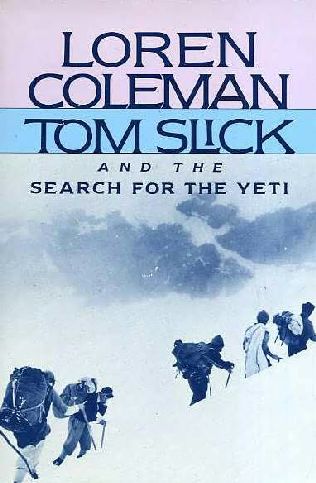
While Slick had decided to invest in oil and beef, he had creative ideas for what else he wanted to do with some of his money. Part of his inheritance went into his search for cryptids. I document in my Slick biography his quests for the Loch Ness Monster, Sumatran rhinos, Trinity Alps' Giant Salamanders, Bigfoot, and Orang Pendek.

Tom Slick (above, after his March 15, 1957, near-death accident in Nepal) was most famous, of course, for his expeditions in search of the Abominable Snowmen, the Yeti of the Himalayan Mountains.

In 1957, Tom Slick personally headed his first of many sponsored expeditions to Nepal in search of the Yeti, with Peter Byrne and Sherpa guides along for his deadly serious initial reconnaissance. From noting the timeline for Slick's trek, remarkably, I discovered that Slick began his actual search in earnest in the Arun Valley on March 17, 1957.

On March 18th and 19th, 1957, the Government of Nepal issued press releases and answered reporters' questions that they officially forbade all foreign mountaineers from "killing, injuring, or capturing a Yeti." Slick's party was allowed to carry guns for their self-defense. But they also had steel traps to capture a Yeti, and the new law was specifically targeted at Slick's expedition.

Abominable Snowman

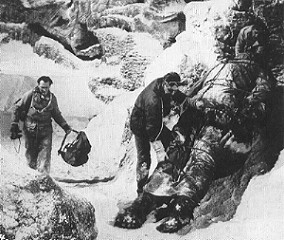
Especially interesting to me is a question I have never had fully answered: Was the character in the movie The Abominable Snowman of the Himalayas of the American Yeti hunter and exploiter "Tom Friend" (shown above next to the film's Yeti body) based, in some part, on the real Texan Yeti hunter Tom Slick?

What was one of the other missions of Tom Slick's 1957 expedition? Apparently, it may have been spying on the Chinese in Tibet. Certainly that was what the Russians thought.


This April 27, 1957, article (above) in The New York Times carried the claims that Tom Slick was behind an effort to subvert the Chinese and free Tibet. (It would be revealed years later that Tom Slick and his Slick Airways were working closely with the OSS and the CIA.)

Two years later, what date would the CIA pick to begin the exit of the Dalai Lama from Tibet? March 17, 1959. Who may have been helping with that trek? Tom Slick and Peter Byrne. Perhaps it was Tom Slick that picked the date, not the CIA?

Colonel Fletcher Prouty has written about this secret mission to Tibet. In 1955, Prouty was appointed the first "Focal Point" officer between the CIA and the Air Force for Clandestine Operations per National Security Council Directive 5412. He was Briefing Officer for the Secretary of Defense (1960-1961), and for the Chairman of the Joint Chiefs of Staff.

Prouty, in his 1973 book about the CIA, Secret Team, writes: "This fantastic escape and its major significance have been buried in the lore of the CIA as one of those successes that are not talked about. The Dalai Lama would have never been saved without the CIA."
On March 17, 1959, three groups, the Dalai Lama, his immediate family and senior advisors, escaped from Lhasa, Tibet.

John Prados writing in The Presidents' Secret Wars: CIA and Pentagon Covert Operations Since World War II (New York: Morrow, 1986), notes: "Tenzin Gyatso [the Dalai Lama] was disguised as a common soldier of the guard.... The best information [about the fleeing Dalai Lama] came from the CIA.... The CIA was so well informed because it had furnished an American radio operator, who traveled with the Dalai Lama's party...There may have been other CIA agents with the party as well."

Who were these individuals? Who helped the Dalai Lama's party get out of Tibet? None other than Peter Byrne, Tom Slick's man in Nepal. He may forget it, but he told me so in 1988, when I was interviewing him about his years of work, overt and covert, with Tom Slick of San Antonio, Texas. I go into further details in my book, Tom Slick: True Life Encounters in Cryptozoology (Fresno: Linden Press, 2002).


Is it a coincidence that on this date, seven years ago, some view this same calendar date as being the one that another Texan, linked to oil, began the present Iraqi War? While most historians use the date of March 20, 2003, as the start of the Iraqi War, others point to March 17, 2003. On that special date, the start of the US invasion of Iraq is keyed to President George W. Bush's announcement in a televised speech that Iraqi President Saddam Hussein and his sons had 48 hours to leave Iraq, or the United States will initiate preemptive military action against Iraq.

On March 17, 2003, Robin Cook, Leader of the British House of Commons, resigned from the UK cabinet over the plan to invade Iraq. The UK and the USA withdrew a proposed UN Security Council resolution on Iraq. The United States advised UNMOVIC and the IAEA to withdraw all weapon inspectors out of Iraq. This all occurred on March 17, 2003. 


What will happen on March 17, 2011? Will be even know it happened on the 17th? In Libya? In Japan?
Texas, Tibet, Nepal, Iraq, Egypt?
Oil, Yeti, Espionage?
Once is happenstance.
Twice is coincidence.
Three times is enemy action.

- Ian Fleming, Goldfinger

Monday, May 17, 2010

Thai Braveheart Assassinated At Triple Overpass


Sometimes, it is all about location, location, location. Read the news more deeply, everyday.

Khattiya Sawasdipol (Thai: ขัตติยะ สวัสดิผล; RTGS: Khattiya Sawatdiphon; born: June 2, 1951, assassination shooting: May 13, 2010; died: May 17, 2010), alias Seh Daeng (Thai: เสธ.แดง; RTGS: Se Daeng; English: Red Commander), was a major general in the Royal Thai Army, assigned to the Internal Security Operations Command.


The U.K.'s Mirror published the above photo, taken moments after the shooting.

Khattiya Sawasdipol was shot in the head (apparently by a sniper) on May 13, 2010, while being interviewed by The New York Times reporter Thomas Fuller while standing at the Sala Daeng Sky Train station, which is literally a triple overpass, near a famed monument.


Khattiya had previously claimed he had helped the United States spy on North Vietnam during the Vietnam War, and to have taken part in the CIA-financed "Secret War" against the communists in the Plain of Jars, in Laos. Khattiya disguised himself as a Muslim in order to infiltrate rebel groups in Aceh Indonesia.


He called* himself "Braveheart," after Mel Gibson.

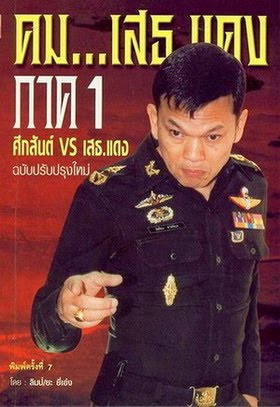
He had written several bestsellers in the Thai language about his adventures in a series called Khom...Seh Daeng (คม...เสธ.แดง). Khattiya frequently appeared on television talk shows and had a cult of followers, achieving celebrity status throughout Southeast Asia.

Khattiya made news on October 18, 2008, by announcing "he would mobilize government supporters against any military attempt to seize political power." Khattiya said members of the pro-government Democratic Alliance against Dictatorship (DAAD) would use petrol bombs against tanks and military vehicles taking part in a coup attempt.

Khattiya was reassigned as an aerobics teacher by Gen. Anupong Paochinda, Thai Army commander. Khattiya responded by saying, "The army chief wants me to be a presenter leading aerobics dancers. I have prepared one dance. It's called the 'throwing-a-hand-grenade' dance."

On 14 January 2010, Army Commander Anupong Paochinda ordered a suspension of Khattiya Sawasdipol after an inquiry committee found that Khattiya has supported the DAAD, a political pressure group that called for elections, breaching official disciplines.The following day, Anupong's office in the Royal Thai Army Headquarters was bombed by rockets launched by a M79 rocket launcher, left the office demolished but no one injured. In this event, Khattiya was described by BBC as a "renegade Thai general who backs anti-government protesters." A backer and part of the protesters' more radical wing, he had accused red-shirt leaders - many of whom have distanced themselves from him - of not being hardline enough.

Khattiya Sawasdipol was shot in the head, apparently by a sniper, at the intersection of the Sala Daeng Sky Train station, in the evening of May 13, 2010. Critically wounded, he was admitted to Huachiew hospital. On May 16, 2010, he suffered renal failure and underwent dialysis. Khattiya Sawasdipol's death was announced on May 17, 2010 at 9:20 am (local time).


The site is also the location of the double life-size monument to King Rama VI. The King Rama VI Monument stands at the gate to the Lumpini Park, overlooking the busy Saladaeng junction. Corrado Feroci, an Italian sculptor completed the monument with the help of four Thai artists on June 7, 1941 and it was inaugurated on March 27, 1942. The King Rama VI Monument is a statute of King Vajiravudh standing in his ceremonial uniform with a sword, on a high pedestal flanked by fountains. An open tiled area where public ceremonies are held surrounds the monument.

King Vajiravudh (188-1925) succeeded King Chulalongkorn ruling as King Rama VI (1910-1925). He had received his education in England at Oxford University and Sandhurst Military Academy. In the early years of his reign he was hindered by the ministers he had inherited, many of whom were actually King Chulalongkorn’s children and although promoting the notion of nation through the slogan “nation, religion, king,” he actually ruled in an authoritarian manner. To back up his authority Vajiravudh created a paramilitary force called the Wild Tigers (เสือป่า). In 1912 members of the regular army felt undermined by the position held by the Wild Tigers and plotted a coup against the monarchy. Although stopped in its infancy this was something new to Siam but has since become a phenomenon that has plagued the country right up to present times (including the recent uprising).


As further background information, the following extract is info about the location where Khattiya's assassination occurred, via Travelfish:

Sala Daeng station is number S2 on the Silom line, two stops away from Siam, the main interchange station. It lies above Silom road, close to the intersection of Rama IV. Simply put, Thanon Silom is one of the liveliest, busiest and most interesting areas in the whole city. Something for every taste can be found here - pirated music and movies, great restaurants, crowded clubs, sleazy sex shows and more. During the day, it's a pretty active area but it really comes alive at night. The sidewalks are crowded with stalls selling all manner of merchandise, the smell of food keeps changing every few seconds and people, motorcycles and cars all vie for their piece of real estate.

This station is also one of three that connect to the subway. The subway station here is named Silom.

If you're coming during the day, a perfect escape from the noise and pollution on the street is to leave via exit number 4 and walk north until you hit Lumphini park. This oasis in the middle of the city isn't as big or as nice as Central Park in New York, but it's got its heart in the right place. Expansive green areas, playgrounds for the kids, biking/walking/running paths, boating and frequent outdoor concerts and shows serve to make this a perfect place to enjoy the sun without the risk of being hit by a motorcycle.

If you're coming at night (Lumphini Park is closed when the sun goes down) or simply want to dive right into the action, a good place to start is through exit number 3 on the north-west corner of the station. From here, you can start walking south down the west side of Thanon Silom. You'll immediately notice a glut of American super-chains - Burger King, Haagen Dazs, McDonalds, Starbucks etc....

If you cross the street to the east side of Thanon Silom, you'll find yourself at CP Tower. Inside there's a McDonald's as well as Bookazine, a well stocked bookstore that stays open until 11pm. Walking north back towards the skytrain you'll pass Liberty Square which houses the multi-story California Wow fitness club which is also open late and packed with hip people who don't go to the McDonald's.

Liberty Square is on the corner of soi Convent, a major soi off of Thanon Silom. The area inside this soi has some of the best street food around and it's well worth a wander around to sample the offerings. Within the first 150m you can also find a Starbucks, several bakeries and restaurants and the Irish X-Change, a nice pub.


Signing autographs, in happier days.

From Times online, here is part of an earlier report (filed on May 13, 2010) on his shooting.

Thailand’s Braveheart, Major-General Khattiya Sawasdipol, injured in riots

He compares* himself to Mel Gibson’s Braveheart but he is more like a Thai version of Andy McNab. Major-General Khattiya Sawasdipol is one of the most colourful but mysterious figures in the crisis, a living example of the contradictions that make it so difficult to resolve or understand.

Even before the confrontation he was a celebrity thanks to bestselling books describing his exploits as commando and undercover operative. By his account, “Commander Red” had an heroic career, supporting the US in Vietnam and infiltrating Muslim rebels in Indonesia.

He is also a passionate supporter of Thaksin Shinawatra, who was deposed in a military coup in 2006. When demonstrations broke out, General Khattiya’s eccentricity shifted into insubordination. While still a serving officer he promised that he would take up arms against any of his colleagues who attempted another coup.

The commander of the Army responded by appointing him an army aerobics instructor. “Everybody laughed at me,” he recalled. “You don’t assign a warrior like me to do a stupid thing like that.” He warned his commander: “I have prepared one dance. It’s called the throwing-a-hand-grenade dance.”


====
*"Do you know the Braveheart movie? Mel Gibson is the same as me." ~ Seh Daeng