Showing posts with label Jack the Ripper. Show all posts

Saturday, November 29, 2014

Tarot Cards As Criminal Twilight Language

The Joker? The Hierophant? Jack the Ripper? The Hanging Man? Twilight Language abounds.

As a followup to the recent Austin shootings (see "Gunman McQuilliams Targets 3 Major Austin Governmental Sites"), the identification of the shooter as Larry Steven McQuillams revealed his use of the Twilight Language.

Before his attack, McQuilliams changed his last public individual Facebook profile photo to the following:
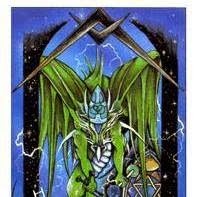

It is the Hierophant Tarot card (h/t SMiles). Following is the complete view.


The Hierophant (V), in some decks named The Pope, is the fifth trump or Major Arcana card in most traditional Tarot decks.
...
In many modern packs, the Hierophant is represented with his right hand raised in what is known esoterically as the blessing or benediction, with two fingers pointing skyward and two pointing down, thus forming a bridge between Heaven and Earth reminiscent of that formed by the body of The Hanged Man. The Hierophant is thus a true “pontiff”, in that he is the builder of the bridge between deity and humanity.
...
In most iconographic depictions, the Hierophant is seen seated on a throne between two pillars symbolizing Law and Liberty or obedience and disobedience, according to different interpretations. He wears a triple crown, and the keys to Heaven are at his feet. Sometimes he is shown with worshippers, as his alternate title is the Pope or, sometimes, Jupiter.
...
Some interpretations also suggest a link between the card and the myth of Isis and Osiris, a claim made about many cards. Source. 

There is a long tradition of leaving "calling cards" of various types at crime scenes. 

One of the most significant examples in history is those left by Jack the Ripper, which were wrongly interpreted as being Jewish in origin, when, in fact, they were Masonic.
Jack the Ripper is believed to have left two calling cards by Goulston Street, London on September 30, 1888, the night he murdered Elizabeth Stride and Catherine Eddowes: a scrap of Eddowes' apron and some graffiti reading Juwes are the men That Will not be Blamed for nothing. Source.
First off, the actual location of the killings, near or in Mitre Square is important, Freemasonically.

Also, in one widely disseminated theory:
Author Stephen Knight suggested that "Juwes" referred not to "Jews," but to Jubela, Jubelo and Jubelum, the three killers of Hiram Abiff, a semi-legendary figure in Freemasonry, and furthermore, that the message was written by the killer (or killers) as part of a Masonic plot. There is no evidence that anyone prior to Knight had ever referred to those three figures by the term "Juwes". Knight's suggestion was used in fictional treatments of the murders, such as the film Murder by Decree, and the graphic novel From Hell by Alan Moore and Eddie Campbell. Source.
In terms of the Beltway Sniper mystery, Tarot cards were used to leave messages.

John Muhammad and Lee Malvo, the so-called "Beltway Snipers," engaged in 23 days of random attacks in the Washington, D.C, area, in October 2002. Muhammad used a Bushmaster .223 rifle.

The snipers left Tarot “Death” cards like this one
at some of the shooting sites. Note the words
“Call me God” at the top. Photo: Official FBI page.

On October 7, 2002, at 8:09 a.m., Iran Brown, a 13-year-old boy, was shot in the abdomen and critically wounded as he arrived at the Benjamin Tasker Middle School at 4901 Collington Road in Bowie, Maryland, in Prince George's County (Brown's name was concealed from the public but was later revealed). His aunt, a nurse who had just brought him to school, rushed him to a hospital emergency room. Despite serious injuries, including damage to several major organs, Brown survived the attack and ultimately testified at Muhammad's trial. At this crime scene the authorities discovered a shell casing as well as a Tarot card (the Death card) inscribed with the phrase, "Call me God" on the front and, on three separate lines on the back, "For you Mr. Police." "Code: 'Call me God'. Do not release to the press."
...
Allegedly, at several scenes Tarot cards were left as calling cards, including one Death card upon which was written "Call me God" on the front and on the back on three separate lines the words, "For you mr. Police." "Code: 'Call me God'." "Do not release to the press." This information was leaked to the press and misquoted often as "I am God" or some similar misquote of the actual words on the tarot card. Source.


Heath Ledger's Joker and his card.


The Hanging Man Tarot card.


The Imaginarium of Doctor Parnassus: Heath Ledger's final role.

Friday, October 01, 2010

Jack The Ripper: September 29, 1888


THE NEMESIS OF NEGLECT.
There floats a phantom on the slum's foul air,
Shaping, to eyes which have the gift of seeing,
Into the Spectre of that loathly lair.
Face it--for vain is fleeing!
Red-handed, ruthless, furtive, unerect,
'Tis murderous Crime--the Nemesis of Neglect!

Jack the Ripper cartoon was published September 29, 1888 in Punch, or The London Charivai, John Tenniel.

The attempted self-immolation by David Parker, 24, at Longfellow Square, Portland, Maine, a block from the Lafayette Hotel, occurred on September 29, 2010. As I have pointed out in recent postings here, the statue dedicated to Henry Wadsworth Longfellow was unveiled on September 29, 1888.

This date is also linked to the infamous Jack the Ripper murders. The same day that Punch published a caricature of Jack the Ripper, the Ripper decided to strike again. The illustrator of that cartoon would be none other than Sir John Tenniel (28 February 1820 – 25 February 1914), who is remembered today for his illustrations for Lewis Carroll's Alice's Adventures in Wonderland and Through the Looking-Glass.


While recorded to have been found dead on September 30th, 1888, the two victims, Stride and Eddowes, would have been killed on the evening of September 29, 1988. Elizabeth Stride was found with her throat cut in Berner Street, St George’s, London, the next morning, on September 30th, as was Mrs May (sic) Eddowes, who had been murdered and mutilated in Mitre Square, Aldgate, London. The Freemasonry symbolism of these 1888 serial killings, emphasized especially by the location of Mitre Square, have been discussed at length in the Ripper literature.

Talk about going through the looking glass.

Tuesday, January 05, 2010

Sherlock Holmes (2009): The Ripper Killings

I found the new Sherlock Holmes (2009) movie intriguingly multi-layered, with an incredible number of synchromystical symbols throughout, often tied to the Masons ("Temple of the Four Orders") and the Ripper case (see below). These are woven nicely within the plot and characters.

Lord Blackwood (who wears a black trenchcoat most of the time ~ as have the spate of recent mass killers), the secret society members, the plotting police, the usual bald giants, the ginger little people, the overly attractive prostitutes, and even the ever present ravens have a good deal to "say" to those watching this cinema closely. Needless to say, the Masonic elements have been mentioned by many reviewers and critics in the blogosphere, so no need to dwell on the straight and narrow there.

Another "character" in the movie is the Tower Bridge, which is shown under construction. Actually, since it is known that the building of the Tower Bridge started in 1886 and took eight years, it nicely dates this version of Sherlock Holmes. The official plot summary of the movie notes this film occurs in "1891 London."

The movie has many facets, overlooked by the casual moviegoer.

For example:

A number of the movie's details were taken directly from "The Adventure of the Mazarin Stone." The first is the name of the villain, Lord Blackwood. Fans may remember him as Count Negretto Sylvius (Negretto is Italian for black and Sylvius is Latin for woods). Interestingly enough, Blackwoods was a competitor of the Strand (the publisher of Doyle's work). Blackwoods also rejected some of Doyle's early work, though the Mazarin story was written 40 years after the fact and Doyle was very successful by then. In any event, Blackwood was NOT some magician with an egg tooth (a tooth most baby snakes are born with to cut through their eggs).

Another common detail is the Crown Diamond, which is the Yellow Mazarin Stone (named for Cardinal Jules Mazarin [1602-1661], minister to Louis XIV). The large yellow stone hung around Irene Adler's neck in the movie. "The Adventure of the Mazarin Stone" is also the first and only story to mention that the 221B Baker Street apartment had multiple exits and a waiting room. The extra exit was through the bedroom which Sherlock employed to follow Irene early in the movie.


I actually think few people "get" what is behind the allusion to the five prostitutes who are killed ritualistically with daggers, before the timeline of the movie begins. These definitely appear to me to be an obvious but subtle reference to the five traditionally acknowledged Ripper killings. Because the phrase "Jack the Ripper" is never used in the movie, I have yet to see it in any deciphering of this present film. Those murders took place around Whitechapel, London, in late 1888, of course, and some, like Stephen Knight, theorize they were Masonic in nature. The present movie has more links to the Sherlock Holmes in A Study in Scarlet and Christopher Plummer in Murder by Decree, than people are noting.

Release Date: December 25th, 2009 (wide)
Distributors: Warner Bros. Pictures Distribution
Produced in: United States

Actors:
Robert Downey Jr. ... Sherlock Holmes
Jude Law ... Dr. John Watson
Rachel McAdams ... Irene Adler
Mark Strong ... Blackwood
Eddie Marsan ... Inspector Lestrade
Kelly Reilly ... Mary

Directed by: Guy Ritchie
++++

Doyle: A Mason?

Sir Arthur Conan Doyle (1859-1930) was the author of fifty-six short stories and three novels with Sherlock Holmes and John H. Watson M.D., as the principal characters.

Conan Doyle was not a particularly active freemason. One widely quoted report in the October 1901 Masonic Illustrated claims: "While at the seat of war, he attended the never-to-be-forgotten scratch lodge at Bloemfontein in company with Bro. Rudyard Kipling." In fact, Kipling was in Bloemfontein only between March 17 and April 3, 1900, a period when Rising Star Lodge No. 1022 E.C., the only lodge meeting in that part of South Africa, did not meet. At an April 5, 1900 meeting letters were received by the lodge from both Lord Kitchener and Conan Doyle, expressing their regrets at being unable to attend. A "loyal resolution" to be sent to the Prince of Wales was proposed by Kitchener at an April 23, 1900 meeting; a document signed by both Lord Roberts, who had not been present at the meeting, and Conan Doyle. The minutes of the lodge’s November 7, 1901 meeting refute the newspaper report and deny that Bros. Doyle and Kipling had ever visited their lodge. Also in 1900 Conan Doyle was made an honorary member of The Lodge of Edinburgh (Mary’s Chapel) No. 1 in recognition of his acceptance of an invitation to speak at a Burns' Night Dinner.

There is no mention of Freemasonry in his autobiography, Memories and Adventures and it is said that "Dr. Doyle looked in on Freemasonry and soon looked out again." There are, however seven distinct and several other oblique references to Freemasonry in his fiction. [AQC 104 & 105]

A prolific writer and an early proponent of a tunnel connecting England and France, he was also responsible for introducing downhill skiing into Switzerland, metal helmets for combat soldiers and the inflatable life-preserver for sailors. He makes a number of Masonic references in his writings, none of them key to his story development.

However, this record exists of his membership:
Initiated: January 26, 1887
Passed: February 23, 1887
Raised: March 23, 1887
Demitted: 1889
Rejoined: 1902
Demitted: 1911
Phoenix Lodge 257, Southsea Hampshire.


See also, other links to strange "Sherlock Holmes" coincidences in 2009, including the "Dr. Watson" killing, and the sudden death of Natasha Richardson, who had made her UK television debut in 1985, in The Adventures Of Sherlock Holmes, appearing as Violet Hunter in the episode, "The Copper Beeches."

Tuesday, April 28, 2009

Time For Copycat Talk

This week people reading the Time Magazine article, "Is Copycat Behavior Driving Murder-Suicides?" are emailing me. Readers are sending messages such as this one: "I was surprised that the article did not mention your book."

The column, upon which I am being asked to comment, is:

Time Magazine, Thursday, Apr. 23, 2009. "Is Copycat Behavior Driving Murder-Suicides?" by Maia Szalavitz.

On March 30, a Santa Clara, Calif., man shot five people to death, including three children, before killing himself. On April 3, a gunman went on a shooting rampage in an immigration center in Binghamton, N.Y., killing 13 people before taking his own life. And on April 20, employees of a Sheraton Hotel in Maryland found the bodies of a husband and wife and two daughters, victims of another apparent murder-suicide.

These are only the most publicized of the recent murder-suicide crimes in the U.S. Since March 10, 2009, at least 43 people have been killed in murder-suicides, and there is no telling why the crimes occurred in such rapid succession. It is also not clear whether the spate of recent deaths represents an escalation in the typical murder-suicide death toll. But it has got some observers wondering why. Past research suggests that factors ranging from the time of year (suicides are more common in spring) to the financial climate may have an impact on the rates of suicide and murder; in the recent events, the apparent motive of the killers included sexual jealousy and economic despair.

But Steven Stack, professor of psychiatry and criminal justice at Wayne State University, offers another explanation: the copycat effect. The copycat theory was first conceived by a criminologist in 1912, after the London newspapers' wall-to-wall coverage of the brutal crimes of Jack the Ripper in the late 1800s led to a wave of copycat rapes and murders throughout England. Since then, there has been much research into copycat events — mostly copycat suicides, which appear to be most common — but, taken together, the findings are inconclusive.

In a 2005 review of 105 previously published studies, Stack found that about 40% of the studies suggested an association between media coverage of suicide, particularly celebrity suicide, and suicide rates in the general public. He also found a dose-response effect: The more coverage of a suicide, the greater the number of copycat deaths.

But 60% of past research found no such link, according to Stack's study. He explains that the studies that were able to find associations were those that tended to involve celebrity death or heavy media coverage — factors that, unsurprisingly, tend to co-occur. "The stories that are most likely to have an impact are ones that concern entertainment and political celebrities. Coverage of these suicides is 5.2 times more likely to produce a copycat effect than coverage of ordinary people's suicides," Stack says. In the month after Marilyn Monroe's death, for example, the suicide rate in the U.S. rose by 12%.

Stack also conducted the only study to examine whether murder-suicide (as opposed to suicide alone) is associated with copycat crimes. That study, published 20 years ago, analyzed the impact of media coverage of mass murders and murder-suicides between 1968 and 1980. The study found no associated increase in homicide rates, but did note an uptick in suicide after well-publicized events. "There was a significant increase in national monthly suicide rates," he said, "It is a fairly substantial association and was independent of major control variables like the unemployment rate."
For now, it seems that the reason behind the recent series of murder-suicides will remain unclear, but whether it's the economy, the season, gun availability or copycatting, it will be no simple task figuring out how to stop them.


While my research associates and readers may be startled to see that The Copycat Effect (NY: Paraview Pocket ~ Simon and Schuster, 2004) is not cited, it is a sign of the times that the "copycat effect" is now more acceptable for media discussions. All the examples and links mentioned within the Time article, from Jack the Ripper to Marilyn Monroe, of course, are explored and discussed within my book.

Instead of being upset, I merely shall reflect upon this generous prophetic endorsement on the back of my book from one Dr. Steven Stack, sociologist, Center for Suicide Research:

"The media are still largely in a state of denial on how their coverage of death contributes to the violence and destructiveness in our society - but Coleman's book should wake them up!"


Perhaps that is what is happening.