Showing posts with label Obelisks. Show all posts

Tuesday, August 23, 2011

DC Obelisk Tilting?


Is the Washington Monument tilting due to the earthquake?
A 5.9 magnitude earthquake centered around Richmond, Virginia was felt as far as New York City and New England on August 23, 2011.
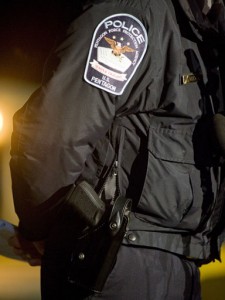
Fox News anchor Megyn Kelly reported at 2:30 pm their bureau received information from a producer saying that a Captiol Hill Police officer was saying the Washington Monument may actually be tilting as a result of the earthquake.
Seismologist John Rundle joined Kelly on her show and confirmed that the Washington Monument could very well be tilting as a result of the earthquake and the structure should be checked out.
Two nuclear reactors have reportedly been taken off line near the epicenter of the earthquake.
According to the AP:
WASHINGTON (AP) — A 5.9 magnitude earthquake centered northwest of Richmond, Va., shook much of Washington, D.C., and was felt as far north as Rhode Island, New York City and Martha's Vineyard, Mass., where President Barack Obama is vacationing.The U.S. Geological Survey said the earthquake was half a mile deep.
Shaking was felt at the White House and all over the East Coast, as far south as Chapel Hill, N.C. Parts of the Pentagon, White House and Capitol were evacuated. There were no immediate reports of injuries.
It was centered near Louisa, Va., which is northwest of Richmond and south of Washington.
Obama and many of the nation's leaders were out of town on August vacation when the quake struck at 1:51 p.m. EDT. The shaking was felt on the Martha's Vineyard golf course as Obama was just starting a round.
The East Coast gets earthquakes, but usually smaller ones and is less prepared than California or Alaska for shaking.At Reagan National Airport outside Washington, ceiling tiles fell during a few seconds of shaking.
Authorities announced it was an earthquake and all flights were put on hold.
At the Pentagon in northern Virginia, a low rumbling built and built to the point that the building was shaking. People ran into the corridors of the government's biggest building and as the shaking continued there were shouts of "Evacuate! Evacuate!"

*UPDATE 1: The Hill is reporting that the Park Service is stating there is no serious damage to any of D.C.'s national monuments:
U.S. Park Police in Washington made an initial survey of the city's monuments after a 5.9 magnitude earthquake and found no serious damage.
According to The Washington Post, the Park Police checked the monuments by helicopter shortly after the earthquake on Tuesday.

*UPDATE 2: (via Real Clear Politics): CNN is reporting that "some stones are loose" at the Washington Monument. 

*Update 3: (Via NBC News Washington): National Park Service: Washington Monument is not tilting
The NPS said it is evaluating the structures to ensure that they are structurally sound and safe for all visitors.
Agency spokesman Jeffrey Olson told the AP that there was "absolutely no damage" to the Washington Monument, contrary to media reports elsewhere that it was leaning.
"Absolutely incorrect," U.S. Park Police Sgt. David Schlosser said of media reports that the Washington Monument was leaning.  "It stands tall and proud."
However, the Washington Monument, because of its structural complexities, will remain closed until further notice, according to the NPS. 


Source: Washington Times, Kelly Picket

Friday, February 04, 2011

Tahrir Square: Egypt's Dealey Plaza


Will Tahrir Square be tomorrow's Dealey Plaza (where a change in the USA government occurred)? Such a question is to not be taken literally but metaphorically. Sometimes, however, the metaphorical can certainly be rather grounded in a deeper meaning.

The Egyptian symbols are everywhere. 
Dealey Plaza's obelisk denotes the site of the first Masonic Lodge in Texas.


The observations made at this blog are that the answers may be in the "where" and the "when," as much as the "what" and the "who." Such threads of reality are being played out in the events from the Middle East.


Others have said this in different ways, regarding the breaking news out of Egypt. Indeed, the evidence is mounting for the pivotal role of this ancient land in the current state of affairs.  I, for example, have been pondering the location and histories of the "squares" in the events, oftentimes sparked by the self-immolations taking place within them, and then watching as they remain significant as the sites of the mass demonstrations.


Despite the beginnings in Tunisia for this current Arab/Moorish/Muslin wave of revolutionary/freedom feelings and changes, it seems to be all coming down to what is going to happen in Egypt for a clue to that part of the world's future.


"If you consider yourself a magician, and especially if you identify with the Rosicrucian or Hermetic traditions -- or even if you're a freemason, or a member of one of dozens of other traditional orders -- Egypt is the source. Egypt is where you end up when you follow all the lines of the Western Tradition to their origins," writes Magian Rumination.


One key location, of course, is Tahrir Square.  Tahrir Square or Midan Tahrir (Arabic: English translation, Liberation Square) is a major public town square in downtown Cairo, Egypt. The square was originally called Midan Ismaileyya (Ismailia Square), after the 19th-century ruler Khedive Ismail Pasha, who commissioned the new downtown district's "Paris on the Nile" design. After the Egyptian Revolution of 1952, bringing Egypt from a constitutional monarchy with British occupation into an independent republic, the square's name was changed to Midan Tahrir or "Liberation Square."

The squares were basically built as Masonic sites. Prince Ismail Pasha (1830-1895) was the Grand Master of the Grand Lodge of Egypt .


On the northeast segment of Tahrir Square is a plaza with a statue of Ottoman Egypt era Cairene Omar Makram, and beyond is the Omar Makram Mosque.


The square is the northern terminus of the historic Qasr al-Ayn Street, western end of Talaat Harb Street, and near the Qasr al-Nil Bridge crossing of the Nile River. 


The area around Tahrir Square includes the Egyptian Museum (the resting site of King Tut and most of the important treasures of Ancient Egypt), the National Democratic Party-NDP headquarters building, the Mogamma government building, the Headquarters of the Arab League building, the Nile Hotel, and the original downtown campus of the American University in Cairo.

The Cairo Metro serves Tahrir Square with the Sadat Station (named after the assassinated leader Anwar al-Sadat), which is the downtown junction of the system's two lines, linking to Giza, Maadi, Helwan, and other districts and suburbs of Greater Cairo. Its underground access viaducts provide the safest routes for pedestrians crossing the broad roads of the heavily trafficked square.


The above statue of Prince Ismail Pasha is located in Alexandria.

There is another Tahrir Square, which is the former Mohammed Ali Square, originally Place des Consuls, in downtown Alexandria, the other major city where mass demonstrations are occurring in Egypt. Alexandria's Mansheyya Square was the site of the October 1954 failed assassination attempt by the Muslim Brotherhood on Gamal Abdel Nasser.


President Obama appeared at the National Prayer Breakfast on February 3, 2011, and the Drudge Report posted a photo that placed the moment in a spiritual light.  Obama said he prays for Egypt.

Saturday, March 06, 2010

Images of the Week

Associated Press photographer Cliff Owen captured some striking images from the scene of the news conference about J. Patrick Bedell's shooting at the Pentagon.

These are my editorial choices for the photographs of the week, which summarize the subtle twilight background to the "active shooter" period currently being experienced in the USA:


Pentagon Police Chief Richard Keevill wears his Glock .40 S&W pistol as he speaks with reporters about a shooting at the Pentagon in Washington, Thursday, March 4, 2010. (AP Photo/Cliff Owen)


A pedestrian passes near the Pentagon Metro complex where a man with a gun opened fire in Washington, Thursday, March 4, 2010. (AP Photo/Cliff Owen)

The object visible in the distance, of course, is the Washington Masonic Monument obelisk.

Monday, July 13, 2009

Sun God Polito Killed By Lightning

A Ukrainian politician who had tried to revive an ancient pagan cult was killed by lightning on Saturday, July 4, 2009, while on a fishing trip. Did this occur about the same time John A. Keel passed away in the USA?


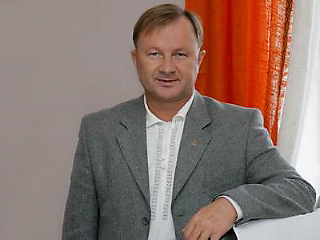
Vasily Chervoni (above) was on a fishing trip near the village of Derazhnoye and suffered a direct lightning hit during a thunderstorm. He was taken to a hospital where he died shortly afterwards, the Russian daily Komsomolskaya Pravda reported on Monday, July 6, 2009.

The newspaper noted that the late politician was a close friend of Ukrainian President Yushchenko and had at one time occupied the governor’s post in Rovno Region. A former activist in the Soviet youth movement Comsomol, Chervoni started an independent political career in the early 1990s with radical Ukrainian nationalists. At some point, Chervoni joined the religious movement Runvera – a Ukrainian sect that seeks revival of obscure ancient cults, in particular, the worship of the sun god Dažbog.

In 1992, Chervoni was excommunicated from the Russian Orthodox Church. When he was retired from the governor’s post in 2006, all Orthodox churches in Rovno Region had a special prayer thanking the Lord for deliverance.

The Sun God: Dažbog


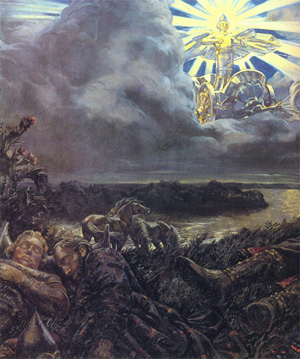
Dažbog (above) was one of the major gods of Slavic mythology, most likely a solar deity and possibly a cultural hero. He is one of several authentic Slavic gods, mentioned by a number of medieval manuscripts, and one of the few Slavic gods for which evidence of worship can be found in all Slavic nations.

While the meaning of Dažbog’s name is not completely clear (as is the case with most other Slavic gods), taking into account several different versions of the name, most scholars agree the root dažd- or daj- is derived from root of the verb dati "to give."

Thus, according to most scholars, Dažbog would be "giving god," "god-giver," "god-donor," deus dator. This is particularly interesting since the Proto-Slavic word for god, *bagu (> Common Slavic *bogъ), the suffix of Dažbog's name, is argued either to be of Iranian origin (being related to Indo-Iranian etymons such as Old Persian baga, Sanskrit bhaga), or being semantically influenced by Iranian source, both being ultimately derived from PIE root *bʰag-, whose reflexes in both Slavic and Indo-Iranian came to mean both "deity" and "wealth, share."

Translated literally, Dažbog would be "giver of fortune." This echoes the ancient Indo-European concept that the deity is, in essence, an entity which gives wealth and abundance, an indication, perhaps, that Dažbog is a relic from common Proto-Indo-European religion, or even that this was not a name for any particular Slavic god, but a general epithet of a deity.


The Slavic god Svarog had two sons: Svarožič, who represented fire on earth, and Dažbog, who represented fire in the sky and was associated with Sun. Svarog was believed to have forged the Sun and have given it to his son Dažbog to carry it across the sky.

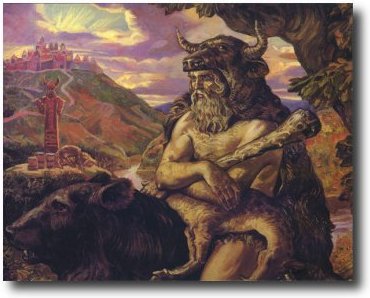
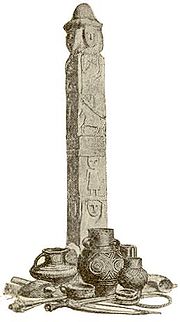
Pagan Slavs left their footprints across the region in a significant number of toponyms whose names can be associated with them and by discoveries of multi-headed statues in various Slavic lands. For example, the four-headed god Svantevit had a white horse and is represented by obelisks such as these.


Keelian Connection

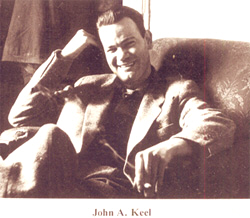
I'm reminded that during the mid-1960s, John A. Keel became literally obsessed with collecting Fortean news clippings of bizarre deaths of people, livestock, and other animals killed by lightning. He would send copies of such newspaper articles to me and others, and requested that his correspondents forward any such events mentioned in local papers. For a time, Keel privately published a newsletter, Anomaly News, in which he would fill the pages with little offset copied news items of all such lightning deaths he could discover.

It is intriguing that Keel would die in New York City on July 3rd and Chervoni's lightning event is listed as July 4th. Of course, with the different time zones, maybe, in some strange Fortean twist of fate, the lightning strike and Keel's death occurred more closely in time that we realize. John would have been happy with this bit of synchronicity.

Saturday, May 09, 2009

De Naald Attack: 8th Person Dies

An eighth person has died in the wake of the assassination attempt on the Dutch Royal Family. (See here for full details on the attack.)


De Naald (in English The Needle), is the obelisk monument in the Dutch city of Apeldoorn that became the final resting place for Karst Tates' automobile.

A woman died of her injuries more than a week after a man plowed his car into a crowd during a parade, becoming the seventh victim of a failed attack (#8 when the attacker is counted) on the Dutch royal family, authorities said Saturday, May 9, 2009.

The 46-year-old woman, whose identity was not released, was among about a dozen people struck down in the April 30 attack. Apeldoorn municipality spokesman Toon Schuiling said she died Friday night, May 8, 2009, in a hospital, the same evening as more than 1,000 people gathered for a memorial service.

Five bystanders died on the day of the April 30 attack near Het Loo palace in Apeldoorn and another died the following day. The car's driver also died. Four other people remain hospitalized.

The car rammed into a stone monument (the Masonic structure pictured above) after speeding through the crowd, narrowly missing an open-topped bus carrying Queen Beatrix and other royal family members.

Police say the car's driver, identified by Dutch media as Karst Tates, admitted attempting to attack the popular monarch shortly after his car came to a halt. He did not give a motive.

The attack on the Queen's Day national holiday raised questions in the Netherlands about the level of security surrounding the royal family.

For more on the symbolic linkages, copycat evidence, and video concerning this attack, please click here.

Friday, May 01, 2009

Dutch Assassin Was Taxi Driver Copycat

The man who drove his car into a crowded Dutch royal parade, targeting Queen Beatrix Wilhelmina Armgard, had shaved his hair into a Mohawk, like the homicidal anti-hero of the film Taxi Driver before launching the attack.
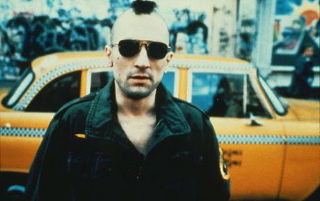


Investigators are focusing on the theory that 38-year old Karst Tates, who died of his injuries on April 30th, had embarked on a mission of vengeance against society after losing his job as a night-shift security guard earlier this year.

His neighbors and locals in the town of Huissen have described an isolated but polite man whose dress resembled that of Travis Bickle, the loner played by Robert de Niro in the 1976 film Taxi Driver, in which he plots to assassinate Senator Palantine, a candidate for the American presidency.

"He wore rolled trousers with high black boots. His hair was often very short and totally shaved at the sides," said one neighbor, according to the London Telegraph.

It will be recalled that the film Taxi Driver formed part of the delusional fantasy of John Hinckley, Jr., which triggered his attempted assassination of President Ronald Reagan in 1981, an act for which he was found not guilty by reason of insanity. Hinckley stated that his actions were an attempt to impress actress Jodie Foster, on whom Hinckley was fixated, by mimicking Travis's Mohawked appearance at the Palantine rally. His attorney concluded his defense by playing the movie for the jury.

The Dutch assassin Karst Tates was attempting to attack Queen Beatrix and other members of the royal family during an annual parade by ramming his black Suzuki Swift car into them on April 30, 2009.

Beatrix (Beatrix Wilhelmina Armgard; born January 31, 1938) has been the Queen regnant of the Kingdom of the Netherlands since April 30, 1980, when her mother, Queen Juliana, abdicated. Her maternal grandmother was Queen Wilhelmina, whom I previously wrote about here, in relationship to the Wilhelmina links to the town of Mena, Arkansas. Queen Beatrix is a member of the Bilderberg Group. Beatrix is an honorary member of the Club of Rome.

In 1965, Princess Beatrix became engaged to the German aristocrat Claus von Amsberg, a diplomat working for the German Foreign Office. Their marriage caused a massive protest during the wedding day in Amsterdam on March 10, 1966. Prince Claus had served in the Hitler Youth and the Wehrmacht and was, therefore, associated by a part of the Dutch population with German Nazism.

Queen Beatrix's father, Bernhard was a member of the Nazi Party, the Sturmabteilung and a special branch of the SS called the "Reiter SS"- an equestrian sporting organization. The Prince was not a Nazi by conviction; these memberships made life easier for an ambitious young man. People defending the Prince have stated that membership was necessary to be a student. The Prince later denied these well-documented memberships.

In the 1930s, with the rise of Adolf Hitler, Prince Bernhard's younger brother, Aschwin, publicly declared his support for the Nazi Party. Prince Bernhard was a member of the honorary German Reiter SS Corps (SS Cavalry Corps). The Prince eventually went to work for the German chemical company, IG Farben. After a period of training, he became Secretary to the Board of Directors at the Paris office in 1935.

During the planning of the invasion of Czechoslovakia and Poland, IG Farben cooperated closely with Nazi officials and directed which chemical plants should be secured and delivered to IG Farben. In 1941, an investigation exposed a "marriage" cartel between John D. Rockefeller's United States-based Standard Oil Co. and I.G. Farben. IG Farben built a factory (named Buna Chemical Plant) for producing synthetic oil and rubber (from coal) in Auschwitz, which was the beginning of SS activity and camps in this location during the Holocaust. At its peak in 1944, this factory made use of 83,000 slave laborers. The patent for pesticide Zyklon B was held by IG Farben. This cyanide-based insecticide was infamous for its use by Nazi Germany against human beings in gas chambers of extermination camps during the Holocaust. At the Nuremberg Trials, 13 IG Farben directors were sentenced to prison terms between one and eight years.

Because Prince Bernhard was a Protestant of royal rank (the Lippes were a mediatized sovereign house), Bernhard was acceptable to Queen Wilhelmina of the Netherlands as a suitable husband for her daughter, Princess Juliana. Bernhard's appropriateness as consort of the future Queen would later become a matter of some public debate.

Prince Bernhard's political affiliations with the Nazi regime have received much attention. Various members of his family and acquaintances were aligned with the Nazis prior to and during the war - a number of these being entertained shortly before and joining the royal wedding party, which occurred on January 7, 1937 in The Hague. Protocol demanded that the prospective Prince-Consort be invited to an audience with his head of state, the German dictator, Adolf Hitler. Hitler himself gives a rendering of the conversation he had with Bernard, in his ‘TischGespraeche’ (TableConversations). The ‘TableConversations’ contains a collection of monologues/remarks/speeches, which Hitler used to give during lunch/dinner-time to those who were invited to the table by him.

Queen Beatrix's time on the throne has not been without protests. A violent riot, for example, occurred on April 30, 1980, during the investiture (sovereigns of the Netherlands are not crowned as such) of Queen Beatrix. Some people, including anarchist squatters, used the occasion to protest against poor housing conditions in the Netherlands and against the monarchy in general.

The date of the attack, April 30th, therefore, is highly symbolic, and, in twilight language translation, it turns out, so was the location.

In the video of the attack, it is clearly seen that Karst Tates' automobile crashes into a monument. But what monument?

The structure is referred to as the "Needle" ~ in English translation ~ by the Dutch reporters. A Masonic monument. Shades of Dealey Plaza.
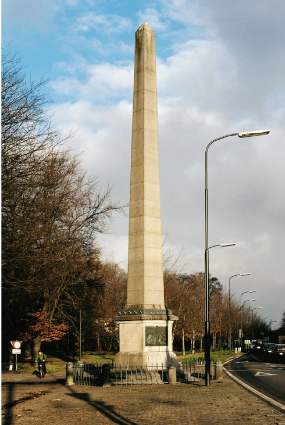


Amazingly, it is the De Naald (in English The Needle), which is an obelisk-shaped monument in the Dutch city of Apeldoorn. It is built of stone and surrounded by a low, iron fence.

The obelisk was dedicated on March 9, 1901, by the citizens of Apeldoorn. It was presented by the people to the bride and groom Queen Wilhelmina and Prince Hendrik. It is also an expression of thanks to the King Willem III and Queen Emma (who are the parents of Queen Wilhelmina). De Naald was the idea of the then mayor of Apeldoorn, Mr Nolthenius. It is 17 meter high, and, of course, based on the design of the Egyptian obelisks. It stands on the corner of Zwolseweg and Loolaan.


The car ended up hitting the Masonic monument De Naald (The Needle). Readers will recall that on 7/7 in London, the location where the attacked double-decker bus came to a standstill was against the Tavistock front door. The Tavistock Institute in London is linked to the Bilderberg Group. The Dutch Royal family are the founders of the Bilderberg group, and they held the 4/30/09 post-attack news conference at the Keizerskroon, which is part of the Bilderberg hotel.

The Dutch Royal bus and the assassin's car was on the street Loolaan. This avenue is 1024 meters long (measured from De Naald to the middle of the church Grote Kerk). From 1808, it was the first paved road in the Netherlands. The road was created by King Louis Napoleon (he was one of the previous owners of palace Het loo). He had this road built from Amersfoort, Het Loo and Apeldoorn to Deventer. It was named the Grand Route.


The latest news is that a seventh person has died as a result of the car attack during Koninginnedag 2009 (Queen's Day) celebrations in Apeldoorn, Netherlands. A 55-year-old military policeman, who was working as a driver, died of his injuries while recovering in a hospital on Friday afternoon, May 1, 2009.

Another woman is said to be in a critical condition. The condition of the other eight people still hospitalized is reportedly stable. Among them are three children.

On Friday morning it was announced that Karst Tates who deliberately drove his car at speed through the crowd of spectators had died in hospital during the night of April 30. His neighbors describe him as a quiet, withdrawn person. His motive for carrying out the attack remains a mystery, according to Radio Netherlands.

On Thursday, April 30, the public prosecutor said the man told police that his attack was aimed at the royal family. The public prosecutor ruled out any terrorist motive and the authorities believe the man was acting alone.

About 250 detectives are involved in the investigation into the incident. The police have received more than 750 tips so far. Witnesses to the incident have uploaded 165 photographs and about 10 videos to a special justice ministry website. The police are still urgently looking for photographs of the black car just before it plowed into the spectators.

The mayor of Apeldoorn, Fred de Graaf, has announced that an investigation will be launched into the security provisions surrounding the royal visit.

After the April 30th tragedy Prime Minister Jan Peter Balkenende said it was too early to speculate about future Queen's Day celebrations. After meeting Queen Beatrix and other members of the royal family in Apeldoorn, the prime minister called for serious reflection.

In a televised address, the queen, visibly shocked, offered sympathy to the victims and their relatives. Prime Minister Balkenende expressed "deep shock at the horrible event" and travelled to Apeldoorn.

Most Queen's Day celebrations across the country were cancelled. In the capital Amsterdam, where some 600,000 people were partying, and a few other towns, festivities went ahead but were toned down.

Flags were lowered to half-mast at the palace and all government buildings.
Sunday, March 15, 2009

Ides of March & Obelisks

Today is Lupercalia, an ancient Roman religious holiday. It is known in modern times as the Ides of March.

Julius Caesar would not see the day through to its end on one memorable Ides of March, but he had been warned. Of course, the Ides of March (literally in Latin, Idus Martias) is the name of the date 15 March in the Roman calendar.


Shakespeare put the infamous warning in prose, with which most of us are familiar.


Caesar: Who is it in the press that calls on me?
I hear a tongue shriller than all the music
Cry "Caesar!" Speak, Caesar is turn'd to hear.


Soothsayer: Beware the ides of March.

Caesar: What man is that?

Brutus:
A soothsayer bids you beware the ides of March.

Julius Caesar Act 1, scene 2, 15–19


The press was the crowd, and the man who would be king had cause for concern from that press.

The time came. Caesar was assassinated. Brutus, Cassius and their friends stabbed him to death (most accounts record 23 wounds, although Shakespeare's play says 33 times) - on the Ides of March, 44 BC, after Julius Caesar declared himself emperor-dictator of Rome for life.

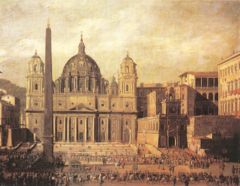
There is a significant obelisk (at top, above) that is tied to the specific location of the death warning to Caesar. It is sited in Rome, in Saint Peter's Square, supposedly on the exact spot where Julius Caesar was told by the soothsayer of the date on which he would be killed.

"An English prelate who traveled to Rome at the beginning of the fourteenth century, Master Gregorius, found the last obelisk still standing up against the walls of Saint Peter's Basilica, in a dark alley flanked by crumbling old houses....Gregorius was captivated by the tradition that the bronze ball on the top of the obelisk contained the ashes of Julius Caesar....Gregorius passed on the story that the obelisk had been raised on the exact spot where Caesar, on the way to the Capitol, had been accosted by an astrologer who warned him he would be killed on the ides of March," from The Magic of Obelisks by Peter Tompkins, New York: Harper & Row, 1981, page 17.

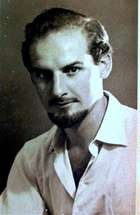
Peter Tompkins

(Peter Tompkins, pictured above as a young man, was a wonderfully textured individual, a former Office of Strategic Services agent who would go on to write scholarly researched books about occult matters. The most famous and successful is The Secret Life of Plants. Tompkins only recently died, on January 24, 2007. See his obituary here.)

The obelisk today is called Vaticano. It began first as an ancient Egyptian obelisk (they were erected in twos). In this one's first known Roman move, it was originally raised in the Forum Iulium in Alexandria by the Prefect Cornelius Gallus on Octavian's orders around 30-28 BC.

It was brought to Rome by Caligula in 37 for the spina of the Vatican Circus. Relocated by Pope Sixtus V in 1586 using a method devised by Domenico Fontana; the first monumental obelisk raised in the modern period, it is the only obelisk in Rome that has not toppled since Roman times. As noted, during the Middle Ages, the gilt ball on top of the obelisk was believed to contain the ashes of Julius Caesar. Fontana later removed the ancient metal ball, now in a Rome museum, that stood atop the obelisk and found only dust.

Today, this authentic Egyptian obelisk is one of only a few* left in the world.

Obelisks are tied to Egypt and Masonic importance, sexual magick and death, and more. I will speak of them further in the future. For this temporal moment, I merely wanted to share the visual impact they leave.

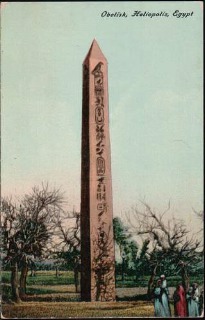
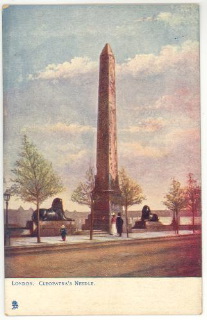
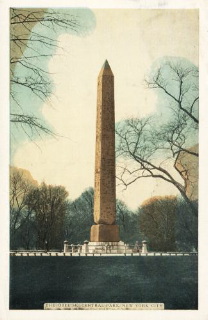
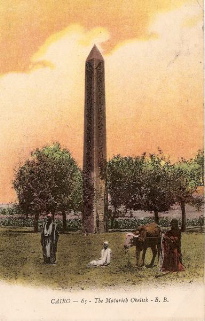
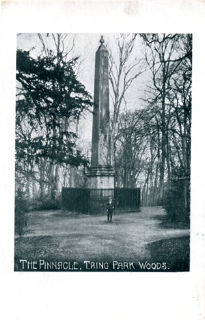
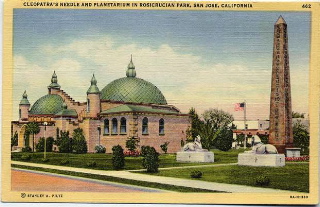
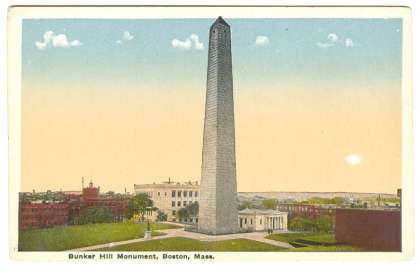
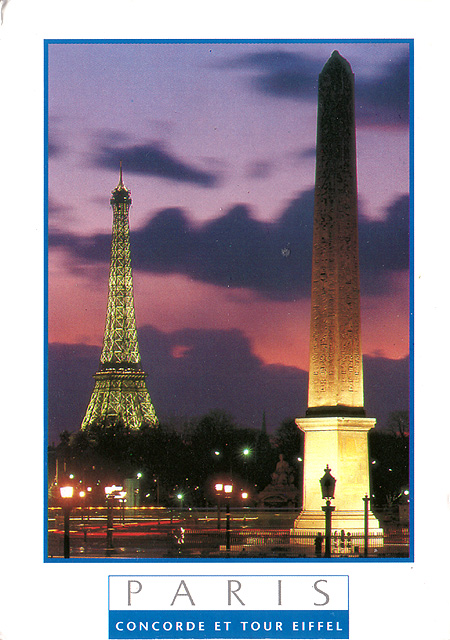
For March 15th, here's a vintage postcard tour of some of the mystical obelisks of various types, from around the globe.

Deploy. Wonder.

Enjoy. Ponder.


Obelisk, Heliopolis, Egypt


Cleopatra's Needle, London, United Kingdom


Cleopatra's Needle, New York, New York


Obelisk, Cairo, Egypt


Tring Park Pinnacle, Rothschilds' Vale of Aylesbury, United Kingdom


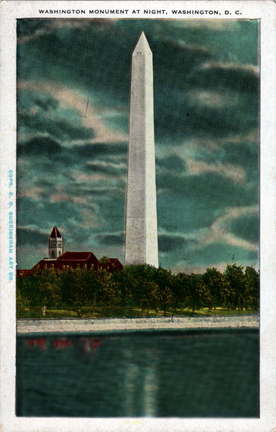
Washington Monument, Washington, D.C.


Cleopatra's Needle, Rosicrucian Park, San Jose, California


Bunker Hill Monument, Charlestown, Massachusetts


La Tour Eiffel vue depuis l'Obélisque, place de la Concorde, Paris, France

+++++++
*Footnote:

There are 29 ancient Egyptian obelisks in the following locations:

Egypt – 9
Pharaoh Tuthmosis I, Karnak Temple, Luxor
Pharaoh Ramses II, Luxor Temple
Pharaoh Hatshepsut, Karnak Temple, Luxor
Pharaoh Senusret I, Al-Masalla area of Al-Matariyyah district in Heliopolis, Cairo
Pharaoh Ramses III, Luxor Museum
Pharaoh Ramses II, Gezira Island, Cairo, 20.4 m
Pharaoh Ramses II, Cairo International Airport, 16.97 m
Pharaoh Seti II, Karnak Temple, Luxor, 7 m
Pharaoh Senusret I, Faiyum (ancient site of Crocodilopolis), 12.9 m

France – 1
Pharaoh Ramses II, in Place de la Concorde, Paris

Israel – 1
Caesarea obelisk

Italy – 11 (includes the only one located in the Vatican City)
8 in Rome (see Obelisks in Rome)
Piazza del Duomo, Catania (Sicily)
Boboli Gardens (Florence)
Urbino

Poland – 1
Ramses II, Poznań Archaeological Museum, Poznań (on loan from Ägyptisches Museum und Papyrussammlung, Berlin)

Turkey – 1
Pharaoh Tuthmosis III, in Square of Horses, Istanbul

United Kingdom – 4
Pharaoh Tuthmosis III, "Cleopatra's Needle", on Victoria Embankment, London
Pharaoh Amenhotep II, in the Oriental Museum, University of Durham
Pharaoh Ptolemy IX, Philae Obelisk, at Kingston Lacy, near Wimborne Minster, Dorset
Pharaoh Nectanebo II, British Museum, London

United States – 1
Pharaoh Tuthmosis III, "Cleopatra's Needle", in Central Park, New York


++++