Showing posts with label Dutch. Show all posts

Monday, March 18, 2019

Terrorist Attack on Utrecht Tram Leaves Three Dead


On Monday, March 18, 2019, a suspected Turkish-born terrorist killed three tram passengers and injured five others in Utrecht, the Netherlands.

The alleged man-of-interest has been identified by the Utrecht Police as Gokmen Tanis, 37.


Local news media quoted witnesses who said there were multiple gunmen involved in the shooting, which took place at 24 October Square, but the police did not comment on the number of attackers.

The attack took place in the Kanaleneiland neighborhood, which is home to a large Muslim community, largely Moroccan and Turkish. It was not clear whether that influenced the decision of the gunman to open fire when and where he did.

The historical significant of "October 24" in Utrecht does relate to the fact the United Nations was established on October 24, 1945. Theo Paijmans mentions that one of the streets leading to the square is named Weg der Verenigde Naties (Street of the United Nations).

The story of this being a terrorist is falling apart, or at least convoluted.

Some news accounts are mentioning that Gokmen Tanis has a long history of previous charges, including recent ones of rape and manslaughter. This specific incident involved his targeting a relative (his sister-in-law?) and then shooting three nearby individuals dead.

One Turkish BBC journalist claims that Tanis fought in Chechnya, and another said he shouted "Allah is great!"

Other reports continue to indicate there may have been more than one gunman.

Late in the day, Tanis was arrested.


Wednesday, May 15, 2013

Dutch Clown Stabs Russian Boy On Crete: UPDATED


On the island of Crete in Hersonissos, a violent fierce attack by a Dutch hotel clown was made against a Russian family's child.

As you may recall, earlier in 2013, three Dutch clowns beat a boy at the Dutch city of Volendam's clown festivities (which involves over 200 clowns) in January.

In Crete, according to the forensic findings the child, aged 11 years, was stabbed 20 times in the chest, back and left arm. No sexual abuse was found.


Police authorities have arrested a 20-year-old Dutch hotel employee, who allegedly has confessed that he is the perpetrator of the attack on the minor. He was the hotel's clown.


Here are some of the photographs of the suspect from European newspapers. On his back is a tattoo with the words, "Vatos Locos."

Vatos Locos (in English, Crazy Dudes) is a widely used name for a street gang. Gangs using this name are active in several American states. The film Blood in, Blood out (1993) about the life of poet Jimmy Santiago Baca in 1972, was based on the experiences of gang members of Vatos Locos. The video game Call of Juarez: The Cartel features a fictional Vatos Locos gang.

The 11 year-old lost his cellphone and laptop, went searching for them, and then was lost. His parents, who had been looking for their child, did not find him until 3:00 AM in the hotel parking garage.

After a lengthy police interrogation, the young Dutch hotel clown reportedly confessed he stabbed the kid and directed the police to where the knife could be found.

The child is of Russian origin and is with his family in Crete for a holiday. 


Hersonissos (Greek: Χερσόνησος, pronounced [xerˈsonisos] - Chersónisos), also transliterated as Chersonisos and Hersónisos, is a town and a municipality in the north of Crete, bordering the Mediterranean/Aegean Sea. The vicinity of Hersonissos is noted for its prehistoric archaeological finds. On the coast approximately one kilometer to the east of Hersonissos was an ancient temple dedicated to the goddess Britomartis.

Britomartis (Βριτόμαρτις) was the Minoan goddess of mountains and hunting. She is among the Minoan goddess figures that passed through the Mycenaeans' culture into classical Greek mythology, with transformations that are unclear in both transferrals. For the Greeks Britomartis (Cretan dialect for "sweet maiden", "sweet virgin") or Diktynna (derived by Hellenistic writers as from diktya, "hunting nets") was a mountain nymph (an oread) whom Greeks recognized also in Artemis and in Aphaea, the "invisible" patroness of Aegina.
Britomartis ("sweet maid") is an epithet that does not reveal the goddess's name, nor her character, for it has the ring of an apotropaic euphemism. The goddess addressed as "Britomartis" was worshipped in Crete as an aspect of Potnia, the "Mistress." The oldest aspect of the Cretan goddess was as Mother of Mountains, who appears on Minoan seals with the demonic features of a Gorgon, accompanied by the double-axes of power and gripping divine snakes. Her terror-inspiring aspect was softened by calling her Britomartis, the "good virgin," a euphemism to allay her dangerous aspect.
Britomart figures in Edmund Spenser's knightly epic The Faerie Queene, where she is an allegorical figure of the virgin Knight of Chastity, representing English virtue—in particular, English military power—through a folk etymology that associated Brit-, as in Briton, with Martis, here thought of as "of Mars," the Roman war god. In Spenser's allegory, Britomart connotes the Virgin Queen, Elizabeth I of England.
In his retelling of the King Arthur legends, Arthur Rex, author Thomas Berger suggests that Queen Guinevere may have become a powerful female knight known as Britomart after the death of the King.
Source.

BTW, media sources are also reporting the attack occurred in the "seaside town of Anissaras" and "in Iraklio, Crete." 

"Anissaras" is a hilly area in east Crete just outside of Hersonissos. "Iraklio" is another spelling for Heraklion, or Heraclion, where the famed ruins of Knossos were excavated and restored by Arthur Evans. English usage formerly preferred the classicizing transliterations "Heraklion" or "Heraclion," but the form "Iraklion" is becoming more common.


(Thanks to Thanassis V. for the news account information on this breaking story.)

Monday, January 14, 2013

Dutch Clowns Attack


In the Dutch city of Volendam three clowns have beaten up a boy at the local clown festivities (which involves over 200 clowns) over weekend.

The boy was taken to the local hospital. The clowns disappeared and were not caught. Source.

The three phantom clowns also damaged the Bassie & Adriaan caravan (above, in the photograph). 

Volendam (Vollendam means "filled dam") is a town in North Holland in the Netherlands, in the municipality of Edam-Volendam (about 23,000 people). The Netherlands is Dutch (Nederland), meaning the "Low Countries" or "Low Country." The name "Holland" is a province of Netherlands; the names Holland and Netherlands are not interchangeable.


Bassie & Adriaan were a Dutch circus duo who starred in their own television series. Bassie is a ginger-haired red-nosed clown who wears a red tartan-jacket and green trousers; he's fond of cream-cakes, and calls himself "stupid, but not smart." His circus friend was named Adriaan.

You will recall there have been recent 2012-2013 stories of attacks by Leprechauns in the USA, Oompa Loompas in the UK, and Smurfs bashing a man in Australia.

For more on "Phantom Clowns," see Mysterious America (NY: Simon and Schuster, 2006). For more on symbolic criminal behavior, see The Copycat Effect (NY: Simon and Schuster, 2004). This blog has noted other evil clown activity, including incidents and listings, such as a report for 2012, one for 2011, another grouping for 2009, and a top ten list for 2008.

Thanks to Theo Paijmans for the news tip.

Saturday, May 09, 2009

De Naald Attack: 8th Person Dies

An eighth person has died in the wake of the assassination attempt on the Dutch Royal Family. (See here for full details on the attack.)


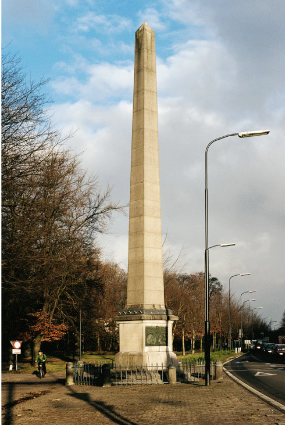
De Naald (in English The Needle), is the obelisk monument in the Dutch city of Apeldoorn that became the final resting place for Karst Tates' automobile.

A woman died of her injuries more than a week after a man plowed his car into a crowd during a parade, becoming the seventh victim of a failed attack (#8 when the attacker is counted) on the Dutch royal family, authorities said Saturday, May 9, 2009.

The 46-year-old woman, whose identity was not released, was among about a dozen people struck down in the April 30 attack. Apeldoorn municipality spokesman Toon Schuiling said she died Friday night, May 8, 2009, in a hospital, the same evening as more than 1,000 people gathered for a memorial service.

Five bystanders died on the day of the April 30 attack near Het Loo palace in Apeldoorn and another died the following day. The car's driver also died. Four other people remain hospitalized.

The car rammed into a stone monument (the Masonic structure pictured above) after speeding through the crowd, narrowly missing an open-topped bus carrying Queen Beatrix and other royal family members.

Police say the car's driver, identified by Dutch media as Karst Tates, admitted attempting to attack the popular monarch shortly after his car came to a halt. He did not give a motive.

The attack on the Queen's Day national holiday raised questions in the Netherlands about the level of security surrounding the royal family.

For more on the symbolic linkages, copycat evidence, and video concerning this attack, please click here.