Friday, November 28, 2008

India's 911: Synchronicity and Coincidence in Mumbai

Astrology and a murdered astrologer. Synchronicity and a Synchronicity Foundation. An actor who had played a terrorist bomber was in the midst of one of the first waves of Mumbai attacks. One of the first people killed was the chief of the Mumbai police's anti-terror squad.

Synchronicity is the coincidental occurrence of events that seem related but are not explained by conventional mechanisms of causality. As we look more closely at the attacks in Mumbai, India, how does one separate the human planning from the synchronicity that apparently underlies these events?

The events will reveal many "coincidences" as the attacks are charted and deconstructed.
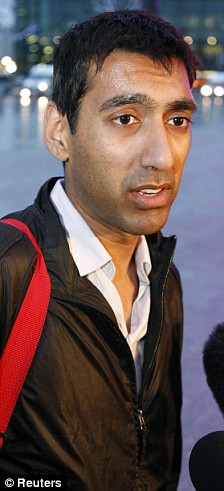


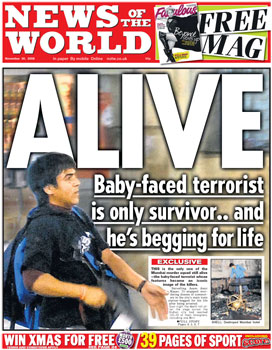
How does an actor who played a terrorist bomber find himself in the midst of a terrorist attack? Daily Mail photo, above.
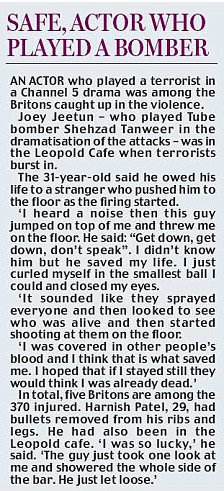


Where, who, why?
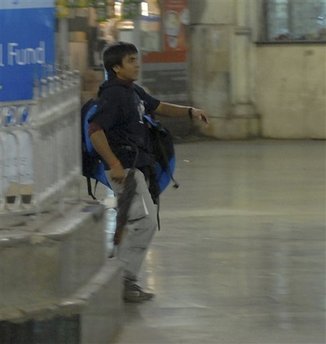


A gunman enters the Chatrapathi Sivaji Terminal railway station in Mumbai, India, Wednesday, November 26, 2008, opening AK-47 gunfire and throwing hand genades, killing at least ten people immediately, including three railway officials. Teams of gunmen in coordinated attacks, storm luxury hotels, a popular restaurant, hospitals and a crowded train station across India's financial capital, killing people, taking Westerners hostage and leaving parts of the city under siege for three days. (Mumbai Mirror, Sebastian D'souza)

Before even an attempt at "why," first let's get straight to the "where" of the attacks. What sites have been hit? Of ten reported, these are the known targets:

1) South Mumbai Police Headquarters;
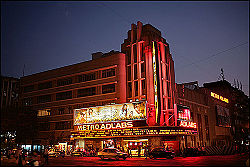


2) Metro Adlabs cinema (historic Art Deco movie theater; Mumbai is the center of the Bollywood film industry);

3) Chhatrapati Shivaji Terminus (railway station);

4) Cafe Leopold (a major tourist center in Mumbai's Colaba area);

5) Nariman House, site of the Chabad Lubavitch Centre (Jewish center);
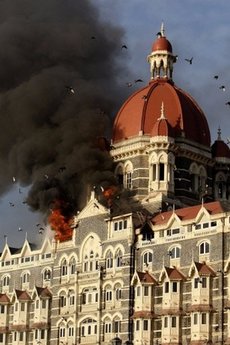


6) Taj Mahal Palace and Tower hotel (above, a castle-like 1903 landmark, across from the Gateway of India monument);

7) Oberoi-Trident Hotel (five star hotel used by foreigners, such as former guests Rupert Murdoch and Bill Gates);

8) Cama Hospital;

9) Vile Parle suburb, North Mumbai; and

10) Mazagaon docks.

It has also been reported that, "Low-intensity blasts were reported in Vile Parle and a grenade attack in Santa Cruz. Two blasts were reported in the Nepean Sea Road area of south Mumbai. Local Mumbai Suburban Railway trains on the Western Railway are running, whereas those of the Central Railway are suspended. More blasts were reported at the Oberoi as the siege continued. Meanwhile, police seized a boat filled with arms and explosives anchored at Mazgaon dock off Mumbai harbour."

I have privately been noting to associates that I think probably eleven sites were actually attacked, not ten. The twilight language use of "11" has been very significant in the history of such terrorist attacks, and sends a message to other founders. (Noted researcher Brad Steiger, "I will swear that the first announcement that I heard regarding the attacks stated that eleven locations had been hit." But even though his wife said she heard ten "10" all other mentions told of "10," Steiger still is certain he heard "11.")

The July 11, 2006 Mumbai train bombings were a series of seven bomb blasts that took place over a period of 11 minutes on the Suburban Railway in Mumbai, killing 209 people and injuring over 700. The reason the 2008 attacks are being called "India's 911" versus the 2006 attacks is due to the 2008 Mumbai's coordinated multi-attacks at several sites, the destruction occurring, the individuals killed, and, for the terrorists, the great media impact they were able to deliver. Media attention is very much a motivation for terrorists, and the wall-to-wall cable news coverage for over three days in the West was a goal, no doubt.
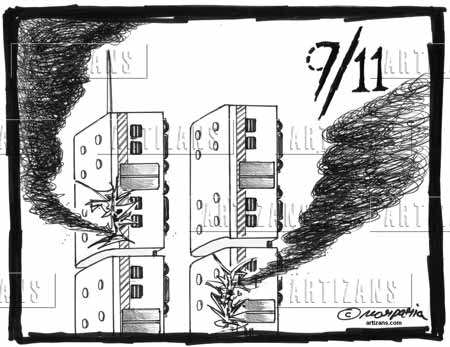


This is how artist Hemant Morparia remembered the earlier 7/11/2006 attacks on Mumbai. He entitled his work, "Mumbai's 9/11."

The site, The Daily Behemoth took a look at the name game apparent with "Mumbai.":

Its present name of Mumbai- used, formally, since 1996, and informally for many centuries before that by speakers of Gujarati- is combined from the local goddess Mumba, and a word meaning 'mother', 'Aai'.

According to Wikipedia, Mumba was the patron of the original inhabitants of the seven islands, the salt collectors and fisherfolk; and is still deeply venerated in the city's seventeenth-century Mumba Devi Temple.

Most intriguingly, Mumba is depicted inside the temple as a black stone sculpture: evoking obvious comparisons not only to the Black Madonnas of Templar-infused Catholicism and Isis, but to the origins of Islam in the pagan worship of the Kaaba at Mecca (a word related to Cybele.) Devi is a Sanskrit word, synonymous with Shakti, the female aspect of the divine.


Other insights can be gained by reading about the "Trident" name at Through the Looking Glass, where Todd Campbell points to the iconic "Indian trident or Trishula of the Goddess Shiva,"linked to the name of one of the major hotels attacked.

Also the astrology of the events is examined at Etemenanki. Indeed, Etemenanki has posted an elaborate astrological precusor chart (below) linking the time and space to the sites of India and Indiana, and a couple opposing temporal points on the calendar. (Bizarrely, on Friday, November 28, 2008, Indiana was in the news again, when five deer jumped off an interstate highway.)



Who are the victims? (Piles of bodies were found Friday after commandos stormed the Taj Mahal Palace hotel, the last of three buildings that terrorists had occupied in the city. The death toll may be close to 300 killed, who were mostly Indians.)

Gunmen who burst into the Taj "were targeting foreigners. They kept shouting: `Who has U.S. or U.K. passports?'" said Ashok Patel, a British citizen who fled from the hotel.

Authorities believed many foreigners were prisoners at the Taj Mahal hotel.

Early reports on Wednesday night indicated at least three top Indian police officers — including the chief of the anti-terror squad — were among those killed. Indeed, most media accounts mention Hemant Karkare, the chief of the Mumbai police's anti-terror squad as one of the first people killed. These individuals were one of the first targets, apparently.

Officials at Bombay Hospital, speaking on condition of anonymity, said a Japanese man had died there and nine Europeans were admitted, three of them in critical condition with gunshot wounds. All were brought in from the Taj Mahal hotel, the officials said.

Brooke Satchwell, an Australian actress who starred in the television soap Neighbours, said she narrowly escaped the gunmen by hiding in a bathroom cupboard at the Taj, where she was staying for a film shoot.

Only a little news is slowly being released on the victims, with, of course, the Americans being noted by the American press.

Who are the known Americans killed in Mumbai?

Rabbi Gavriel Noach Holtzberg, 29, and his wife, Rivkah, 28, died in the attack on the ultra-Orthodox Chabad-Lubavitch movement's center in Mumbai, Rabbi Zalman Shmotkin said in New York. Their son, Moshe, was rescued by a brave staff member who had earlier been able to flee with the baby.

The group said three other victims in the building apparently had been visiting there. Shmotkin said the dead included Bentzion Chroman, an Israeli with dual U.S. citizenship; Rabbi Leibish Teitlebaum, an American from Brooklyn; and an Israeli woman whose name was not released. The Israeli Foreign Ministry said the body of a fourth victim, an unidentified woman, was also found inside the five-story building.

Some of the victims had been bound.

Two other American individuals have been identified as Alan Scherr, 58, and his daughter Naomi, 13, both there on a spiritual trip with a group called the Synchronicity Foundation. Alan Scherr was a Vedic astrologer.

According to the foundation's Web site, the community is led by Master Charles, a former leading disciple of Swami Paramahansa Muktananda. He is described on the Web site as "one of the most popular spiritual teachers from India to build a following [in] the West in the 1970s." He taught a form of yoga.

The Washington Post says this about the Scherrs:
Twelve years ago, Alan Scherr committed his life to meditation and spirituality, moving his family to the Synchronicity spiritual community in Faber, Va., about 30 miles southwest of Charlottesville in the Blue Ridge mountains.

It was that spiritual journey that led the former art professor at the University of Maryland to be in Mumbai Wednesday evening, eating a late dinner with his 13-year-old daughter at the Oberoi Hotel, when armed gunmen attacked. Both Alan and Naomi Scherr were killed. Local media had reported that they were killed at the historic Leopold Cafe, but U.S. officials later said that the two died at the Oberoi.

The Scherrs were among 25 participants from the Synchronicity community who had traveled to a program in Mumbai. Four other members of the group were injured in the shooting, the Associated Press reported.

According to a statement put out by Synchronicity this morning, Scherr, 58, and his wife, Kia, had been part of the community since the 1990s. Kia Scherr and the couple's other children had not traveled to India on the spiritual mission, the AP reported.

"Alan committed most of his adult life to meditation, spirituality and conscious living," the statement from Synchronicity said. "He was a passionate Vedic astrologer and meditation teacher who inspired many people to begin a journey of self-awareness and meditation. He was committed to making a positive difference in the world and devoted himself to the community he lived in."

The Synchronicity statement described Naomi as "a bright and lively young woman who loved spending time with people and living life to the fullest. She was passionate, if not a little mischievous, and will be fondly remembered by many of us for colorful hair styles and radiant energy."

In an essay in the Web magazine Realization in 2000, Alan Scherr described his journey from college professor and follower of Eastern meditation to a member and full-time staff member of the Synchronicity community, led by Master Charles, described as a contemporary mystic and master of meditation.

After listening to Master Charles speak in 1994, Scherr wrote, he and his wife decided to join the community, which promotes high-tech meditation and a holistic lifestyle. They moved to Faber in 1996.

"For me, real freedom means living life in each moment, as it unfolds, without concepts or conditions." Scherr wrote. "It is a life very few choose because it requires an orientation and re-prioritization of life that is, in many ways, antithetical to our modern Western culture. And yet, it is always available whenever one is truly focused upon self-mastery. The miracle of this life continues to unfold for me on daily basis."

Bobbie Garvey, a Synchronicity spokesperson, told the Associated Press that other members of the mission narrowly escaped the armed attack.

Garvey identified those from the group who were injured in the shooting as Helen Connolly of Toronto, who was grazed by a bullet; Rudrani Devi and Linda Ragsdale, both of Nashville, who both underwent surgery for bullet wounds; and Michael Rudder of Montreal, who remains in intensive care after being shot three times. Other members of the mission narrowly escaped the attack.


The Baltimore Sun also noted:

"I would call them bright stars," said Bobbie Garvey, a spokeswoman for the Synchronicity Foundation meditation group, of the Scherrs. "Extraordinary, bright, very positive -- examples to the world."

The Scherrs had lived at the foundation all of Naomi's life, Garvey said. Alan Scherr's wife, Kia, and her two sons did not travel with them to India.


One captured individual (pictured widely from the train station attack), Azam Amir Kasav, a 21 year old terrorist, has told authorities that the terrorists arrived at Mumbai from Karachi via Porbandar. He reportedly said that he and other terrorists had received automatic loading revolvers, AK-57, bullet magazines and dry fruits from their coordinator.

Azam confessed to the police that they wanted to replicate the attack that destroyed the packed Marriott Hotel in the city of Islamabad, Pakistan, on September 20, 2008, and reduce the Taj Hotel to rubbles, replicating the 9/11 attacks in India. Pakistan's Human Rights Minister Farooq H. Naek said after the Islamabad attack: "This is 9/11 of Pakistan."
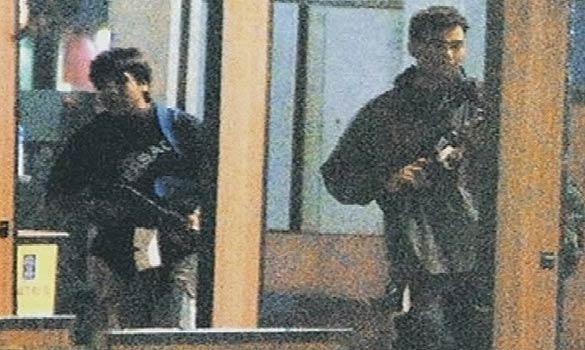


Azam melted in with the crowds, and reportedly wore an innocent looking "Versa" shirt, according to one reporter. Or did it say "Universal"? Probably it does refer to "Versace," as suggested by Todd, which is an Italian fashion label founded by Gianni Versace in 1978. Gianni Versace was killed by serial killer Andrew Cunanan on July 15, 1997.



The Versace logo does appear to be the "innocent" icon visible on Azam's shirt.



The television coverage appeared unreal, at times. The violent movies of Hollywood seemed to be playing out in reality on the same streets that gives us Bollywood, where violence like it is not part of their scripts.


********
Update: Some of the well-known victims have begun to be identified.

Ashok Kapur, chairman of Yes Bank, was killed at Oberoi Hotel (attacked in dining area, but found dead on the 19th floor).

Bollywood actor Ashish Chowdhury's sister, Monica Chhabaria, and her husband were killed at the Oberoi. Chowdhury has appeared in numerous Indian films. According to the Indian media, he reportedly had a small role in the U.S. film Fight Club, starring Brad Pitt. But this is incorrect. Pitt's Fight Club was a 1999 film. Chowdhury's Fight Club: Members Only was a 2006 movie, according to the IMDBb

The body of Sabina Sehgal Saikia, a Times of India consulting editor and food critic, was recovered from the Taj hotel.

Boris Rego, a management trainee at the Taj Mahal hotel, was killed in the hotel's restaurant when gunmen barged in and opened fire.

The Taj hotel's general manager lost his family in a fire that broke out in the hotel Wednesday night. The bodies of Karambir Kang's wife and two children were burned beyond recognition in the fire, but it was unclear whether they were killed in the blaze.

A military funeral was held Saturday in Bangalore for Maj. Sandeep Unnikrishnan, a National Security Guard commando who was killed at the Taj hotel.

The body of another Security Guard officer, Gajendra Singh, was taken to New Delhi before being transported for last rights in his native Dehradun. He was killed at Mumbai's Chabad House, a Jewish community center where American-born rabbi Gavriel Noach Holtzberg and his Israeli wife, Rivka, were killed along with another American rabbi, Leibish Teitelbaum.

As mentioned before, Hemant Karkare, chief of Mumbai's Anti-Terrorism Squad, among 17 police killed.

IBN listed other slain police officers as:
Ashok Kamte (IPS), additional commissioner of police, East Region, Mumbai.
Vijay Salaskar, police inspector, anti-extortion cell, Mumbai.
Shashank Shinde, police inspector, CST Railway Police Station, Mumbai.
Praksh P. More, police sub inspector, LT Marg Police Station
Bapusaheb Durugade, police sub inspector, L.A.1, Naigaon
Tukaram G. Omble, assistant police sub inspector, D.B. Marg Police Station
Balasaheb Bhosale, assistant police sub inspector
Arun Chitte, police constable
Jaywant Patil, police constable
Yogesh Patil, police constable
Ambadas Pawar, police constable
M.C. Chowdhary, police head constable, R.P.F.
Mukesh B. Jadhav, Home Guard constable


Sources: Associated Press, IDN India News, CNN, MSNBC, Synchronicity Foundation, Mumbai Mirror, Times of India, Baltimore Sun, Washington Post, Yahoo News, Through The Looking Glass, and The Daily Behemoth.

Tuesday, November 25, 2008

Coincidence 27


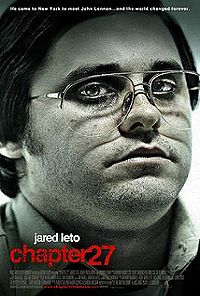
Late in November 2008, Showtime TV began screening the recent movie, Chapter 27. I suppose it is being shown now because its broadcast is tied to the anniversary of the assassination of John Lennon on December 8th. Timing is everything.

The movie has many intriguing moments.

First some background. Chapter 27 is an independent film depicting the murder of John Lennon by Mark David Chapman, starring Jared Leto and Lindsay Lohan. It was written and directed by J. P. Schaefer. Although it premiered at the Sundance Film Festival in January 2007, it did not make it to a release in theaters in the USA until March 2008. It came and went quickly, as they say, because it was a box office failure. It retains its "made for television" docudrama feel, and so, perhaps, it is more fitting I saw it on cable.

The film's title refers to Mark David Chapman's alleged obsession with J.D. Salinger's novel The Catcher in the Rye. The title implies that Chapman's killing of Lennon was a continuation of the book, which only has 26 chapters, and which Chapman was carrying (as his "statement") when he shot Lennon. Chapman appears to have attempted to model (copycat) his life after the novel's anti-hero Holden Caulfield.

According to the December 2007 issue of the British music magazine Mojo and the Spanish language newsweekly Proceso, the film's title was further inspired by Chapter 27 of Robert Rosen's book Nowhere Man: The Final Days of John Lennon. Rosen's book examines the numerological meaning of 27, “the triple 9,” a number of profound importance to John Lennon. Lennon was deeply interested in numerology, particularly via Cheiro’s Book of Numbers, and by the number nine and all its multiples.

Since the movie focussed just on the three days that Mark David Chapman spent in New York City, leading up to Lennon's murder, many significant items in Chapman's life were left out of the film. These included

1) that when young, Chapman fantasized about having God-like power over a group of imaginary "Little People";

2) he worked for the YMCA;

3) he visited Lebanon;

4) he once met and shook hands with President Gerald Ford;

5) he worked in Georgia as a security guard;

6) he traveled extensively, visiting such places as Tokyo, Seoul, Hong Kong, Singapore, Bangkok, Delhi, Israel, Geneva, London, Paris, and Dublin;

7) Chapman got a job as a security guard in Hawaii; and finally,

8) while in Hawaii, he told his "Little People" he intended to go to New York and kill John Lennon and they begged him not to, saying "Please, think of your wife. Please, Mr. President. Think of your mother. Think of yourself." Chapman says he told them his mind was made up, and that their reaction was silence. (Was Chapman's "Little People" the menehune?)


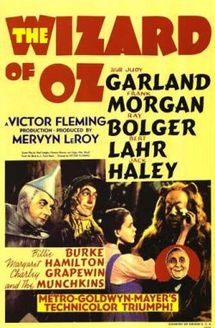
Also, we are shown throughout the movie that Chapman was obsessed by The Wizard of Oz, but not that he thought of himself as "Dorothy Gale."

In Chapter 27, I find the key focal point of the film is an involved sequence about coincidences, shortly after Chapman is made aware that Lennon's new album is called Double Fantasy. (See Todd Campbell's new blog posting on "Double Deception.")


In this scene, Chapman is seen making the links that included,

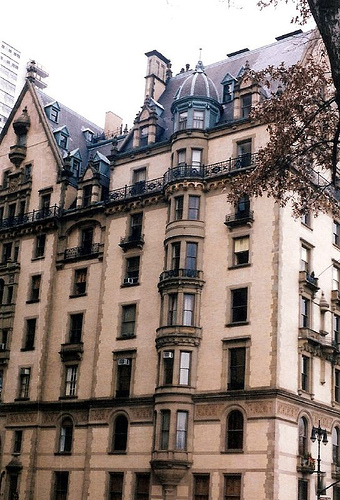
1) the Dakota Building, where Lennon resided, was the site where the movie Rosemary's Baby was filmed;

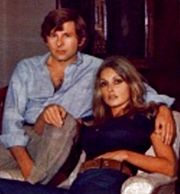
2) that Roman Polanski was the screenwriter and director of Rosemary's Baby;

3) that it was Polanski's pregnant wife, Sharon Tate, who was murdered by Charles Manson and his Family;


4) that the killings were based on Manson's notion of "Helter Skelter," and

5) that Manson based his scenario on John Lennon's song, Helter Skelter.

Did any of this happen? Or is it movie fiction?

Or, perhaps, is this film placing into popular culture the overt dots that can be connected in what happened at the Dakota on December 8, 1980?

Forthcoming showings of Chapter 27 will occur on

Showtime Next, November 28, 2008, at 9:40 AM ET/PT
Showtime Next, November 28, 2008, at 6:30 PM ET/PT
The Movie Channel, December 7, 2008, at 8:00 PM ET/PT
TMC Xtra, December 14, 2008, at 11:15 AM ET/PT

Monday, November 24, 2008

Stock Market Suicides: Update

Will a rash of copycat suicides occur because of graphic wall-to-wall media coverage of future "celebrity suicides" linked to stock market collapses?

Reporter Kyle Martin surveyed this blog, The Copycat Effect, and interviewed me for Sunday's article in Hernando Today, a publication of The Tampa Tribune to attempt to answer this question.


Link Is Shaky Between Suicide And Economy
by Kyle Martin
Hernando Today
November 23, 2008

It's the kind of water cooler theory that has just enough credibility to sound plausible.

As the economy continues to post record losses, it's generally accepted that more people will commit suicide as their 401ks evaporate and unemployment rises.

After all, brokers jumped from windows during the market crash of 1929, right?

Well, yes and no.

Like many rumors, it's necessary to sift through the fiction to find the nuggets of truth that are often the genesis of these stories. First, take a look at the numbers.

Records from the medical examiner's office show there were 20 suicides in Hernando County in 2007. Through Oct. 31 of this year, there were 26.

Without examining each case specifically, there's no way to extrapolate that the deaths were specifically linked to an ailing economy. That leaves anecdotal evidence.

Darlene Linville, president of Hernando County's chapter of the National Alliance on Mental Illness, doesn't overrule the possibility that the economy played a part in recent suicides.

"I think it's pretty obvious that there will be some kind of link," Linville said, but she cautioned that it's hard to determine exactly how far that link extends.

There's global evidence to consider. On Monday, a Brazilian trader in the open outcry pit of Sao Paulo's commodities exchange shot himself in the chest, according to media reports.

In Calcutta, India, a man hanged himself on Nov. 15 with his wife's sari after losing a large amount on the stocks exchange. Also this month, a London investment-fund executive stepped in front of a train in what the local press called the "first City suicide of the credit crunch."

So what about the crash of 1929? Stories of citizens who had lost their fortunes plummeting to their death are exactly that - stories. Between Oct. 24, or "Black Thursday," and the end of the year only four of the 100 suicides or attempted suicides were linked to the crash, according to a contemporary New York Times account.

It seems there were two grisly jumps on Wall Street that kept the myth going, along with quips about hotels asking if their guests wanted their room for "sleeping or jumping."

Investors have since learned to diversify their portfolios so that a stock market crash does not wipe out their entire fortune, as frequently happened in 1929.

Linville said people with existing mental illnesses are particularly susceptible to suicide, especially people suffering from depression and bipolar disorder. But even mentally healthy people can be overwhelmed by a "life stressor," she said.

The economy is one of many stressors that can that lead to suicide, said Tricia Wilmouth, a psychologist with a practice on Citrus Way. But she adds that it's certainly something to be considered.

"People are losing everything, their homes, jobs and retirement," she said. "They're back at ground zero."

Then again, consider that veterans returning from war also have higher than average suicide rates, she said.

Historical studies show that suicides actually decrease during times of national economic and emotional stress, said Loren Coleman, author of the "Copycat Effect."

Coleman's research focuses on the perpetuation of violent acts and suicides, called the copycat effect. School shootings are a classic example of students mimicking their peers.

This cycle has grown stronger with the advent of cable news networks and the Internet, which can keep a story alive for longer periods, Coleman said.

Lately the media has been preoccupied with post-election coverage. But if they start reporting on suicides and the economy then the copycat effect will kick in and it will become a self-fulfilling prophesy, Coleman said.

The same could happen if a major CEO decides to kill himself in a graphic fashion, he added.

When evaluating rumors, "look for trends and rates, as opposed to anecdotal (evidence)," he said.

Although not everyone is on the brink of suicide, the tough times are impacting people in different ways. The amount of people suffering is piquing the collective conscience, said Wilmouth, citing a term coined by psychology pioneer Carl Jung.

That empathy on an unconscious level for the less fortunate is sparking more small acts of kindness, Wilmouth said. She attributes that to people feeling lucky and blessed, but also a touch of guilt.

Wilmouth has also noticed that many people in these tough times are reverting back to their most recent bad habit.

"Everyone is trying to find a moment of peace and serenity and it's real hard to find these days," Wilmouth said.

Monday, November 17, 2008

Suicide Attempt at Brazilian Exchange; Suicides in India & Korea

Reuters is reporting that a Brazilian trader shot himself on Monday, November 17th, in the open outcry pit of Sao Paulo's commodities and futures exchange in an apparent suicide attempt. Trading was halted for a few minutes after the shot was fired on Monday, right before the regularly scheduled closing time.

Paulo Sergio Silva, 36, a trader for the brokerage arm of Brazilian banking giant Itau (ITAU4.SA: Quote, Profile, Research, Stock Buzz), shot himself in the chest during the afternoon trading session, the exchange said, and hospital staff said he was in critical condition.

Silva was given first aid on the scene before being transported to the hospital, BM&F Bovespa SA (BVMF3.SA: Quote, Profile, Research, Stock Buzz), which operates the exchange, said in a statement without providing further details.

Traders said the incident happened in the interest rate futures pit, a raucous circle where on average $21 billion worth of contracts exchange hands every day.

Brazil's financial markets have taken a pounding in recent months as the global credit crunch has spread, causing massive losses for investors and companies alike.

Brazil's main stock index, the Bovespa .BVSP, has plunged more than 50 percent since hitting an all-time high in late May. The local currency, the real BRBY, has shed a third of its value since touching a nine-year high in early August.

Meanwhile, in India, The Telegraph of Calcutta has reported on a Gurgaon beverage dealer, apparently staggering under the weight of stock losses, who has died by suicide after leaving behind a note donating his eyes.

Rajendra Gupta, in his late 30s, hanged himself from the ceiling with his wife’s sari on Saturday night, November 15th, at his home in the Helimandi police station area of Gurgaon, near Delhi.

It isn’t clear how much money Gupta lost in the market crash but police said he had started investing in shares a few months ago, hoping to boost his earnings.

In his suicide note, Gupta, father of two kids, said he was unable to bear the huge losses following the crash.

“My last request to my family is to donate my eyes,” he wrote.

A police officer said it was possible Gupta had taken loans to invest and was finding it difficult to repay them.

Since the family accepted his request to donate his eyes, a civil hospital doctor removed them and conducted the post-mortem,” sub-inspector Hawa Singh of Helimandi police station said over the phone from Gurgaon.

Gupta’s soft drinks agency on Gurgaon’s Pataudi Road was said to be doing well, which has left his family struggling to understand what drove him to risk investing in stocks.

Stock market related suicides are being reported in Korea, as well. The gloomy stock market in South Korea has begun to claim victims with investors committing suicide after losing money in the recent series of crashes.

According to police reports, a 47-year-old man from Gwangju who suffered serious depression after huge losses on the stock market, died by suicide on October 25, 2008.

He invested 370 million won after taking out a mortgage on his house and using his life insurance as security for the loan two years ago, but the recent financial recession resulted in him losing about 60 percent of his total investment.

"When the nation's stock market index fell below 1,000 [earlier in October], he stopped eating and went on a drinking binge for days and finally decided to kill himself,'' his wife was quoted as saying to police.

On the same day, a couple in their 60s from Busan were saved by police during their suicide attempt.

They borrowed 100 million won from a security company last year and invested 130 million won on the stock market. But they lost most of the money in the recent crashes.

On Oct. 22, a 42-year-old branch manager of an insurance company was found dead in an apparent suicide on a mountain in Gongju, South Chungcheong Province. Police believe that he killed himself due to concerns over losses his firm recorded with various insurance products.

On Oct. 9, a 32-year-old employee from a security firm was found hanging at an inn in Seoul, which police claimed was also related to the stock market crash.

In the United Kingdom, rumblings about the "first" market crash suicide are still in the papers.

On a mild Thursday morning in late September 2008, Kirk Stephenson, a London investment-fund executive, ate breakfast with his wife and eight-year-old son, then drove to a train station about 30 miles from his Chelsea home.

As an express train approached, Mr. Stephenson stepped onto the tracks, according to British Transport Police. The driver applied emergency brakes but couldn't stop in time. Mr. Stephenson, 47 years old, died at the scene.


...wrote Ianthe Jeanne Dugan and Cassell Bryan-Low in the article "In a Suicide, Crisis and Life Cross," published in the November 15, 2008 issue of The Wall Street Journal.

Nick Cohen of London's Observer on November 9th, noted:

The Buckinghamshire coroner has yet to hear the case of Kirk Stephenson, but Fleet Street already knows why he threw himself in front of an express train. He was the "first City suicide of the credit crunch" (the Mirror). His death "evokes memories of the 1929 Wall Street crash" (the Mail).


(Reuters reporting by Daniela Machado and Filipe Pacheco, writing by Todd Benson; editing by Eric Beech; unnamed correspondent in India; Kim Tae-jong in Korea.)

Saturday, November 15, 2008

Jonestown, Harvey Milk, and George Moscone

Few realize that the massacre at Jonestown is related to the assassinations of Harvey Milk and George Moscone, and to the murders of others more obviously linked to the People's Temple cult.

In the following excerpt from The Copycat Effect, the ripples from this 30 year old tragedy are examined and these dots are connected.


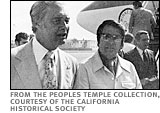
George Moscone, Jim Jones, and Walter Mondale (above).

Jonestown

One of the most discussed modern mass suicides occurred in the unique setting of Jonestown, Guyana.

Jonestown in the early 1970s was little more than a nine‑hundred acre island cut out of the thick South American rainforest. It was there that the Reverend James Warren “Jim” Jones relocated his People's Temple from the San Francisco area. Allegations were first published in the Guyana Daily Mirror that Jonestown was a “concentration camp” in which Jones’s flock were given psychotropic drugs, sexually abused, sleep deprived, and forced to work 18 hour days. Former members told of drills, called “white nights,” in which middle-of-the-night sirens called members to a line up where they were told they were going to have to take a poison.

Jonestown residents became pre-conditioned into expecting a coming invasion of the camp by Russians, the CIA, or other imagined “enemies” by the delusional Jones. In the wake of these claims, the pressure mounted for San Francisco officials to look into the Jonestown “cult.”

On July 26, 1977, San Francisco Mayor George Moscone announced that he would not hold an investigation of Jones. In a letter to President Jimmy Carter, San Francisco Supervisor Harvey Milk defended Jones as a friend to minority communities. But soon, San Francisco family members asked their congressional representative to fly to Jonestown to look into the situation (and hopefully rescue their relatives). This finally occurred with a one-day delegation headed by Congressman Leo Ryan.

On November 18, 1978, supposedly frightened by the investigative visit of Ryan, cult leader Jim Jones ordered Larry Schact, a medical school graduate and designated camp doctor, to prepare a huge cyanide‑laced vat of grape Flavor‑aide.

At the Guyanese airstrip near Jonestown, Jones sent gunmen to ambush Ryan and about 30 newsmen, government aides, and relatives of People's Temple members before they could board their plane for a return to the United States. Ryan, three reporters, and a Jonestown defector were killed, and among the wounded were the area’s alleged CIA's Chief of Station Richard Dwyer, and Ryan aide, Jackie Speier. Later Jones, with armed guards at his side, had his followers drink the potion and kill themselves. Those that refused to take the poison were machine-gunned to death by guards who apparently escaped. Thus some of the Jonestown deaths were indeed murders.

By most counts, the death toll was 913. Initially, the general public could not believe that the news accounts were true, despite widespread press and broadcast attention bringing the details into American living rooms. Media reports about the People’s Temple suicides would drag on for years. (It was not until 1986 that one of Jim Jones's assistants, Larry Layton*, the only person prosecuted for any of the events in and around Jonestown, was convicted for his involvement in the Jonestown incidents and Ryan’s death. Layton was released from custody in April 2002, on parole, after 18 years in prison. Many believed he was an innocent scapegoat.)

As often happens after well-publicized suicides and mass suicides, the copycat effect took the form of follow-up murders. This happened quickly and in spectacular fashion in San Francisco.

Nine days after the Jonestown events, on November 27, 1978, San Francisco Bay Area residents would learn of the assassinations of Mayor Moscone and Supervisor Milk. Law enforcement officials repeated the local rumors that some Bay Area residents believed that Moscone and Milk were murdered by the hauntingly named "White Night" hit squads said to have been sent by the Peoples Temple to avenge Jim Jones. As San Francisco Chronicle reporter Richard Rapaport observed, “When authorities went through the personal effects left behind in San Francisco by Jones, they found a hit list with the names of erstwhile political friends and allies like George Moscone and Willie Brown.”

The Moscone-Milk murders were carried out by a recently resigned former supervisor, Dan White, and were not directly linked to Jim Jones. White had impulsively retired from his position one year after his election and a mere two days after the Jonestown event. A former Vietnam vet, former police officer, and former firefighter, White would often go into trances during supervisors’ meetings and then impulsively goose-step around the room. His past was filled with mystery, including an enigmatic “missing year” of 1972. White’s murderous instability appeared to have been set off by the Jonestown murder-suicides and their link to San Francisco. The Chronicle’s Rapaport noted in 2003: “Part of the connection between the events came through media coverage. Each day between Saturday, Nov. 18, and Monday, Nov. 27, new and terrible video, photos and revelations emanated from the jungle retreat where many former San Franciscans had chosen, been coerced or programmed to join the man they called ‘Father.’”

In 1979 Dan White was found guilty of “manslaughter by diminished capacity,” despite opening arguments by attorney Doug Schmidt that linked Jonestown to the assassinations. Many still believe that the reason White was not convicted of first degree murder was because of what most of the media reported as the “Twinkie defense” – a phrase coined by well-known satirist Paul Krassner - that junk food had made White do it. While it was in reality HoHos and Ding Dongs, White’s defense claimed that his love of junk food was the result of his depression, not the cause of it.

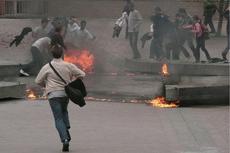
The night the verdict was handed down, on May 21, 1979, the streets around San Francisco, especially near City Hall, erupted in violent protests. They became known, ironically, as the “White Night Riots.” Dan White would only serve five of his seven-year sentence. He was paroled in January 1984, tried exile in Ireland, and then returned to San Francisco despite requests from Mayor Dianne Feinstein (who had succeeded Moscone) not to do so.

On the morning of October 21, 1985, Dan White attached a garden hose to the exhaust pipe of his car, a yellow 1970 Buick Le Sabre, and died by suicide at his San Francisco home. Tom, his brother, discovered the body just before 2 p.m. White had died as an Irish ballad, “The Town I Loved So Well,” played from a cassette player inside the car as it filled with deadly carbon monoxide.

Milk’s less than a month old will requested that his body be cremated, and by his direction, the ashes were enshrined with a mixture of bubble bath (to denote his gay lifestyle) and Kool Aid (to signify the People’s Temple victims). On the 25th anniversary of the assassinations, Milk was remembered as the world’s first openly gay politician to hold office, the subject of the Oscar-winning film, The Life and Times of Harvey Milk, and the focus of operas, plays, and museum exhibits. An elementary school, a civic plaza, a restaurant, a gay cultural institute and a library in San Francisco bear his name, as does a one-of-a-kind high school in New York for gay students who were tormented in mainstream schools.

Milk and Moscone were not the only persons killed in the wake of the People’s Temple suicides and murder-suicides.

In 1980, news accounts told of an alleged People Temple “hit squad,” which were suspected of killing, on February 26, a family of three who had defected in 1975 and testified against the cult. Elmer Mertle (identified in early news accounts under the alias Al Mills), was found shot in the head, lying face down in his bedroom in the family's Berkeley home. The body of his 40-year-old wife Deanna Mertle (also known as Jeannie Mills, author of Six Years with God), also shot in the head with a small-caliber weapon, was discovered on her back in an adjacent bathroom. The couple's 15-year-old daughter, Daphene, was taken to Alta Bates Hospital with two gunshots in the head, and died there later. The Mertles were the founders of Concerned Relatives, and the principal organizers of Ryan's attempt to intervene in the Jonestown cult. Jones called them “white devils.”

Less than a month later, the ripples from the San Francisco murders reached civil rights worker Dennis Sweeney. On March 14, 1980, Sweeney shot seven bullets point-blank into his former friend, Congressman Allard K. Lowenstein, at Lowenstein’s New York City law offices. Activist Lowenstein had marched in the 1964 Freedom Summer in Mississippi, campaigned for Robert F. Kennedy, authored the "Dump Johnson" movement, and ran the National Student Association, which was later revealed to be CIA-subsidized. After the shooting, Sweeney sat down, smoked a cigarette, seemed to be in a trance state, and calmly waited for the police to arrive.

During his trial, Sweeny testified that the CIA (with Lowenstein's help) had implanted a chip in his head 15 years earlier, and he could hear voices transmitted through his dental work. Sweeny blamed CIA “controllers” for his uncle's heart attack and the assassination of San Francisco mayor George Moscone. Sweeney was found not guilty by reason of insanity, and in 2000, was released from a mental hospital in upstate New York. (The media loved the Sweeney-Lowenstein story. Teresa Carpenter even won a Pultizer Prize for her Village Voice exclusive, quoting Sweeney saying that the shooting was a gay lovers’ quarrel. The only trouble was that Carpenter never interviewed Sweeney; she had made the whole thing up.)

Other deaths followed. Joe Mazor, the private detective hired by the Concerned Relatives to persuade people to leave Jonestown, was shot dead a few years after the Mertles/Mills deaths. Walter Rodney, an intellectual and renowned Caribbean scholar born and raised in Guyana, was assassinated there on December 13, 1980, via a bomb-implanted walkie-talkie. Paula Neustel Adams, Jim Jones's top liaison in the upper echelons of the Guyanese government, was murdered in suburban Bethesda, Maryland in October 1983. Her longtime companion, Laurence Mann, Guyana's ambassador to the United States from 1975-81, apparently killed her, their child and then himself, in a murder-suicide. Members of the Jonestown Institute and author Garrett Lambrev have written that many questions remain unanswered about the true extent of all the copycat suicides, murder-suicides, and murders that occurred since the Jonestown massacre.

The specter of Jonestown filled the newspapers for years and produced a made‑for‑television movie called Guyana Tragedy: The Story of Jim Jones (1980), starring the then-new and unknown actor Powers Boothe in a highly acclaimed performance as Jones. The Jonestown event had other broad cultural outcomes besides creating a model for mass suicides. For example, despite the actual use of Flavor-aide, the media had quickly mislabeled what was used as “Kool Aid,” and worldwide sales of Kool Aid crashed. Another lasting linguistic legacy of the People’s Temple tragedy is the expression, “Don’t drink the Kool-Aid.” This has come to mean, “Don’t trust any group you find to be a little on the fanatical side.”

© Loren Coleman 2004 ~ from The Copycat Effect (NY: Simon and Schuster, 2004).

*Please note, Alex Constantine has posted another point of view regarding Larry Layton. He says he was a Nazi, KKK member, and a glassy-eyed mind-controlled agent. "Layton was a member of the military family that actually controlled Jones and the People's Temple," writes Constantine in his blog. You can read his writings to decide if you wish to consider his facts valid and informative.

Wednesday, November 12, 2008

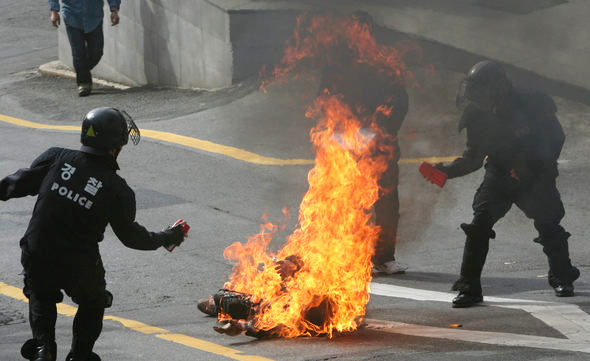
Liberty Square Self-Immolation

A self-immolation of an elder Chinese man has occurred at Taiwan's Liberty Square, the site of a student sit-in on October 7, 2008.

Liu Po-yen, a 79-year-old man, set himself on fire around noon (local time) on November 11, 2008, at the Square and was rushed to NTU, according to the Taipei Police Bureau

The 79-year-old ignited inflammable liquid on his body and he was then soon put out by the police and passers-by. The old man was sent to National Taiwan University Hospital by ambulance, with 90% total body surface area burn and in critical condition.

According to the inspection chief of Chongcheng First Branch, issuing flyers blasting the government at Liberty Square at noon, the old man suddenly set himself on fire. The elder had poured onto himself some inflammable liquid, possibly gasoline or diesel fuel, said the chief.

The fire department received a report at 1:03 pm of an elder citizen self-immolation. While the ambulance arrived, the fire was doused by people nearby and police officers. The victim was immediately rushed to the nearest hospital.

The man left a note in the name of Liu Po-yen (劉柏煙) and burned himself possibly for political reason. He was diagnosed two to three degrees burn and then sent to the burn unit intensive care for subsequent treatment.

According to an Emergency Medicine Department Director, over 10% total body surface area burn was quite serious for an elder person. If over 50%, in addition to the burned areas, other symptoms such as infection, septicemia and breathing problems should also be heeded and the patient’s life may be in critical condition.

Source: Taiwan News

Monday, November 03, 2008

Another Self-Immolation

In the wake of the University of Washington self-immolation, another university-related suicide by fire has occurred on the other side of the country on Halloween. (Also, there is an update on the identity of the UW victim.)

Is there some key to understanding these deaths, based on their dates?

On November 2, 1965, Norman Morrison of Baltimore set himself afire outside the Pentagon office of the Secretary of Defense, Robert McNamara, in direct protest to the Vietnam War. Norman was the executive secretary of a Quaker community in Baltimore, and, according to his wife, appeared to decide on his act after reading an article by a South Vietnamese priest about the bombing of a village there.

A week after Norman Morrison's death, on November 9, 1965, another American Roger A. LaPorte, 21, a member of the Catholic Worker movement, died in a self-immolation protest. Norman sat down in front of the Dag Hammarskjold Library at the United Nations in New York, calmly composed himself in the position of the Buddhist monks who had immolated themselves in Vietnam earlier, doused himself with gasoline, and set himself aflame.

La Porte died the next day from second- and third-degree burns covering 95 percent of his body. Despite his burns, he remained conscious, lucid, clearly able to speak. When asked why he had burned himself, La Porte calmly replied, "I'm a Catholic Worker. I'm against war, all wars. I did this as a religious action." (Credit to cvllelaw of Democratic Central for reawakening me to the anniversaries of these events, detailed in The Copycat Effect. The timing seems more than coincidence but then again, perhaps it only is a temporal accident.)


University of Washington, USA: 2008

Nevertheless, we appear to be going into a new cycle, if even only, hopefully, a short one.

Some new details about the 61-year-old man who died by fire (pictured above) in Red Square at the University of Washington (UW) in Seattle on October 30, 2008, have emerged.

The King County medical examiner's office has identified the 61-year-old man who set himself on fire at the University of Washington campus last Thursday as Nin Soo Chun.

The medical examiner ruled Chun's death a suicide Monday, four days after the former UW worker poured gasoline on himself and set himself ablaze in Red Square during the middle of the day.

Chun died after shortly after being brought to Harborview Medical Center with second- and third-degree burns.

The medical examiner says Chun died from "thermal burns involving 90 percent of total body surface area."

The man had worked for UW Facilities Services for some time, said UW spokesman Norm Arkans. His employment ended in late August, 2008, Arkans said, following a process to release him.

"At the very end, he had stopped coming to work, so a process was initiated to separate him from the university," Arkans said.

Chun had worked as a custodian for the UW's Facilities Services as a custodian from December 2005 to early summer this year. He emigrated to the U.S. from Korea in 1977 and became a naturalized citizen in 1982.

After several "confrontational, but not necessarily physical" altercations with co-workers in June, Chun was reassigned from his usual work site in Padelford Hall.

Soon after these incidents, which Arkans said were enough to make his co-workers "uncomfortable," Chun requested and was granted several weeks' vacation, after which he did not return to work.

The UW tried, unsuccessfully, to contact him throughout the summer. On Aug. 25, when he came to campus to collect his paycheck, he was told he was being fired, and that he had 10 days to seek reinstatement. The UW offered Chun counseling assistance but he did not accept it, Arkans said.

Chun instead filed an unemployment claim with the state, which was denied. Chun appealed the denial at an Oct. 24 hearing, Arkans said.

"The man was clearly a troubled individual, and I think everyone who's encountered this wants to be respectful" of the circumstances surrounding Chun's death, Arkans said. Until the incidents at the beginning of the summer, Chun had been a good employee, Arkans said.


Meanwhile, the day after the self-immolation in Seattle, another university-related suicide by fire occurred in New York State.

A body found burned beyond recognition in a western New York cemetery on Halloween night (October 31, 2008) is believed to be that of a college student who took his own life.

University of Rochester, Rochester, NY, officials sent an e-mail to faculty and students sent early Saturday, November 1, 2008, telling them that while authorities have yet to identify the victim or a cause of death, the apparent self-immolation appears to have been a suicide.

Rochester Police Capt. Lloyd Cuyler says officers responded the historic Mt. Hope Cemetery _ which is adjacent to the campus _ at around 11:50 p.m. Friday, October 31, after receiving a report of a person on fire.

He says they found the scorched male body in a remote section of the cemetery next to a gasoline can and a book bag.
The copycat and behavior contagion nature of self-immolations is well-documented.


Political self-immolations in our media-conscious world, historically began in Vietnam in 1963.

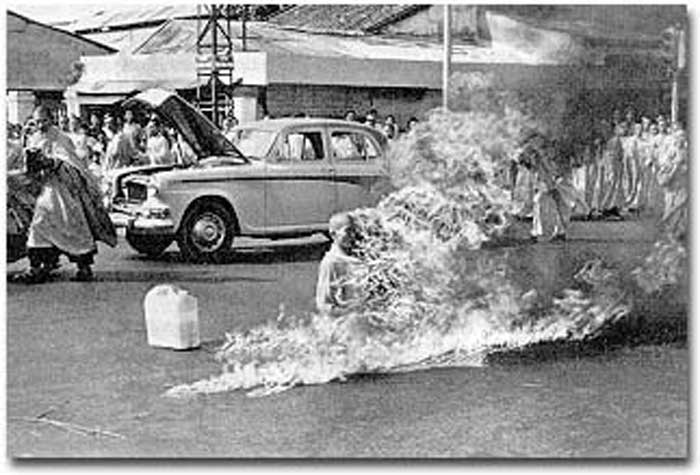
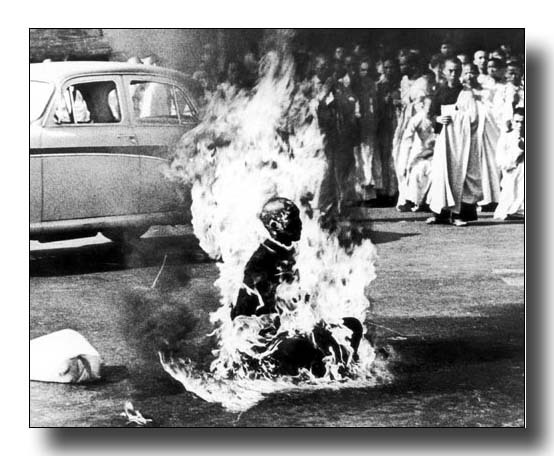
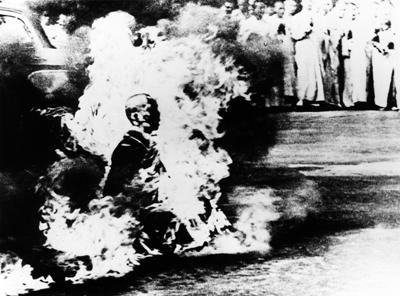
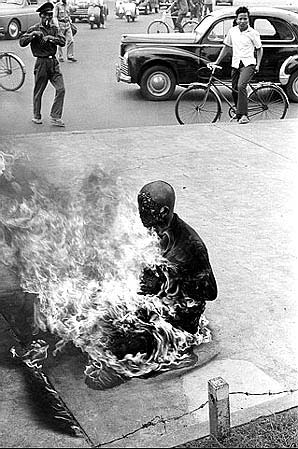
Journalist Malcolm Browne took photographs (below) of Thích Quảng Ðức during his self-immolation. These photographs were so widely disseminated, they became one of the lasting images of the early days of the Vietnam War. Browne won many awards for his photographs of the immolation, including the World Press Photo of the Year (1963) and the Pulitzer Prize for International Reporting (1964).

After Thích Quảng Ðức's death, his body was re-cremated, but his heart remained intact. The heart did not burn. It was considered to be holy and placed in a glass chalice at Xa Loi Pagoda. The intact heart relic is regarded as a symbol of compassion and Thích Quảng Đức has subsequently been revered by Vietnamese Buddhists as a bodhisattva (Bồ Tát) - an enlightened, heroic wisdom-being - and accordingly is often referred to in Vietnamese as Bồ Tát Thích Quảng Đức.


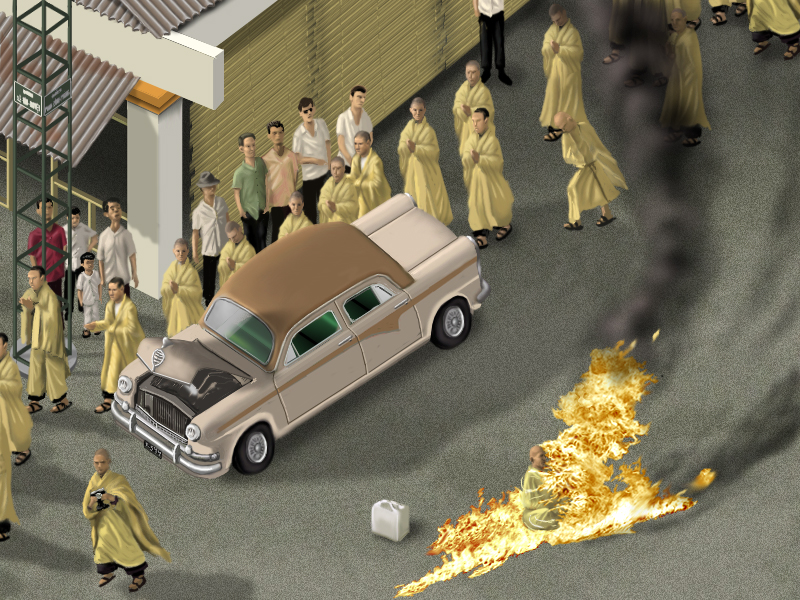
This is a Jon Haddock painting that recreates the Thích Quảng Ðức self-immolation based on Malcolm Browne's photographs.


David Halberstam won a Pulitzer Prize for his written account of Thích Quảng Ðức's fiery protest.


Fiery political suicides continue....


Korea: 2007


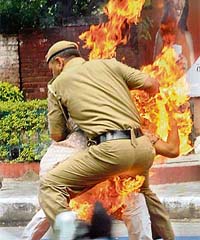
India: 2006

Friday, October 31, 2008

Halloween Hostages in Maine

A gunman, Randall Hofland, 55, who had been on the lam for a week held 11 fifth-graders hostage at a Stockton Springs, Maine, elementary school on Friday, Halloween, October 31, 2008. He was tackled outside a classroom without any harm to the children, police said.

Hofland had released all the students and had turned over a loaded gun to one of the young hostages before he was arrested at the Stockton Springs Elementary School, authorities said. The school in the small coastal town of Stockton Springs has about 80 students.

He was taken to jail and all of the school's pupils were taken by bus to an elementary school in neighboring Searsport.

"These children are very brave. They did a tremendous job," Gov. John Baldacci said.

The gunman walked into a fifth-grade classroom in the small coastal town (in Waldo County) around the start of the day. State police were called at 8:42 a.m. and Hofland was arrested about 20 minutes later after he was tackled by a state trooper.

Hofland was the object of a manhunt that began on the night of Oct. 23 after he allegedly pointed a gun at a police officer who stopped him during a seat belt safety check in Searsport. Hofland drove off, eventually abandoning his car in a field.

A two-mile stretch of U.S. 1 was closed to traffic for a time during the search, which involved more than three dozen police officers, including the state police tactical team. Schools in School Administrative District 56, including Stockton Springs Elementary School, were closed for the day after Hofland fled, out of concern for students' safety.

Hofland was charged Friday with criminal threatening with a dangerous weapon in the Oct. 23 traffic stop. Police and prosecutors were meeting to discuss charges related to the hostage situation.

Baldacci praised school and police for their fast response on Friday. He said the school secretary called a "code blue" and then dialed 911. After being locked down on Oct. 24, the day after the traffic stop, the schools have been in a state of heightened security.

Details of the school's emergency plan weren't immediately available, but district school Superintendent Raymond Freve said they included a code broadcast on the intercom to advise teachers there was a serious situation and classrooms had to be locked down.

"Everyone was calm. They did what they were supposed to do. The bottom line: Nobody got hurt," Freve said.

The Maine Department of Education began requiring schools to enlist local police, fire and emergency preparedness officials in creating emergency response plans in 2002.

The school district has scheduled counseling sessions for students and meetings with parents Saturday.

Hofland had lived in the area for about seven years, most recently in a trailer off a dirt road, Searsport Police Chief Dick LaHaye said.

LaHaye said he was aware of reports that Hofland may have posted comments on an Internet message board questioning whether police had the right to stop motorists at roadblocks.

Hofland once appealed a parking ticket he received in Concord, N.H., to the Supreme Court of New Hampshire. He claimed his constitutional rights were violated because the city didn't have signs that provided notice of a city ordinance prohibiting parking on city streets for more than 30 minutes between 2 a.m. and 6 a.m. The court rejected his appeal.

This location, Stockton Springs, Maine, is not to be confused with the Stockton, California event of 1989. On January 17, 1989, Patrick Purdy, also known as Patrick West and by other names, returned to the school he had attended 15 years before. Purdy, wearing a t-shirt with the word Satan on it, opened fire at the playground of the Cleveland Elementary School in Stockton, California, killing five children and wounding 35 youngsters and a teacher with his AK-47. All were the children of Southeast Asian refugees. Purdy then turned the gun on himself, and died by suicide.

Thursday, October 30, 2008

Self-Immolation at UW

A 61-year-old man poured gasoline over himself and set himself on fire on Thursday afternoon, October 30, 2008, in Red Square, a crowded University of Washington plaza, in an attempt at suicide, local Seattle police told the Associated Press.

The man was taken to a hospital with second- and third-degree burns, said Ralph H. Robinson, assistant campus police chief. The unidentified individual died late on Thursday.

The fire was reported in the early afternoon in Red Square, a brick plaza at the center of campus, said Robinson and city Fire Department spokeswoman Helen Fitzpatrick.

Robinson said witnesses told him, "All of a sudden there was this big flame and a ball of fire."

UW student Jayoung Kim said she initially thought the flames were a joke. People threw clothing and tried to squirt the man with water bottles, she said; one man even took off his jeans and tried to use them to douse the flames.

"Nobody could do anything. We couldn't help," she said.

The square was full of people at the lunch hour, said Bjarne Varnes, a university maintenance worker.

Tom Giardino, a student walking to work near the square, said a crowd gathered as the man was put into the ambulance.

"The guy wasn't part of any sort of organized protest and didn't make any declarations before he started," Giardino said.

After the flames were extinguished, the man appeared to be badly burned and was incoherent when medics arrived, UW student Jacob Maria told KOMO-TV. There was a strong smell of gasoline and a gas can in the man's backpack, he said.

It appeared to be a suicide attempt, Robinson said, adding: "We do not know why he did this. We do not know whether he was a student or staff or what his affiliation was."

The King County medical examiner's office has not identified the man. One report indicates the individual is a former UW staff member.

Self-immolation is suicide by fire, and has historically been used as a form of anti-war protest.

A number of Buddhist monks used self-immolation in protest of the South Vietnamese regimen in the 1960s. Their protests were copied worldwide, including in the USA. On November 2, 1965, Norman Morrison used kerosene to burn himself to death outside The Pentagon as a protest against the Vietnam War. Roger Allen LaPorte did so one week later outside the United Nations headquarters.

The wars in Iraq have resulted in little publicized self-immolations too.

The elder George Bush had sent U.S. forces against Iraqis during the First Gulf War, and his actions were stirring up war protests. Fire suicides soon followed.

Gregory Levey understood the power of the media and symbolism; after all, it was in his genetic makeup. On February 18, 1991, Levey, 30, son of newspaper reporter Bob Levey and stepson of Boston Globe columnist Ellen Goodman, set himself on fire in protest of the First Gulf War in the university community of Amherst, Massachusetts. Levey identified with Buddhist beliefs and left clear symbols of his intentions at his side, a placard with the word “Peace” on it, and a statue of the Buddha. Three days later, in nearby Springfield, Massachusetts, Raymond Moules followed suit.

Malachi Ritscher was a Chicago musician and anti-war protestor who died by suicide by fire in 2006, as a political protest against the War in Iraq.

The motivation of today's self-immolation in Seattle is unclear, tonight.

+++
October 31, 2008 update.

No identity of the man has been released. Rumors that he was a former professor have been denied and UW will only say he is a former staff member.

"We do not know the motive," UW Police Department spokesman Ralph Robinson said. "Obviously, that's the primary question."

Robinson said there were no planned activities or political events in Red Square before the incident.

Tom Yang, a 21-year-old international studies undergrad at the UW, who was an eyewitness, said there were no protest signs, but said another man at the scene -- partially clothed after having used his own clothing to fight back the flames -- was bowing and praying loudly over the victim.

"I don't know what that was about, but it reminded me of the Vietnam War," Yang said. "We kept asking him to stop, and eventually some people dragged him away."

Red Square was cordoned off with yellow tape and closed for more than an hour by police after the incident.

Police said the man wasn't close to others when he lit himself on fire. No other injuries were reported.

Wednesday, October 29, 2008

Phantom Clowns On Coast to Coast


I was driving around Portland the other day, minding my own business. Then, while stopped at a red light, the driver in the car (not a van) next to me pulled up alongside, rolled down his window, and yelled out: "Are you Loren Coleman, who is on Coast to Coast?"

Thank goodness, he wasn't in a clown suit!

I'm not sure how he recognized me from my radio appearances, but what could I say? One hardly expects such things to happen on a busy roadway, but, of course, shocked or not, I merely said, "Yep, that's me."

As it turns out, I'll be on George Noory's Coast to Coast AM again soon ~ on this Friday's Halloween 2008 program, briefly, during the first hour's news segment. Although cryptozoology may be mentioned, I will be mostly there to update listeners about the recent wave of "Phantom Clown" sightings. The strange potential child abductors have now shown up in Bloomington, Illinois, which is quite a few miles from the original Chicago area encounters.

Earlier in the week, Coast to Coast AM's website mentioned my recent blog postings on the new Phantom Clown accounts, and it caused a lot of comments to my Copycat Effect blog.

No telling what I'll see out there on the streets after my Friday guest appearance.

Just a footnote again, it is in Mysterious America where I detailed the national wave of 1981 sightings of costumed sinister jokers in vans, trying to kidnap children, from Boston to Kansas City. I coined the term "Phantom Clowns" to describe them because they are seen but never caught.

Monday, October 27, 2008

Plan 88: The Plot to Assassinate Obama

In Neo-Nazi jargon, "88" equals "Heil Hitler," the twilight language that underlies today's overturned plot.

Federal agents have broken up a plot to assassinate Democratic presidential candidate Barack Obama and shoot or decapitate 102 black people in a Tennessee murder spree, the ATF said Monday. In court records unsealed Monday, federal agents said they disrupted plans to rob a gun store and target a predominantly African-American high school by two neo-Nazi skinheads. Agents said the skinheads did not identify the school by name.

Jim Cavanaugh, special agent in charge of the Nashville field office for the Bureau of Alcohol, Tobacco, Firearms and Explosives, said the two men planned to shoot 88 black people and decapitate another 14. The numbers 88 and 14 are symbolic in the white supremacist community.

The men also sought to go on a national killing spree, with Obama as its final target, Cavanaugh told The Associated Press.
"They said that would be their last, final act - that they would attempt to kill Sen. Obama," Cavanaugh said. "They didn't believe they would be able to do it, but that they would get killed trying."

According to sources within their movement, eighty-eight (88) is used as code among Neo-Nazis to identify each other. H is the 8th letter of the alphabet, so 88 is taken to stand for HH which in turn means Heil Hitler. For example, the number is used in the song "88 rock`n`roll band" by the neo-Nazi group Landser.14 is used similarly, referring to the so-called "Fourteen Words," often found in combination with 88 (1488, 14/88, etc.). This form of the number has inspired the naming of the groups Column 88, Unit 88 and White Legion 88.

The "Fourteen Words" is a phrase used by white nationalists, Neo-Nazis, and others. It refers to both the 14-word slogan: "We must secure the existence of our people and a future for white children."

Also, this is found in the 14-word slogan: "Because the beauty of the White Aryan woman must not perish from the earth."

Both 14-word slogans were coined by David Lane, a member of the Neo-Nazi organization The Order. The first slogan was inspired by a statement, 88 words in length, quoted from Volume 1, Chapter 8 of Adolf Hitler's Mein Kampf:

What we must fight for is to safeguard the existence and reproduction of our race and our people, the sustenance of our children and the purity of our blood, the freedom and independence of the fatherland, so that our people may mature for the fulfillment of the mission allotted it by the creator of the universe. Every thought and every idea, every doctrine and all knowledge, must serve this purpose. And everything must be examined from this point of view and used or rejected according to its utility.

It can be combined with 88, as in 14/88 or 1488. The 8s stand for the eighth letter of the alphabet (H), with HH standing for Heil Hitler. 88 can also stand for the book 88 Precepts by David Lane. It can also refer to the Ubermensche, the Neo-Nazis superpower.

As I have written and stressed extensively in The Copycat Effect, the significance of dates in several school shooting scenarios point to the heavy influence of Neo-Nazi thought and symbolism. This all needs to be taken very seriously by those guarding Senator Barack Obama. His protection and security details must be aware of this symbolic but real level of danger to the man who certainly seems in line to be our next president.

===
More info later:

According to a court affidavit sworn out by a Bureau of Alcohol, Tobacco, Firearms and Explosives agent, Daniel Cowart, 20, and Paul Schlesselman, 18, began discussing the murder plot after meeting online about a month ago. In the ATF affidavit, a copy of which you'll find below, Cowart and Schlesselman "discussed the killing spree to include targeting a predominately African-American school, going state to state while robbing individuals and continuing to kill people."

The pair's "final act of violence" would be an attempt to kill Obama, the Democratic presidential nominee. In separate interviews with investigators, the men said that they planned to speed their vehicle toward Obama while "shooting at him from the windows." Apparently befitting the historic assault, Cowart and Schlesselman "stated they would dress in all white tuxedos and wear top hats during the assassination attempt."

Cowart and Schlesselman were arrested last Wednesday night by Tennessee sheriff's deputies soon after the pair used chalk to write "numerous racially motivated words and symbols," including a swastika, on the exterior of Cowart's automobile.

The city of West Helena, Arkansas has been under a 24-hour curfew (a virtual declaration of martial law) since Thursday, Aug. 7th, 2008, in response to a surge of violent crime in parts of the town, as noted by Todd Campbell.

Connecting The Dots of December 5th


George Bush, Dick Cheney, the Westroads Mall shooting, and the mysterious death of reporter Anne Pressly? A coincidence in time, space, and fiction only?

Anne Pressly, 26, the Little Rock anchor for KATV-TV, played a conservative news commentator in Oliver Stone's new movie, W.. She died on Saturday, after an unsolved savage attack, without forced entry, in her home on October 20, 2008. It turns out an event in her past has a strange temporal overlap with Vice President Dick Cheney and President George Bush. And a mall shooting.

On December 5, 2007, Pressly had the brush with history that brought her to the attention of Oliver Stone, leading him to pick her for his movie. That was the date of Pressly's famous interview with Vice President Dick Cheney. Pressly was returning from a story, and traveling through Stuttgart, Arkansas, when she found the highway blocked in front of a hunting supply store, Mack's Prairie Wings. It turned out that inside was Dick Cheney. Pressly asked him for an interview, which she conducted in the ammunition aisle.

On that same day, on Wednesday, December 5, 2007, at the Westroads Mall in Omaha, Nebraska, Robert A. Hawkins, 19, killed nine (counting himself). He used a hooded black sweatshirt to sneak in the AK-47 he used.

SWAT teams were able to respond quickly to Omaha's Westroads Mall shooting because they were on high alert due to President Bush's quiet visit to the Nebraska city.

President George W. Bush was in Omaha, Nebraska, on the morning of December 5, 2007. While in Omaha, Bush visited the OneWorld Community Health Centers, a clinic that provides medical, dental and nutritional aid. Bush was mainly in Omaha to support candidate Mike Johanns for the United States Senate. The Johanns fundraiser was held at the large estate of billionaire businessman and philanthropist Walter Scott Jr. It was closed to the media. Reportedly, Bush also went shopping - perhaps at the Westroads mall for a scarf or tie, supposedly. Soon after Bush departed, a mall shooting occurred at the Westroads Mall.

Bush is in Nebraska shopping. Cheney is in Arkansas shopping. Pressly ran into Cheney. Bush almost ran into Hawkins.

The Westroads Mall shooting occurred on December 5, 2007, beginning at 1:42 p.m. (local time) at the Westroads Mall in Omaha, Nebraska. The main location of the shooting happened at the Von Maur customer service desk.

The gunman was identified as Robert A. Hawkins, 19, who was armed with an SKS assault rifle. A month before, there had been an infamous Finnish school shooting. The Jokela school shooting occurred on November 7, 2007, at Jokela High School (Finnish: Jokelan koulukeskus), a public secondary school in the town of Jokela, Tuusula municipality, Finland. The gunman was 18-year-old Pekka-Eric Auvinen, and the end result was nine people were dead. Auvinen was a known Columbine copycatter. The recent September 23, 2008, Finnish college shooting that left eleven dead in Kauhajoki, in western Finland, appears to have been a copycat of the Jokela shooting. The shooter of the 2008 incident even went to Jokela to the same gunshop as Auvinen to obtain his guns.

The Finnish music (H.I.M.) was admired by Omaha shooter Robert A. Hawkins, as it was by the Columbine shooters.

"Similar traces of gothic musical tendencies of a more Germanic variety...these things always have the smell of Arayan Nation all over them," comments blogger Todd Campbell.

"[Security video] shows Hawkins as he walks into Von Maur, wearing a stocking cap and an unzipped, blackhooded sweat shirt over a black Jack Daniels T-shirt. A design on the sweat shirt appears to be the logo that is shared by skateboarder and MTV personality Bam Margera and the Finnish alternative rock band H.I.M. The band played Sokol Auditorium the day before Halloween." (Source: Omaha World Herald, "Von Maur's cameras show Hawkins toting AK-47," by Lynn Safranek, December 7, 2007).

The group H.I.M. did perform at the Sokol Auditorium in Omaha, on Tuesday, October 30, 2007, at 8:00 PM. (Source: Ticketmaster records.)

H.I.M. is a rock band from Finland formed in 1991 by vocalist Ville Valo, guitarist Mikko Lindström, and bassist Mikko Paananen. They have released six full length albums to date. As of 2007, they are the first and only Finnish rock band to go Gold in the United States.

According to the Omaha World Herald, the Hawkins's sweatshirt had on it the H.I.M. heartagram, which is their trademarked symbol, best described as a combination of a heart and an inverted pentacle (love & hate), created by Ville Valo the day after his twentieth birthday.

"According to Ville Valo, lead vocalist for Finnish rockers H.I.M., 'It's very hard to sing about sunshine and ice cream and birds in fast cars.' So he doesn't even try. Instead, song titles like 'Cyanide Sun', 'Dead Lovers' Lane', and 'Song or Suicide' populate his band's latest CD, Venus Doom. The 30-year-old Valo discovered his affinity for the darker side of rock as a kid, when he heard a few bars of Blue Oyster Cult's '(Don't Fear) the Reaper' while watching John Carpenter's Halloween....[In 1999, HIM] scored a breakthrough hit in Germany with the single 'Join Me in Death'. Like 'Reaper' before it, that song drew flak from folks who believed it glamorized suicide. (Source: Music Features by Steve Newton, November 8, 2007.)

Looking a bit more deeply at the date of December 5th, especially via the Germanic culture of Austria, it happens to be Krampus>.

The word Krampus originates from the Old High German word for claw (Krampen). In the Alpine region the Krampus is represented by an incubus in company of Santa Claus. Traditionally, young men dress up as the Krampus in the first two weeks of December, particularly in the evening of December 5, and roam the streets frightening children (and adults) with rusty chains and bells. In some rural areas also slight birching especially of young females by the Krampus is part of tradition.

The present day Krampus costume consists of red wooden masks or Larve, black sheep's skin and horns. Considerable effort goes into the manufacture of the hand-crafted masks, as many younger adults in rural communities engage competitively in the Krampus events.


(Thanks to Todd Campbell, Through the Looking Glass, for the private tip on the date links.)

Sunday, October 26, 2008

Reporter Anne Pressly, in Stone's W., Killed

An Arkansas television anchor who filmed a bit role for the movie W. has died, after being found in her home early Monday, October 20, 2008, suffering from life-threatening injuries caused by a brutal beating.

Anne Pressly, 26, the morning anchor for KATV-TV in Little Rock, was found by her mother at about 4:30 a.m. lying in her bed and bleeding from "severe injuries," police said.

"We do believe she was beaten," Sgt. Cassandra Davis of the Little Rock Police Department told FOXNews.com. She said the injuries were to the upper body and included stab wounds.

Earlier in the week, Pressly was listed in critical condition at a local hospital, Davis said. She reportedly was improving by mid-week, before she died on Saturday.

Pressly may have been attacked during a robbery, as her purse is missing. But Davis said that police haven't found any forced entry to her home on Club Road in Little Rock. (Emphasis added - LC.)

"It's not a neighborhood known for any violent crime," Davis said.

Police do not have suspects in the case, but said they were questioning neighbors, friends and co-workers, Davis said.

Pressly was seen in "good condition" at 10:30 p.m. and her mother, who normally gives Pressly a wake-up call, found her daughter, Davis said.

"She didn't get an answer so she went to the address on Club Road, and she found her daughter inside the residence lying in the bed suffering from some severe injuries," Davis told FOXNews.com.

Pressly's dogs, which were also missing, have been found.

Early Monday afternoon, a man who answered a phone listed for Pressly's mother, Patricia Cannady, said the family had no comment.

According to her resume on the Internet Movie Database, the ABC anchor played a news commentator in Oliver Stone's new movie, W. She also played a sorority girl on the soap opera "As The World Turns."

Pressly won her role in W., which was filmed in Shreveport, La., when she went to the city for a story on the movie and Shreveport's film industry. She appears briefly as a conservative commentator who speaks favorably of President Bush's "Mission Accomplished" speech.

KATV's Web site notes that Pressly's most notable interview was with Vice President Dick Cheney. Pressly was returning from a story in Humphrey and traveling through Stuttgart, where the highway was blocked in front of hunting supply store Mack's Prairie Wings.

It turned out that Cheney, an avid hunter, was inside. Pressly asked for an interview, which she conducted in the ammunition aisle.

Anne Pressly, 26, died Saturday at St. Vincent Infirmary Medical Center, hospital spokeswoman Margaret Preston said.

In a statement released by the hospital, Pressly's parents Guy and Patti Cannady asked for privacy as they grieved their daughter's death.

"It was our hope, as was yours, that Anne would overcome the injuries inflicted upon her in the brutal attack at her home," the statement read. "We were with her in her last moments, and although our hearts are broken, we are at the same time comforted by our faith knowing that Anne is now with our heavenly father."

Pressly was beaten around the head, face and neck. She had been unable to communicate with her family or police while being kept sedated in the intensive care unit.

She was discovered Monday morning a half-hour before she was to appear on ABC affiliate KATV's "Daybreak" program. Her mother went to her home after she didn't answer her regular wake-up call.

Little Rock police have yet to identify a suspect.

Pressly was a native of Greenville, S.C., and moved with her family to Little Rock while she was in high school.

Pressly is a 2004 graduate of Rhodes College in Memphis, Tenn.

Wednesday, October 22, 2008

Men In Black Reported As Shooters On Campus

Officials at Western Kentucky University at Bowling Green, Kentucky, reported four black-clad armed men on campus.

WLKY-TV in Louisville reported that the university issued the following text alert at 12:30 p.m. Wednesday, October 22, 2008: "An armed man has been reported on WKU South Campus. Please stay clear of this area."

WBKO in Bowling Green reported that police are searching for four people dressed in black with guns.

Officials sent out the following text: "Shots fired near Pearce Ford tower. Seek shelter immediately."

James Williams said that he got the following text message from his daughter at 1:37 p.m.: "Stay away from south campus because armed men are running around campus. All students have been moved to the main campus."

University spokesman Bob Skipper said the incident was occurring inside the school's South Campus. Skipper said the building has been evacuated and police are searching the area.

Someone reported seeing people with weapons in a building on a satellite campus and police later received reports that shots had been fired on the main campus, a mile away.

Police searched a South Campus building but did not find any people with guns or witnesses who could confirm those reports.

Shortly before 1 p.m., the university sent a text message warning students to seek shelter after reports of shots fired in or near Pearce Ford Tower residence hall, on the school's main campus, though those reports were also unconfirmed.

Officials said there was some type of fight in or near the residence hall, though it did not involve weapons, reported WCBS-TV.

"We did have a fight and initial reports were that a weapon was involved but that has not been confirmed," said Bob Skipper, director of media relations for the school about an hour north of Nashville, Tenn. "We actually had reports of three different fights, one on our south campus about a mile from our main campus."

He said he did not know whether the fights were connected. Spokeswoman Robbin Taylor said four people were being questioned by police but no charges had been filed.

University lawyer Deborah Wilkins said there were no immediate reports of injuries.

The campus emergency warning system was activated and students and employees were told to remain indoors. An "all clear" was issued around 4 p.m. Classes were canceled for the rest of Wednesday.

The university's South Campus is home to Bowling Green Community College. The university, which has about 16,500 undergraduates, is on a hill in Bowling Green. Its students and sports teams are known as Hilltoppers.

(Clearly, this may be a localized example of behavior contagion or something more. Thanks for the heads up to Curt Rowlett.)

Friday, October 17, 2008

Phantom Clowns Are Back!

2515011147_4756ffd160_m.jpg

They have returned.

In Mysterious America, I detailed the national wave of shadowy 1981 sightings of clowns in vans, trying to kidnap children, from Boston to Kansas City.

The encounters began in May of 1981, in Boston, Brookline, and other Massachusetts communities. By the end of the month, the local newspapers in Kansas City were publishing warnings about "Killer Clowns" said to be after children at bus stops there.

During an era before emails and the Internet, I was able to discover, via my network of correspondents, that a rash of local news articles were appearing across the USA, describing similar abduction scenarios. Although the national newspapers and wire services were totally unaware of the widespread nature of such accounts, the stories were remarkably alike. I called them the "Phantom Clowns."

Repeats of almost identical Phantom Clown encounters have been recorded since 1981. The latest one is now developing in Illinois.

The reports coming from Chicago have even been tied to a Wicker Park, which has a symbolic name linked to New York City's Son of Sam killings of 1976-1977. In letters to the media, the serial killer signed himself as "The Wicked King Wicker" and allegedly shoot a Wicker Street German shepherd.

In the October 2008 incidents, a man wearing clown make-up and a wig is using balloons in an attempt to lure children into his vehicle on the South Side of Chicago, Illinois. Police issued an alert about a week after a man with a similar description was spotted on the West Side.

The near abductions were reported in the 8300 block of South Mackinaw and the 10000 block of South Normal, according to a community alert by Calumet Area detectives.

The man, who wears clown make-up and a wig, approached children with balloons attempting to lure them into his vehicle, but the children ran and called 911, the alert said.

The man, who wears a clown mask or white face paint with teardrops on the cheek, has approached children walking to and from school, police said. Witnesses told police he was seen driving a white or brown van with the windows broken out.

The attempted kidnapping/child abduction occurred on October 7, 2008, at 5:55 p.m. and October 10, 2008, at 8:55 a.m.

Police on Sunday morning, October 12th, said the sightings have not been concentrated to one specific area and there have been multiple sightings of clowns across the city, according to a Harrison Area Special Victims Unit detective.

One suspect was seen on foot in the Garfield Park neighborhood and near Beidler Elementary School, 3151 W. Walnut St., and Polaris Charter Academy, 620 N. Sawyer Avenue.

Dressed in a multi-colored clown suit with a mask or white face paint, a red nose and a teardrop on his cheek, the man escaped in a van after the failed attempts.

Police elaborated that there have been multiple sightings of clowns across the city, including one sighting in Wicker Park, but there has been no hard evidence leading to a suspect. No arrests have been made.

(Thanks to Christopher Balzano and Richard D. Hendricks for their news tips on the developing Chicago story.)


To undermine any incorrect misunderstandings regarding the rumored origins of the Phantom Clown stories, they cannot be referenced as being "caused" by Stephen King, as is sometimes written.

Stephen King's It (below) terrorized children (as a novel in 1986 and a TV movie in 1990), after I published my notes on the discovery of the "Phantom Clown" wave of 1981 (first in magazine articles and later in my 1983 first edition of Mysterious America).

clown-sewer-untouchable.jpg

Tuesday, October 07, 2008

Stock Market Suicides?

Are bankers going to start jumping out of windows? What is the actual relationship between suicides and economic downturns?


When researching my book, I looked into this topic, and did write in The Copycat Effect (Simon and Schuster, 2003) one short passage in summary.

Historical studies conducted by sociologist Steven Stack and others have discovered a noticeable dip in suicides and related violent events when there is society-wide anguish, for example, in times of massive immediate grieving in periods of wars and economic depressions.


As opposed to the common thought that during the holidays the suicide rate is high, it is usually down in western cultures from late November through early January. Likewise, it appears to be more urban myth than historical fact that the suicide rate is higher during financial recessions and economic depressions. Some of the best research studies on this subject have been conducted by sociologist Steven Stack, Department of Criminal Justice, Wayne State University, who found that during the periods, for example, after assassinations and during the Great Depression, the suicide rate was lower.

It is a truism that it takes energy to kill oneself, and societally, this translates into actual chronic psychological (not fiscal) depression resulting in less self-inflicted deaths, through a stabilization of suicides or a real decrease.

Now we find ourselves in 2008, with the US Stock Market dipping below 10,000. The news stories have begun to pop up. A UK financial advisor leaps in front of a subway train a couple weeks ago. This last weekend's Porter Ranch, California, mass murder-suicide of six is being blamed by the media on the money worries by the financial advisor who was the murderer.

The 1929 historical tale of guys jumping out of buildings in the opening hours of the Great Depression is part of the ongoing urban legend associated with dark financial days. But an actual look at the data shows something else, entirely.

A subtle background theme is that the people on the street in 1929 wanted the bankers to jump. Is there a similar feeling today?

Will Rogers observed, "When Wall Street took that tail spin, you had to stand in line to get a window to jump out of, and speculators were selling space for bodies in the East River."

But it just wasn't true.

The scholarly economist John Kenneth Galbraith addressed the topic in his book The Great Crash, 1929, (published in 1955). Studying U.S. death statistics, Galbraith found that while the U.S. suicide rate increased steadily between 1925 and 1932, during October and November of 1929, the number of suicides was low.

But it is like anything else, if you look hard enough, you will find suicides that seem to be related to the Great Crash and the Great Depression.

On Friday, November 8, 1929, J. J. Riordan, president of the County Trust Company, took a gun from a teller's cage at his bank, went to his home in downtown Manhattan, and used it to kill himself. The news was suppressed until after the bank closed at noon Saturday, to avoid causing a run on the bank.

A vice president of the Earl Radio Corporation jumped to his death from the window of a Manhattan hotel. His suicide note read, "We are broke. Last April I was worth $100,000. Today I am $24,000 in the red." But that deadly event happened in early October, weeks before the Great Crash.

Jesse Livermore, perhaps the most famous of the Wall Street speculators, shot himself - but not until 1940.

Several well-publicized suicides did fulfill the urban mythical stereotype. Winston Churchill, visiting New York City, was awakened the day after Black Tuesday (October 29, 1929) by the noise of a crowd outside the Savoy-Plaza Hotel. "Under my very window a gentleman cast himself down fifteen storeys and was dashed to pieces, causing a wild commotion and the arrival of the fire brigade," he wrote.

In 1929: The Year of the Great Crash (1989), historian William K. Klingaman noted that asphyxiation by gas was the most common method of suicide, although there was considerable variety. I found this true throughout the early 1900s. Klingaman wrote:

The wife of a Long Island broker shot herself in the heart; a utilities executive in Rochester, New York, shut himself in his bathroom and opened a wall jet of illuminating gas; a St. Louis broker swallowed poison; a Philadelphia financier shot himself in his athletic club; a divorcee in Allentown, Pennsylvania, closed the doors and windows of her home and turned on a gas oven. In Milwaukee, one gentleman who took his own life left a note that read, 'My body should go to science, my soul to Andrew W. Mellon, and sympathy to my creditors.'


Will there be an increase in actual suicides "caused" by or in the wake of the Great Crash of 2008? It is highly doubtful.

Nevertheless, look for a dramatic spike in reporting on every stockbroker and bankrupt CEO who dies by suicide.

What we may see, however, are some bizarre suicides and violent crimes continuing through October (i.e. copycats of the strange bus stabbings and the Norwegian school shooting incident), plus a very dangerous March-April in 2009, in the schools and colleges. The mainstream vs Wall Street impact may be rather real and dramatic in terms of the copycat ripple effect that bounces from the fall to spring.

Friday, October 03, 2008

Zoo Killing Spree

The younger brother of a youth who was involved in a violent attack at the same location in 2003, has gone on a killing spree in a well-known Australian zoo.

An “expressionless” seven-year-old boy broke into the zoo, bludgeoned to death giant lizards and fed them – and other live animals - to a crocodile named Terry in Outback Australia this week.

Zookeepers were horrified when they arrived at work on October 1, 2008, Wednesday morning to see Terry, an 11-foot long saltwater crocodile, feasting on his fellow showcase reptilians at the Alice Springs Reptile Centre in the Northern Territory.

At first they thought the animals, including the zoo’s favourite, metre-long, 20-year-old goanna, had escaped from their outdoor pens and accidentally become breakfast for Terry - the local zoo’s prize attraction.

But further investigation uncovered CCTV footage of the local boy’s horrific 35-minute killing spree which began when he scaled the fence of the zoo, located in the centre of Alice Springs, a popular tourist destination town in central Australia, just before 8am on Wednesday morning.

The blank-faced boy, who had evaded security cameras because of his slight size, then began his deadly rampage, smashing rocks on the heads of the reptiles and throwing them and other live animals into the crocodile enclosure, according to the zoo’s director Rex Neindorf.

The boy killed 13 animals in total, including a large turtle, bearded dragons, goannas and lizards including Thorny Devils and Western Blue tongues, which are hard to find in captivity.

“It’s absolutely devastating for us, we’re just horrified,” Mr Neindorf told Times Online today.

“The goanna was 20 years old, she was an absolute doll.”

The boy was so brazen he even climbed over an outer fence to get a closer look at the action.

“He was lucky because if he got in there with the goanna, she would have torn him to pieces,” Mr Neindorf said.

Police were called and questioned the boy, who comes from a family well known in the local area, but because of his age they are unable to do anything. According to Northern Territory law, children under 10 are not liable for criminal offences.

“I thought for the sheer consequences of what he did that there would have to be some severe punishment, but he’s only seven, they can’t do anything to kids under 10,” Mr Neindorf said.

“We’re going to see what we can do, maybe try and sue the family in the civil court, we’ll look down that avenue.”

According to Mr Neindorf, the “nasty” boy’s brother was part of a group who attacked Terry the crocodile about five years ago.

He said they often get kids trying to throw rocks at the animal enclosures from a nearby hill, but this incident is the worst that has happened in the history of the zoo.

“He will just get worse and worse and worse, by the time he’s 10 he will be a hardened criminal,” Mr Neindorf said of the boy.

The Alice Springs Reptile Centre is in central Australia, almost 300 miles from Uluru (Ayres Rock), and has 200 animals on display, including Perentie Goanna, Frill Neck Lizards, Thorny Devils, pythons, taipans and death adders, and, of course, Terry, the 440-pound salt-water crocodile.