A week ago, on the Full Strawberry Moon of June 7th, 2009, as you may have noticed, I changed the name of this blog.
Perhaps that does not seem like a major move to most, but monikers mean much to me.
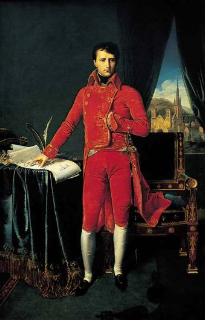 Hidden meanings sometimes are right in front of us, in plain sight.The Copycat Effect
 blog, begun on December 2, 2004, was directly based on my 2004 Paraview Pocket ~ Simon and Schuster
book of that title and the concept after which it was named. The "copycat effect" is a popular rendering of the more academic "Werther Effect."
The scholarly phrase was itself based on the story told about a novel written by Johann Wolfgang von Goethe (August 28, 1749- March 22, 1832). Goethe’s novel
Die Leiden des jungen Werthers (
The Sorrows of Young Werther), published in 1774, told of how a hero shoots himself at his writing table, while wearing a yellow coat, after an ill-fated love. Shortly after its publication there were reports of young men using the same method to die by suicide, and even copying the scene of their deaths in the same clothes worn by young Werther in a similar setting. This resulted in the ban of Goethe's novel in several locations throughout Europe.
The term "Werther Effect" was coined by sociologist and behavior contagion researcher David Phillips in 1974, on the 200th anniversary of Goethe's work. Both my 2004 book and my earlier 1987 Faber and Faber book
Suicide Clusters (which was dedicated to Phillips) explored the influence and impact of media and other factors on historical and contemporary suicidal, homicidal, and murder-suicide events.
For this blog, lately, I have grown to find "The Copycat Effect" too restrictive, and too tied to the name of my 2004 book. Indeed, I feel I need to return to a more broad-based exploration of areas of interest I have had for a long time. For example, my classic book, first published in 1983 and still in-print in a greatly updated/revised edition,
Mysterious America, includes an often-quoted and well-known chapter, "The Name Game."
I have, therefore, changed the name of this blog at the blogspot.com site to "Twilight Language," to more fully embrace the body of my work.
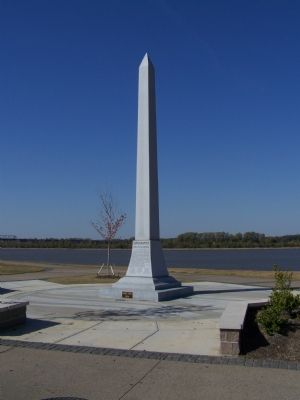 The Tom Lee Memorial (above and below), erected in 1954, celebrates the heroic efforts of the African-American Lee, who saved thirty-two lives when the steamer U.S. Norman sank about twenty miles below Memphis on May 8, 1925. The obelisk is located 0.4 miles from the Lorraine Motel, where the Rev. Martin Luther King was assassinated on April 4, 1968, at 6:01 p.m.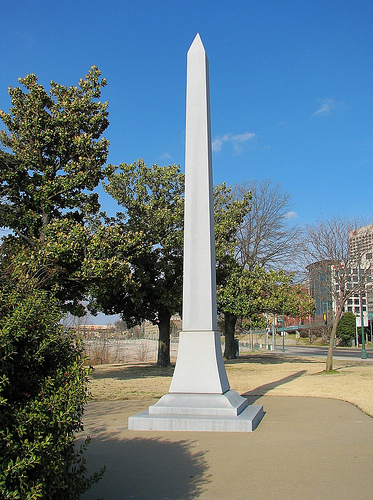
Why this name?
Most of what happens around us is ignored psychologically. The rationalistic filters allow for only the mundane details of most interactions to awaken any response. In deciphering mystery deaths, assassinations, suicide clusters, school shootings, workplace violence, killings, and other acts propelled to our attention via the media, we must forensically look a little deeper.
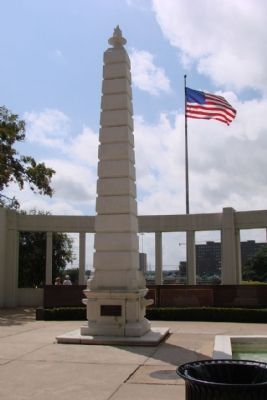 Few people realize that the site of JFK's assassination is the same location as the first Masonic temple in Dallas and the birthplace of the city. It is marked by an obelisk and plaque, near this special place next to the Trinity River, the Triple Overpass, and the former Texas School Book Depository.
 “Twilight language” concerns, to name a few of its parts, from psychology, the hidden significance of dates and other signs, from religious studies, the hidden symbolism that lies in stories and texts, and from criminology, the profiling insights that have revealed the ritualistic nature of certain crimes and violent incidents.
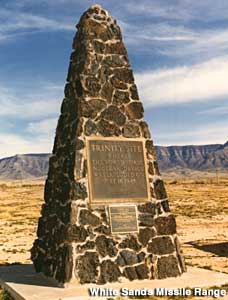 The Trinity Site Marker, an obelisk, sits exactly at 33° 40.638′ N, 106° 28.517′ W. The plaque says: "Trinity Site where the world's first nuclear device was exploded on July 16, 1945 Erected 1965 White Sands Missile Range J. Frederick Thorlin Major General U.S. Army Commanding." The time of the explosion was 5:29:45 a.m. Mountain War Time.
Nonfiction events in which the outcome may be a death are often only viewed in terms of the end result. They are more than this tragic statistic. They are a chain of events, a summary of incidents that contain the essence of many themes. These motifs are common to influential literature and ancestral traditions, which have imprinted people to such an extent, that these stories are passed down from generation to generation.
For all who wish to decipher the dates, locations, symbols, images, and twilight language surrounding, encompassing, and behind suicides, murder-suicides, and violent “random” acts to prevent or understand these incidents, the “text” may be as difficult to read as those created by the ancient Buddhists who hide meanings from outsiders. Their words in allegory, symbolism, and code were often misinterpreted and misused by unworthy or skeptical seekers. I would not expect anything less today.
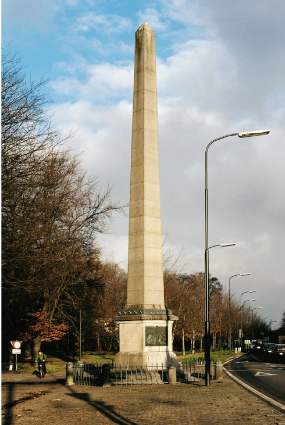 De Naald (in English The Needle), is the obelisk monument in the Dutch city of Apeldoorn that became the final resting place for the April 30, 2009, assassin Karst Tates' automobile.
Events appear to have the ability to attract additional symbolism and synchronicity. They trigger a type of behavior contagion in time and space, which generates other catastrophic events of ritual significance, as indicated by the symbols and twilight language that are attached to them.
I will keep making the same types of observations, encompassing varied Fortean, sociological, occult, and synchromystical themes, which I've been writing about for several decades now. This blog, as an extension of my writings, in part, is also an exploration in onomatology (the study of names) and toponomy (the study of places), in the context of current and past events.
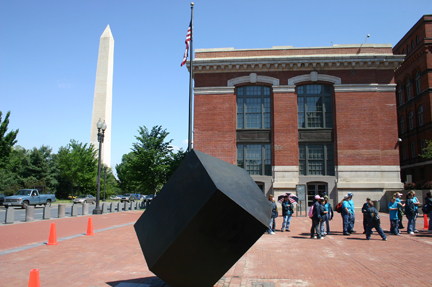 The Holocaust Remembrance Museum, the site of a recent violent encounter, is in the foreground, with the obelisk of the Washington Monument nearby.
Hopefully the new blog title will allow me to stretch my legs intellectually again, in a direction I find myself constantly exploring, and it will alert future readers to the sweeping horizons that I wish to discuss.
For the purposes of folks who have signed up via RSS feeds and bookmarked the former site, however, I am retaining the url and archives of the old blog:
http://copycateffect.blogspot.com/Regular visitors should not see too many changes, other than the masthead revision, and new readers are welcomed with the more harmonic name.
Thank you for following my thoughts and view of the news, and leaving your helpful and insightful comments. Your feedback on the name is appreciated.
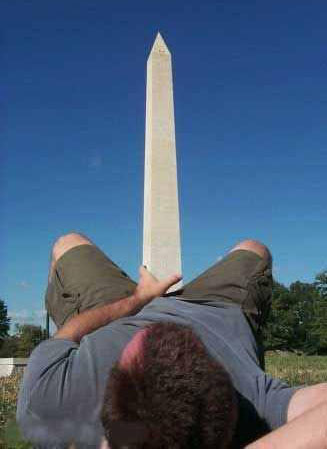 Decoding the meaning of the Washington Monument has become a photographic parlor game on the web.
Remember, a sense of humor is often required along the way.
We are, needless to say, joined with each other on spaceship Earth in this journey together. We might as well see if we can make some sense of what's happening, in our own special and unique ways.
πππππππππππππππππππππππππππππππ
P.S. The mysteries I examine on the "Twilight Language" blog appear to be generated by mostly humans. Meanwhile, I shall continue to write about
cryptozoology,
biographies, and the
many varied natural history mysteries I tend to track over at the popular
Cryptomundo site and in my books in that realm.
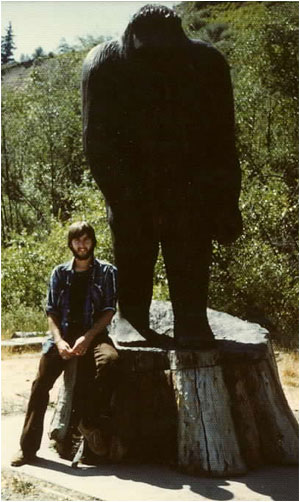
Willow Creek, California, 1975.
Thank You.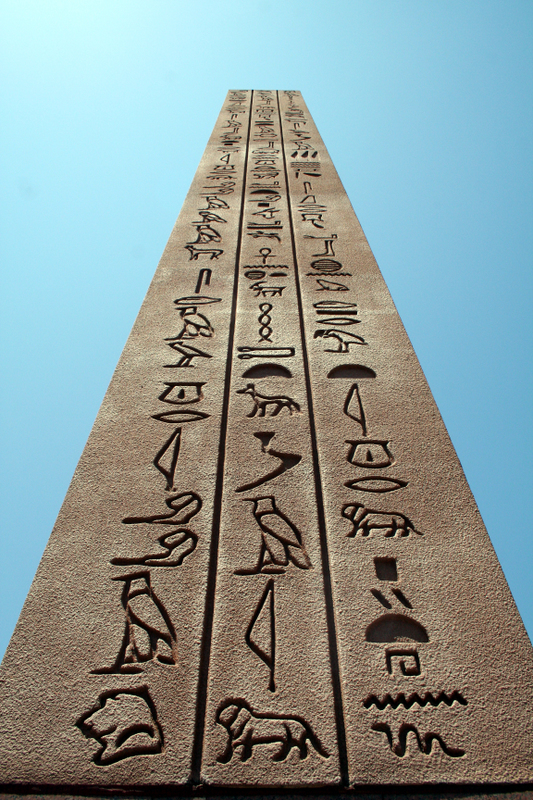 This obelisk is not in Memphis, Egypt, but at the Memphis Zoo in Tennessee.
+++++
The word "synchromysticism" was first coined by Jake Kotze in August 2006, on his website-at-the-time, Brave New World Order. Kotze defined the concept as: "The art of realizing meaningful coincidence in the seemingly mundane with mystical or esoteric significance."
"Synchro" = synchronicity.
The justification or the rationality for this type of activity usually involves a direct or indirect reference to the "collective unconscious mind," thus the "synchro-" in "synchromystic," refers to "synchronicity."
"Mystic" = from the Greek
μυστικός,
mystikos, an initiate of a mystery religion is the pursuit of communion with, identity with, or conscious awareness of an ultimate reality, divinity, spiritual truth, or God through direct experience, intuition, instinct or insight.
See also, the following post,
"Synchromysticism's Godfather."

