Showing posts with label Maine. Show all posts

Saturday, February 06, 2021

Chicken Feathers


The ramifications from the events on January 6, 2021, and the links to other anti-government incidents continue. 
Earlier reviewed were the deaths tied to the attempted Capitol takeover (see here). Now a FBI case breaks open a can of worms in Maine, and perhaps throughout New England.

Arrest


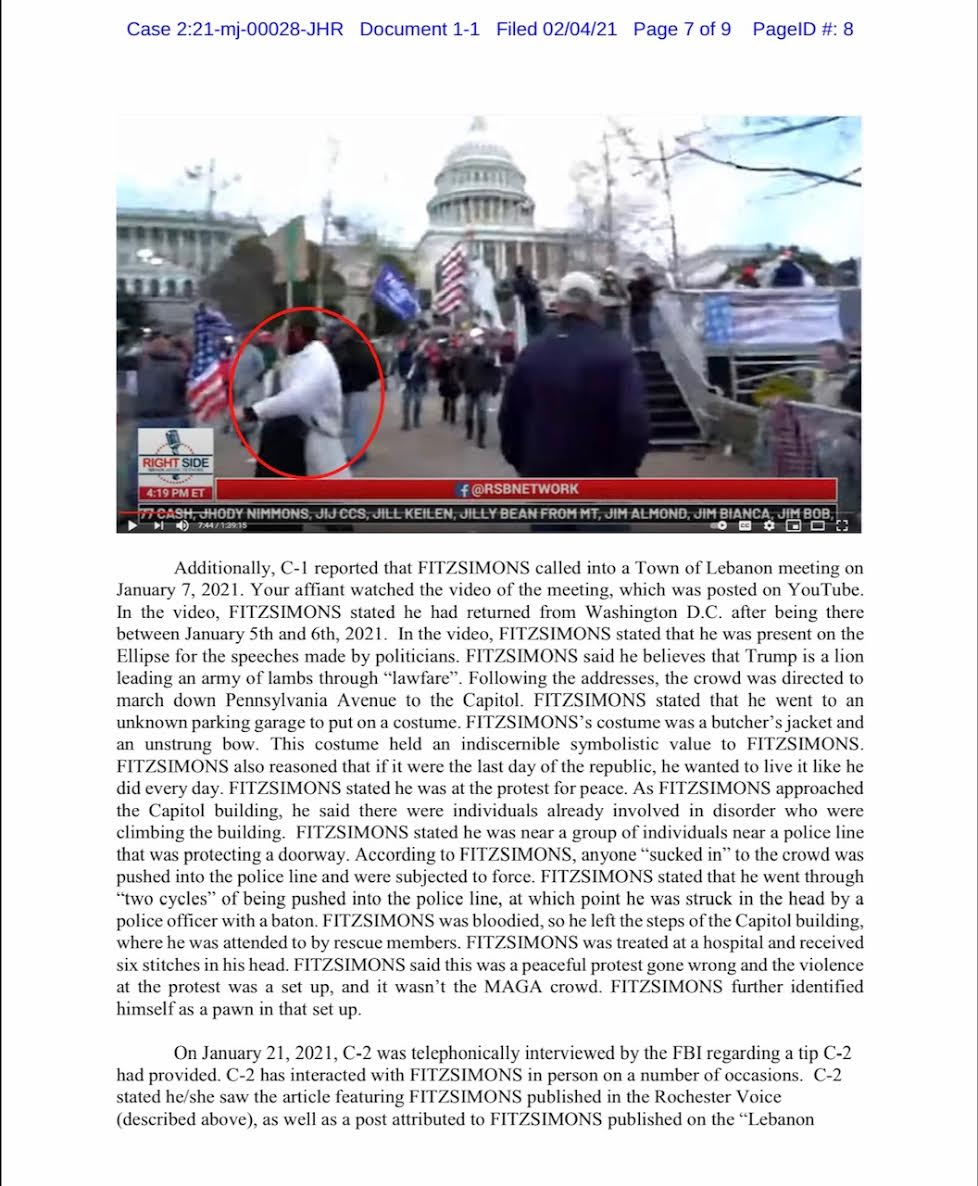
The FBI says 37-year-old Kyle Fitzsimons of Lebanon was arrested February 4, 2021, for taking part in the Capitol riots.  Fitzsimons, 37, is the first Mainer to be prosecuted for his alleged participation in the Jan. 6 insurrection. He appeared in U.S. District Court of Maine for the first time Friday.

Photos released by the FBI show Fitzsimons at the riots. In some, he's covered in blood from his clashes with the police.

In their complaint, the FBI shows screenshots of Fitzsimons allegedly lowering his shoulder and charging at police officers, getting hit by their batons and swinging at officers.

Fitzsimons’s charged with four federal offenses, including assaulting a federal officer. Fitzsimons called the violence a "set up."
~ 18 U.S.C. 1752 (a)(4) – Knowingly Entering or Remaining in Any Restricted Building or Grounds without Lawful Authority
~ 40 U.S.C. 5104 (e)(2)(F) – Violent Entry and Disorderly Conduct on Capitol Grounds
~ 18 U.S.C. 111 (a)(1) – Assault on a Federal Officer
~ 18 U.S.C. 231 (a)(3) – Certain Acts During a Civil Disorder


The FBI complaint also shows Fitzsimons dressed as a butcher, wearing a white coat with the name "Kyle" on it. (Fitzsimons is said in the document to have worked for the Hannaford Store in York. In a statement to WMTW, Hannaford says he did not work there but decline to offer any details of Fitzsimons having worked for the grocery store chain in the past.)

Fitzsimons Meaning


Fitzsimons (also spelled FitzSimons, Fitzsimmons or FitzSimmons) is a surname of Norman origin common in both Ireland and England. The name is a variant of "Sigmundsson," meaning son of Sigmund. The Gaelicization of this surname is Mac Shíomóin.

Sigmund, also spelled Siegmund, is a Germanic given name with roots in proto-Germanic *segaz and *mundō, giving a rough translation of "protection through victory."

Sigmund (also Siegmund), a hero in Norse mythology.
Siegmund, a focal character in Richard Wagner's Die Walküre.

Feathers


Also, Portland police confirm 
Fitzsimons is a person of interest in their investigation of a suspicious package left at the Portland Museum of Art.  The suspicious package was made up of feathers surrounding a box along with a spray painted message at the Portland Museum of Art at 3:00 p.m. on Saturday, January 23, 2021.

The word "BALM" was spray painted on the sidewalk.

Fitzsimons told the Rochester Voice newspaper in a Jan. 11 article that he changed into a “costume” – his white butcher jacket – before he joined the throng at the Capitol that day, and he carried an unstrung bow as a sign of peace. Rochester is across the Maine-New Hampshire border from Lebanon.

The affidavit also describes him wearing what appeared to be a fur pelt around his neck, and Fitzsimons described himself as a trapper when he called in to the Lebanon Board of Selectman meeting Jan. 7 to describe his experience the previous day in Washington.

“Fitzsimons was identified early in our investigation as the person who placed the package at the PMA,” Portland police Lt. Robert Martin said Friday evening, February 5, 2021, in a text message. Martin said surveillance footage from the area and extensive work by detectives helped make the identification.


Feathers as Symbols

White Feathers As Symbols of Cowardice
During World War I, thousands of women across the British Empire gave men white feathers to shame them into enlisting in the military. By 1785 in England “show the white feather” was a folk saying for the behavior of a timid fighting cock. Fighting cocks was not then or subsequently a respectable activity. In 1902, British novelist A. E. W. Mason used the white feather as a central symbol of a British army officer’s cowardice in his adventure novel, The Four Feathers. A silent-film adaptation of that novel, Four Feathers, was produced in the U.S. in 1915. Mason’s novel thus symbolically elevated the white feather into a potent means for publicly shaming men into fighting in World War I. Source.


American's Stonehenge

Investigator Enki King has pointed to various strange crimes occurring around New England in recent years.

For example, in September-October 2019, vandalism was investigated at America's Stonehenge/Mystery Hill at North Salem, New Hampshire. The power tool infected carvings appeared to have the fingerprints of QAnon all over this. The suggestions go in a few different directions and point to a variety of conspiracy angles.


My posting at that time in 2019, overviews the connections being made, "October 27: Anti-Masonic, Anti-Semitic, and Anti-Pagan Terrorism."

Mid-2020, "Colorado, Aurora, Waffle House, and the Watts Name Game" reared its head. At the end of last year and the beginning of the present one, "Aurora" was back in the news.

What's next?


FBI Filing 


The U.S. Department of Justice Office of Public Affairs has created a web page where the public can track the charging and arrest of defendants in connection with the Capitol breach. The page includes defendants’ names, charges and case status. Please find that site here.


Monday, July 08, 2019

The Aroostook Triangle


Cartoon by Andrew Greenstone.

Souliere's Strange Sojourn 

Michelle Souliere noticed a void. She felt that Maine's weirdness was being ignored.

In 2016, Souliere shared her personal journey towards "strangeness" with the Lewiston Sun Journal's Mark LaFlamme:
I sensed a void, and had lots of material to fill it with. I had read Loren Coleman’s Mysterious America, Joseph Citro’s Weird New England, William Robinson’s Abandoned New England. I was fired up! I wanted to know if I could I find out more about our own Maine urban legends, hauntings, weird history and personalities.
By 2005, Souliere had begun her blog Strange Maine, and soon after, a print version, the Strange Maine Gazette.


On November 6, 2009, her bookstore, The Green Hand opened at 661 Congress Street, Portland, Maine, and gave her a foundation location in Portland from which her art, research and writings grew.


In 2010, Michelle Souliere published her first book, Strange Maine: True Tales from the Pine Tree State. Soon after, I asked her to join me in writing Bigfoot in Maine, after the publisher asked me to pen that book. But I was overwhelmed with book projects, and soon was delighted to turn the entire title over to her. For almost a decade Souliere has been working on the historical and contemporary sightings of large forest giants in Maine.


Conducting research for her Bigfoot book, Souliere has traveled extensively throughout the State of Maine.

A Weird Window

In 2006, Michelle Souliere, in her blog Strange Maine, hinted at a mysterious area, called a "triangle" or "window area" by Forteans and ufologists, in the upper tier of Maine. She was learning more and more about it, sometimes as reflected in popular culture. She wrote:

There is
a television show, made in Northern Maine, that is currently [in 2006] running on over 50 public access stations across the country. Dark Currents [was] its name.
The Story takes place in the fictional town of Hawks Landing and in an area that is a magnet for strange events and even stranger characters. At one time, HAWKS LANDING was an Indian village. The area is filled with old stories and legends. The land between the river and the town is kind of a "Bermuda Triangle" for Maine. The town itself is supposedly cursed. One Indian tale told of an Indian chief saying "The Matawahoc river shall run Dark Currents as long as the white man lives on it."
Like most home-grown shows, Dark Currents exists on a meager budget, and is produced predominantly on the enthusiasm of its staff, to the delight of a small cult following in New England, according to their site.
By 2006, the show was gone, and yet Michelle Souliere pursued the notion of this "triangle" area in her research.

In June 2019, cartoonish/journalist Andrew Greenstone captured a lecture that Souliere had given at the Third Annual International Cryptozoology Conference in September 2018. He recorded his impression of the talk via a cartoon overview.


"Of the stories I've heard, a number of them all take place in this little triangle in the northeast quadrant. Ten miles at its base and 25 miles tip-to-tip in this isolated area around US Route 1," Michelle Souliere said in her lecture. On the screen in the background, a map of Maine showed the little triangle.


Greenstone continued, "Michelle related stories about a series of mysterious woodland encounters. Wood knocks, trees snapping, large rocks being thrown, and unidentifiable roars that left those who experienced them forever changed."

These all can be linked to Sasquatch/Windigo/Wendigo/Bigfoot characteristics, but Souliere is correct in merely pointing to the collective unexplainable nature of these pieces of evidence. No telling what is making all these signs, but what may be more intriguing is that Souliere has discovered a concentration of such reports in one specific area.


Comparing Greenstone's rendering of Souliere's map and where the Triangle is located, you will see the dot is southeast of the little town of Presque Isle. The location of this anomalous area is larger than it looks and near Presque Isle.

Presque Isle

Presque Isle is the commercial center and largest city in Aroostook County, Maine, United States. The population was 9,078 in 2017 as estimated by the US Census, a decrease from the count of 9,692 in the 2010 Census. The city is home to the University of Maine at Presque Isle, Northern Maine Community College, Husson University Presque Isle, Northern Maine Fairgrounds, The Aroostook Centre Mall, and the Presque Isle International Airport.

Presque Isle is the headquarters of the Aroostook Band of Micmac, a federally recognized tribe, with, at last estimate, a population of 960. Like their kin in Canada, the Micmac in Maine would rather be termed Mi'kmaq. Since the 1980s, the Miꞌkmaq consider the spelling Micmac as "colonially tainted." Lnu (the adjectival and singular noun, previously spelled "L'nu"; the plural is Lnúk, Lnuꞌk, Lnuꞌg, or Lnùg) is the term the Miꞌkmaq use for themselves, their autonym, meaning "human being" or "the people".

The Miꞌkmaq or Miꞌgmaq (also Micmac, Lnu, Miꞌkmaw or Miꞌgmaw) are a First Nations people indigenous to Canada's Atlantic Provinces and the Gaspé Peninsula of Quebec as well as the northeastern region of Maine. They call their national territory Miꞌkmaꞌki (or Miꞌgmaꞌgi). The nation has a population of about 170,000 (including 18,044 members in the recently formed Qalipu First Nation in Newfoundland), of whom nearly 11,000 speak Miꞌkmaq, an Eastern Algonquian language. Once written in Miꞌkmaq hieroglyphic writing, it is now written using most letters of the Latin alphabet.

The Aroostook Triangle

After Greenstone's cartoon panels were published on July 5, 2019, they were spread around Facebook by various folks who were at the conference. Soon a discussion took place on Michelle Souliere's FB page. I was startled that the location was nameless, and commented that only the "faint of heart" do not venture forth to name events, creatures, and locations.

So, for the stake of gathering all the comments on the topic, I named this weird new spot that Michelle Souliere had discovered The Aroostook Triangle, for after all, that's what it is.  Of course, if it becomes known by some other moniker from Souliere or other commentaries on this weird wonder, so be it.


This triangle, like Aroostock County itself, is sparely populated. Formed in 1839, Aroostook County has the largest area of any county in New England, and Maine residents often call it “the” county. The Britannica says its name is derived from a Mi’kmaq word meaning “clear,” or “beautiful water.” Some others, like Your Dictionary, say the meaning is "unknown," which would fit well with the stories behind this "Triangle."

Triangles Elsewhere


The actual coining of the term "Bermuda Triangle" seems to point to Vincent Gaddis, a Fortean friend of Ivan T. Sanderson and correspondent of mine too. In the February 1964 issue of Argosy, Vincent Gaddis' article "The Deadly Bermuda Triangle" used the phrase widely for the first time. Sanderson wrote the well-known followup article, "The Twelve Devil's Graveyards Around the World," in 1972, for Saga magazine.

Based on their inspiration, the name "Bridgewater Triangle" was coined in the late 1970s (circa 1976) by yours truly, Loren Coleman, when the phrase was published for the first time in the April 1980 article of the same name in Boston Magazine, and in the 1983 book, Mysterious America (Faber and Faber, 1983; now in the revised 2007 Simon & Schuster edition). A local newspaper published the name "The Bridgewater Triangle" after I gave a Bridgewater area library lecture using the phrase in the late 1970s, in the Bridgewater area.

In 2015, due to the national broadcast of the 2013 documentary film, The Bridgewater Triangle (directed by Aaron Cadieux and Manny Famolare), I wrote an essay about the "Top Ten American Bridgewater Triangles."

These include:
1. Bridgewater Triangle, Massachusetts.
2. Bennington Triangle, Vermont. 
3. Coudersport Triangle, Pennsylvania.
4. Virginia Triangle, Virginia-North Carolina.
5. Great Lakes Triangle or Michigan Triangle, Wisconsin, Michigan, Canada
6. Big Lick Triangle, Indiana-Kentucky
7. Nevada Triangle, Nevada-California
8. Alaska Triangle, Alaska.
9. Little Egypt Triangle, Illinois.
10. Ossipee Triangle, New Hampshire. 

Some are small, like the Aroostook Triangle. Others are huge.


A few such as the Bridgewater Triangle in Massachusetts and the Big Lick Triangle in Indiana-Kentucky nicely have, respectively, "Bridgewater" town names on each corner, and "Lick" town names on theirs.

There is a lot to absorb from these triangles.  And I'm sure Michelle Souliere has a great deal to share about the Maine's special spot too.


Michelle Souliere's forthcoming Bigfoot in Maine book will have much to say on the Aroostook Triangle.


Wednesday, November 21, 2018

Charles Manson, Sharon Tate, and Wayne Maunder


Charles Manson lived from November 12, 1934 to November 19, 2017.


Wayne Maunder lived from December 19, 1937 to November 11, 2018. He is shown above in his role as Scott Lancer.


Luke Perry (born October 11, 1966) is set to play Scott Lancer (read "Wayne Maunder") in Tarantino’s forthcoming Once Upon a Time in Hollywood, about the Manson Family. The 1960s-1970s real-life actor Wayne Maunder lived next door to Sharon Tate. 

Maunder reportedly suffered a heart attack.

Rachel Yang of Variety wrote the following on November 21, 2018:

Wayne Maunder, the star of 1960s TV Westerns who may have inspired a character in Quentin Tarantino’s upcoming film, died of cardiovascular disease Nov. 11 in Battleboro, Vt., a Vermont Department of Health spokesperson confirmed to Variety. He was 80.
Maunder starred in ABC’s Custer as the titular Lt. Col. Custer. The Western aired just 17 episodes before it was canceled in 1967. He also appeared in another Western, CBS’ Lancer, as Scott Lancer. The show ran for two seasons from 1968 to 1970.
The actor also appeared on shows like Kung Fu with David Carradine, The F.B.I., and The Rookies, as well as the 1971 film The Seven Minutes, in which he starred as attorney Mike Barrett.
Tarantino’s upcoming film, Once Upon a Time in Hollywood, is set in 1969 and features Luke Perry as the character Scott Lancer. Based on real events surrounding the Manson murders, the movie stars actors as recognizable Hollywood figures from the era, like Sharon Tate (Margot Robbie) and Steve McQueen (Damian Lewis).
Born Dec. 19, 1937, in New Brunswick, Canada, Maunder was raised in Bangor, Maine. Following high school, he had stretches in the U.S. Navy and tryouts for baseball teams like the Milwaukee Braves and the Pittsburgh Pirates. Later, Maunder caught the acting bug and studied under Stella Adler in New York City.
...
The late actor is survived by his two brothers. Variety.


Once Upon a Time in Hollywood will mark Luke Perry's first time working with Quentin Tarantino.

Sunday, June 03, 2018

2018 Ramming Death Linked to 1968 Hit-and-Run Killing

This is a complex story that starts one place, in time and space, and ends up traveling back to the past. 


To begin with, I was struck by the sync of the unfolding historical mention of 133 feet linked to the Maine event. In the news recently, three women's bodies have been found at 1333 Page Blvd, Springfield, Massachusetts, the house where Stewart Weldon buried them.

1333, 133, 22, 22, 44, Halloween, and 50 years. 1968. 68. Numbers. Just numbers. People died. 

It begins, contemporarily, at 7:09 pm, on Friday night, June 1, 2018, at a Babe Ruth baseball field in Sanford, Maine. The town is known for it's strong community support of its youth baseball. Damn it. My sons have played there. This incident was a shocker in Maine.


As the game was in progress, a car came through an open gate onto the Maine field, scattering the boys’ on-field baseball team, then striking and killing a man.


A West Newfield, Maine resident Douglas Parkhurst, 68, holding the gate, reportedly pushed kids out of the way, and was hit. Parkhurst was trying to close the main gate so the car could not leave the field.

68.

The maroon Honda sedan at one point struck a closed gate, sped toward the main gate and struck Parkhurst before speeding from the scene. He died on the way to the hospital.


Police charged 51-year-old Carol Sharrow with manslaughter. She remained in York Couty Jail.

Sharrow (English). The habitational name from Sharrow in Sheffield or Sharow in North Yorkshire, both named with Old English scearu "boundary" + hōh "hillspur." It is the Americanized spelling of French Charron. Intriguingly, the term sharrow is used with regard to a specialized symbol on the road for the right of passage of bikes.


One of the first developments was more information on Sharrow. Her actions seemed bizarre to the parents, coaches, and players there, as if she was driving in a trance, possessed.

Sanford police Detective Sgt. Matthew Jones said Sharrow has a drunken driving conviction in Maine and an aggravated drunken driving conviction in Portsmouth, New Hampshire. Jones declined to say whether alcohol was involved in Friday’s incident.

As details emerged about the victim, Douglas Parkhurst, the first stories were of his  heroism, how he was a Vietnam Vet (he served as a cook in the Air Force), and a grandfather.

Then a deep sync was revealed.


Fifty-years ago, Parkhurst had killed a little four-year-old on Halloween 1968, in a hit-and-run incident with his car. But he hid that fact.

1968.

Finally, in 2013, after the cold case was re-opened on Facebook, and detectives were getting closer, Parkhurst confessed 44 years after the girl's death.  

44.

Carolee Sadie Ashby, 4, died in 1968. She was born on February 22, 1964.

22.

Parkhurst hit Carolee Sadie Ashby, and she was thrown 133 feet through the air, in Fulton, New York. 

133.

The 1968 site.

The details are chilling. Carolee was walking across the road, eating softserve ice cream, with her older sister Darlene and a cousin, after going to get birthday candles from the nearby Victory Store for Darlene's 15th birthday.

The girls were looking forward to going home and dressing up to go Halloween trick or treating. It was about 6:30 pm when they crossed the road. And Carolee was hit. 
A motorist watched as a car drifted to the center of a Fulton intersection and hit a teddy bear. 
The stuffed animal flew 133 feet. The car sped away from Division and South Second (now Route 481) streets.
When people began running up and down the street, the man drove closer and realized he'd been mistaken. The teddy bear had actually been a little girl. He sped up to the scene....
Carolee's black cowboy boots lay 20 feet from where she landed. The man found her crumpled body about a foot from the curb. She wasn't moving. ~ wrote Syracuse Post-Standard reporters Ken Sturtz and Jeff Stein


Therefore a Carol allegedly killed with her car the man who confessed to killing a Carolee with his car.

Origin of the name Carol: Feminine form of the Latin Carolus, which is a cognate of Charles (full-grown, a man, freeman), and a short form of Caroline, another feminine form of Carolus. Alternatively, the name is derived from the vocabulary word carol (joyous song, a carol). Var: Carol, Carrol, Carroll, Carryl, Caryl. And Carolee.

When the confession came in 44 years after the little 4 year-old girl who was born on February 22, had been killed, Doug Parkhurst could not be charged because the statute of limitations had expired. The Syracuse newspaper asked for records of the investigation under the Freedom of Information. On May 22, 2013, the request was denied because it was allegedly "still an ongoing investigation."

4. 44. 22. 22.

On June 2, 2018, Russ Johnson, the retired Fulton police officer whose Facebook post led to the tip that helped crack the case, called Douglas Parkhurst’s death "ironic and a strange twist of fate."

“God works in mysterious ways,” Johnson said in a telephone interview with Beth Quimby of the Portland Press Herald.

Johnson, who joined the force in 1985, said he reopened the case in 1999 but never got anywhere before he retired in 2006.

“It was mind-blowing that the community had remained so distraught over the decades,” Johnson said.


Karma?


Sources: 1, 2, 3, 4, 5, 6, and 7.