Showing posts with label Folklore. Show all posts

Friday, November 18, 2016

Fakelore and Fake News: Have You Heard The One About Anti-Trump Protesters Blocking The Ambulance?

Paul Bunyan is a clear example of fakelore. Fakelore is described as "inauthentic, manufactured folklore" presented as if it were genuinely traditional.

The term fakelore was coined in 1950 by American folklorist Richard M. Dorson. Dorson's examples included the fictional cowboy Pecos Bill, who was presented as a folk hero of the American West but was actually invented by the writer Edward S. O'Reilly in 1923. 

Dorson also regarded Paul Bunyan as fakelore. Although the number one fakelore hero, Paul Bunyan originated as a character in traditional tales told by loggers in the Great Lakes region of North America, James Stevens, an ad writer working for the Red River Lumber Company in Minnesota, is said to have invented many of the stories about him that are known today. Others say the character originated in the oral tradition of North American loggers, and was later popularized by freelance writer William B. Laughead (1882–1958) in a 1916 promotional pamphlet for the same previously mentioned Red River Lumber Company. According to Dorson, advertisers and popularizers turned Bunyan into a "pseudo folk hero of twentieth-century mass culture" who bore little resemblance to the original.

Research does not demonstrate
whether Bunyan actually lived or was wholly mythical. [Researchers] have noted, however, that some of the older lumberjacks whom they interviewed claimed to have known him or members of his crew, and the supposed location of his grave was actually pointed out in northern Minnesota. In this regard, it should be noted that Bunyan's extreme gigantism was a later invention, and that early stories either do not mention it or, as in [one research] paper, refer to him as being about seven feet tall. Source.
Fakelore, at some level, develops from "fake news," i.e. local or regional stories that are untrue but many people are convinced what they have heard or read in social media is "real."


Fake news has been in the news of late, as the realization settles on the mainstream media, Facebook executives, and Twitter readers that much of what they read has little to do with reality.
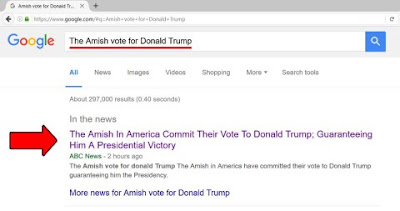


Headline stories this week speak volumes about what is occurring:

"Trump's fake-news presidency," Washington Post, November 18, 2016.

"Obama, With Angela Merkel in Berlin, Assails Spread of Fake News," New York Times, November 17, 2016.


"7 signs the news you're sharing is fake," Mashable, November 17, 2016.

"Here are all the fake 'news' sites to watch out for on Facebook," The Daily Dot, November 16, 2016.

Let's look at one "fake news" story that has greatly circulated in the wake of Donald Trump's election and the anti-Trump demonstrations. It is the alleged story of anti-Trump protesters blocking an ambulance with the father of a 4-year-old girl dying. It's false, fake, and a hoax, but it's become fakelore extraordinary.


There are a half million hits on the Internet where you can read versions of the story, with most mentions of them presenting the "news" as "real."

The only problem with the "news item" is that there are no names, no locations (although various ones do pop up before another one is mentioned), no sources, and not too surprisingly, there is a short history of the same tale showing up down through the years.

Earlier in 2016, a variant on the story was tied to Black Lives Matter protestors on a bridge with a "suffering child" in an ambulance being blocked by their march. The child was reported to have died.

ABC News, on July 11, 2016, debunked that story:
A rumor swirled on Facebook that a young girl died as a result of the "Black Lives Matter" protest Sunday night. That rumor is not true.
Early during Sunday's protest that stopped traffic on the Interstate 40 bridge, a car trying to take a child to St. Jude Children's Research Hospital got stuck in the traffic jam. Police worked with protesters, who let the car go through. Source.
The debunking site Snopes examined the post-Election Day fake news of the father dying because of the blocked ambulance, and 
found no corresponding news reports of any such death occurring (in conjunction with anti-Trump protests or otherwise) in the United States since the 8 November 2016 election. Source.
But the protesters-blocking-ambulances fake news continues to spread, and is now part of current urban fakelore.

Could you have seen us being here, ten years ago? This is the era of post-truth.

Saturday, December 07, 2013

Pearl Harbor: A Synchromystical Place?


Americans tend to brutally and concretely remember the "Pearl Harbor Attack." I find great affection for the Japanese today, but my mother (born in 1927) grew up hating them. This generational split about "December 7th" is disappearing, and we can now speak to the fact that the location is mystical. There is another side of Pearl Harbor. I'm not talking about the many myths associated with the actual 1941 military action (see here). It was a place of legends before 1941, and has developed its own new tales since then.

Legends of ancient Hawaii tell of waters called Puuloa, which was the home of the beneficent Shark Goddess Kaahupahau. Her sharks were man's protectors against many evil spirits and also against the other "man-eating sharks."
The legends, when first recorded in the 19th Century, refer to Ewa as the first area populated on Oahu by the immigrant Polynesians. One Ewa king, Chief Keaunui, is credited with deepening the entrance of the harbour to 15 feet in about the year 1650. During those years and into the 20th Century numerous fish ponds and fish traps were in the entrance and in the many lochs of that body of water. Most were maintained for royal use only.
As early as 1796 European visitors recorded that those waters produced oysters which were used for food, and that pearls were frequently found in them. The pearls were milk white, spherical, and of exquisite lustre. By 1810 the king had found the trading value of the pearls and kept them under royal control.
In the same year (1810), the river leading into the bay was referred to as Wymumme, and in 1819 as Wy Momi which, translated to English, is Pearl River. (The difference in spelling is that of the person recording the spoken word.) Again in 1836 it was recorded that the small pearl oyster was quite abundant and common on the table. From about that time on, the large area of water at the mouth of the river was called Pearl Harbour.
For generations the land surrounding Pearl Harbour was subject to natural erosion and the attrition of "civilization" which allowed much of the harbour to be filled with mud. The oysters could not survive in the mud and were nearly extinct by the late 19th Century.
A visitor from the United States noted in 1840 that there was a depth of 15 feet over the coral bar at the harbour entrance. He suggested to the U.S. Government that they attempt an agreement with the Hawaiian king for the use of the harbour for U.S. ships. This was not acted upon until 1873 and not agreed until 1898. Then the actual work of deepening and widening the channel wasn't started until 1901, at which time a coaling station for the fuelling of ships was erected just inside the entrance. Source.


Pearl Harbor was originally an extensive deep embayment called Wai Nomi (meaning, “pearl water”) or Puʻuloa (meaning, “long hill”) by the Hawaiians. Puʻuloa was regarded as the neighbor of the dolphin god, Kaʻahupahau, and his brother (or father), Kahiʻuka, in Hawaiian legends. According to tradition, Keaunui, the head of the powerful Ewu chiefs, is credited with cutting a navigable channel near the present Puʻuloa saltworks, by which he made the estuary, known as "Pearl Lake," accessible to navigation. Making due allowance for legendary amplification, the estuary already had an outlet for its waters where the present gap is; but Keaunui is typically given the credit for widening and deepening it. Source.

The Church of Jesus Christ of Latter-day Saints have a story in their mythos that a Japanese bomber refused to bomb the Laie Hawaii Temple during the bombing of Pearl Harbor.

The temporal importance of Pearl Harbor Day was reinforced immediately, and lives on today.


USS Wisconsin (BB-64), "Wisky" or "WisKy," is an Iowa-class battleship, the second ship of the United States Navy to be named in honor of the U.S. state of Wisconsin. She was built at the Philadelphia Naval Shipyard in Philadelphia, Pennsylvania and launched on December 7, 1943 (the second anniversary of the Pearl Harbor raid), sponsored by the wife of Governor of Wisconsin, Walter Goodland. That was during the time of the Philadelphia Experiment, allegedly. Was Pearl Harbor the motivation behind the Philadelphia Experiment, if it even existed?

What special synchromysticism do you associate with Pearl Harbor?

"Look with horror in your mirror at the eyes without curiosity; 
at the lips which never question."
~ Tiffany Thayer, in his Introduction to Charles Fort's Lo!

Monday, July 09, 2012

12 July 1947: Bertrand Méheust

I was born on July 12th, in Norfolk, Virginia, in that synchromystical year, 1947. I only recently discovered another researcher and writer, interested in topics not too distant from ones being pursued by me, who was born exactly on the same day, half a world away.  His name is Bertrand Méheust, and he is from France. Happy Birthday, Monsieur Méheust.

Let me introduce him to you.


Bertrand Méheust 

Bertrand Méheust was born, as it is written in France, on 12 July 1947, and one of his early complaints to his mother was that he wasn't born three weeks earlier, on 24 June. (Both Méheust and I were raised in poor, working class families.)

Méheust is a researcher and writer in French, who is known as a specialist in Jungian ufology, parapsychology, sociology, and politics. Formerly a professor of philosophy at Troyes, Méheust is now retired. (I was a fulltime university researcher and associate/assistant/adjunct professor in documentary film, anthropology, sociology, and social work. I retired from teaching in 2003.)

Méheust's masters thesis, in 1981, was on William James. He is a doctor of sociology, received in 1997 from the Sorbonne, on animal magnetism. (My masters thesis, in 1978, was on sexism in the professions. I was admitted but never finished two Ph. D. programs, one in social anthropology, one in sociology.)

He is a member of the steering committee of the International Psychic Institute. (I was a founding member/honorary member/life member of the Society for the Investigation of the Unexplained and the International Society of Cryptozoology; I am the founder/director of the International Cryptozoology Museum.)

   
In 1975 and 1978, I coauthored (with Jerome Clark) my first two books on Jungian ufology, cryptozoology, and Fortean accounts. Since then, as many of you know, I have written mostly about cryptozoology, sociology, biographies, anomalies, social work, and human mysteries.

In 1978, Bertrand Méheust wrote his first book (pictured at top), dealing with the question of the anticipation of science fiction of the UFO phenomenon. His mentor was Aime Michel. (Mine were Ivan T. Sanderson, Bernard Heuvelmans, and John Keel.) Méheust's book examined how the authors of the pulp science fiction novels at the beginning of the 20th century presented a phenomenon that would not appear until several years later. One must consider that it was only in 1947 that Kenneth Arnold brought about the modern history of flying saucers.

Méheust's book is regularly cited by skeptics who see a strong argument in favor of a simplistic psychological explanation of the UFO phenomenon. But Méheust's thesis is much more complex. In his book, which was very influenced by Carl Gustav Jung, Méheust defends the extraterrestrial hypothesis.

In 1999, his university thesis, investigating mediums, was published in two volumes (1,200 pages). The book was updated on the controversy surrounding parapsychology, but also psychology. It traces the history of research, theories and concepts that have generated the issue of potential hidden human abilities, since the end of the 18th century.

Georges Bertin wrote of Méheust's work on mediums, that he has "against the irrevocable existential certainty that conscience is inaccessible to any other consciousness, the author will examined historically and sociologically, to consider and discharge, the field of magnetism, the métagnomie and the magnetic lucidity evacuated by rationalism."

Méheust asked both how the phenomena observed and supported on primary properties of the human psyche and how they tie in to culture, observing that, of all the cultures that have integrated and updated this potentiality, Western culture is the only to have opted for the rejection of it.

Bertrand Méheust is currently a leader in the field of metaphysics in the French language and, as such, he is regularly responds to the challenges of French skeptics. He has published on metaphysical history, about the lives of Henri Broch and Georges Charpak,  regarding sorcerers, and on psychic phenomena and the paranormal. 

Bertrand Méheust has written books on science fiction and flying saucers, flying saucers and folklore, sleepwalking and médiums, psychic science, biographies, wizards, sorcerers, clairvoyance and divination, democratic psychotherapy, and paranormal stories of the Titanic. One of his newest books' titles is translated as The Nostalgia of Occupation: Can We Rebel Against New Forms of Enslavement? (published in February 2012).

For more about some of his books (in French), see here and here.

Talk about synchronicity of births. I was amazed to discover Monsieur Bertrand Méheust.

So, who was born exactly the same day you were born?