Showing posts with label New Zealand. Show all posts

Tuesday, May 07, 2019

Hellfire: The Violent Days of Spring 2019


April has come and gone. As forecast in "The Red Zone of April," the past is prologue. Let us look at a jam-packed Spring of 2019 that, indeed, was filled with "hellfire." And Spring is not through with us!


Al Noor Mosque, Christchurch, New Zealand.

The Christchurch mosque shootings were two consecutive terrorist attacks at mosques in Christchurch, New Zealand, during Friday Prayer on 15 March 2019. The attacks began at the Al Noor Mosque in the suburb of Riccarton at 1:40 pm and continued at the Linwood Islamic Centre at about 1:55 pm. The gunman live-streamed the first attack on Facebook Live. After being at Al Noor Mosque and going to Linwood, the gunman left the scene, in his car, to the music of "Fire" by The Crazy World of Arthur Brown, where the singer proclaims: "I am the god of hellfire!"


The attacks killed 51 people and injured 49 others. A 28-year-old Australian man, Brenton Harrison Tarrant, described in media reports as a white supremacist and part of the alt-right, was arrested and charged with murder. The attacks have been linked to an increase in white supremacism and alt-right extremism globally observed since the mid-2010s. Politicians and world leaders condemned the attacks, and Prime Minister Jacinda Ardern described it as "one of New Zealand's darkest days." The government has established a royal commission of inquiry into its security agencies in the wake of the attacks, which are the deadliest mass shootings in modern New Zealand history.

Fatalities 51 (47 of them male, and 4 female)
42 at the Al Noor Mosque
7 at the Linwood Islamic Centre
2 later at Christchurch Hospital


Monday, March 18, 2019

The God of Hellfire Cancels


The Christchurch attacks had a soundtrack. The gunman Brenton Harrison Tennent  decided what he wanted to have playing as he killed and killed and killed.

The livestream had the sounds and the media identified the music for those who were unaware.
...he picks up his gun, storms into the mosque, and cuts down one innocent life after another.
When it is over, he climbs back into his car, where he has left his music playing — the song Fire by the English rock band The Crazy World of Arthur Brown. And right after the singer bellows, 'I am the God of Hellfire!' the gunman drives away.
Source.


But Arthur Brown has some choices to make too.

Arthur Wilton Brown was born on June 24, 1942 ~ St. John's Day, which is associated with fire, and which would be the date of the birth of flying saucers five years later in 1947. Brown is an English rock singer and songwriter best known for his flamboyant theatrical performances, resulting in his creation of The Crazy World of Arthur Brown. His signature lyric from his wildly popular song Fire is "I am the God of Hellfire and I bring you fire." 

In the 1980s, Brown moved to Austin, Texas, where his wife was from, and obtained a master's degree in counselling. He moved back to the U.K., and then back to Austin, where he has been living for several years.

Arthur Brown in 1968.

On the night of the Ides of March 2019, Brown performed at Austin's Empire Garage, ending with his 1968 song, Fire.

In New Zealand, the killer Tarrant livestreamed (without permission) as he murdered Muslims, Fire, also on the March 15, 2019.

As I noted here, Brenton Tarrant's name literally means "flame" + "thunder," and thus rather close to "Hellfire."

On Saturday, March 16, 2019, Arthur Brown was due to give a live appearance of at Waterloo Records in Austin, Texas. But he cancelled and posted this:

Message From the Heart

As co-writer and performer of the song Fire, and creator of The God of Hellfire persona, I would like to express my horror and sadness in the use of Fire, in an act of terror in New Zealand. My heart goes out to all the victims and families of victims of this atrocity – and to all the communities affected.
I should like to say that I support no group or individual that uses terrorist tactics and killing as a means of dealing with other beliefs than their own.
I believe that all religions reach for the same root in the human being. I believe all people of all colours and all races deserve equal respect. I also believe that all people have a duty of care towards each other and all creatures on this earth.
OUT OF RESPECT for the victims of this horrifying act in New Zealand and following the advice of respected local authorities, I have decided to CANCEL the 'instore' performance at WATERLOO RECORDS in AUSTIN tomorrow. Source.


See also:


Saturday, March 16, 2019

The Twilight Language of the Christchurch Attacks

As you've heard, the alleged terrorist assassin of 49 Muslims in Christchurch, New Zealand, left behind a lengthy 74-page document. But he left more. The media is analyzing what was messaged.


Accused gunman Brenton Tarrant flashed the white power sign during his court appearance.

Brenton Harrison Tarrant, 28, placed some landmines in his self-styled manifesto, The Great Replacement, for the media. Knowing the news organizations would dive deeply into it, he placed false blame in the document, to a point finger in misdirection. For example, he cited conservative activist Candace Owens as his "biggest influence," but this clearly appeared to not be the case.

Tarrant was broadcasting "news" and "messages" to his fellow white supremacists. His weapon, backpack, and manifesto were filled with direct twilight language to those in the know.


The writing on the rifle related to the following:
Serbian Milos Obilic, who assassinated Ottoman Sultan Murad I at the end of the Kosovo War in 1389. The terrorist had written Obilic's name on his gun in Cyrillic letters.
Marco Antonio Bragadin, a Venetian commander who fought against the Ottoman Empire in Cyprus in 1571. He was captured by the Ottoman forces soon after he had killed Turkish hostages with different torture methods such as cutting their ears and noses. Bragadin was hanged to death for his crimes.
Ernst Rudiger von Starhemberg, a military commander of Vienna who fought against the Ottoman troops in the Second Siege of Vienna.
Feliks Kazimiers Potocki, a Polish soldier who also fight against the Ottoman Turks in the Siege of Vienna.
Skanderberg, an Albanian leader who was responsible for an uprising against the Ottoman Empire.
Charles Martel, a Frankish statesman and military leader who stopped the Islamic Caliphate from conquering a significant part of Europe, forcing it back to Spain in 732.
Josue Estebanez, a Spanish neo-Nazi who became a ‘hero’ for neo-Nazis for killing 16-year-old leftist activist Carlos Palomino, by stabbing him in Madrid in 2007.
Alexandre Bissonnette, a white supremacist who also attacked a mosque in Canada and killed six worshippers in January 2017.
Anton Lundin Pettersson, who killed two migrant students in October 2015, in Sweden. Source.
Also on the rifle:
'Here's Your Migration Compact!' refers to the much-criticised non-binding UN agreement that seeks to establish a common global approach to international migration.
John Hunyadi was a Hungarian military leader who ruled the country between 1446 and 1456 and led the national struggle against the Turks.
'14 Words' (the number is repainted in several places on the ammo) is a nod to the 14-word white supremacist slogan derived from Adolf Hitler's Mein Kampf: "We must secure the existence of our people and a future for white children".
'Tours 732' refers to the Battle of Tours in 732. Frankish military leader Charles Martel pushed back the last Arab invasion of Western Europe.
'Turkofagos' ('Turk-eater' in Greek) was the nickname of Nikitas Stamatelopoulos, one of the main heroes of the Greek War of Independence waged by revolutionaries against the Ottomans between 1821 and 1829.
On the other side of the stock, there's also a marking reading 'Anton Lundin Pettersson' — the attacker who fatally stabbed a teaching assistant and a student and wounded two other people in what police described as a racially charged incident. He later succumbed to the gunshot wounds he received during his apprehension. Source.
 Remember, this is horror revealed. Don't forget that. The workings of the homicidal mind to justify carnage.


Throughout the manifesto, the theme he returns to most often is conflict between people of European descent and Muslims, often framing it in terms of the Crusades.
He wrote that the episode that pushed him toward violence took place in 2017 while he was touring through Western Europe. That was when an Uzbek man drove a truck into a crowd of people in Stockholm, killing five. The Australian was particularly enraged by the death of an 11-year-old Swedish girl in the attack.
He said his desire for violence grew when he arrived in France, where he became enraged by the sight of immigrants in the cities and towns he visited.
And so he began to plot his attack. Three months ago, he started planning to target Christchurch. He claimed not to be a direct member of any organization or group, though he said he has donated to many nationalist groups. He also claimed he contacted an anti-immigration group called the reborn Knights Templar and got the blessing of Anders Breivik for the attack.
Breivik is a right-wing Norwegian extremist who killed 77 people in Oslo and a nearby island in 2011. Breivik's lawyer Oeystein Storrvik told Norway's VG newspaper that his client, who is in prison, has 'very limited contacts with the surrounding world, so it seems very unlikely that he has had contact' with the New Zealand gunman. Source.

One picture on the suspected shooter's now deleted Twitter page included the Black Sun symbol which is used in Satanism and neo-Nazism.


Also on his gear:
Josur Estrbanez was a then-22-year-old Spanish neo-Nazi who fatally stabbed 16-year-old anti-fascist protester in 2007. He was sentenced to 26 years in prison two years later.
Milos Obilic was a semi-legendary knight who is said to have killed Ottoman sultan Murad I in the Battle of Kosovo in 1389. He has been venerated as a saint in the Serbian Church.
Sigismund of Luxembourg was a European noble who ruled the Holy Roman Empire in 1433-1437. He led the Crusade of Nicopolis, the last major crusade of the Middle Ages, which failed to liberate Bulgaria from the Ottoman rule in 1396.
Feliks Kazimierz Potocki was a Polish commander, known as one of the country's richest noblemen of his time, who fought with the Ottomans and Tatars in the second half of the 17th century.
Iosif Gurko was a Russian marshal credited with a series of victories in the Russo-Ottoman War of 1877-1878.
'Vienna 1683' refers to the Battle of Vienna which is considered to be a watershed moment in the Holy Roman Empire's centuries-long struggle with the Ottomans. After losing this battle, the Ottoman Empire no longer posed a threat to Christian Europe until its collapse in WW1.
'Acre 1189' is a reference to two the sieges of Acre, an ancient city today located in Israel. The first siege lasted from 1189 until 1191, and saw the king of the crusader-controlled Jerusalem repel Ottoman ruler Saladin.
"For Rotherdam" refers to the child sexual exploitation scandal in the UK, wherein a British-Pakistani gang was convicted of sexually abusing at least 1,400 children between 1997 and 2013.
Alexandre Bissonnette was the gunman who received a life sentence for killing six people at a Quebec mosque in January 2017.
Luca Traini is an Italian neo-Nazi sympathizer who injured six African migrants in a shooting rampage in February 2017 and was sentenced to 12 years in prison.
The Battle of Kagul of 1770 (written in Russian) was the key battle of the Russian-Ottoman War of 1768-1774, which saw Russian troops achieve a decisive victory over overwhelming Turkish forces.
Bajo Pivljanin is a popular figure in Serbian epic poetry. He was a Serb commander who fought against the Ottomans in the second half of the 17thcentury.
Fruzhin was a Bulgarian prince who headed an uprising against Ottoman rule in the early 15th century.
The Battle of Bulair of 1913 was part of the First Balkan War; it saw Bulgarians defeat an Ottoman infantry division.
Sebastiano Venier was a 16th-century Venetian ruler who headed the city's fleet in the Fourth Ottoman-Venetian War. He is perhaps best known as the admiral at the Battle of Lepanto of 1571, which saw the fleet of the so-called Holy League (an alliance of Christian states) deliver a stunning defeat to the Ottoman Empire off the Greek coast.
Shipka Pass was a strategic path through the Balkan Mountains; joint Russian-Bulgarian forces successfully repulsed a series of attacks by the Ottoman army in 1877-1888, during the war which eventually led to the liberation of Bulgaria from the Ottoman Empire.
Novak Vujošević was the hero of the Battle of Fundina against the Ottoman Empire's forces, who is believed to have killed 28 enemy soldiers. Source.

Some of the references are foggy, but Tarrant has the world's media attempting to figure them out.
For Georgians, the references are perplexing and worrying....
One of the two Georgian names is a king known to nearly all Georgian schoolchildren: David IV, or David the Builder. Formally known as Davit Aghmashenebeli in Georgian, he was ruler of the Christian kingdom in the 12th century when it was attacked by the armies of the Seljuk Empire, an empire of various Muslim communities that, at its height, stretched from the Aegean Sea to what is today northern Afghanistan.
At the Battle of Didgori, the Georgian army defeated much larger Seljuk forces in 1121, and led the way for Georgia to expand its own kingdom between the Caspian and Black seas. The victory is called "miraculous" in Georgian, and its literature and culture is littered with references to the event.
The second name was David Soslan, who was a military leader and husband of the Georgian queen at the time, Tamar. He played a key role in leading Georgian forces in battles several decades later, against Islamic forces at Shamkor -- in what is today's Azerbaijan -- and Basian- in what is today's Turkey.

David Soslan is not nearly so well known in Georgian culture, possibly because he wasn't considered as royal as his wife, but also because, according to some sources, he was ethnically Ossetian, another ethnic group living in close proximity to Georgia and Russia.
How the two Georgian leaders became associated with the white nationalism of the New Zealand gunman wasn't immediately clear.
Source.


Though [Tarrant] claimed not to be a Nazi, in the video he livestreamed of the shooting the number 14 is seen on his rifle. That may be a reference to the '14 Words,' a white supremacist slogan attributed in part to Adolf Hitler's Mein Kampf, according to the Southern Poverty Law Center.
He also used the symbol of the Schwarze Sonne, or black sun, which 'has become synonymous with myriad far-right groups who traffic in neo-Nazi,' according to the center.
His victims, he wrote, were chosen because he saw them as invaders who would replace the white race. He predicted he would feel no remorse for their deaths. And in the video he livestreamed of his shooting, no remorse can be seen or heard. Instead, he simply says: 'Let's get this party started.'
Then he picks up his gun, storms into the mosque, and cuts down one innocent life after another.
When it is over, he climbs back into his car, where he has left his music playing — the song Fire by the English rock band The Crazy World of Arthur Brown. And right after the singer bellows, 'I am the god of hellfire!' the gunman drives away.
Source.


Friday, March 15, 2019

Christchurch Mosque Attacks: 50 Dead

Friday is the Muslim holy day, a day of worship at mosques.


The naming of Christchurch, New Zealand, the capital city of the Canterbury region, occurred in 1848, when the founders who had attended Christ Church College in Oxford, named it after their Alma Mater.


At around 1:40 pm, attacks at two mosques, perhaps more, have left fifty people deceased and another fifty injured, on Friday, March 15, 2019, in Christchurch, New Zealand. (The death toll was updated to 50 when another body was found on March 16, 2019.)

First reports were that four individuals had been arrested, one woman and three men. But only one person was tied to the actual shooting. One male has been identified as an Australian Caucasian.


This Christchurch shooter self-identified himself as "Brenton Tarrant." He posted this photo of himself. (He was charged with murder on March 16, 2019.
+++
Brenton is an English place name and surname. The surname Brenton indicates that one's ancestors came from a place called Brenton near Exminster, England, the original meaning of which was "Bryni's homestead." Bryni was an Old English given name based on the word bryne, "flame."
Tarrant is a Welsh name meaning "thunder."
+++
After going back outside and shooting a woman there, he gets back in his car, where the song 'Fire' by the English rock band The Crazy World of Arthur Brown can be heard blasting. The singer bellows, 'I am the god of hellfire!' and the gunman drives away. Source.

Australian Prime Minister Scott Morrison confirmed that at least one of the individuals taken into custody is an Australian born citizen. He called the shooting as being at the hands of a "extremist right wing, violent terrorist," at a press conference Friday.


The attacks appear to have unfolded at the Al Door Mosque, Deans Avenue, next to Hagley Park, and at the Linwood Mosque in the suburban location of Linwood.  One shooter live-streamed his attack on social media, gruesomely displaying how he entered the mosque and shot innocents. New Zealand Police have requested this video be taken down from any social media site.

In a social media post just before the attack, an account that is believed to belong to one of the attackers posted a link to an 87-page manifesto that was filled with anti-immigrant, anti-Muslim ideas and explanations for an attack. The manifesto was not signed.


The shooter's weapons were marked with white supremacist symbols and the names of historical figures who fought against the Ottoman Empire, the Islamic superpower of its day.


Besides automatic weapons employed, multiple improvised explosive devices were attached to vehicles as part of the attack.

All schools, for a time being, and all mosques were closed. Christchurch experienced a massive lockdown. A worldwide alert went out, and mosques in many locations - New York City, Los Angeles, London, Minneapolis and other cities - were closed or security forces were sent to guard them.


New Zealand Prime Minister Jacinda Ardern said, "This is one of New Zealand's darkest days."

Journalist Chris Lynch, a radio host on New Zealand station ZB Radio, told CNN that one of the shootings had occurred at "the biggest mosque in all of Christchurch."

+++


After a period of relatively quiet, as far as mass violence, it will be noted that on Wednesday, March 13, 2019, Brazil experienced a mass shooting at the state school in Suzano, near São Paulo, when students were on a snack break. Two school employees, five adolescent students, and the two former students all died. One owner of a nearby car rental shop was also killed. One of the gunmen was his nephew and they stole a car from him before the school shooting.

Thursday, February 07, 2013

Superman Curse Strikes Again: Man of Steel Producer Dies


A famed film producer of the upcoming Superman film, Man of Steel, Lloyd Phillips, 63, has died suddenly in Malibu, California. He passed away on January 28, 2013. Was it the Superman Curse?

Lloyd Phillips. IMDb photo.

Phillips won an Oscar in 1981 for the short film, The Dollar Bottom; he was the first person from New Zealand to win an Academy Award. In recent years, he also produced several synchrocinematic films, including The Tourist (2010),  Inglourious Basterds (2009), The International (2009), Legend of Zorro (2005), and Twelve Monkeys (1995). He was in pre-production on The Great Wall, a mystery thriller about the construction of the Great Wall of China, according to Variety and IMDb.

The forthcoming Superman movie, Man of Steel, due out June 14, 2013, is being directed by Zach Snyder.

Could it be The Superman Curse again?
The Superman Curse refers to a superstition that is based on a series of misfortunes that have plagued creative people involved in adaptations of Superman in various media, particularly actors who have played the role of Superman on film and television. The "curse" is frequently associated with George Reeves, who starred in Adventures of Superman on television from 1952 to 1958, and died of a gunshot wound at age 45 under disputed circumstances (officially ruled a suicide); and Christopher Reeve, who played the superhero in four theatrical films from 1978 to 1987, was paralyzed in a 1995 horseback riding accident, and died nine years later at age 52. Source.

Some say that television's original Superman, George Reeves died in an apparent suicide in 1959. Others made the claim the same hex struck Christopher Reeve, who soared to fame after first starring in the 1978 Superman movie.

Whoever wrote the "Superman Curse" entry at Wikipedia did a remarkably good job of researching the subject, and discussing a greatly expanded list of individuals to which it may apply. These, besides George Reeves and Chris Reeve, were other Superman-linked people, including Bud Collyer, Lee Quigley, Kirk Alyn, Margot Kidder, Richard Pryor, and Dana Reeve. Several people were explored in the 2006 documentary, The Curse of Superman.


Besides Lloyd Phillips who now will forever be linked to the curse, an unfortunate adolescent may be a candidate for the list too. In June 2007, a 13-year-old teenager's feet were severed above her ankles when cables snapped on the "Superman Tower of Power" ride at Six Flags Kentucky Kingdom in Louisville, Kentucky.

The use of the word "curse" is often in the eye of the beholder. A curse can be blamed as the cause of as few as one death. Several significant "curses" are part of modern popular culture.

The so-called "Poltergeist Curse" is based on only four deaths. 

The "Mothman Death Curse" is linked to well over 80 deaths. 

A study of the well-known "King Tutankhamun Curse" showed that of the 58 people who were present when the tomb and sarcophagus were opened, only eight died within a dozen years. Of course, no one explains how the tracking of all the Egyptian porters and locals occurred. Suppose the study group was only talking about the deaths of Europeans?

Before my posting on the "Superman Curse," the bad luck and/or deaths of 9 people were directly linked to this "curse."

I wrote of Lloyd Phillips on the 8th of February 2013, and added the fate of the 13-year-old severely injured on the Superman ride. A correspondent, R. Sullivan, commented below at this posting, writing: "Coincidentally, the make up artist Stuart Freeborn who was the make up artist for Superman, Superman II, Superman III and Superman IV passed away today as well."

So are there 11 on the Superman list now?
Phillips news: h/t to Mark Ordesky.

Tuesday, December 04, 2012

Eileen Moran, VFX Wizard of Prometheus, LOTR, & The Hobbit, Dies


Eileen Moran, one of the industry’s top visual effects producers, and the Oscar-winning special effects wizard who worked on such diverse films as King Kong, Fight Club, Prometheus, and The Hobbit, died on Tuesday, December 4, 2012, in New Zealand, after a battle with ovarian cancer. She was a longtime confidant of director Peter Jackson.


Moran was involved in The Lord of the Rings trilogy, and, as the one of the leaders of the Weta Digital team, she won the Best Visual Effects Oscar for Avatar in 2009.

Moran was a co-producer on Jackson’s latest epic, The Hobbit: An Unexpected Journey.

Moran was instrumental in "building Weta Digital into the most powerful engine for imaginative imagery that ever existed,” said James Cameron.

Moran won an award from the Visual Effects Society for her work on King Kong (2005),  two for Avatar, and was nominated for The Adventures of Tintin.

Her film work included the three Lord of the Rings films, Fight Club (1999), Lake Placid (1999), EDtv (1999), I, Robot (2004), X-Men: The Last Stand (2006), Eragon (2006), Bridge to Terabithia (2007), Fantastic 4: Rise of the Silver Surfer (2007), 30 Days of Night (2007), The Water Horse (2007), Jumper (2008), The Chronicles of Narnia: Prince Caspian (2008), The Day the Earth Stood Still (2008), District 9 (2009), The Lovely Bones (2009), The A-Team (2010; executive producer: Weta Digital Ltd.), Rise of the Planet of the Apes (2011; visual effects executive producer: Weta Digital) and Prometheus (2012; executive producer: Weta Digital).


Moran was raised on Long Island and went to the State University of New York at New Paltz, with the notion of being an actor. She moved to Los Angeles, and worked for the late director Tony Scott (who died by suicide this year). She then got into music videos, and ended up at the v/sfx group Digital Domain, owned by Cameron. Her breakthrough work was on a pair of memorable Budweiser commercials featuring digital frogs, lizards, and ants.

In 1991, Moran got an email that changed her life: Jackson was turning J.R.R. Tolkein’s LOTR trilogy into a movie and needed a visual-effects producer. She took the job, moved to New Zealand, and the rest, as they say, became part of her history.


Our condolences to Eileen Moran's survivors include her children, Jack and Ava, and her extended family of friends and fans of her work. 

She was in her mid-50s.

Sources: 1, 2, and 3.

Saturday, September 03, 2011

9/11/11: Small Planes Into Buildings?

Bank of America, Tampa, Florida, 2002.


Sam Vaknin, Ph.D., in the Global Politician on September 26, 2005, wrote, "the September atrocities [of 9/11] provoked a wave of copycats and renewed awareness of such risks."

Pirelli Tower, Milan, Italy, 2002.


Mentioning the January 2002-Tampa and April 2002-Milan incidents I wrote about in my "Planes into Buildings" chapter of The Copycat Effect (2004), Vaknin also cited another one: "At the beginning of May 2002, an Indian air force jet crashed into a bank building in northwestern India. Eight died in the ensuing fire."

It all began with the 9/11 attack on the Twin Towers.


World Trade Center Complex; image of replica by InFocusTech (10% of sales to the American Red Cross).


Could a copycat event occur at the world's other twin towers in the future? 


Petronas Towers are located in Kuala Lumpur, Malaysia. Image of replica by InFocusTech.

Were you aware there have been other possible and actual small-planes-into-buildings copycat events in the last decade?

On Monday, September 12, 2005, a father in a "too large for the detectors" wheelchair dodged a checkpoint and smuggled grenades onto a plane. The father and son hijackers surrendered five hours after commandeering an Aires airliner around midday on that Monday after it departed from the southern city of Florencia on a flight headed to Colombia's capital, Bogota. All passengers and crew were eventually freed unharmed before the hijackers, 42-year-old Porfirio Ramirez and his 22-year-old son, Linsen Ramirez, gave up and were arrested.

As to Porfirio Ramirez, one realizes that he had his own motives and reasons, but the copycat factor comes into play regarding the whole theme of my posting - he picked the day after a September 11th.  I don't consider hijackers heroes, no matter their reasons or how many movies are made of them.

On the morning of Tuesday, September 13, 2005, Adane Bayu Arage, an Israeli youth attempted to get a disassembled gun and 22 bullets, hidden inside a tool, onto a plane. He allegedly planned to hijack a passenger plane, Ethiopian Airlines Flight Number 424, in the capital of Addis Ababa, Ethiopia. The youth was born in Ethiopia and later immigrated to Israel. The Israeli Foreign Ministry questioned whether the suspect was Israeli.


On Saturday, September 17, 2005, a man hijacked a plane in "New Zealand’s commercial capital and biggest city," in direct copycat of 9/11, which occurred in America's commerical, financial, and media "capital," New York City. The N.Z. hijacker said he was going to fly it into Auckland's tallest building, the Sky Tower (shown directly above). Instead, he crashed the plane into the sea on that Saturday night and was rescued and taken to a hospital. Not coincidentally, September 17th is New Zealand's General Election Day. The leaders of the parties were awaiting the election results in Auckland, not in N.Z.'s capital city, Wellington.


On January 5, 2002, Charles Bishara Bishop, 15, crashed a plane into Tampa's Bank of America Building (above and at top), in a copycat of the 9/11 attacks. Bishop died by suicide during that event. It can be done. A sixteen-year-old boy was arrested by FBI agents for plotting to hijack a plane as part of his own bizarre suicide bid, as reported on January 25, 2008. FBI spokesman George Bolds said the teenager was removed Tuesday night (January 22, 2008) from Southwest Airlines Flight 284 by authorities at Nashville International Airport and found with "suspicious" items (handcuffs, rope and duct tape in his bag). The juvenile was alone and suicidal. He remains unidentified.

The airliner reportedly was suppose to be crashed into the "Hannah Montana" concert performing on Friday, January 25, 2008, in Lafayette, Louisiana, at the Lafayette Cajundome (above).


On February 17, 2010, in Palo Alto, California, a twin-engine Cessna 310 crashed in a residential neighborhood (above), killing three employees of electric-car maker Tesla Motors (logo, below) who were aboard the plane. The accident caused a major power outage in Palo Alto, including at the office of Facebook, but no one was injured on the ground.

The pilot was Doug Bourn, 56, a senior electrical engineer who had worked for the electric carmaker for five years and who mentored others. The other two passengers have been identified as Andrew Ingram, 31, of Palo Alto, an electrical engineer; and Brian M. Finn, 42, of East Palo Alto; a senior manager of interactive electronics. Finn reportedly lived with his one-year-old daughter just two blocks from where the plane went down in East Palo Alto. Chief Executive Elon Musk noted: “Tesla is a small, tightly-knit company, and this is a tragic day for us.”


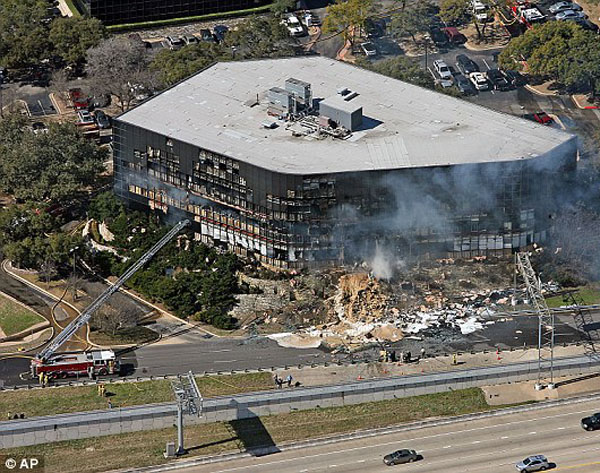
On February 18, 2010, Joseph Andrew Stack, flying a Piper Cherokee PA-28 (registration N2889D) plane, crashed into Building I of the Echelon office complex (above) in Austin, Texas, United States. An Internal Revenue Service (IRS) field office is located in the seven-story office building along with other state and federal government agencies. Stack had posted a manifesto dated February 18, 2010, to his business website. The pilot was killed in the incident along with Vernon Hunter, a 67-year-old Revenue Office Manager for the IRS. Thirteen people were reported as injured, two of them critically. Debris from the crash reportedly struck a Lexus sedan being driven on the southbound access road of U.S. Route 183 in front of the building and shattering the windshield. Another driver on the southbound access road of U.S. Route 183 had his windows and sunroof shattered during the impact and had debris fall inside his car yet escaped uninjured.


What should you look out for on the 10th anniversary of 9/11? Will there be more copycats?

The FBI and Homeland Security have issued a nationwide warning about al-Qaida threats to small airplanes, just days before the anniversary of the 2001 terrorist attacks.

Authorities say there is no specific or credible terrorist threat for the 10-year anniversary of the attacks on the World Trade Center and Pentagon. But they have stepped up security across America as a precaution.

According to a five-page law enforcement bulletin issued on September 2, 2011, as recently as early this year, al-Qaida was considering ways to attack airplanes.

The alert, issued ahead of the summer's last busy travel weekend, said terrorists have considered renting private planes and loading them with explosives.

"Al-Qaida and its affiliates have maintained an interest in obtaining aviation training, particularly on small aircraft, and in recruiting Western individuals for training in Europe or the United States, although we do not have current, credible information or intelligence of an imminent attack being planned," according to the bulletin obtained by The Associated Press.

The bulletin also says al-Qaida would like to use sympathetic Westerners to get flight training, then get them to become flight instructors.

Matthew Chandler, a spokesman for the Department of Homeland Security, described the bulletin as routine.

"We shared this information with our partners to highlight the need for continued awareness and vigilance," he said.

Aviation security is much tighter than it was a decade ago, but al-Qaida remains keenly interested in launching attacks on airplanes, believing large attacks with high body counts are more likely to grab headlines.

Threats to small airplanes are nothing new. After the 2001 attacks, the government grounded thousands of crop dusters amid fears the planes could be used in an attack.

In 2002, U.S. officials said they uncovered an al-Qaida plot to fly a small plane into a U.S. warship in the Gulf. And in 2003, U.S. officials uncovered an al-Qaida plot to crash an explosives-laden small aircraft into the American consulate in Karachi, Pakistan.

And, of course, there were all the very real incidents above, as well.

+++


List analysis 

September 11, 2001 – Four plane events: two fly into two separate buildings at the World Trade Center's Twin Towers; one flies into the Pentagon; one bound for a DC building crashes in Pennsylvania. (common knowledge, referenced in blog and detailed in The Copycat Effect - TCE)

January 5, 2002 – Small plane into Tampa's Bank of America Building (in blog and TCE)

April 18, 2002 – Small plane into Milan's Pirelli Tower (in blog and TCE)

May [4], 2002 – Indian air force jet crashed into Indian bank building (this was in the scholarly paper linked to my two examples above, noted in blog, but this Indian event merely may have been caused by mechanical failure - still it was a bank during a time when banks were being targeted);

November 17, 2002 – Attempted hijacking of plane in a stated "9/11 copycat plan" to fly into a Tel Aviv building (detailed in TCE)

November 27, 2002 – Attempted hijacking of plane by a man saying he was with al-Qaida on Bolonga, Italy to Paris flight (detailed in TCE)

January 7, 2003 – Frankfurt, Germany man stole plan and threatened to fly it into the European Central Bank (detailed in TCE)

September 12, 2005 – Attempted hijacking of plane from Florencia to Colombia's capital, Bogota (in blog)

September 13, 2005 – Attempted hijacking of plane from Addis Ababa to Tel Aviv (in blog)

September 17, 2005 – Small plane hijacked, threatened to be flown into Auckland, New Zealand's Star Tower (in blog)

January 22, 2008 – Attempted hijacking of plane to be flown into the Lafayette Cajundome in Lafayette, Louisiana (in blog) (Note: This is a young man who mirrored Charles Bishop's age and whose plot somewhat copied that January 2002 event.)

February 17, 2010 – Small plane crashes into Palo Alto, California neighborhood (by Telsa senior engineer) (in blog) (p.s. in TCE, majority of single plane crashes are suicides)

February 18, 2010 – Small plane (with homicidal-suicidal pilot) crashes into IRS field office in Austin, Texas at Building 1 of the Echelon office complex (in blog)

Details on the September 3, 2011, Homeland Security warning advisory on small planes. They include these two uncovered plots: "In 2002, U.S. officials said they uncovered an al-Qaida plot to fly a small plane into a U.S. warship in the Gulf. And in 2003, U.S. officials uncovered an al-Qaida plot to crash an explosives-laden small aircraft into the American consulate in Karachi, Pakistan." (in blog)