Showing posts with label Juneteenth. Show all posts

Saturday, June 20, 2020

The Allegorical Assault on Albert Pike


The last most significant demonstration on Juneteenth, June 19, 2020, was the toppling and symbolic burning of the Albert Pike statue in Washington D.C.


I foresaw this coming. I am not a conspiracy theorist. I am a predictor of human behavior based on social insights and psychological science.

A few in the synchromystic and cryptopolitical fields were able to forecast where the demonstrations might go. Michael Hoffman tweeted about the Pike monument six days ago. He was on-target. Although, according to Adam Parfrey's and Craig Heimbichner's Ritual America, Hoffman may have overstated Pike's "Satanism," as it has much to do with Pike's plagiarism. Hoffman and I disagree about some fundamentals but I listen to intelligent people, even with different bias than mine. We all have them.


Parfrey and Heimbichner did make the point in their book, however, that the usual Masonic pushback against the questioning of Pike's hidden leadership in establishing the Ku Klux Klan is weakened by the fact Pike's daughter shared a photograph of her father in a prominent position of authority for a book on the subject. Also, the KKK was set up, in essence, as a Lodge of Freemasonry, and Pike's involvement in creating it was covert but clear.


The Founders of the KKK. That's Pike in the central position.

Pike did not mince words in his support of slavery and of his negative feelings towards "negroes."

+++


Bill Grimstad and I have written about Albert Pike since 1978. I corresponded with Grimstad as recently as June 18, 2020, wondering aloud about the D.C. statue's probable removal.

Pike Name Game

Albert Pike was a failed Confederate general, a manipulator of Native peoples, pro-slavery, pro-Indian removal, and a supporter of his Native soldiers under his command scalping Union soldiers. There is little that was redeeming in his nature.


Pike went on to be to be elected Sovereign Grand Commander of the Scottish Rite's Southern Jurisdiction in 1859. One theory is that the Civil War may have begun as a battle between the northern & southern branches of Freemasonry ~ with the Scottish Rite being the "southern branch."

The Rebirth of Pan: Hidden Faces of the American Earth Spirit straightforwardly speaks to the "Pike Name Game."


The Pike section of this book, a difficult tome to find in libraries or via booksellers, begins with these words:

"Pike is a name only slightly less charged with strange significance than Fayette across our land."


© William Grimstad, with permission.


Grimstad is to be credited, besides noting Fayette, with alerting his readers to the "names like Bell, Beall and variants, Crowley, Francis, Grafton, Grubb, Magee/McGee, Mason, McKinney, Montpelier, Parsons, Pike, Shelby, Vernon, Watson/Watt, Williams/Williamson."

In Mysterious America, I talked of the “Name Game” or “Power” monikers of significance: Devil, Fayette, Lafayette, La/Fayetteville, Lagrange, Decatur, Pike, Wetzel, Reeves/Reed, Watts/Watkins/Watson, Bell, Mason/Macon, Parsons, Pike, Vernon, Logan, Shelby, and Warren. Also, I looked at Coleman via Coalman, the Perceivers, of course.

Pike is an English name for one who lived by a hill with a sharp point, from Old English pic “point,” “hill.” Also (1) a predatory fish; (2) a sharp pointed weapon; and (3) short for turnpike.  Pike as a boy's name is of English origin, and the meaning of Pike is "a spear.”

The harmonic naming of the United States of America, from Lafayette locations to Pike places, from Washington wonders to Decatur destinations, are part of Masonic America. The rest of the nation is beginning to be alert to the hidden meaning on the land.


How Quickly It Fell

It appeared various off-the-wall claims were afloat that the Masons were protecting D.C.'s Albert Pike statue. Or that Democratic leaders were looking to take down Confederate statues, but were ignoring the Pike memorial.

Instead, when the time came, events moved quickly.


Friday night, in Judiciary Square, exactly 13 blocks from the Capitol building, a crowd of 80-100 gathered steps away from the D.C. police headquarters, at 11:00 p.m., in front of the Albert Pike statue. Within 15 minutes, the monument was pulled off its pedestal and was on the ground. Demonstrators doused it with lighter fluid, and set it on fire. But since the statue is made of mostly bronze, the flames were more allegorical than damaging. Video.


June 20, 2020


National Mall and Memorial Parks, National Park Service (the caretakers of the Washington Monument, Lincoln Memorial, National Mall sites & more) confirmed to Fox5-DC, they have a truck at the site to remove the toppled Albert Pike statue by 3rd & D Streets NW. It will go to one of their maintenance facilities.


Before June 19, 2020.
Brigadier General Albert Pike was a public artwork in Washington, D.C. honoring Albert Pike (1809–1891), a senior officer of the Confederate States Army as well as a poet, lawyer, soldier, and influential figure in the Scottish Rite of freemasonry. The memorial was sited near the corner of 3rd and D Streets NW in the Judiciary Square neighborhood. The memorial's two bronze figures were sculpted by Gaetano Trentanove, an Italian-American artist responsible for another Washington, D.C. sculptural landmark, the Daniel Webster Memorial. The dedication ceremony in 1901 was attended by thousands of Masons who marched in a celebratory parade.


In 2009, the chapter, "The Double-Headed Phoenix" by Loren Coleman appeared in An Illustrated Guide to The Lost Symbol. (See here.)


The Pike memorial was the only outdoor sculpture in Washington, D.C. honoring a Confederate general. Though Pike was depicted as a Mason, not a soldier, the memorial often stirred controversy. The memorial was one of 18 Civil War monuments in Washington, D.C., which were collectively listed on the National Register of Historic Places in 1978. The memorial was owned and maintained by the National Park Service, a federal agency of the Interior Department.
The monument was toppled and burned by protesters on the night of June 19, 2020, as protests continued in response to the killing of George Floyd. Wikipedia


Pike's memorial has often stirred controversy throughout its history, beginning with the GAR's lobbying efforts against its erection to protesters arguing it honors a traitor and racist. Starting in the 1990s, there was renewed interest in removing the statue. In late 1992, members of the LaRouche movement, including civil rights activist and Lyndon LaRouche's vice presidential candidate James Bevel, began a series of protests demanding the memorial be removed, citing Pike's alleged links with the KKK. During one such event, LaRouche supporters draped Pike's statue with a KKK pointed hat and gown. Source.

The Future

A realistic view of this one week will see that great cultural change is occurring. The racist underpinning of everything from college football chants ("Gator Bait") to pancake brand names (Aunt Jemima), from Confederate statues to colonial monuments, are toppling in the wake of these events.

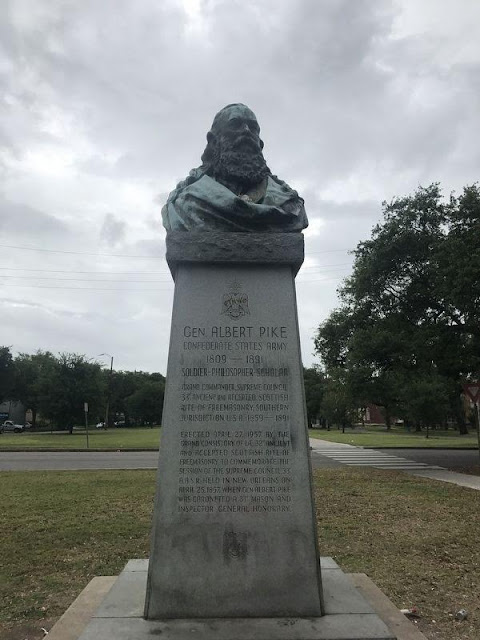
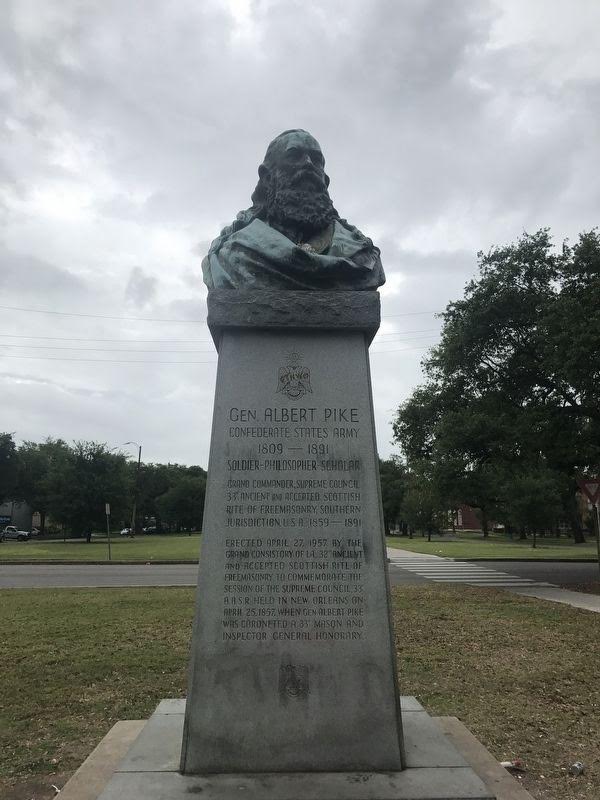
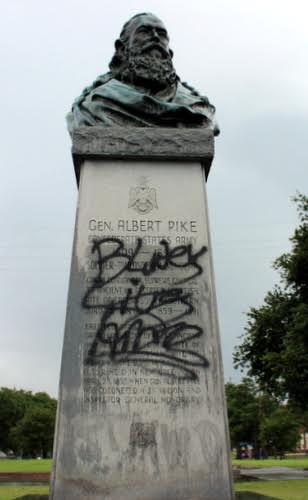
Look for the removal of other Confederate Brigadier General and Freemason Albert Pike’s monuments sitting outside in New York and mid-city New Orleans, but it is doubtful that any of his busts inside Masonic temples around the country will be disturbed (on private property).

Black lives matter. And as people look more closely at Pike's history in the future, perhaps, folks will figure out that Native lives matter too. Pike did not really care about America's indigenous peoples any more than he cared about Black ones.




See also:


Thursday, June 11, 2020

June 19: Tulsa Danger

UPDATE:
President Trump bowed to pressure on Friday night and announced that he would delay his upcoming campaign rally in Tulsa, Okla., rather than hold it on the day that honors the end of slavery in the United States and is considered a major holiday by many Black Americans.
The rally was originally set for next Friday, or June 19, the date known as Juneteenth, which marks the day in 1865 when Union soldiers arrived in Texas and read the Emancipation Proclamation announcing that slaves had been freed, the last of the Confederate states to officially receive the news, reported The New York Times.
Trump's campaign said they would hold the Tulsa rally on Saturday, June 20, 2020.


While I predicted June 17th would be a date to watch, it is becoming clearer that more danger may exist ahead for June 19, 2020.

One early commenter (Ra1119bee) at my posting "Take Heel on June 17" mentioned, "Also The Law of the Three is in play as well. So if your target is 17 then: June 14, 15, 16, and June 18, 19, 20 are all possible dates with the same 'energy' as your Target Date."

The 19th is now in focus.

The President of the United States appears to be creating a situation of theater of his own design. The choices for his proposed event is full of twilight language.

On Wednesday, June 10, 2020, the White House announced that President Donald Trump will host his first rally in months on Friday, June 19, 2020, in Tulsa, Oklahoma.

CNN observed: "The decision to hold a rally in Tulsa, a city with a checkered racial history, on June 19, or Juneteenth -- the day that marks the end of slavery in the United States -- is especially striking as the nation undergoes a conversation about racism in the wake of George Floyd's killing at the hands of police officers."

Juneteenth (a portmanteau of "June" and "nineteenth"), also known as Freedom Day, Jubilee Day, and Cel-Liberation Day, is an American holiday celebrated on June 19. On June 19, 1865, the Emancipation Proclamation (signed by President Abraham Lincoln) — which had been issued on January 1, 1863 — was read to enslaved African Americans in Texas by Gordon Granger. Texas was the last Confederate State to have the proclamation announced, after the end of the American Civil War in April of that year. Texas was the most remote of the slave states, and minimal fighting meant there were few Union troops present to enforce the Emancipation Proclamation until after the war ended.

The holiday is considered the "longest running African-American holiday" and has been called "America's second Independence Day," notes the media and the Encyclopedia of African American Popular Culture (2011).


Andy Thomas' The Republican Club, with Trump, Abraham Lincoln (sitting as he was when assassinated), Ronald Reagan (a target of an assassination attempt), and others, with Kamala Harris (?) coming forth in the background. It was featured on 60 Minutes in 2018. This painting was installed in the White House by Trump. See here.


Sen. Kamala Harris, a California Democrat who is widely viewed as a top contender to be Joe Biden's vice presidential pick, blasted Trump's decision to hold the rally there on Juneteenth.

"This isn't just a wink to white supremacists—he's throwing them a welcome home party," Harris tweeted Thursday [June 11, 2020]." 

Picking Tulsa seems like tossing dynamite on a fire, for another reason too, CNN wrote:

"In 1921, Tulsa was the site of a massacre of hundreds of African Americans during racial unrest in the historic section of the city known as 'Black Wall Street.'" 


The Tulsa race massacre (also called the Tulsa race riot, the Greenwood Massacre, or the Black Wall Street Massacre) of 1921 took place on May 31 and June 1, 1921, when mobs of white residents attacked black residents and businesses of the Greenwood District in Tulsa, Oklahoma. It has been called "the single worst incident of racial violence in American history." The attack, carried out on the ground and from private aircraft, destroyed more than 35 square blocks of the district—at that time the wealthiest black community in the United States, known as "Black Wall Street". More than 800 people were admitted to hospitals and as many as 6,000 black residents were interned at large facilities, many for several days. Source.


White America suffered from universal amnesia until HBO broadcast a new television series in 2019. Watchmen (2019), the acclaimed TV series on HBO, was based on the characters of the graphic novel of the same name. The series' producer, Damon Lindelof, was inspired to open the pilot episode with depictions of the white riots of the black massacre, and based the series on racial tensions after reading a 2014 Atlantic article by writer Ta-Nehesi Coates. Many aspects of the series' plot, centers on the legacy of the graphic novel and the massacre in an alternate timeline in the present day in Tulsa, where racial conflict remains high. The popularity of Watchmen was considered to be the first exposure to the Tulsa race massacre via the entertainment industry as its history was generally not widely discussed and had not been depicted in that form before.


This graphic from HBO's series Watchmen appears to broadcast the number 19.


HBO brought the Tulsa massacre alive, in a time when face masks were worn. It was an extremely prophetic series.

Tulsa has a history that is generally ignored. Coates wrote in the Atlantic article: "Terrorism carried the day. Federal troops withdrew from the South in 1877. The dream of Reconstruction died. For the next century, political violence was visited upon blacks wantonly, with special treatment meted out toward black people of ambition. Black schools and churches were burned to the ground. Black voters and the political candidates who attempted to rally them were intimidated, and some were murdered. At the end of World War I, black veterans returning to their homes were assaulted for daring to wear the American uniform. The demobilization of soldiers after the war, which put white and black veterans into competition for scarce jobs, produced the Red Summer of 1919: a succession of racist pogroms against dozens of cities ranging from Longview, Texas, to Chicago to Washington, D.C. Organized white violence against blacks continued into the 1920s—in 1921 a white mob leveled Tulsa’s “Black Wall Street,” and in 1923 another one razed the black town of Rosewood, Florida—and virtually no one was punished."

My research on adjusting the awareness from the 17th to the 19th was reinforced by such incoming comments, as by JDM: "I would look at June 19th. The MAGA rally in Tulsa is likely to be a flashpoint. See also tons of predictive programming from last fall's Watchmen television adaptation, which begins with the Black Wall Street [white] riots [and black massacre] and is set in Tulsa."


In the spring of 1921, a white mob leveled “Black Wall Street” in Tulsa, Oklahoma. Here, wounded prisoners ride in an Army truck during the martial law imposed by the Oklahoma governor in response to the race riot. (Hulton-Deutsch Collection/Corbis)


City of Tulsa leaders and other dignitaries dedicated the John Hope Franklin Reconciliation Park at 415 North Detroit, Tulsa, Oklahoma, in 2010. Reconciliation Park features elements that tell the story of the Tulsa Race Riot of 1921. The park is named for Franklin, the son of a race riot survivor. He became a leading scholar on black history. He died in 2009, shortly after the groundbreaking on the park.

Meanwhile, syncs from the George Floyd killing remain to be explored. See, for example, this video here.

Consider the counterfeit twenty dollar ($20) bill for which George Floyd reportedly was taken into custody. An Andrew Jackson bill. I am a bit shocked by the non-comments on the coincidence of it being a Jackson bill.


Jackson was a brutal slave owner who owned 300+ individuals in his lifetime, and he was known to pay extra rewards for the extensive whipping of his captured runaway slaves.

Also, as President Jackson, he was responsible for the Indian Removal Act.


A mounted Andrew Jackson statue is situated significantly in Lafayette Park, the location which had to be cleared of peaceful demonstrators for Trump's photo opportunity on May 31, 2020. The Fayette Factor again.

NASCAR issued a short statement on June 10, 2020 at 4:45 PM:

“The presence of the confederate flag at NASCAR events runs contrary to our commitment to providing a welcoming and inclusive environment for all fans, our competitors and our industry. Bringing people together around a love for racing and the community that it creates is what makes our fans and sport special. The display of the confederate flag will be prohibited from all NASCAR events and properties.”


Meanwhile, more statues were toppled:


Columbus statue in Boston was beheaded.


Confederate President Jefferson Davis statue was towed away in Richmond, Virginia.

The BBC reported, in part, this summary:
Statues of Confederate leaders and the explorer Christopher Columbus have been torn down in the US, as pressure grows on authorities to remove monuments connected to slavery and colonialism.
A statue of Confederate President Jefferson Davis was toppled in Richmond, Virginia, on Wednesday night.
Statues of Columbus in Boston, Miami and Virginia have been vandalised.
***
A number of Confederate statues on Monument Avenue in Richmond have been marked with graffiti during the protests.
Richmond also saw a statue of Italian explorer Columbus pulled down, set alight and thrown into a lake earlier this week,.
A three-metre tall (10ft) bronze statue of Columbus was toppled in Saint Paul, Minnesota, on Wednesday.
The Columbus statue in Boston, which stands on a plinth at the heart of town, was beheaded.
Many people in the US celebrate the memory of Columbus, who in school textbooks is credited with discovering "the New World", the Americas, in the 15th Century.
But Native American activists have long objected to honouring Columbus, saying that his expeditions to the Americas led to the colonisation and genocide of their ancestors.
***
Many cities and organisations have taken steps to remove Confederate symbols, which have long stirred controversy because of their association with racism.
Last week, for example, Virginia's Governor Ralph Northam announced that a statue of Confederate General Robert E Lee would be removed from Richmond.
However, a judge has since granted a temporary injunction stopping the removal.
Stock-car racing organisers Nascar announced on Wednesday it was banning Confederate flags, frequently seen at races.
US President Donald Trump has meanwhile rejected calls to rename military bases named after Confederate generals, saying they remain part of America's heritage.
He tweeted: "The United States of America trained and deployed our HEROES on these Hallowed Grounds, and won two World Wars. Therefore, my Administration will not even consider the renaming of these Magnificent and Fabled Military Installations."
* * *
On Thursday, Bristol City Council said it had retrieved the statue, which will be taken to a secure location before becoming a museum exhibit.
Earlier this week, a statue of noted slaveholder Robert Milligan was removed from outside the Museum of London Docklands.
And, during a Black Lives Matter protest in London last weekend, a statue of Sir Winston Churchill in Parliament Square was sprayed with graffiti. Source.

CNN carried a tally of Confederate statues removed since George Floyd's death here. See also the Wikipedia lists, here and here.


Example: In Tampa, Florida, Memoria In Aeterna ("Eternal Memory"), monument is comprised of two Confederate soldiers: one facing north, in a fresh uniform, upright and heading to battle, and the other facing south, his clothes tattered as he heads home humbled by war. Between them is a 32-foot-tall obelisk with the image of a Confederate flag chiseled into it. It was first erected in 1911 at Franklin and Lafayette Streets, and was moved on September 5, 2017, to the Brandon Family Cemetery.