Showing posts with label Mexico. Show all posts

Thursday, April 07, 2016

Bad Clowns Abound


This year has begun with a big bang in the world of the morbid fear of clowns. Released on April 1st, Benjamin Radford's new book, Bad Clowns (Albuquerque: University of New Mexico, 2016) is no joke.

Circus clowns have no redeeming value in this book. You will find John Wayne Gacy and  It's Pennywise, of course. But almost like a Fortean, Radford has filled this book with an awful collection, literary a "bad clown alley," as a group of evil clowns would be called. Radford, without any bias, one way or the other, tackles the topic of coulrophobia, evil clowns, criminal clowns, killer clowns, and nasty clowns in this insightful book.


Radford also takes on the topic for which I coined a new word, "Phantom Clowns." Indeed, he turns over an entire chapter, #12, to this special variety of clowns. As Radford (page 151) poetically states it, the Phantom Clowns seem "to exist somewhere in the twilight between the cold, clear reality of daylight and the slumbered stuff of nightmares."


In the 1980s, I first devoted an article about Phantom Clowns in Fate, and then expanded my thoughts on these reports in 1983's first edition of Mysterious America. As a reader here, you know I've continued this discussion on this blog.

So, how about an update on recent "bad clown" stories?

First, let's review two clown incidents from 2015, and get to two new ones from 2016.

(1) Antioch, Tennessee.


Vincente David Montano, in the crosshairs.

On August 5, 2015, a predicted theater incident occurred exactly two weeks after a shooting at a showing of Trainwreck in Lafayette, Louisiana. It involved a "man in a clown costume," as it was reported in the media. The Mad Max: Fury Road hatchet attack and air pistol shooting resulted in the death of the attacker. That incident took place at the Carmike Hickory 8 Cinema in Antioch, Tennessee. The gunman at the Hickory Hollow Cinema, Vincente David Montano (pictured above, in the news story) was allegedly armed with a hatchet, pepper spray, an Airsoft gun, and a fake bomb. He reportedly was wearing a surgical mask. Later reports said he actually was dressed up as a clown.


(2) Hickory, North Carolina.
Jimmy Daniel Rayon. Another clown?

Now comes word of an incident Friday, August 7, 2015, from Hickory, North Carolina. A woman living in the 1300 block of 20th Avenue NE in Hickory, reported to police that at 4:32 a.m. Friday a clown with an ax knocked at her residence. The suspect then began swinging an ax and attempted to cut the victim. The clown was wearing a mask and a multicolored wig. She was able to remove his mask and recognized him as an acquaintance before he left, according to the Hickory Daily Record. An arrest warrant was issued. The suspect, still at large, is Jimmy Daniel Raybon (pictured above) and he has an outstanding warrant for the charge of assault with a deadly weapon.

(3) Kassel, Germany


Two activists in clown costumes disrupted a meeting of the German anti-migrant party Alternative for Germany by throwing a cake into the face of Beatrix von Storch, one of the party’s leaders and a European Parliament member. The men approached von Storch while she was presiding over a closed-door Alternative for Germany party meeting held in Kassel, Germany, on February 28, 2016. They sang “Happy Birthday” as one of them threw a cake into von Storch’s face and the other filmed the incident.


(4) Sonora, Mexico.

Tony Tambor.

Clowns are an important part of culture in Mexico. But parties can get out of hand, if the children and parents don't like the clown events they buy - or the kids think the games didn't go their way. On the weekend of March 19-20, 2016, Tony Tambor, also known as Marco Antonio Vazquez, claims he was repeatedly punched and kicked at a Sonora, Mexico party for 30 children, according to the Houston Chronicle. Tambor may lose his eyesight, according to the Mexico News Daily.

Sometimes clowns get beat up. Other times they get killed or arrested. Clown behaviors have consequences.

Sunday, February 21, 2016

Kalamazoo Shooting


Starting at 6 pm local time, Saturday, February 20, 2016, a man in a black Chevy HHR began driving around Kalamazoo, Michigan, shooting and killing people. Some initial reports said nine or seven people were killed. It turns out that six did die, as one 14-year-old girl shot at a Cracker Barrel restaurant did not expire. She remains in critical condition in a hospital.

It was the 42nd shooting of 2016.*
The first shooting took place around 6 p.m., when a woman was shot four times in an apartment complex parking lot....She was with her three children. The woman is in serious condition.
Shortly after 10 p.m., two people were shot and killed at a car dealership....the victims were there looking at a vehicle.
Kelly Bainbridge was with her fiance and friends at Bell's Brewery in Kalamazoo when she started getting texts and calls from concerned family members about the gunman.
"As the shootings continued to occur, the situation because more frightening," Bainbridge told CNN. She was less than 4 miles away from the dealership.
Some of her friends decided to leave the bar, but Bainbridge and her fiance stayed. The brewery's owner locked the doors to protect his patrons.
Less than 8 miles away, the third shooting occurred, this time outside a Cracker Barrel. Five people in two separate cars were shot....
The suspect was arrested about two blocks away from the brewery, Bainbridge said. Source.
Kalamazoo County, Michigan, prosecutor Jeff Getting said Sunday that there is "no reason to believe" that the shooting rampage was related to terrorism. All the victims were picked at random.

The suspect, Jason Brian Dalton, 45, was arrested when his vehicle was recognized in downtown Kalamazoo early Sunday morning.

Authorities recovered a weapon from the suspect's car, his black Chevy HHR, shown below. (I hated to hear this news, as I always do, but also then to learn about Dalton's car, since my own personal car is a black Chevy HHR that was a sync I didn't wish to read.)
Uber driver?
 The man suspected of killing six people and injuring two more in a Saturday evening shooting rampage in Kalamazoo, Michigan, was an Uber driver who may have picked up passengers that same evening, according to the ride-sharing company and police. 
"Jason Brian Dalton had passed a background check, and was a driver-partner with Uber," said Uber's chief security officer, Joe Sullivan, in a statement. "We have reached out to the police to help with their investigation in any way that we can."
While the company did not address reports that Dalton picked up and dropped off customers Saturday night, authorities told CNN that it was "certainly part of our investigation."
"We're looking into his connection to Uber and whether or not he was picking up fares in between the shootings," said Public Safety Chief Jeff Hadley. CNN.

Jason is a common given name for a male. It comes from Greek Ἰάσων (Iasōn), meaning "healer," from the verb ἰάομαι, iaomai, "heal," "cure," cognate with Ἰασώ, Iasō, the goddess of healing and ἰατρός, iatros, "healer," "physician."

Brian is a male given name of Irish and Breton origin, as well as a surname of Occitan origin. It is common in the English-speaking world. It is possible that the name is derived from an Old Celtic word bre meaning "hill", or by extension "high, noble."
The name Dalton is an English name, with the meaning "from the farm in the dale." The Old English meaning is "valley town."

The name "Dalton" is familiar due to the Dalton Gang. The Dalton Gang was a group of outlaws in the American Old West during 1890–1892. It was also known as The Dalton Brothers because three of its members were brothers. The gang specialized in bank and train robberies. The Dalton Gang continues name-recognition because of its popular culture mentions.

Kalamazoo
Originally known as Bronson (after founder Titus Bronson) in the township of Arcadia, the names of both the city and the township were changed to "Kalamazoo" in 1836 and 1837, respectively. The Kalamazoo name comes from a Potawatomi word, first found in a British report in 1772. However, the Kalamazoo River, which passes through the modern city of Kalamazoo, was located on the route between Detroit and Fort Saint-Joseph (nowadays Niles, Michigan). French-Canadian traders, missionaries, and military personnel were quite familiar with this area during the French era and thereafter. The name for the Kalamazoo River was then known by Canadians and French as La rivière Kikanamaso. The name "Kikanamaso" was also recorded by Father Pierre Potier, a Jesuit missionary for the Huron-Wendats at the Assumption mission (south shore of Detroit), while en route to Fort Saint-Joseph during the fall of 1760. Legend has it that "Ki-ka-ma-sung," meaning "boiling water," referring to a footrace held each fall by local Native Americans, who had to run to the river and back before the pot boiled. Still another theory is that it means "the mirage or reflecting river." Another legend is that the image of "boiling water" referred to fog on the river as seen from the hills above the current downtown. The name was also given to the river that flows almost all the way across the state. Source.


HHR

The Chevrolet HHR (for Heritage High Roof) is a retro-styled station wagon launched by Chevrolet at the 2005 Los Angeles Auto Show as a 2006 model — and designed by Bryan Nesbitt. The HHR shares the GM Delta platform with the Chevrolet Cobalt, Pontiac G5, and Saturn Ion. In Mexico, it was sold alongside its predecessor, the Opel-sourced Chevrolet Zafira compact MPV.

The vehicle's design was inspired by the mid-1940s Chevrolet cars and trucks, specifically the 1947 Chevrolet Suburban and Advance Design pickups, with large, square fender flares and a hemispherical grille. The design of the HHR has been credited to Bryan Nesbitt who was a former designer at Chrysler where he was the lead designer of the Chrysler PT Cruiser.

The HHR was assembled in Ramos Arizpe, Mexico, and was available for sale throughout North America.

In the fourth quarter of 2010, Chevrolet announced that the HHR would be discontinued after the 2011 model year, with the last HHR's available in dealerships starting in late January to early February. HHRs were also available for fleet order until May 2011.


*42


Update: Uber riders who rode with Dalton in-between the shootings describe his vehicle as being silver, as it appears to be in the following photo.


Thursday, November 20, 2014

Trident Times: FSU, Zócalo, Mockingjay, and Bangkok


Watch for rising levels of violence, protests, and related activities on November 20-21, 2014. Here's some early indicators....


There has been a college shooting at Florida State University.

The shooter is dead and, at least, three students are seriously injured after being shot inside the first floor lobby at Strozier Library at Florida State University (FSU), in the heart of the Tallahassee campus. As CNN and other major news outlets are reporting, the shooting began around 12:30 am on Thursday, November 20, 2014.

The library is open 24 hours a day, and was packed with students studying for finals, before the beginning of Thanksgiving break. Police confronted the gunman (some accounts say on the steps of the library), who refused to drop his gun, and he was shot dead.


The male individual who shot several students on Florida State University's campus Thursday night was identified as a graduate who later became a lawyer. Myron May graduated from FSU before earning his law degree at Texas Tech, according to the Associated Press, which cited an unnamed official providing the information. The AP also interviewed a woman, Abigail Taunton, who said she rented a house to May.

May graduated from FSU in 2005.

Myron (Arabic = sweet oil) May was from Dayton, Ohio, and has lived in Lubbock, Texas; Houston, Texas; and most recently, Wewahitchka (Seminole = water eyes), Florida. Source.

Florida State University student Jason Derfuss found this bullet and damaged book in his backpack after leaving the scene of Thursday night's shooting at the campus library.

FSU is one of the top research universities in the nation. It has about 40,000 students spread out in various campuses in the city, and is also considered one of the nation's top-ranked football teams.

The history of the campus is long and detailed. In 1856, the land and buildings in an area formerly known as Gallows Hill, site of public executions in early Tallahassee, where the Florida Institute was built, was accepted as the site of the state seminary for male students. The cadets from the Confederate military school there defeated Union forces at the Battle of Natural Bridge in 1865. The FSU Army ROTC, to this day, is only one of four collegiate military units in the US with permission to display a Confederate battle streamer.

During the 1960s and 1970s the Florida State University became a center for student activism especially in the areas of racial integration, women's rights and opposition to the Vietnam War. The school acquired the nickname "Berkeley of the South." The FSU chapter of the Students for a Democratic Society were especially active there in 1969, leading to the "Night of the Bayonets."

"Seminoles, who lived and fought in swampy everglades, tended not to ride horses." The stereotype of the Plains Indians is used for the FSU mascot.
(The most recent school shooting before the FSU incident involved the Tulalip First Nation of Washington State. Six died in the Marysville-Pilchuck High School event of Friday, October 24, 2014.)

Florida State has been the home of the “Seminoles” since 1947. In recent years, the name and symbols tied to FSU has called "The Champions of Racist Mascots." Dave Zirin has written therein:

Any Florida State fanatic will shout at you, the university has “a formal agreement with Seminole Nation” and that makes everything all right.
...the existence of this “agreement with the Seminole Nation” is a myth.
The agreement is with the Florida Seminole Tribal Council and not the Seminole Nation. The majority of Seminoles don’t even live in Florida. They live in Oklahoma, one of the fruits of the Seminole Wars, the Indian Removal Act and The Trail of Tears. These Oklahoma Seminoles—who, remember, are the majority—oppose the name. On October 26, 2013, the Seminole Nation of Oklahoma’s governing body passed a resolution that read in part, “The Seminole Nation condemns the use of all American Indian sports team mascots in the public school system, by college and university level and by professional teams.”

FSU's logo, three burning staffs, contains the motto, vires, artes, mores (in Latin), strength, skill, character (in English).

Meanwhile, in Mexico,


RPJ writes from Mexico City:
Things might get VERY interesting [on Thursday, November 20, 2014] down here. They've announced a triple protest march, starting from different points of the city, and converging at the Zócalo plaza. A literal trident of angry people.

It's synchromystically interesting that [Thursday] is when we celebrate the 104th anniversary of the Mexican revolution, and a day later the first part of Mockingjay will be premiered worldwide.
There is great symbolism behind Zócalo:
The main plaza of Mexico City is commonly known as the Zócalo (Spanish pronunciation: [ˈsokalo], plinth), meaning plinth. It was the main ceremonial center in the Aztec city of Tenochtitlan and from the colonial period on, the main plaza or square in the heart of the historic center of Mexico City. The site is just one block southwest of the Templo Mayor which, according to Aztec legend and mythology, was considered the center of the universe....A European-style plaza was not part of the conquered Aztec Tenochtitlan; the old city had a sacred precinct or "teocalli" which was the absolute center of the city (and the universe, according to Aztec belief), but it was located to the immediate north and northeast of the modern-day Zócalo. Source.
"Mexico is facing an escalating political crisis amid growing fury over a mansion built for the presidential family and the disappearance and probable massacre of 43 student teachers," notes the Guardian article, "Mexico at breaking point as anti-government anger escalates."

Mockingjay and Bangkok

The movie, The Hunger Games: Mockingjay Part I, has the release dates in Indonesia and the Philippines of November 20th, and in the United States of November 21th. It is a movie about revolution.


"Tridents" are to be found in The Hunger Games via the "three-finger salute."


NBC News has broken the news, November 20, 2014, that protest leader Nachacha Kongudom was arrested by undercover cops outside a Bangkok cinema after using the Hunger Games three-finger salute to defy Thailand's military rulers. The new The Hunger Games movie has been pulled from the Apex chain of Thai theaters.


The Hunger Games salute has actually been banned by the Thai military.

The Hunger Games: Mockingjay – Part 1 is a 2014 American science fiction adventure film directed by Francis Lawrence with a screenplay by Peter Craig and Danny Strong. It is the first of two cinematic parts based on the novel Mockingjay, the final book in The Hunger Games trilogy, written by Suzanne Collins, and the third installment in The Hunger Games film series, produced by Nina Jacobson and Jon Kilik and distributed by Lionsgate. The film stars Jennifer Lawrence, Josh Hutcherson, Liam Hemsworth, Woody Harrelson, Elizabeth Banks, Julianne Moore, [the now deceased] Philip Seymour Hoffman, Jeffrey Wright, Stanley Tucci and Donald Sutherland. Source.
Other areas of concern...

The car rammings, protests, and now open attacks against Jews and Arabs related to the Temple Mount situation are increasing. (See here.) This is not going to go away. The fear after the recent massacre is high.

The Ferguson grand jury finding comes in soon too.

Also...

Michael Nichols, 83, director of Carnal Knowledge, The Odd Couple and The Graduate, has died of a heart attackWednesday evening.

Friday, November 15, 2013

Old Route 66 Again: McStay Remains Found


Victorville, California's Route 66 Museum.


Old Route 66 is in the news again. Recently, a murder of a college coach in Joplin, Missouri, and a Bigfoot hunt shooting at Catoosa, Oklahoma both took place along the old 66. Now comes word from Victorville, California, also along Route 66, of bodies of some missing people being found.

Two of the four sets of remains found this week in a Southern California desert are those of a couple who disappeared in 2010 -- Joseph McStay and his wife, Summer -- San Bernardino County Sheriff John McMahon said today, citing dental records.

Authorities believe the other two sets of remains are those of the McStays' sons, Joseph and Gianni, but those identities still need to be confirmed through DNA records, McMahon said. The manner of the deaths was homicide, he said.


Joseph McStay disappeared along with his wife, Summer, and their two young children, Gianni and Joey, in February 2010, launching what San Diego sheriff's investigators called their most extensive missing-persons search ever.

Investigators reportedly pursued hundreds of tips and eventually came to believe the family left voluntarily for Mexico. Investigators were convinced that four people seen on a dimly lit surveillance video walking into Tijuana, Mexico were the McStays.

Authorities announced Friday that remains found Wednesday in shallow graves near Victorville, about 60 miles northeast of Los Angeles, were those of 40-year-old Joseph McStay and his 43-year-old wife, Summer. Authorities said they believe the other remains belong to the McStay children, but they have more work to do to confirm it. Their deaths were determined to be homicides.

In 1926, the highway U.S. Route 66 was begun, and it passed through Victorville. Today, that former route is known as Seventh Street and continues across Interstate 15 and becomes Palmdale Road. It is the primary street through Old Town Victorville.

Autopsies were still being completed, and the cause of death has not been released.


The name McStay is Northern Irish (County Down) in origin, an altered form of Irish Mustey, which is an Anglicized form of Gaelic Ó Maoilstéighe "descendant of Maoilstéighe," a personal name of unknown origin.

Saturday, September 07, 2013

Mexico's Diana Huntress of Bus Drivers


Mexicans are very familiar with La Diana Cazadora, as it's known in Spanish. A stone monument of the Roman goddess, nude, long-haired and holding a bow, stands on Mexico City's Reforma Avenue, a major thoroughfare. A replica was erected in Ciudad Juarez.

Now a woman who calls herself "Diana, the Huntress" is killing bus drivers for revenge against sexual assaults on working women who ride the bus. Authorities say the elusive woman has killed at least two bus drivers in Ciudad Juarez, Mexico.

A police sketch of the woman dubbed "Diana Huntress of Bus Drivers," who is suspected of killing two bus drivers in Ciudad Juárez.
According to the Chihuahua state attorney's office, the unidentified woman, with either hair dyed blond or wearing a blond wig, shot and killed a city bus driver identified as Jose Roberto Flores Carrera, 45, on August 28. He was shot in the head several times.

Another bus driver, Fredy Zarate Morales, 32, was killed the next day, via shoots to the back of his head. In both cases, officials say, "Diana, the Hunter" boarded the buses and shot the drivers point blank.

After the second shooting, several media outlets in Ciudad Juarez reported receiving an e-mail from a sender claiming to be the killer. In the e-mail, she calls herself "Diana, the Hunter of Drivers."

She reportedly says in the e-mails that her motive is retaliation against bus drivers who have raped vulnerable women, especially those who work in the "maquiladoras," or foreign assembly plants (mainly American) on the Mexican side of the border.

"I'm an instrument that will avenge [the attacks against] several women," the e-mail is reported to say. "We seem weak to society, but we're truly not. We're courageous and, if they don't show respect to us, we will make them respect us by our own means. We women of Juarez are strong."

The Chihuahua state attorney's office released a sketch of the suspect Wednesday and asked for the public's help to catch her.

"The sketch was done after interviewing more than 20 people who witnessed the homicides and who gave us very valuable information for this investigation," authorities said in a statement.

The slayings have terrorized many bus drivers, especially those operating Route 4, also known as the Yellow Route, which serves main thoroughfares and downtown Ciudad Juarez, a city of 1.5 million located across the border from El Paso, Texas. The No 4 bus always enjoyed a certain reputation. Wending its way west from Ciudad Juárez's dilapidated centre to a lower-middle class suburb, through nondescript roads and strip malls, this was always a quiet journey in an unquiet city.

Thirty drivers normally cover the route, but many have decided not to show up for work since the second slaying. Julian Vazquez, a bus driver on the same route, is one of those still behind the wheel, although he admits he's afraid.

Ciudad Juarez gained international notoriety in the late 1990s and early 2000s after a wave of slayings involving women. The victims, mainly young, single women, would disappear, their bodies later found in shallow graves in desert areas around the arid city. According to an Amnesty International report, 370 young women and girl were killed in Ciudad Juarez between 1993 and 2005. Most of the slayings remain unsolved.

The Fountain of Diana the Huntress (originally The Flechadora of the North Stars) is a monument located in Paseo de la Reforma in Mexico City . Its construction began in 1938. The fountain was designed by the architect Vicente Mendiola Quezada , and the sculpture was created by sculptor Juan Fernando Olaguíbel , was inaugurated on October 10, 1942 by President Manuel Ávila Camacho . It depicts the goddess Artemis or Diana, deity of the hunt. It is one of the best known and represented icons of the Mexican capital - and throughout the nation.

The sculpture of Diana the Huntress, whose real name is "The Flechadora of the North Star" (La flechadora de las estrellas del norte) began its history in 1942, when then-President of Mexico, Manuel Avila Camacho, through the mayor of Mexico City, Javier Rojo Gomez, began a program of beautification of the city that included the creation of several monumental fountains representative roundabouts or corners.

The architect Vicente Mendiola and sculptor Juan Olaguíbel , were commissioned to undertake the construction of one of these sources for a gazebo that was located on the Paseo de la Reforma near the entrance to Chapultepec Park . The theme chosen was that of Diana, the Roman goddess of the hunt, the moon, but this source, that goddess, instead of hunting with his bow beasts in the woods, now Flecharía the Stars of the northern skies, hence the name of the sculpture.


The identity of who posed for the artist has long been a mystery, until the year 1992 it was revealed that the model was 16 years old, was called Verdayes Helvia Martinez (now widow of Jorge Diaz Serrano ) and worked for evenings as a secretary in the offices of Petroleos Mexicanos , in an office led by Vicente Mendiola , friend of the sculptor. It was there that he suggested she modeled for the sculpture. She accepted and the sculpture was made from April to September 1942, the month in which was finally held in bronze casting of it. During that time, Martinez Verdayes Helvia posed nude for the sculptor without receiving other pay than vanity to see his body immortalized in one of the most beautiful avenues in the city. However, to avoid scandal, she asked to keep his identity anonymous, as declared later in interviews to Channel 22 and the magazine Macrópolis in June 1992, plus she was the model of the source of Petroleos 10 years later, in 1952.

La flechadora de las estrellas del norte was opened on October 10, 1942 and since that time he won the affection of the people, who began to call "Diana the Huntress," but since that time also received criticism from more ultraconservative sectors of Mexican society at the time, and a year later the League of Decency, after a series of protests that included placing fabric underwear on sculpture, got him placed Juan Olaguíbel underpants bronze to his work. However, the artist other times providing more freedom-only fixed it with three spot welds in waiting to remove later.

Over time, the mentality of Mexican society was transformed and, to seize the holding Mexico Olympics in 1968, the then ruler Alfonso Corona del Rosal, in response to a request from John Olaguíbel, decided to withdraw the bronze loincloth sculpture, and so after 25 years, Diana returned to shine its original beauty in 1967. However, to accomplish this, the statue suffered some damage. To remedy the situation, it was decided melt a flawless new piece to occupy that place, while that was damaged was sold by the artist to the regent to prevent the piece was destroyed. That piece was donated by political Ixmiquilpan, Hidalgo, his hometown, where he remained from 1970.


Statues of Diana the Huntress are in various locations throughout Mexico, such as this one above from Acapulco de Juárez.

(Some information was obtained from English translations of Spanish text, so I apologize for any errors in transmission of the correct data.)


Monday, July 25, 2011

Knights Templars of Norway and Mexico

For Part One, on the Anders Behring Breivik attacks in Norway of July 22, 2011, click and read here.
CNN have written this about the upswelling of Templarism. (Tip of hat to aferrismoon who left the mention attached to another posting not related to this topic, by mistake.)
The Washington Post's Elizabeth Flock has highlighted the Knights Templar link to the Norwegian attacks. She writes:
Knights Templar: Norway ‘crusader’s’ group explained


This image of Anders Behring Breivik from a manifesto attributed to him shows Breivik in a uniform with a white and red cross of the Knights Templar. (AP)

In a detailed diary kept by Anders Behring Breivik — the Norwegian man charged with killing at least 94 people in a bombing in Oslo and shooting on a nearby island Friday — the suspect details months of preparations...

Breivik also exhaustively references the Knights Templar, which he calls an “international Christian military order,” that “fights” against “Islamic suppression.”

Monday, it was reported that a Mexican drug ring also invoked the obscure Knights Templar.

Who are they?

The Knights Templar’s earliest function in around 1119 was to protect Christian pilgrims traveling to the Holy Land. The armed group soon became known as the most skilled in the battles to reclaim Jerusalem from the Arabs and racked up several successive victories over Muslim forces.

But by 1303, the knights had been forced out of the Holy Land and returned to western Europe. They fled to France, where they were seen as an armed threat by King Philip the Fair, who had many of them tortured and executed. The king had the support of Pope Clement V, who issued a papal bull that made sure the group was disbanded by 1312.

Since then, rumors of the surviving knights have come and gone, including one rumor that the knights could destroy the Catholic church with a single secret they held.

Breivik says the Christian military order was refounded in 2002 in London under the name PCCTS as an armed “anti-Jihad crusader-organization.”

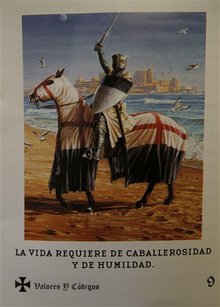
The Templar are recognizable by white tunics with red crosses, a symbol Breivik put on the front page of his “2083: A European Declaration of Independence,” and emblazoned on homemade uniforms featured on his Facebook page.
Read here for the rest of Flock's blog.
Regarding the Mexican connection, the following is an earlier summary of that news:
Mexico: Top hitman for Knights Templar gang nabbed
July 13, 2011 
MEXICO CITY (AP) — Mexico's federal police have caught the top hitman for the Knights Templar drug gang in the western state of Michoacan, authorities said Wednesday.
Federal police allege that suspect Javier Beltran Arco oversaw murders for the meth-trafficking gang. Beltran Arco is known by the nickname "El Chivo," or The Goat.
A federal police statement said that two suspected cartel lookouts had been detained with Beltran Arco, along with three assault rifles and about two pounds (0.8 kilograms) of methamphetamines.
Police also found books, clothing and banners referring to the Knights Templar, the statement said.
The gang split off recently from La Familia, a Michoacan-based drug cartel that also uses quasi-religious rhetoric and instructional material.
Also in Michoacan, authorities announced the seizure of 44 metric tons of chemicals used to produce methamphetamine. The material was found at the Lazaro Cardenas seaport in two containers that had been shipped from Shanghai in China.
In the northern Mexico border city of Ciudad Juarez, prosecutors raised Tuesday's total of homicides to 21 from a previously reported 18. That made it the bloodiest day of 2011 so far, surpassing the 20 killings reported Feb. 18.
Ciudad Juarez, which sits across the border from El Paso, Texas, is a sprawling industrial city that has been plagued by violence as rival drug cartels fight over turf and smuggling routes. AP.
For more information on the Knights Templar booklet, robes, and other evidence (shown below) discovered in Mexico, see here.


July 14, 2011: White robes with Maltese crosses and Templar Knights paraphernalia are shown to the press when a training camp was discovered after a firefight between Mexican army soldiers and gunmen in the woods near the town of Santa Gertrudis, Mexico.