Showing posts with label Mysterious America. Show all posts

Tuesday, June 02, 2020

George Floyd and the Fayette Factor: Fayetteville to Lafayette Square


George Perry Floyd (Oct 14, 1973 – May 25, 2020, age 46) was born in Fayetteville, North Carolina. Over 140 cities were impacted by the demonstrations and uprisings coming in the wake of the murder of George Floyd in Minneapolis on Memorial Day, May 25, 2020.  See "George Floyd: Syncs, Coincidences, and Name Games" for more.


One location was Market House, Fayetteville, North Carolina, built in 1832, and was formally used as a site to sell slaves. It was set on fire on May 31, 2020. 


On June 1, 2020, there was a peaceful Floyd-related protest in Lafayette Square, Washington, D.C.  This occurred right as President Donald J. Trump gave a speech in the Rose Garden where he said, "I'm an ally to peaceful protestors."At the same time, the US Park Police and Secret Service, under orders from Trump, pushed the protesters out of the way with their shields, used smoke bombs, flash-bang shells, and rubber bullets to clear a path for Trump to walk across the street to St. John's Episcopal Church for a 7:04 minute photo op with him holding up a Bible.


Lafayette Park/Lafayette Square
Planned as part of the pleasure grounds surrounding the Executive Mansion, this square was originally part of "President's Park", which is the larger National Park Service unit that also includes the White House grounds, The Ellipse, the Eisenhower Executive Office Building and grounds and the Treasury Building and grounds. In 1804, President Thomas Jefferson had Pennsylvania Avenue cut through that park, separating what would become Lafayette Square from the White House grounds. In 1824, the park was officially renamed in honor of the Marquis de Lafayette, the French general whose involvement was indispensable in securing victory in the American Revolutionary War.
Why was the park renamed in 1824? The year is significant as the year of Lafayette's grand Masonic tour of America. The Marquis de Lafayette was the last surviving French general of the American Revolutionary War in 1824, and he made a tour of the 24 states in the United States from July 1824 to September 1825. He was received by the populace with a hero's welcome at many stops, and many honors and monuments were presented to commemorate and memorialize the visit. Lafayette was only nineteen years old when entering America with no combat experience.

Lafayette laying cornerstone of Bunker Hill Monument June 17, 1825.

New York, Boston, and Philadelphia did their best to outdo each other in the celebrations honoring Lafayette. Philadelphia renovated the Old State House (today Independence Hall) which might otherwise have been torn down, because they needed a location for a reception to him. Until that point, it had not been usual in the United States to build monuments, but Lafayette's visit set off a wave of construction—usually with him laying the cornerstone himself, in his capacity as mason. The arts benefited by his visit, as well, as many cities commissioned portraits for their civic buildings, and the likenesses were seen on innumerable souvenirs. Lafayette had intended to visit only the original 13 states during a four-month visit, but the stay stretched to 16 months as he visited all 24 states.
The towns and cities that he visited gave him enthusiastic welcomes, including Fayetteville, North Carolina, the first city named in his honor. Source.


President Andrew Jackson statue.

Lafayette Square has been used as a racetrack, a graveyard, a zoo, a slave market, an encampment for soldiers during the War of 1812, and many political protests and celebrations. In 1851, Andrew Jackson Downing landscaped Lafayette Square in the picturesque style. On February 27, 1859 Representative Daniel Sickles killed Philip Barton Key II in Lafayette Square. Key had come to the park for an assignation with Sickles' wife, only to be discovered and killed by the congressman.
Major General Comte Jean de Rochambeau statue.

Major General Marquis Gilbert de Lafayette statue.
Today's plan, with its five large statues, dates from the 1930s. In the center stands Clark Mills' equestrian statue of President Andrew Jackson, erected in 1853. In the four corners are statues of foreign Revolutionary War heroes: Major General Marquis Gilbert de Lafayette and Major General Comte Jean de Rochambeau of France, Brigadier General Thaddeus Kosciuszko of Poland, and Major General Friedrich Wilhelm von Steuben of Prussia. Source: Wikipedia.

The Fayette Factor

The Fayette Factor, as I characterize it, was first documented by researcher and writer William Grimstad back in 1977. Grimstad wrote about the Fayette concept in an article entitled "Fateful Fayette," Fortean Times, No. 25, Spring 1978, and in his two books - Weird America and The Rebirth of Pan - credited as being authored by "Jim Brandon," who we know as Bill Grimstad. In all editions of Mysterious America (1983 through 2007), you will find added material on the "Fayette" name game.

The "Fayette Factor" is a phrase capturing the surprisingly high numbers of Fortean or inexplicable events, violent incidents, and synchromystic findings linked to places named after one of the USA's Founding Fathers--Gilbert du Motier, the Marquis de Lafayette (1757–1834).

The word "fay" + "ette" = "fairy" + "little" = little little people.

Lafayette can also be translated from the French as "the little enchantment," as well as "the little fairy." Joan of Arc at the age of 8 danced around a "fay tree," a "fairy tree," some saying she saw fairies (which links to the French surname from Occitan, "the little beech tree"). Others tell that she heard voices, had visions, and was "enchanted."

The cities, towns, and counties across the United States, which are the hotspots linked to the Fayette Factor, are tied to the renamed Masonic lodges and affiliated sites that the Marquis de Lafayette visited on his grand tour of the country in 1824-1825. His visits were highly ritualized happenings, in which he was involved with laying many cornerstones. 

For a list of all the postings on "Twilight Language" related to the Fayette Factor, see here.


All three books deal with the "Fayette Factor" and the "Name Game."

For autographed copies of Mysterious America, click on the title.

Wednesday, September 12, 2018

Ohio's Sasquatch Triangle


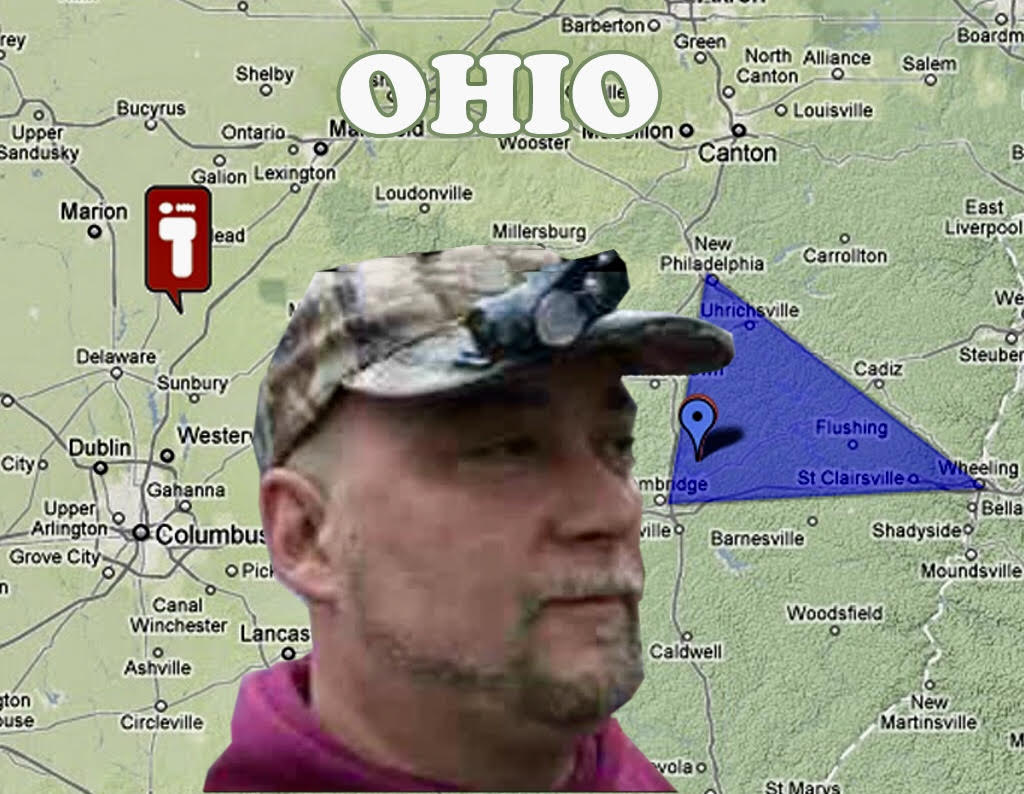
Ten years ago, on June 18, 2008, Don Keating, the head of the Eastern Ohio Bigfoot Investigation Center, appeared on MonsterQuest to detail his investigations of local sightings. The creatures were known as the Ohio Grassman and where they lived was called the Sasquatch Triangle.


The Sasquatch Triangle of Ohio is a well-established research area of Bigfoot sightings, although some investigators may disagree on the exact borders of the "triangle."

As Guy Edwards notes in his Bigfoot Lunch Club, January 28, 2012: "This triangle, including sections of Tuscarawas, Guernsey, Muskingum and Coshocton counties, is home to the most frequent Bigfoot sightings in the state."

Don Keating is generally given credit for coining the word, although you will find internet mention of a "newspaper" having come up with the term in 1987. I find this a misunderstanding of the stories that began to appear about Keating's search groups.

For example, in the following article published on April 19, 1987, in the Dover Times Reporter, Dover, Ohio, the content centers on Don Keating and his associates.


Below, on the right is Donald Keating, who first published in 1987, The Sasquatch Triangle, about this specific area in Ohio. Keating began the concept of large Bigfoot conferences in Newcomerstown, Ohio; they evolved into the Ohio Bigfoot Conference today run by Marc DeWerth.


In 2001, Keating self-published his The Sasquatch Triangle Revisited, a revised edition of his original work.


When Finding Bigfoot broadcast their episode on Sunday, January 29, 2012, about the Sasquatch Triangle and Ohio Grassmen, they focused on local hunter Tim Stover.


In recent years, Don Keating is known and respected in East-Central Ohio, as a television weatherman. 


Sometimes you do need a weatherperson to know which way the wind blows...

++++++++++++++++++++++

About other "Triangles":

See also "Top Ten American 'Bridgewater Triangles'" in Twilight Language, August 30, 2015. 


I first wrote about the “Bridgewater Triangle” in Boston Magazine in 1980, and in my book Mysterious America in 1983. Vincent Gaddis coined the name “Bermuda Triangle” in Argosy, February 1964. There is some thought that Ivan T. Sanderson worked with Gaddis on the concept from the beginning.

Sanderson died February 19, 1973, at 62. Gaddis died February 25, 1997, at 83. Keating and Coleman, needless to say, are still alive and active.

Wednesday, August 15, 2018

Michael A. Persinger, Developed God Helmet, Dies

A youthful Michael A. Persinger, Ph. D., was an early Fortean.

In the early 1970s, when Jerry Clark and I were writing extensively together, often for Fate, on Illinois cases, I engaged in an intense but brief correspondence with Michael A. Persinger. He was a professor interested in out-of-the-ordinary reports of all kinds. I found him a bright individual who was well-read on Forteana.


I was struck later to find his book, Space-Time Transients and Unusual Events, (Chicago: Nelson-Hall, 1977) contained maps, which correlated high levels of Fortean weirdness for southern Illinois based on the Clark-Coleman articles. I spoke of my skepticism for these results in Mysterious America (1983). 


On August 15, 2018, Laurentian University announced on Twitter that Dr. Michael Persinger has passed away at the age of 73, on Tuesday, August 14, 2018, at Sudbury, Ontario, Canada.

A professor of psychology at Laurentian since 1971, Persinger is perhaps best-known for the development of the "God Helmet," a device used to study creativity, religious experiences, and the effects of stimulation of the temporal lobes.


The God Helmet is a popular name given to a laboratory apparatus originally called the "Koren Helmet," after Stanley Koren of Laurentian University's Neuroscience Department, who built it according to specifications provided by Dr. Michael A. Persinger, it's director.


Michael A. Persinger (born June 26, 1945, Jacksonville, Florida) was most well-known for hypotheses that concluded the temporal lobes as the central correlate for mystical experiences, that subtle changes in geomagnetic activity were mediators of parapsychological phenomena, that the tectonic strain within the Earth’s crust was the source of luminous phenomena attributed to unidentified aerial objects, and that the importance were specific quantifications for energy (10−20 Joules), photon flux density (picoWatt per meter squared), and small shifts in magnetic field intensities (picoTesla to nanoTesla range) for integrating cellular activity as well as human thought with universal phenomena.

His major research themes have involved electromagnetic field effects upon biological organisms, epilepsy, temporal lobe functions, properties of biophotons, geophysical-human interactions, physical cosmology, and the quantifiable examination of what Persinger terms "low-probability phenomena," such as time travel, parallel universes, and the universe as a simulation.

In November 2006, Persinger called the school's administration “draconian” and “fascist” when they refused to allow a television crew to film a demonstration of his research.

In February 2007, he was asked to vacate three testing rooms at Laurentian's animal care facility, due to a shortage of research space on the campus.

At the time, Persinger's students filed a lawsuit against the university for locking them out of the research space and he filed a grievance with the faculty association to remedy the situation.

Despite his feuds with Laurentian's administration over the years, Persinger has also been recognized for his teaching style.

In 2007, he won a TVOntario contest and was named the province's best lecturer.

Persinger made national news headlines in 2016 when he was removed from a course by the university because of a form he had students sign, warning them that they would encounter some words and language that they may find offensive.

An online petition was started to re-instate Persinger, which garnered hundreds of signatures and positive comments from students who believed he was being treated unfairly.


Sunday, February 26, 2017

Bellingham's Ramming: Bell Name Game Again

After rammings in Heilelberg and New Orleans, there has been another. On Sunday, February 26, 2017, a car ramming took place in London.


At about 8:20 am on Sunday, February 26, 2017, a car rammed into pedestrians on Bromley Road, Bellingham, southeast London. Five people have been injured, with at least one person trapped under the vehicle at the site.

Allegedly, the driver reportedly lost control and crashed into the group of pedestrians before hitting a wall.

The driver was detained at the scene by an off duty police officer before being arrested on suspicion of drink driving and causing serious injury by dangerous driving.
The road remains closed as investigations are carried out.

A spokesman for the Metropolitan Police said:
Five people - four men and a woman, believed to be aged between 25 and 46 years - were treated at the scene before being taken to south and east London hospitals.
Three of the pedestrians - a 35-year-old woman and two 25-year-old men remain in a critical condition.
Two other men, aged 36 and 46 are in a stable condition; their injuries are not believed to be life-threatening.
The driver of the car was detained at the scene by an off-duty police officer before being arrested on suspicion of causing serious injury by dangerous driving.
He was also arrested on suspicion of drink drive before being taken to a south London hospital with a head injury.
The crash happened opposite a car wash outside Catford bus garage.

Photos posted online show a Mercedes sedan that appears to have come off the road and rammed into the end of a hedge, its hood and trunk popped open by the impact. 


Bellingham, U.K.
Bellingham is an area of southeast London, Within the London Borough of Lewisham. It lies south of Lewisham and north of Beckenham.
The Bellingham Estate is an London County Council cottage estate bordered to the east and west by railway lines running south from Catford. Along the south it is bordered by Southend Lane, the A2218 main road. The River Ravensbourne runs through Bellingham, although it is either underground or part of a man-made section of the river. The Prime Meridian passes to the east of Bellingham.
Randlesdown Road serves as a mini "High Street" for Bellingham providing a local supermarket, men's and women's hair dressers, dry cleaner, off license, newsagent, fish and chip shop, pub, various takeaways and a recently built gym (situated on Bellingham playing fields). Source.

Bellingham, Washington State, U.S.A.

Bellingham in America is a well-known site of strangeness. "Bellingham alone has been linked to no less than four serial killers in the last 30 years," writes Ali LeRoy in "Bellingham's Most Violent Visitors." (Thanks, RDS.)


Bellingham has been a focus of Bigfoot cases, conferences, and even the tragic death of a Sasquatch conference organizer, Star Sams, in 2006. Source.

The X-Files episode "Jose Chung's From Outer Space" has the Air Force pilot, dressed as an alien, as being shown to be born in Bellingham, Washington. (Thanks, AWG.)

Bell Green
Bell Green is an area in the London Borough of Lewisham, between Perry Vale and Bellingham. The area was historically known for its gas works and the poverty of the local workers, in what Charles Booth called "the one really poor district in this quarter of London." The gasworks closed in 1968 and the whole area redeveloped; it is best known today for the eponymous retail park. Source.

Bell Name Game, Again

Are we seeing a bit of the The Name Game this weekend? Should we watch what monikers come our way through Tuesday, Mardi Gras?

In Jim Brandon's 1983 book, The Rebirth of Pan: Hidden Faces of the American Earth Spirit, he writes, regarding the "name game":
I'm not talking here of such spooky tongue-twisters as H.P. Lovecraft's Yog-Sothoth or Arthur Machen's Ishakshar, but of quite ordinary names like Bell, Beall and variants, Crowley, Francis, Grafton, Grubb, Magee/McGee, Mason, McKinney, Montpelier, Parsons, Pike, Shelby, Vernon, Watson/Watt, Williams/Williamson. I have others on file, but these are the ones which I have accumulated the most instances.
Besides detailing the Fayette Factor often, in my 1983 Mysterious America, I noted:
Cryptologic or coincidence? Jim Brandon should be credited with calling attention to the name Watts/Watkins/Watson, and its entanglement with inexplicable things. Some other names involved in mysterious events pinpointed by Brandon are Bell, Mason, Parsons, Pike, Vernon, and Warren. The influence of such names as Mason, Pike, Warren, and Lafayette, for example, issues, in some cryptopolitical and occult way, from their ties to the Masonic tradition.


See also:

Sunday, January 01, 2017

Top Ten Creepy Clown Clusters of 2016


Top Ten Creepy Clown Clusters of 2016

by Loren Coleman, author of The Copycat Effect 
(New York: Simon and Schuster, 2004).


Following in the tradition of my clown list from 2008, my notes on evil clowns (and Joker copycats) for 2009, my documenting of real killer clowns in 2010, my list of evil clowns of 2011, similar weirdness in 2012, a compilation for 2013, and the creepy clown reports in California, countrywide in the USA & in France, ending us back in Aurora for 2014, and finally Top Ten Evil Clown Stories of 2015, here is my new "top ten" gathering of "creepy clown clusters" that occurred in the extraordinary Year of 2016.


First, let us reflect on 2016. No year since 1981 - when Phantom Clowns were sighted and then first discussed in book form via Mysterious America -  has there been such a multilayered, massive explosion of reports of clown accounts among the populace, first in America, and then worldwide.

The hints began in the Spring of '16, overseas.

(1) Germany ~ February


The first unusual clown event of 2016 occurred in Kassel, Germany. Two activists in clown costumes disrupted a meeting of the German anti-migrant party Alternative for Germany by throwing a cake into the face of Beatrix von Storch, one of the party’s leaders and a European Parliament member. The men approached von Storch while she was presiding over a closed-door Alternative for Germany party meeting held in Kassel, Germany, on February 28, 2016. They sang “Happy Birthday” as one of them threw a cake into von Storch’s face and the other filmed the incident.

(2) Mexico ~ March


On the weekend of March 19-20, 2016, Tony Tambor, also known as Marco Antonio Vazquez, claimed he was repeatedly punched and kicked at a Sonora, Mexico party for 30 children, according to the Houston Chronicle. Tambor may lose his eyesight, according to the Mexico News Daily.


(3) Wisconsin ~ August


The largest wave of reports of clowns in recent history began in a small way in Green Bay, Wisconsin, in early August 2016. A mysterious clown that seemingly came out of someone’s warped sense of humor was spotted in Green Bay, according to photographs making the rounds of the social media. A Facebook page called “Gags – The Green Bay Clown” claimed the first sighting happened August 1, 2016, at 2:00 a.m.

By definition, these clowns were "stalking clowns."

(4) Carolinas ~ August


"Phantom Clowns" soon popped up. On August 29, 2016, residents at the Fleetwood Manor Apartments in Greenville County, South Carolina, reported that a person wearing a clown costume had been spotted lurking around the apartment complex trying to convince children to come into the woods. This was followed quickly on September 4, 2016, when police in Winston-Salem, North Carolina, received a call about a clown looking to lure children into the woods. The Phantom Clown accounts then spread throughout the Carolinas. See also "Phantom Clowns in Greenville: Four Sightings," "Phantom Clowns: Spartanburg," "Phantom Clowns: Winston-Salem," "Phantom Clowns: Two New Piedmont Triad Incidents," "Phantom Clowns: Fayette Factor," and "Phantom Clowns: High Point."


These reports were classic "Phantom Clowns," and did not seem to be real people dressing up as clowns, i.e. "Stalking Clowns." See, "Phantom Clowns: Classified."

(5) Ohio ~ August


Like dropping a pebble in a pond, the ripples of Phantom Clown sightings went out from the Carolinas. Ohio seemed to be hit first.

A knife-wielding clown reported in the Northland area might prove a hoax, but Columbus, Ohio, police say they aren't taking any chances. A 14-year-old boy told police that a 6-foot-tall man in dark clothing and a clown mask chased him a short distance as he walked to a school bus stop at about 6:15 a.m. Tuesday, August 30, 2016, said police spokesman Sgt. Rich Weiner.  The boy told police that the incident occurred just before sunrise in his neighborhood, near Satinwood and Ironwood drives.

See also, "Phantom Clowns: Ohio."

(6) Georgia and Alabama ~ September


Next, leaping from the Carolinas to Ohio, clown incidents turned up in Georgia and Alabama. On September 14, 2016, McDuffie County deputies in Georgia say Cameron Frails, 12, and his little brother, were walking to a bus stop when they were chased by men donning clown costumes. The next day, on September 15, 2016, authorities locked down Escambia County High School and Flomaton High School in Southern Alabama after clowns threaten students and post gun emojis on Facebook. So-called "Flomo Klowns" were spotted on the premises of both schools. On September 15, 2016, police in Flomaton, Alabama, arrest 22-year-old Makayla Smith and two underage accomplices in connection with the threats to students at Escambia County High School and Flomaton High School. A middle school girl in Athens, Georgia, was arrested on September 21, 2016, after bringing a knife into school. She claims it was for protection against clown attacks.

See also, "Phantom Clowns: Alabama," "Phantom Clown: Macon + LaGrange," and "Phantom Clowns: Greensboro + Green Name Game."

(7) United States ~ September

Creepy Clown Sightings Map 2016.


After the initial sightings, all kinds of encounters with clowns were reported throughout the United States, as can be seen from this summary or this one.

    Sep. 19: Several children report a series of clown sightings in different neighborhoods of Annapolis, Maryland. Police later confirm the reports to be a hoax.
    Sep. 21: A 12-year-old in Pottsville, Pennsylvania, is chased by a clown through a park.
    Sep. 24: A Palm Bay, Florida, resident reports spotting two “killer clowns” while walking her dog. She says the clowns were staring at her and frightened her to the point that she called police after returning home.
    Sep. 25: A child in Phillipsburg, New Jersey, is chased by three people who emerged from the woods dressed as clowns. Nobody has been hurt in the town but it is the fourth such incident reported in the area. Residents plead with the troublemakers to stop their antics.
    Sep. 27: Tennessee officials put out a warning telling residents to be vigilant as Halloween approaches. One teenager reports being attacked by a clown.
    Sep. 27: Police in Phoenix say two different fast-food restaurants were robbed by suspects wearing clown masks.
    Sep. 30: The New York Times reports that false reports or threats in connection to sightings of "creepy clowns" have led to the arrest of 12 people in over 10 states.
    Sep. 30: Threatening Facebook post from the account "Aint Clownin Around" leave at least five schools in three separate states on high alert. The post sent to students in students in Westside High School in Houston reads, "We will be at all High schools this Friday to either kidnap students or kill teachers going to they cars ..."

By October, reports were coming in from Idaho, Alaska, California, Arkansas, and several other states.

(8) Worldwide ~ October


By mid-October 2016, clown sightings were being recorded in Australia, Brazil, Canada, Denmark, Finland, Germany, Ireland, New Zealand, Netherlands, Norway, Singapore, Spain, Sweden, Switzerland, and the United Kingdom. 

Reports in the UK - in England, Scotland, Wales, and Northern Ireland - called them "Killer Clowns."

(9) USA ~ October


One of the major outcomes of the "Creepy Clown Epidemic" of 2016 was the temporary (?) retiring of Ronald McDonald.

On Tuesday, October 11, 2016, the McDonald's Corporation acknowledged that it will henceforth be "thoughtful in respect to Ronald McDonald's participation in community events" as a result of the "current climate around clown sightings in communities." It became obvious that the overlap was not imaginary.


See also, "Precursor to Creepy Clowns: Ronald McDonald."

(10) USA - 2016


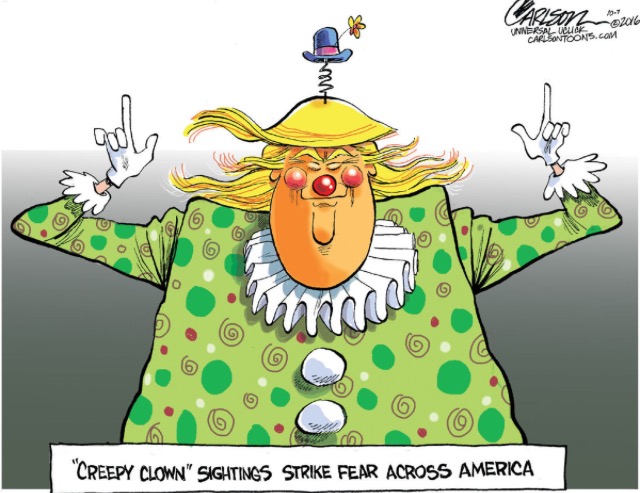
An earlier indicator that "creepy clowns" were on the horizon happened in June 2015, and continued into early 2016, when front page clown images and political cartoons of Donald Trump appeared in New York City and other newspapers.

The number of clown-Trump visual jokes merely increased as the year went along.


The above meme was based on an infamous scene from Stephen King's IT!


+++
One last note.

The media's many stories on the "Creepy Clown Epidemic" personally pulled me into the analysis long before any reporter interviewed me. Instead, the use of my 1981 work and coining of the phrase "Phantom Clowns" caused journalists to write about and quote me. See here and this brief overview.