Thursday, April 18, 2013

Near Waco Anniversary, Near Waco Explosion


There has been a massive explosion at a fertilizer plant in West, Texas, just north of Waco.

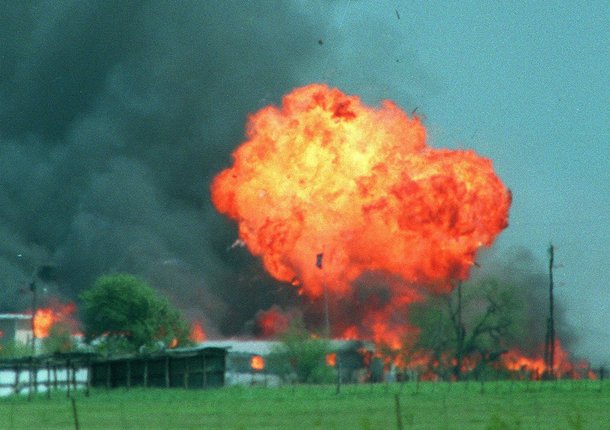
The photograph above was taken of the mushroom cloud coming from the explosion. Enki writes: "Note the Sonic Drive-In sign to the left. Recall that Blaec Lammers, the would-be Twilight shooter, was apprehended at a Sonic Drive-in."


Since fertilizer was one of the compounds of the Murrah Building/Oklahoma City bombing, this event has brought to mind many links. As Enki also notes, "The explosion took place at 1471 Jerry Mashek Drive. Mashek means descendant of Thomas (twin). Elvis Presley had a twin brother who died at birth, and the suspect in the mailing of ricin-laced letters to Senator Wicker, Paul Kevin Curtis, was in an Elvis tribute act with his brother."

Images above are from Waco, Texas, 1993.

Tomorrow, April 19th, is the 20th anniversary of the end of the siege at the Waco, Texas compound of the Branch Davidians. The Waco siege began on February 28, 1993, when the United States Bureau of Alcohol, Tobacco, and Firearms attempted to execute a search warrant at the Branch Davidian ranch at Mount Carmel, a property located nine miles east-northeast of Waco, Texas. An exchange of gunfire resulted in the deaths of four agents and six followers of David Koresh. A subsequent 51-day siege by the FBI ended on April 19th when fire destroyed the compound. Seventy-six people (24 of them British nationals) died in the fire, including more than 20 children, two pregnant women, and Koresh himself.

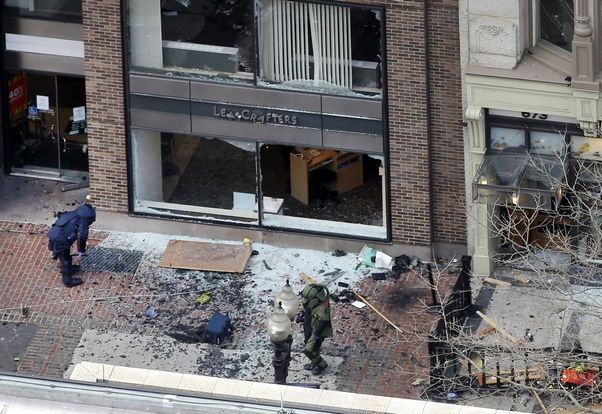
Images above are from West, Texas, 2013.

The fertilizer plant explosion, origins unknown, has killed between five and 15 people, according to Sgt. William Patrick Swanton of the nearby Waco Police Department. The death toll is predicted to increase, as reportedly over 60 people are missing.

"160 injured in West, Texas. 168 killed in OKC bombing," emails editor Andrew W. Griffin, Red Dirt Report.

The massive new blast has forced the evacuation of about half of the small town of West.


Houses and apartment houses were destroyed.


The Wednesday night blast shook houses 50 miles away and measured as a 2.1-magnitude seismic event, according to the United States Geological Survey.

Another Texas explosion anniversary was remembered, as well:

The force of the French freighter S.S. Grandcamp explosion, coupled with flying debris produced by the blast and a surge of water pushed from the harbor, left this scene of destruction throughout Texas City, Texas on April 16, 1947. The explosion killed at least 576 people and injured 5,000 making it the nation's worst industrial disaster. (Moore Memorial Public Library/Houston Chronicle via AP)
Thanks for alerts from the following folks regarding this news: 
Enki, Darren, and Daniel.
Photo at top, credit Andy Bartee.

Tuesday, April 16, 2013

Ricin Wicker Man


The name game demons have been released.


On Tuesday, April 16, 2013, the anniversary of the VA Tech massacre and the day after the Patriots' Day Boston Marathon bombing, the spotlight focused on "Wicker."

The U.S. Senate office of Senator Roger Wicker (R-Miss.) received a letter with a substance that has tested positive for Ricin, it was noted today by media and law enforcement sources. No date has been shared as to when the letter was received. The substance underwent three tests to make certain there was no error in the Ricin results.

"Sen. Claire McCaskill (D-Mo.) said members were briefed that the substance had been found in a letter and a suspect has been identified. McCaskill said the letter came from an individual who frequently writes to lawmakers. She wouldn’t identify the person but confirmed officials had identified someone. McCaskill said state offices have been told what to look for if there are more letters containing the toxic substance," said the news service Politico.
"Americans are going to wake up Thursday morning with Puerto Rico well on its way to becoming the 51st state, and they're going to ask why weren't we informed?" — Roger Wicker, a few years ago, in one of the few quotes his legacy has left on the Internet.

The Wicker Man is a highly symbolic Pagan image.

The Wicker Man is set on fire to pay tribute to the gods. The sacrifice of the humans inside is part of a religious ritual to increase fertility, crops, commerce, or merely to re-ignite the chances that bad times will disappear.

According to Julius Caesar in his Commentarii de Bello Gallico (Commentary on the Gallic Wars), the Wicker Man was a large wicker statue of a human used by the ancient Druids (priests of Celtic paganism) for human sacrifice by burning it in effigy. Other records talk of people being placed inside.

It appears to go beyond coincidence to find the moniker of Wicker turning up during incidents from 1976-1977's Son of Sam killings ("The Wicked King Wicker") to 2008's Chicago's Wicker Park accounts of "Phantom Clowns" and near-abductions of children.

The Son of Sam events, btw, took place in the Pelham Bay area of New York City's northernmost borough, the Bronx.

The Hotel Pelham (above) existed from 1857 to 1916, on Boylston Street, at the corner of Tremont Street, Boston, Massachusetts, very close to being across the street from the first bomb explosion at the end of the Boston Marathon on April 15, 2013.

For more on the Wicker Man, see my 2009 essay on the topic here.

Cinematically, the doomed law enforcement "Wicker Men" have all strangely grimaced as their fate was decided by the Pagans. You know, sort of like the Joker's smile.


Mapping The Tragedy: Boston Bombs Set On Symbolic Street


“We shall pick up an existence by its frogs.” ― Charles Fort, Lo!


And its Masonic Taverns.


The Patriots' Day explosions at the end of the Boston Marathon were placed on Boylston Street. So far, 176 were injured and three have died, caused by two pressure cooker-style bombs in black duffel bag, left concealed near the race's end stretch.


There will be discussions of many aspects of this sad tragedy. Here we look at the twilight language. Yesterday, I examined parts of the hidden and forgotten history of the date


The first bomb was placed in front of LensCrafters, 699 Boylston St, Boston, MA 02116, near the end of the Boston Marathon, next to a shop called Marathon Place, to the side of a reviewing stand. The white ash of the bomb is visible above. The second bomb (below) was across from the Lenox Hotel.


The location of the second bomb seems to have been in front of the Forum in the 700 block of Boylston Street.

What do we know about the general but specific site? The location? If we dig more deeply into the toponymy (the study of place names) of this event, what do we find?


Detail of a 1723 map of Boston
The White Horse Tavern stood on Newbury (later Washington Street), near Frogg Lane (later Boylston Street).

Detail of an 1883 map of Boston. The location of the Masonic Temple is clearly visible.

Boylston Street is the name of a major east-west thoroughfare in the city of Boston, Massachusetts. The Boston street was known as Frog Lane (or Frogg Lane) in the early 18th century and was later known as Common Street. The street stretches from the Fenway neighborhood to Copley Square and the Boston Common. 

In 1749 and 1750, it is known that the Third Lodge of Freemasonry in Boston was held at the White Horse Tavern on the first and third Wednesday in every month.

This one section of Boston has some of the most important old Masonic landmarks and sites of anyplace in America. This area housed many taverns which served as Masonic Meeting Houses, including the Greyhound Tavern (Washington & Warren Sts), British Coffee House (King St, now State St), George, later called King's Arm Tavern (Boston Neck), White Horse Tavern (Frog Lane, now Boylston St), and the two most famous Masonic taverns, the Green-Dragon Tavern (Hanover & Union Sts) and Brunch-of-Grapes Tavern (King St, now State St).


Masonic Temple, corner of Tremont and Boylston Street.

Frog (or Frogg) Lane was later again renamed for Ward Nicholas Boylston (1747–1828), a man of wealth and refinement, an officer of the Crown, and philanthropist.

Wikipedia notes the background of the man who would lend his name to this street:
Ward Nicholas Boylston (1747-1828; born Ward Hallowell), a descendent of the physician Zabdiel Boylston, was a man of wealth and refinement, a merchant, a philanthropist and a great benefactor of Harvard University. He was a brother of Admiral Sir Benjamin Hallowell Carew, one of Nelson's Band of Brothers, and a nephew of Governor Moses Gill.
He was born in Boston and spent much of his life in it. His father, Benjamin Hallowell, Esq., was the Commissioner of Customs, and the family lived in the Jamaica Plain end of what was then the town of Roxbury, just south of Boston. His mother, Mrs. Mary (Boylston) Hallowell, was the daughter of Thomas Boylston, and a first cousin of Susanna Boylston, the mother of the 2nd President of the United States, John Adams, and grandmother of the 6th President, John Quincy Adams.
Ward received his early education in the free public schools of Boston. In 1770 at the request of his uncle Nicholas Boylston, he dropped his surname of Hallowell and changed it to his uncle's name, Boylston, who promised to leave him certain large estates in his will.
In 1773, Boylston left Boston for an extended journey through Europe and Asia. In 1775 he arrived in London, living there for twenty-five years and in various aspects of trade.
In 1800 he returned to Boston.

Old maps often do not match the parallel nature of the current street names, as in the following new maps. It is to be assumed that shifts in street placements and names have occurred over time.


The area of the bombings on Boylston Street are graphically shown above.

This is a significant symbolic site that was picked for a reason.

That motivation remains to be discovered.


Monday, April 15, 2013

Targeting Patriots' Day Is Significant for Boston Marathon Bombing


The damage to bodies was graphic. The damage to the nation's psyche will be deep.

Patriots' Day is a holiday in Massachusetts, the day the Boston Marathon is run. At the end of the running of the race, there were explosions from two apparent bombs. There are reports are of, at least, 176 injured, with three confirmed dead, one being an eight-year-old boy. Several people remain in ICU. Most of the injuries are to the lower limbs, and amputations have been made.

+++
See also my Tuesday discussion:


+++

As this event unfolds, it cannot be ignored that there was a specific special time picked by the bomber or bombers.


Spelled differently in Maine (e.g. Patriot's Day), the specific date of April 19th commemorates the anniversary of the Battles of Lexington and Concord, the first battles of the American Revolutionary War. Down through the years, the actual date has drifted to other days, as Patriots' Day is now observed on the third Monday in April in Massachusetts and Maine (once part of Massachusetts). Also, it is a public school observance day in Wisconsin. This year, therefore, Patriots' Day was celebrated on April 15th, which actually was not "Tax Day" in Massachusetts because citizens there get an extra day.

As I already alerted readers here on April 9th, I was expecting some danger this week.

("I was just preparing to write that the annual heightened 'danger zone' of school/college violence of late April, which occurs following an active fall, is almost upon us," is what I wrote last week.)

This is a time of high violence dates of April 19 (Waco and Oklahoma City bombing anniversaries) and April 20 (Hitler's birthday and Columbine). April 19th is the anniversary of the deaths occurring at the end of the Waco events and the Oklahoma City bombing. It is an older anniversary of the Revolutionary War, of militia deaths, and past school violence incidents. 


The Waco siege began on February 28, 1993, when the United States Bureau of Alcohol, Tobacco, and Firearms (ATF) attempted to execute a search warrant at the Branch Davidian ranch at Mount Carmel, a property located nine miles east-northeast of Waco, Texas. An exchange of gunfire resulted in the deaths of four agents and six followers of David Koresh. A subsequent 51-day siege by the Federal Bureau of Investigation ended on April 19th when fire destroyed the compound. Seventy-six people (24 of them British nationals) died in the fire, including more than 20 children, two pregnant women, and Koresh himself.


The Oklahoma City bombing (OKBomb) was the bomb attack on the Alfred P. Murrah Federal Building in downtown Oklahoma City on April 19, 1995, when American militia movement sympathizer Timothy McVeigh allegedly detonated a truck filled with explosives parked in front of the building. McVeigh's co-conspirator, Terry Nichols, had assisted in the bomb preparation. Their motive allegedly was to avenge the government's handling of the Waco siege and Ruby Ridge incidents.

There, too, is the Virginia Tech massacre, which was a school shooting that took place on April 16, 2007, on the campus of Virginia Polytechnic Institute and State University in Blacksburg, Virginia. A senior at Virginia Tech shot and killed 32 people and wounded 17 others in two separate attacks, approximately two hours apart, before dying by suicide.

In 2004, in The Copycat Effect, I wrote of the importance of Patriots' Days and its ties to domestic terrorists. There are background events linked to previous Patriots' Days that often are forgotten:
The “Patriot’s Day” holiday, the date the Revolutionary War began, now has links to a date holding symbolic importance around the nation. April 19th is historically significant. In 1943, the Nazis entered the Warsaw Ghetto, in 1993, the Waco raid occurred, and then in 1995, the Murrah Federal Building in Oklahoma City was bombed.

This last event has also been tied to April 19, 1985; when 200 lawmen surrounded the Arkansas compound of the paramilitary Covenant, the Sword and the Arm.
When the CSA surrendered four days later, authorities discovered that several members of The Order, the group accused of assassinating Denver radio talk-show host Alan Berg, were hiding at the CSA compound. Kerry Noble, who was second-in-command for the CSA, told The Denver Post "dates are so important in the movement. Everything has to have some kind of significance, either with the dates or numbers or something." 
One of the people who found particular significance in the April 19 date was white supremacist Richard Wayne Snell, who had been associated with the CSA. A decade earlier, he allegedly plotted to blow up the Murrah building. At three minutes past noon on April 19, 1995 -- three hours after the Oklahoma City blast -- Snell turned to a prison official as they watched live coverage of the Oklahoma City tragedy. According to the minute-by-minute log of Snell's last days on death row, Snell told the prison lieutenant that "today is a very significant day for various reasons." 
On April 19, 1995, Snell was executed in Arkansas.
...
More notice should be taken of the special dates being chosen for these so-called "random" acts of violence and suicides, as there may be more of a link to the twilight meanings underlying them than originally envisioned.
Sometimes the setting, the surrounding, and the site serve as that special little push that beguiles the copycat’s soul. Sometimes it’s the date. Usually it is a combination of the two.
Some of the details of the attack are reminding people of the style of the bombings of Eric Rudolph too.
Eric Robert Rudolph (born September 19, 1966), also known as the Olympic Park Bomber, is responsible for a series of bombings across the southern United States between 1996 and 1998, which killed two people and injured at least 150 others in the name of an anti-abortion and anti-gay agenda. The Federal Bureau of Investigation considers him a terrorist.
As a teenager Rudolph was taken by his mother to a Church of Israel compound in 1984; it is connected to the Christian Identity movement. He has called himself a Roman Catholic in "the war to end this holocaust" (in reference to abortion). He has confirmed religious motivation, but denied racial motivation for his crimes. He was caught in 2003.Rudolph is best known as the perpetrator of Centennial Olympic Park bombing in Atlanta which occurred on July 27, 1996, during the 1996 Summer Olympics. He called the police, warning about the bomb before it detonated. The blast killed spectator Alice Hawthorne and wounded 111 others. Melih Uzunyol, a Turkish cameraman who ran to the scene following the blast, died of a heart attack. Wikipedia.
The technique of setting off one bomb, then moving people into danger where a second bomb would go off, was used by Rudolph. In 1997, two bombs were placed outside a women's clinic in the Atlanta suburb of Sandy Springs, going off an hour apart. Seven people were injured in the second blast, which investigators say they believe was designed to kill and injure law enforcement officers responding to the first bomb.

Eric Rudolph has confessed to the bombings of an abortion clinic in the Atlanta suburb of Sandy Springs on January 16, 1997; the Otherside Lounge of Atlanta lesbian bar on February 21, 1997 (also using two bombs), injuring five; and an abortion clinic in Birmingham, Alabama on January 29, 1998, killing Birmingham police officer and part-time clinic security guard Robert Sanderson, and critically injuring nurse Emily Lyons. Rudolph's bombs were made of dynamite surrounded by nails, which acted as shrapnel.

+++

Don't be sidetracked by this date not being April 15th. It was on Patriots' Day. That is significant. As is the street, Boylston.

Let us hope the suspect or suspects are captured soon. I would not be surprised to discover this is a home-grown event.

Why the reports of a "dark-skinned" foreign national being sought?


Why is there a New York Post's early report that a "Saudi National" is under arrest? Law enforcement officials in Boston deny there is any truth to this rumor. Conflicting reports are that he is being merely questioned because he was tackled, running from the scene. Also, the search warrant in Revere has been tied to this alleged "person of interest's residence."

This all sounds like the early reports after the OKBomb.


UPDATES

The New York Times on Tuesday, April 16, 2013, has noted what I mentioned above, regarding these dates:

Blasts at Boston Marathon Kill 3 and Injure 100
By John Eligon and Michael Cooper
***
Some law enforcement officials noted that the blasts came at the start of a week that has sometimes been seen as significant for radical American antigovernment groups: it was the April 15 deadline for filing taxes, and Patriots’ Day in Massachusetts, the start of a week that has seen violence in the past. April 19 is the anniversary of the 1995 bombing of the Alfred P. Murrah Federal Building in Oklahoma City.
The explosive devices used in the attacks on Monday were similar in size to the device used in the 1996 attack at the Centennial Olympic Park bombing in Atlanta but were not nearly as large as the one used in Oklahoma City. In the Atlanta attack, a pipe bomb was detonated near pedestrians, killing 2 and injuring more than 100 — similar numbers to Monday’s attack.
The attack in Oklahoma City was far larger because the perpetrator used a truck packed with thousands of pounds of explosives. The device killed more than 150 people.
***


At a news conference on Tuesday morning, Dr. George Velmahos, the chief of trauma surgery at Massachusetts General Hospital, said pellets and nails (many forms of shrapnel) had been removed from victims.

+++
Liz Goodwin is reporting:

A second victim in the Boston Marathon bombings has been identified: Krystle M. Campbell, a 29-year-old from Medford, Mass.
Her father, William A. Campbell Jr., told Yahoo News he's in shock that his daughter was killed.
"My daughter was the most lovable girl. She helped everybody, and I'm just so shocked right now. We're just devastated," he said. "She was a wonderful, wonderful girl. Always willing to lend a hand."
Campbell was at the finish line with a friend to cheer on her boyfriend, who was running the race. William Campbell said he doesn't know if her boyfriend finished the race before the bombs went off.
More than 170 people were wounded—17 of them critically—and three were killed in the attacks.
The other identified victim, 8-year-old Martin Richard, was running away from the first explosion with his family when the second blast killed him. His mother and 6-year-old sister were injured in the blast as well.


 Martin Richard, above and below, was 8 years old.

Krystle M. Campbell was 29.


A Chinese citizen was killed in the Boston Marathon bombings, the Chinese consulate in New York said. The press release did not identify the woman. Boston University earlier confirmed that the person was a graduate student at the school.


+++PHOTO GRAPHIC WARNING+++


Carlos Arredondo, wearing the cowboy-style hat, helps a first responder run a severely injured man past the finish line following one of the Boston Marathon explosions. Arredondo was at the race to support five runners from Run for the Fallen Maine, an organization that honors soldiers who died overseas. Photo: Charles Krups.

Bodies were torn apart. These events have human victims. We must never forget that.

Tuesday, April 09, 2013

Cypress Stabbings


The attacker stabbed women. 


He is long-haired, white, deaf, an enrolled student, and carries around a stuffed animal toy, reportedly a monkey. His first name is said to be "Dylan." The suspect, Dylan Quick, 20, was later charged.

Multiple people were injured in a stabbing incident today at a Houston-area college, prompting officials to urge students to take shelter, the school said.

At least 14 people were injured in the incident at Lone Star College's CyFair campus in Cypress, Texas, according to CNN affiliates KHOU, KTRK and KPRC, Fox News, and other sources.

Authorities have detained one suspect, the school said in a statement.

"There are multiple injuries and conflicting reports on the total number of victims and severity of injuries," the school's statement said. "We an confirm that several people have been transported to area hospitals."

Four were serious, two critical. Two individuals refused treatment.

There is no motive known.

The timing is intriguing, considering the attempts to restriction gun purchases without background checks and limiting ammunition magazine volumes. Stabbings have traditionally been a problem in China.

I was just preparing to write that the annual heightened "danger zone" of school/college violence of late April, which occurs following an active fall, is almost upon us.

(Also, in a "name game" coincidence, on this very morning, on Twitter, I published an image I had just taken in southern Illinois of a cypress tree and its enigmatic knees, strangely blurry in the photo near a Bucky Fuller dome.)


Earlier on April 9, 2013: A 60-year-old veteran gunned down 13 people in Serbia, including a baby, in a pre-dawn house-to-house rampage today before trying to kill himself and his wife, in what RT is calling Serbia's "worst peacetime shooting." The man, identified as Ljubisa Bogdanovic, used a handgun in the shooting spree at five houses in Velika Ivanca, a village 30 miles southeast of Belgrade. Residents of the village said he first killed his son before leaving the house and then began shooting his neighbors, some of whom were still asleep.

"He knocked on the doors and as they were opened he just fired a shot," said one. Reuters reports that his mother was among the dead. The man and his wife were both severely injured by the shootings; officials say the motive is unclear. The suspect had lost his job last year and fought as a Serb volunteer soldier in the war in Croatia in 1992, the police chief said. Villagers said Bogdanovic fought in Vukovar, the eastern Croatian town that was destroyed in a massive Serbian-led army offensive, the scene of the worst bloodshed during Croatia's 1991-95 war for independence.