Showing posts with label Congress. Show all posts

Wednesday, June 14, 2017

Congressional Baseball + UPS Attacks

June 14 is Flag Day and President Donald Trump's 71st birthday. ~ Loren


On June 14, 2017, in Alexandria, Virginia, James T. Hodgkinson (pictured above) of Belleville, Illinois, opened fire on a group of Republican members of Congress and their staffers.

Almost immediately upon establishment of what in the future would be called "Alexandria," the town founders called the new town "Belhaven", believed to be in honor of a Scottish patriot, John Hamilton, 2nd Lord Belhaven and Stenton, the Northern Neck tobacco trade being then dominated by Scots.
This surname Hodgkinson is derived from the name of an ancestor, "the son of Roger," from the nickname, Hodge, and suffix -kin = Hodgkin (v. kin, Skeat). Genitive form Hodgkins.
Bell is one of the name game names I have written about in these twilight language pages. Belleville (French: belle ville, meaning "beautiful city") is a city in St. Clair County, Illinois. Little Egypt's, southern Illinois' most populated city is currently Belleville (see The Bell Name) at 44,478. ~ Loren

The ones being shot at were practicing for the Congressional Baseball Game scheduled for the next day. A shootout ensued between the gunman and two Capitol Police officers assigned to protect House Majority Whip Steve Scalise (R-LA). Six people were shot: Scalise; David Bailey and Crystal Greiner, the two Capitol Police officers assigned to protect Scalise; Zack Barth, a legislative aide to Rep. Roger Williams (R-TX); Matt Mika, a lobbyist; and the gunman, who later died from his injuries. Williams was also reportedly injured during the attack but was not shot. Authorities have not commented on the gunman's motivation.


Stephen Joseph Scalise, born October 6, 1965. Scalise is a Masonic Brother of the Acacia Fraternity Masonic Lodge.

The social media account of the shooter contained this cartoon of Scalise.


Scalise is the first sitting member of Congress to be shot since Arizona Rep. Gabrielle Giffords in 2011.

The shooting took place at Eugene Simpson Stadium Park in Alexandria, Virginia, where 20 to 25 Republican congressmen gathered to practice for the Congressional Baseball Game, which was to be held the next day, on June 15. The bipartisan game is held annually at the Nationals Park and is a charity event. Republican Majority Whip Steve Scalise, Senator Rand Paul, Representative Chuck Fleischmann, Representative Ron DeSantis, Representative Mo Brooks, Representative Brad Wenstrup, and Representative Jeff Duncan were among those at the practice. According to Representative DeSantis, a man asked him whether Republicans or Democrats were on the field as he was walking to his car, although he is not sure whether the man asking was the perpetrator.


Found some bizarre dot connections to the events in DC this morning for you, the media keeps referencing that baseball field as the HS field from the REMEMBER THE TITANS movie with actors D washington and WILL PATTON who as we know had major screen time in the MOTHMAN movie of 2001, also I saw on the sat image map the street of MASON in alexandria va runs right into the 3rd base bag on that same field, also a very nearby side steet called MT VERNON is also a major street in PP WV , lastly that baseball field is part of SIMPSON park in va, jeff wamsleys sister is married to a mike simpson and that is now her married suffix name...also the passing of BATMAN (mothman villain) was only 2 days ago ~ Todd W (sends in his insights)


The Capitol Police were present at the practice to protect Scalise. Because of his leadership position, he has a security detail assigned to protect him.

The team started playing a practice game around 7 a.m. Rep. Rodney Davis of Illinois was at bat when the shooting started. According to reports, the shooter opened fire from behind the dugout. Witnesses said the shooter was armed with a semi-automatic rifle. A gunfight followed between the Capitol Police and the shooter, and 50 to 100 shots were fired.


See the "Masonic Origins of Baseball." And for more, see here.

The Alexandria Police received a 911 call of shots fired at 7:09 a.m. Two police officers arrived within three minutes and also engaged the shooter. The shootout lasted about 10 minutes until the shooter was shot by a Capitol Police officer. Scalise, who was playing second base, was shot in the hip; while the shooting was still going on, Rep. Mo Brooks tried to stop Scalise's bleeding using his belt as a tourniquet. Representative Brad Wenstrup, who is a podiatrist and combat surgeon, also helped Scalise.

Several witnesses stated that their lives were saved by the presence of the Capitol Police, who were there because of Scalise's position as the majority whip. The Capitol Police were able to immediately engage the shooter and keep him pinned down, preventing him from continuing to fire on all the unarmed baseball players. Rep. Davis said later, "If they hadn't been there, this would have been a massacre."

Scalise was shot in the hip and was evacuated by medical helicopter to a local hospital, where he underwent surgery. He was reported to be in stable condition with non-life threatening injuries. David Bailey and Krystal Griner, the two Capitol Police officers assigned to protect Scalise, were shot and wounded. Zack Barth, a legislative aide to Rep. Roger Williams (R-TX), and Matt Mika, a lobbyist, were also shot and wounded. Mika's injuries were the most serious, according to Sen. Jeff Flake. Williams himself was not shot, but was lifted from the area on a stretcher after injuring himself while jumping into the dugout during the attack. Williams identified his aide as legal correspondent Zack Barth and stated that Barth is expected to make a full recovery.

The shooter was severely injured and transported to George Washington University Hospital, where he later died from his injuries. Alexandria police initially said they had one person in custody following the shooting who was described as a white male. Police later identified the shooter as James T. Hodgkinson, 66, of Belleville, Illinois. Hodgkinson owned a home inspection business that had an expired license. He was charged in 2006 in Illinois with battery and aiding damage to a motor vehicle; the charges were dismissed. Hodgkinson had campaigned for Bernie Sanders during the 2016 United States Presidential election, and has been described as a "passionate progressive," by a man he worked with. The Daily Beast reported that Hodgkinson belonged to a Facebook club called "Terminate the Republican Party". On May 22, 2017, he wrote “Trump is a Traitor. Trump Has Destroyed Our Democracy. It's Time to Destroy Trump & Co.” above his repost of a Change.org petition demanding "the legal removal" of Trump and Vice President Mike Pence for "treason."

The FBI stated that they would be taking over the investigation. During a press conference, an FBI spokesperson stated it is too early in the investigation to determine the shooter's motive.

Fair use details from Wikipedia, Zachary H., Todd W., Matt B., and others.


+++

Also on this date, there was a workplace shooting in San Francisco, California, at a UPS facility, after the Congressional shooting. This is a rare same-day copycat event.


A UPS employee opened fire in a San Francisco package delivery facility in a shooting spree that left four dead, including the gunman, on Wednesday, June 14, 2017, police and the company said.

The gunman barged into the facility near 17th and Vermont streets around 9 a.m. local time and began shooting, San Francisco police confirmed to Fox News. The building is located in the Potrero Hill, which is about 2 1/2 miles from downtown San Francisco.

Two other people remain hospitalized. The gunman died of a self-inflicted wound, police said. Others say the shooter is still alive.

Monday, April 18, 2016

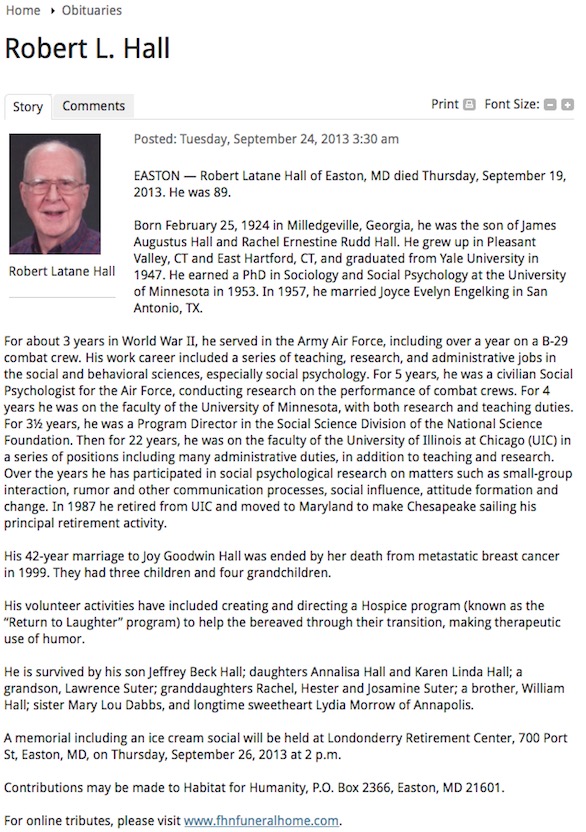
UFO Sociologist Robert L. Hall, Brother of Ufologist Richard, Died in 2013


The news sometimes takes a long time to reach a speciality community, especially if the local obituaries do not list that someone rather accomplished also did unusual research, such as on UFOs. This is the case in learning that Robert L. Hall has passed away on September 19, 2013.

"This news did not make the rounds of ufology," at the time of his death, noted one* ufologist to others, yesterday. Allow me to fill in the picture of Robert's life, in ufology and outside of it.

Robert Hall, a Ph.D. in Sociology and Social Psychology, working in his last position for 22 years at the University of Illinois in Chicago, found himself testifying before the U.S. House Committee on Science and Astronautics - Symposium on UFOs, in 1968. (The complete statement by Dr. Robert L. Hall at the 1968 hearings can be found here.)

Hall contributed and saw his paper, “Sociological Perspectives on UFO Reports,” published in Carl Sagan and Thornton Page, eds., UFO's: A Scientific Debate (New York: Norton, 1972: 213-222).

Robert Hall's paper, therefore, was read widely, as it appeared in various editions of that anthology (as shown above and below):


Robert L. Hall was also the brother of famed ufologist Richard Hall, who worked for the National Investigations Committee on Aerial Phenomena, from 1958 to 1969.


In 1964 Hall researched, edited, and wrote much of The UFO Evidence, a compendium of the best UFO sightings and incidents of the 1940s, 1950s, and early 1960s. A copy of The UFO Evidence was sent to every member of Congress in 1964, and the book is still regarded by many UFO researchers and historians as one of the best UFO books ever published. 


On the morning of July 17, 2009, Richard Hall passed away due to a long battle with cancer. (See my obit on Richard Hall here.)

Richard's brother, Robert L. Hall's formal obituary is posted below. It does not mention his links to UFOs, nor is that connection noted in his more formal resume, also shown below.

Our condolences to the Hall family and friends, for their dual losses.


Vitae (prepared for Congress in 1968)

DR ROBERT L. HALL
Born February 25, 1924, at Atlanta, Georgia. Married; 3 children.

EDUCATION
Yale University, 1941-42. B.A. 1947.

University of Stockholm, Sweden, 1947-48.

University of Minnesota, 1949-52. M.A., 1950. Ph.D., 1953.

PROFESSIONAL EXPERIENCE
1. Instructor, Extension Division, University of Stockholm, Sweden, 1948.

2. Research Assistant, University of Minnesota, 1950-52.

3. Social Psychologist in the Air Force Personnel & Training Research Center, 1952-1957. Engaged in research on performance of bomber crews, the role of the aircraft commander, and processes of evaluation of small teams.

4. Assistant Professor (1957-1960) and Associate Professor (1960-62) of Sociology. Teaching social psychology, especially the processes of mass communication and opinion change. Conducting research on social psychological aspects of higher education and effects of social interaction on the learning process.

5. Program Director for Sociology and Social Psychology, National Science Foundation, 1962-1965. Administered a program of research grants and related activities to strengthen Sociology and Social Psychology in universities in the United States and to bolster understanding in these fields through basic research.

6. Associate Professor of Sociology and Psychology (1965-66) and Professor of Sociology and Head of the Department of Sociology (since 1966), University of Illinois at Chicago Circle.

PUBLICATIONS
A number of articles in Sociological and Psychological journals and chapters in professional books. A few selected publications are listed below:

Social influence on the Aircraft Commander's role, "American Sociological Review" 1955,20,292-299.

Military Sociology, 1945-1955. "Chapter in Sociology in the United States of America," ed. by Hans Zetterberg, Paris: UNESCO, 1966.

Group performance under feedback that confounds responses of group members. "Sociometry," 1957,20,297-305.

The informal control of everyday behavior. Chapter in "Controlling Human Behavior," ed. by Roy Francis, Social Science Research Center, University of Minnesota; 1959.

Two alternative learning in interdependent dyads. Chapter 12 in "Mathematical Methods in Small Group Processes," ed. by Joan Criswell, H. Solomon, and P. Suppes, Stanford Univ. Press: 1962.

The educational influence of dormitory roommates. "Sociometry," 1963,26,294-318 (with Ben Willerman).

The effects of different social feedback conditions upon performance in dyadic teams. Chapter in "Communication and Culture," ed. by A. G. Smith, 1966, 353-364.


+++

My thanks to the following people for discovering this news and informing me, via the informal network of informants: Patrick Huyghe, Walt Webb, and *Rob Swaitek.


+++

Other ufologists’ obituaries for 2016.


Sunday, January 16, 2011

Congress Style Assassinations


In American history, there has been a relatively small number of members of Congress who have been killed or wounded while in office. Not all members included in the list were the targets of assassins. Some died in duels or were not intentionally targeted. This list does not include instances when members died in accidents or suicides. Fourteen members have been killed and eight have been seriously wounded by assailants. Additionally, the circumstances surrounding the deaths of at least three members are disputed and they may have died as a result of natural causes or accidents.
The four incidents below are the ones recalled by the media in the wake of the Giffords shooting.  But the list is a long one. See below.

Rep. Jonathan Cilley
Jonathan Cilley of Maine was killed in a duel with Rep. William Graves of Kentucky Feb. 24, 1838. Cilley had accused Graves of bribery on the floor of the House to which Graves responded by challenging him to a duel with pistols.
Graves killed Cilley after three rounds. After the duel, the House voted to ban all forms of dueling between members in Washington, D.C. Although the House considered censuring Graves, not enough votes were garnered and Graves was largely unpunished for killing one of his colleagues.
Sen. Charles Sumner
Reps. Preston Brooks and Laurence Keitt, both of South Carolina, severely beat Sen. Charles Sumner of Massachusetts so badly he needed three years to recover. Brooks beat Sumner over an anti-slavery speech that verbally attacked Sen. Andrew Butler of South Carolina, a relative of Brooks.
Brooks and Keitt eventually resigned after the House voted to censure Keitt and the state of Maryland prosecuted Brooks. The assault, which took place May 22, 1856, was a precursor of tensions between the north and south which would eventually lead to the Civil War.
Puerto Rican Nationalists
Four Puerto Rican nationalists stormed the Capitol March 1, 1954. The House was in session as they were taking a vote regarding the employment of Mexican migrant workers.
Five Congressmen were wounded by gunfire from the visitor's gallery: Alvin Bentley of Michigan, Ben Jensen of Iowa, Clifford Davis of Tennessee, George Fallon of Maryland and Kenneth Roberts of Alabama. All five survived the 30 shots which rang out from above the floor. All four perpetrators were eventually sentenced to long prison terms.
Rep. Leo Ryan
Rep. Leo Ryan of California made a trip to Guyana to try to ascertain why members of his congressional district were disappearing into the jungle. When he and his team attempted to leave by airplane the encampment of cult leader Jim Jones of People's Temple, five of Ryan's delegation including Ryan were killed in an ambush November 18, 1978, at the airfield.
The Ryan incident was the last time a sitting member of Congress was assassinated. Ryan's assistant Jackie Speier who survived the attack, went on to serve in the California legislature 20 years before being elected to Congress in 2008.

The complete listing from Wikipedia is below.

Members of Congress Assassinated:

Spencer Pettis–Missouri
(1st at-large seat)
August 28, 1831Thomas BiddleBoth Pettis and Biddle sustained fatal gunshot wounds during a duel on Bloody Island in Illinois.[1]
Jonathan CilleyJonathan CilleyMaine
(3rd district)
February 24, 1838William GravesCilley was shot by Graves, the Whig Congressman from Kentucky's 8th district, during a duel on the Marlboro Pike inMaryland.[1]
John Montgomery–Pennsylvania
(12th district)
April 24, 1857Unknown(disputed)Multiple people staying at the National Hotel in Washington, D.C. died of National Hotel Disease during this time period. It is disputed whether the "disease" was an attempt to poison hotel boarders or simply a case of accidental food poisoning.[1]
John QuitmanJohn QuitmanMississippi
(5th district)
July, 17, 1858
David BroderickDavid BroderickCalifornia
(senator)
September 13, 1859David TerryBroderick and Terry, the Chief Justice of the Supreme Court of California, took part in a duel in San Francisco. Broderick was shot and died three days later.[1]
Edward BakerEdward BakerOregon
(senator)
October 21, 18617th Brigade, 4th Division of the Confederate Army of the Potomac (under the command of Nathan Evans)Baker died during the Battle of Ball's Bluff, while assigned command of a brigade in Brigadier General Charles Pomeroy Stone's division, guarding fords along thePotomac River in Virginia. The Confederate soldiers were commanded by Brigadier General Nathan George Evans.[2][3]
Cornelius Hamilton–Ohio
(8th district)
December 22, 1867Thomas HamiltonHamilton was killed by his mentally ill 18-year-old son, Thomas, in Marysville, Ohio.[1][4]
James Hinds–Arkansas
(2nd district)
October 22, 1868George ClarkHinds was killed in Indian Bays in Monroe County, Arkansas after being shot in the back by George A. Clark, a member of the Ku Klux Klan and the secretary of the Democratic committee of the county.[1][5][6]
John PinckneyJohn PinckneyTexas
(8th district)
April 24, 1905Unknown (riot started by J. N. Brown)A political event in Hempstead,Texas turned violent when one of the participants, J. N. Brown, began shooting. Other attendees began to shoot as well and a riot broke out. Pickney, his brother Tom, and Brown were all killed at the scene.[1][7]
Huey LongHuey LongLouisiana
(senator)
September 8, 1935Carl Weiss(disputed)Long died two days after Weiss fired a handgun at him at close range inside the Louisiana State Capitol in Baton Rouge. More recent evidence suggests that Long's bodyguards may have accidentally shot and killed Long when they open fire on Weiss, who was killed at the scene.[8][9]
Thomas SchallThomas SchallMinnesota
(10th district)
December 19, 1935Lester HumphriesSchall was hit by a car being driven by Lester G. Humphries as he was walking across the Baltimore–Washington Parkway in Cottage City, Maryland; he died three days later. Humphries was arrested for reckless driving.[10][11]
Robert KennedyRobert KennedyNew York
(senator)
June 5, 1968Sirhan SirhanKennedy was shot at the Ambassador Hotel in Los Angeles after giving a speech for his presidential campaign; he died about 25 hours later.[12]
Leo RyanLeo RyanCalifornia
(11th district)
November 18, 1978Peoples Temple (under the direction of Jim Jones)While on an official visit to Guyana to investigate the activities of the Peoples Temple cult led by Jim Jones, Ryan was shot multiple times while attempting to board an airplane leaving Jonestown.[13]
Larry McDonaldLarry McDonaldGeorgia
(7th district)
September 1, 1983Soviet Far East District Air Defense Forces (under orders from Anatoly Kornukov)McDonald was a passenger on board Korean Air Lines Flight 007 which was shot over the Sea of Japan near Sakhalin island by Soviet interceptors per the orders of General Kornukov, Commander of Sokol Air Base.[14]
Members of Congress Wounded:

Charles SumnerCharles SumnerMassachusetts
(senator)
May 22, 1856Preston BrooksRepresentative Preston Brooks, a Democrat from South Carolina's 4th district, assaulted Sumner with a cane on the floor of the Senate in the Capitol Building in Washington, D.C. The attack followed Sumner's verbal attacks on pro-slavery politicians.[15]
Josiah GrinnellJosiah GrinnellIowa
(4th district)
June 14, 1866Lovell RousseauGrinnell was assaulted with an iron-tipped cane by Rousseau, anUnconditional UnionistCongressman from Kentucky's 7th district, on the east portico of the Capitol Building in Washington, D.C., in retaliation for derogatory statements he made earlier. Grinnell was pummeled on the "head and face until the cane broke," and was heavily bruised.[16]
Alvin BentleyAlvin BentleyMichigan
(8th district)
March 1, 1954Rafael Cancel Miranda,
Andres Figueroa Cordero,
Irving Flores Rodríguez,
Lolita Lebrón
In an event known as 1954 United States Capitol shooting incident, armed Puerto Rican nationalists shot and wounded five representatives from the Ladies Gallery of the House of Representatives in the Capitol Building in Washington, D.C.[17]
Clifford DavisClifford DavisTennessee
(10th district)
George FallonGeorge FallonMaryland
(4th district)
Ben JensenBen JensenIowa
(7th district)
Kenneth RobertsKenneth RobertsAlabama
(4th district)
Gabrielle GiffordsGabrielle GiffordsArizona
(8th district)
January 8, 2011Jared Loughner (alleged)Giffords was shot in the head during the 2011 Tucson shooting, which occurred at a constituency meeting held in a supermarket parking lot in Casas Adobes, Arizona.[18]