Showing posts with label King-Kill 33. Show all posts

Tuesday, August 21, 2012

Tony Scott: Divine Sacrifice of the King

by Loren Coleman ©2012


Was the suicide of Tony Scott an occult (as in hidden) ritual "Killing of the King"?

Thankfully, no new theater shootings occurred at the one month anniversary of the horror of the red dawn event of Colorado's Aurora. I said we should be aware of an event on August 19-20. Should we, perhaps, look to a less-than-obvious incident that occurred to bring a balance to the sychroncinematic cosmos?

I was saddened to hear on Monday of the self-death of movie director Tony Scott, who, without hesitation, is said to have leapt from a bridge tied to Hollywood into the Pacific Ocean. Other directors have died by suicide, but it is a rare death, indeed.

Note now how Tony Scott is being remembered. The Independent of London headlines him, "Cinema's King of Thrills." The IB Times uses the phrase, "The Blockbuster King." Youtube, Facebook, and Twitter tributes simply call him the "Director/Producer King." The man had a regal film legacy.

Did we just witness an unconscious sacrifice of a king?

Needless to say, you've heard of this ritual before. James Shelby Downard, William Grimstad, Adam Parfrey, and Michael Hoffman II brought this into our consciousness, and you have read me write of it in terms of the twilight language that surrounds us.
Downard is probably best known for his essay "King-Kill/33: Masonic Symbolism in the Assassination of John F. Kennedy," originally published by Adam Parfrey in the first edition of the book Apocalypse Culture, which speculates that the Freemasons were responsible for the assassination of President John F. Kennedy. The essay was removed from the second edition of the book and replaced by another essay by Downard, "The Call to Chaos." Apocalypse Culture II contains another Downard essay, "America, The Possessed Corpse." Jim Keith, editor of yet another Feral House publication, Secret and Suppressed: Banned Ideas and Hidden History, included "Sorcery, Sex, Assassination," the original article of which King Kill/33 is an abridgement.
Source.
Human Sacrifice by Gaulish Druids 
in a Wicker Man ~ Magasin Pittoresque, 1833

Jim Brandon, writing even before "King-Kill/33" was published, was able to walk a wonderfully skeptical open-minded fence, as he passed along the following summary of Downard's "killing of the king" insights in Weird America in 1978:
Would you believe John F. Kennedy as a ceremonial king-who-must-die? I'm afraid there is a certain body of opinion, undoubtedly the farthest-out brain wave of assassinology yet, that maintains the killing was pulled off, not by the Russians, the Cubans, the CIA, or the Mafia, but by alchemists.
As I understand the hypothesis, President Kennedy was for some reason chosen as The King (remember "Camelot," "Macbird" and all that?) after the fashion of James G. Frazer and Mary Renault whose "The King Must Die" he had been given to read before his death. This killing of the king in Dallas was related somehow to the touching off of the world's first atomic bomb at the Trinity Site in New Mexico 18 years earlier. Apparently the Bomb was the "destruction of primordial matter" stage of the grand alchemical working, but these conspiracy buffs aren't much more specific on details than were the early alchemists in their recipes. Anyway, Kennedy represented the next stage of the process - the "Death of the White King" - when he was immolated on a trinity site of his own. For, aren't Dealey Plaza and the ill-famed Triple Underpass on the bank of the old Trinity River?
Could Tony Scott, being a king of cinema mayhem, have been sacrificed (by his own hand through suicide) to bring balance back into the universe in the wake of what happened in Aurora? Was he thinking about what kind of society his movies had created?

Look at the twilight language within Tony Scott's name.

The name Scott means "painted warrior" and originally issues from Old English to mean "Scotsman."

The name Anthony or Tony means "highly praiseworthy and priceless." The name comes directly from Antonius, a gens (an old Roman family name) linked to Mark Antony (Marcus Antonius, 82-30 BC), Roman triumvir (one of three rulers), a general who sat on the throne and aligned his political career with Queen Cleopatra of Egypt. Mark Antony claimed that his gens was descended from Anton, a son of Heracles ("divine glory," son of Zeus, also Roman Hercules). Mark Antony's triumvirate broke up in 33 BC.


Marcus Antonius - above - (on August 1st) and Cleopatra - below - (on August 12th) both died by suicide in August 30 BC.


In many historical societies, the position of kingship carries a sacral meaning, that is, it is identical with that of a high priest and of judge. The concept of theocracy is related, although a sacred king need not necessarily rule through his religious authority; rather, the temporal position itself has a religious significance…The king might…be designated to suffer and atone for his people, meaning that the sacral king could be the pre-ordained victim of a human sacrifice, either regularly killed at the end of his term in the position, or sacrificed in times of crisis.
Source.


How violent were Tony Scott's films? He began his tent pole movies with the bloody Hunger, about vampires. How much of the burden of our mayhem-driven culture did Scott feel on his soul and shoulders?

Early rumors were planted out there of Tony Scott having brain cancer. These were false rumors to "explain away" Tony Scott's suicide. His family said there was no brain cancer, no cancer. Why would someone float fake explanations? Law enforcement sources said that several notes Scott left do not speak of any health problems or offer solid clues about why he jumped.

Was the reality behind his suicide more about his legacy, some considerations in his own conceptualizations of what he wrought?

None of us will ever know.

You will be judge of what he directed and produced. But do so with care. Sometimes things happen without easy explanations, and suicide is one of the major baffling mysteries of our time. Still, I present this notion of the "divine self-sacrifice of the king" as a possible thought that could occasionally come into the mind of a director of violent movies.

BTW, was there a "queen" to Tony Scott's "king"? The other mystery death in the wake of Aurora is of the Irish nurse who tried to save the lives of Aurora's shooting victims.
Victim identified in West Okoboji drowning
Published on Wednesday, 08 August 2012 06:30
On Tuesday, August 7, the Dickinson County Sheriff’s Office responded to a drowning on West Lake Okoboji. An investigation found that Jennifer Galagher, age 46, from Denver, Colorado, had been swimming the previous night in West Lake. On Tuesday morning, Galagher [sic - misspelled] was reported missing by family.
A short time later, a family member located Galagher underneath a nearby dock. Medical personnel responded and she was pronounced dead at the scene.
Source.

Her correct name is Jennifer "Jenny" Gallagher.  Jennifer is a female name of Welsh origin, meaning "fair and smooth," from Gwenhwyfar, which also can mean "white waves." It is a variant of Guinevere, who in the Arthurian tales was Arthur's Queen!

The meaning of Gallagher is "foreign helper," due to how that clan's members were the collaborators of the Norsemen invading their homeland.

Journalist Andrew Griffin of Red Dirt Report noted "I knew I had heard 'Lake Okoboji' before on The X-Files. It is in the episode 'Conduit.' In the episode it was spelled Lake Okobogee but it was meant to be the same lake in Iowa, from what I understand. West Lake Okoboji is where Jenny Gallagher, the Aurora massacre nurse, drowned."

Gallagher was found dead on August 7, 2012, in that lake in Dickson County, Iowa, about 700 miles from her home town of Denver by car, where she was "on vacation."


Tony Scott was found dead in the ocean, beneath the Vincent Thomas Bridge off San Pedro, California.


An image from the prologue of Prometheus, in which one of the extraterrestrial Engineers sacrifices himself, by drowning, in order to allow his DNA to plant the seeds of life on Earth.

A drowning in a lake. A jumping into the sea. The occult element of water is being thrown onto the fire of the Aurora fiery red dawn. Maybe it all means something. Or nothing.

“Judge not, that you be not judged. For with the judgment you pronounce you will be judged, and with the measure you use it will be measured to you." ~ Matthew 7: 1-2.
“Judge not, and you will not be judged; condemn not, and you will not be condemned; forgive, and you will be forgiven." ~ Luke 6: 37.
The metaphor of the unseen (occult) push. 


“I make a movie because it's 
something that inspires me.” 
~ Tony Scott

List of Tony Scott’s feature films 
(as director and/or producer):
  • The Hunger (1983)
  • Top Gun (1986)
  • Beverly Hills Cop II (1987)
  • Revenge (1990)
  • Days of Thunder (1990)
  • The Last Boy Scout (1991)
  • True Romance (1993)
  • Crimson Tide (1995)
  • The Fan (1996)
  • Enemy of the State (1998)
  • Spy Game (2001)
  • Man on Fire (2004)
  • Domino (2005)
  • Déjà Vu (2006)
  • The Assassination of Jesse James by the Coward Robert Ford (2007)
  • The Taking of Pelham 1 2 3 (2009)
  • The A-Team (2010)
  • Unstoppable (2010)
  • Prometheus (2012)
  • Coma (2012)
  • Killing Lincoln (2013)
  • Ion (2013)
  • Prometheus 2 (future)
  • Emma's War (future)
Television:
  • The Hunger (1 episode in 1997 and 1 in 1999)
  • AFP: American Fighter Pilot, Executive producer (2002)
  • Numb3rs, Executive producer (2009 to 2010)
  • The Good Wife, Executive producer (2009–2012)
  • Gettysburg, Executive producer (2011)
  • Labyrinth, Executive producer (2012)
Short films:
  • Loving Memory (1969)
  • One of the Missing (1971)
  • The Hire: Beat the Devil (2002)
  • Agent Orange (2004)
Music videos:
  • "Danger Zone" – Kenny Loggins (1986)
  • "One More Try" – George Michael (1988)
Commercials:
  • DIM Underwear (1979)
  • Player, Achievements and Big Bang for Barclays Bank (2000)
  • Telecom Italia (2000) (Starring Marlon Brando and Woody Allen)
  • Ice Soldier for US Army (2002)
  • One Man, One Land for Marlboro (2003)


Sources for this list 1, 2, 3.


(NY: Simon and Schuster, 2004)

Tuesday, February 28, 2012

Chardon: Killing of the Kings

What is the twilight language covertly existing in this event saying? Perhaps there is nothing to be discovered. Or maybe there is more than you wish to know about?


"Things are not always what they seem; the first appearance deceives many; the intelligence of a few perceives what has been carefully hidden." ~ Phaedrus (Roman fabulist, 15-50 B.C., the first writer to Latinize entire books of fables, retelling in iambic meter the Greek prose tales of Aesop.)

Remember, when looking at the events of Columbine, there was intensive exploration of the date, April 20, 1999. It happened to be the 110th anniversary of Adolph Hitler's birthday.

What of February 27th? It is also a date of some significance in Nazi history. February 27, 1933, was the date of the Reichstag fireGermany's parliament building in Berlin, the Reichstag, is set on fire. (BTW, the cornerstone of the Reichstag was laid on June 29, 1884, by Kaiser Wilhelm I, who was the patron of the three Berlin Grand Lodges. Wilhelm I died in 1888, Dreikaiserjahr, the Year of Three Kaisers.) 

The Reichstag fire on February 27, 1933, is seen as pivotal in the establishment of Nazi GermanyIt is the one incident leading directly to the increased power for Hitler and his party.

How about names? Looking a bit closer, you will find that the "name game" dwells here too.  If you translate the monikers of the tragically deceased victims, you will discover literally, the fact that "three kings" (The Holy Trinity?) were killed in Ohio in Chardon, supposedly randomly. 


The three young men (shown above) who were killed in the Ohio school shooting of yesterday, February 27th, were named Demetrius Hewlin, Russell King Jr., and Daniel Parmertor

So, what we find is this:

Demetrius = King of Macedonia 294–288 BCE

King = King

Parmertor = Of Irish origin, from an Old Celtic word meaning "high" or "noble."


The alleged shooter is named Thomas (T. J.) Lane. He was caught when he turned himself in on Wilder Road, near the Chardon High School.  This is less than four miles from Wisner Road in Chardon Township, Ohio, the reported location for sightings of the legendary Melon Heads.

Meanwhile, more on the name of the town of the shootings:

The town of Chardon was named after one of the wealthiest men in America, Peter Chardon Brooks, who gave the land to Ohio. 


Peter Chardon Brooks was the son of Rev. Edward Brooks and Abigail (Brown) Brooks. 


Rev. Brooks was one of the "high Sons of Liberty," the elite of the Masterminds of the Boston Tea Party, who assembled at the Green Dragon Tavern (above) in Boston.  Reverend Brooks was at "Lexington on the 19th of April, 1775, with his gun on his shoulder, in his full-bottomed wig."  


Peter Chardon Brooks established his first insurance business at the corner of King Street (today's State Street) and Kilby Street, at the Bunch-of-Grapes Tavern (above), the site of the first grand lodge of Masons in America


After the Siege of Boston ended in March 1776, "General Washington was handsomely entertained" at the Bunch-of-Grapes Tavern, as was Marquis de Lafayette (see also, the Fayette Factor), and General John Stark (who fought at the Battle of Bunker Hill, a site denoted today by a Masonic obelisk, seen above).

For more on the covert Masonic and other secret landscape, as well as the King-Kill/33 symbolism, see Adam Parfrey's and Craig Heimbichner's Ritual America.

Friday, December 19, 2008

Synchromysticism's Godfather

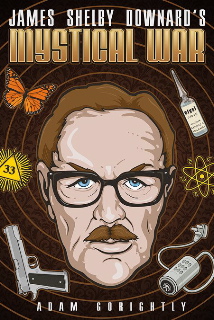
Adam Gorightly's newest book documents the remarkable phantasmagoria that was the person named James Shelby Downard, an American theorist and pamphleteer who shared his thoughts about conspiracies, coincidences, synchronicity, and symbolism.


James Shelby Downard's Mystical War was released by Virtual Bookworm Publishing, in November 2008. The subject of the book, Downard, lived from March 13, 1913 to March 16, 1998, unless, of course, his death was a disappearing act and he's still alive somewhere, writing under an assumed name. (I'm joking, right?)

Downard appeared on the scene when many of my contemporaries and I were just beginning to have lexilinked thoughts and overlapping insights into coincidences. His influence, as Gorightly notes, today has spread far beyond this strange man's life and death.

I easily understand the reach of Downard's impact within my own life from this twilight realm. In the 1960s and 1970s, first in correspondence, and then later in Fortean Times columns, I wrote about the connections I found between names and weirdnesses. Some of those writings appeared (see Devil Names and Fortean Places) in my 1983 book, Mysterious America, along with another chapter, entitled "Name Game."

In the beginning, I pointed to names such as Devil, Diablo, Manitou, and Hockomock for locations, and people names like Hobbs and Wetzel to watch. These were early explorations on the edges of what today is a vast journey in onomatology (the study of names) and toponomy (the study of places).

In the 1960s, John A. Keel carried on a lively correspondence with me and others, in which he examined the frequent appearance of certain proper names, like Reeves/Reaves, McDaniel, Hill, Allen, Maddox, and Heflin, as eyewitnesses of anomalistic incidents.

Soon, I was corresponding with Bill Grimstad and Michael Anthony Hoffman II (both known for their alleged Holocaust denier views, btw), who were close associates of Downard. Many people feel they got letters from Downard, but mostly, it was Hoffman and Grimstad who were assisting in getting Downard's thoughts and words to the rest of us.

Exchanging ideas with Grimstad, about locations linked to Fayette and LaGrange, and names like Bell, Mason/Macon, Pike, Warren, and Lafayette, all went hand in hand with being a Fortean in the 1960s-1970s, especially if an interest in assassinations and strange suicides fit into the mindset.

Hoffman, who authored the modern notion of the twilight language (versus the ancient Buddhist understanding of the phrase) and Grimstad, who was the source of the Fayette factor, were interesting and stimulating correspondents who nicely intellectualized many of Downard's ideas. Hidden meanings were there for the finding, and Hoffman, Grimstad, and Downard were the miners.

James Shelby Downard, who wrote short tracts, which later were published in various anthologies from Adam Parfray at Feral House, examined his own perceived decodings behind historical events in the 20th century, on a parallel track to what was happening with Forteans, anomalists, and demonologists. Downard's approach was mostly cryptopolitical, and some of us drifted over into his world, as often happens in attempting to get a holistic view of history and current events.

How does a biographer working with a secretive subject capture the life of the hidden one? That was Gorightly's task.

As you begin to read this new book about Downard, you might think that you have opened a cryptocomedic LSD trip about a conspiracy-oriented Forrest Gump-like character, who amazingly finds himself in all the wrong places at the wrong times.

Gorightly escorts the reader abroad a rollercoaster ride in which Downard is a Freemason scapegoat being ritualistically abused, watching the KKK hang a person at a crossroads, seeing Alexander Graham Bell receiving homoerotic sex magik fellatio, visiting J. Edgar Hoover's office, and getting a phone call from FDR.

The opening sections of the book are so breathlessly delivered that by the time I arrived at the chapter noting that Downard was at the "first ever meeting of the Baker Street Irregulars on July 5, 1934" in a New York City eating establishment, I hardly was startled by the statement.

All of this made me flashback to what Gorightly observed in his second paragraph of the book: "Some cynics have gone so far to suggest that Downard never actually existed, the group creation of Michael Hoffman, William Grimstad and Adam Parfrey."

Indeed!

The publisher's tagline for James Shelby Downard’s Mystical War, tells us that author Adam Gorightly "chronicles the famed conspiracy researcher’s life long battles against Masonic Sorcery as an investigator and exposer of the Science of Symbolism, Onomatology and Mystical Toponomy."

Well, yes, but what is real and what are Downard's fantasies? We clearly can't tell from Gorightly's text, because, of course, who knows?

The book is an odd mix, at points, of biographical tales about Downard's unbelievable life, his intellectual perceptions in symbol decoding, and details of specific historical milestones along the twilight highway.

When you realize that James Shelby Downard's first published work was only released in 1979, via the short work, The Masonic Assassination of John Fitzgerald Kennedy, you do come to grips with the fact his overall output was limited, but powerful.

Downard's refined and well-edited King-Kill 33° had everything to do with the skills of Michael Hoffman channeling Downard. Combined with Grimstad's Sirius Rising reel-to-reel tapes of conversations with Downard, the two works had a ripple effect. “King-Kill/33: Masonic Symbolism in the Assassination of John F. Kennedy” eventually was published by Adam Parfrey in the first edition of the book Apocalypse Culture. The essay theorizes the Freemasons were responsible for the assassination of President John F. Kennedy.

Grimstad, writing even before it was published, was able to walk a wonderfully skeptical open-minded fence, as he passed along the following summary of Downard's JFK insights in Weird America in 1978:

Would you believe John F. Kennedy as a ceremonial king-who-must-die? I'm afraid there is a certain body of opinion, undoubtedly the farthest-out brain wave of assassinology yet, that maintains the killing was pulled off, not by the Russians, the Cubans, the CIA, or the Mafia, but by alchemists.

As I understand the hypothesis, President Kennedy was for some reason chosen as The King (remember "Camelot," "Macbird" and all that?) after the fashion of James G. Frazer and Mary Renault whose "The King Must Die" he had been given to read before his death. This killing of the king in Dallas was related somehow to the touching off of the world's first atomic bomb at the Trinity Site in New Mexico 18 years earlier. Apparently the Bomb was the "destruction of primordial matter" stage of the grand alchemical working, but these conspiracy buffs aren't much more specific on details than were the early alchemists in their recipes. Anyway, Kennedy represented the next stage of the process - the "Death of the White King" - when he was immolated on a trinity site of his own. For, aren't Dealey Plaza and the ill-famed Triple Underpass on the bank of the old Trinity River?

William Grimstad


Popular cultural outlets, such as Robert Anton Wilson's works (e.g. Cosmic Trigger), the music of Marilyn Manson, and the various books and movies about the numbers 23 and 33, have Downard living onward into the morrow. My own books, including The Copycat Effect, show Downard influences.

Everyone has the sense they "discovered" the significance of certain names or dates, or even factoids like Dealey Plaza being the first Masonic temple in Texas, but remarkably, most of these revelations track back to Downard.


Adam Gorightly, who authored the underground classic, The Prankster and the Conspiracy: The Story of Kerry Thornley and How He Met Oswald and Inspired the Counterculture (with its foreword by Robert Anton Wilson), is a good person to be at the wheel for this biography of Downard. Oh, I wish it would have been twice as long, but I understand how difficult it is to write biographies of people that do not wish to be known.

Gorightly's book does an excellent job, nevertheless, in opening the door to a comprehensive world of symbol decodifications that may be new to many people. Today, there is much 21st century intrigue involving Downard's legacy, in new areas such as synchromysticism.

Several writers and commentators, including Todd Campbell, Robert Schneck, Theo Paijmans, SMiles, Michael Janitch, Mike Gos, Goro Adachi, Greg Bishop, Ben Fairhall, Henrik Palmgren, Richard Hendricks, Craig Heimbichner, Christopher Knowles, Fredrik Palmgren, Anthony Sutton, Kenn Thomas, the late Jim Keith, the late Ron Bond, and Jake Kotze inhabit the netherworld of conspiracies and synchromysticism, with the later being "an emerging field of study and subculture existing on the fringe of areas already considered fringe – primarily mysticism and Jungian psychology."

The word "synchromysticism" was first coined by Jake Kotze in August 2006, on his website-at-the-time, Brave New World Order. Kotze defined the concept as: "The art of realizing meaningful coincidence in the seemingly mundane with mystical or esoteric significance."

Downard's modern influence on Forteana, assassination studies, occult symbolism decoding, twilight language research and synchromysticism is so deep that he must be acknowledged as the Godfather to many of the points of view that inhabit those arenas.

I'm not sure if I take even half of what Downard wrote about as reality, but to get caught up in that intellectual side trick in critical thinking misses the point. In realizing the reality behind the twilight language, the metaphor is the method and the Downard as revealed by Gorightly is the message.


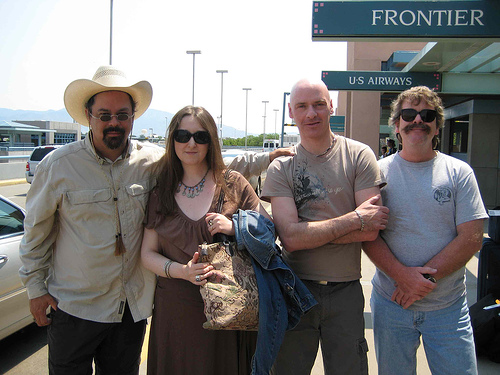
Greg Bishop, Farah Yurdozu, Nick Redfern, and Adam Gorightly somewhere near Roswell, on 07/09/07. Photo by Sigrid Hudson.

Glossary ~ James Shelby Downard examined the world through a variety of methodologies, including the following:

Onomastics or onomatology is the study of proper names of all kinds and the origins of names. The word is Greek: ὀνοματολογία (from ὄνομα (ónoma) "name").

Toponymy or toponomastics, the study of place names, is one of the principal branches of onomastics.

Anthroponomastics (or Anthroponymy), a branch of onomastics, is the study of anthroponyms (anthropos, 'man', + onuma, 'name'), the names of human beings.

Etymology is the study of the history of words — when they entered a language, from what source, and how their form and meaning have changed over time. In languages with a long detailed history, etymology makes use of philology, the study of how words change from culture to culture over time. The word "etymology" itself comes from the Ancient Athens ἐτυμολογία (etumologia) < ἔτυμον (etumon), “‘true sense’” + -λογία (-logia), “‘study of’”, from λόγος (logos), "speech, oration, discourse, word."

+++

If you have questions about the identity of Bill Grimstad: 

 See The Dirty Little Secrets of Twilight Forteans.