Friday, April 22, 2016

Name Game Killings: 8 in Ohio & 5 in Georgia


UPDATE: Investigators found three marijuana "grow operations" at residences where eight family members were slain in southern Ohio, state Attorney General Mike DeWine said Sunday at a news conference. He didn't say whether the marijuana was connected to the execution-style killings discovered last Friday at four residences in Piketon. According to DeWine, 18 pieces of evidence has been submitted to the crime lab and at least five search warrants have been issued and completed. Source.


The name game has hit another Pike location, rather dramatically, and involved a Wayne, elsewhere.

Most Pike counties around the country are named after Zebulon Montgomery Pike Jr. (January 5, 1778 – April 27, 1813), an American soldier, explorer, and Freemason, whose Pike expedition, often compared to the Lewis and Clark Expedition, mapped much of the southern portion of the Louisiana Purchase. Pike's Peak is one of the most famous locations named after Zebulon Pike.

In The Rebirth of Pan: Hidden Faces of the American Earth Spirit, Jim Brandon writes, regarding the overall "name game":
I'm not talking here of such spooky tongue-twisters as H.P. Lovecraft's Yog-Sothoth or Arthur Machen's Ishakshar, but of quite ordinary names like Bell, Beall and variants, Crowley, Francis, Grafton, Grubb, Magee/McGee, Mason, McKinney, Montpelier, Parsons, Pike, Shelby, Vernon, Watson/Watt, Williams/Williamson.
Ohio Attorney General Mike DeWine said eight people were found dead in Pike County, Ohio, on Friday, April 22, 2016.

Originally said to be seven dead, the toll is up to eight. The eight people were found shot to death at a Pike County home. Reports indicate as the people are dead in Pike County, near the Adams County line, east of Peebles.

At least eight members of the Rhoden family, including a 16-year-old boy, were found dead from gunshot wounds to the head at multiple locations along Union Hill and Left Fork roads just northeast of Peebles early Friday morning.

The name Rhoden is generally associated with the German name Roden. Roden is a name of Germanic origin, originally meaning "red valley."

[The urban dictionary says Rhoden originates from the Jamaican language; it is a mixture of words: “rawda” meaning rather and “don” usually meaning a male mafia boss. A person described as a rhoden is a person who embodies the pinnacle of all the important social aspects. If a rhoden is not at a social gathering it’s not worth going to that event. The people usually put under this “rhoden” category are usually Jamaican but can also be from African-American origins as well.]

Officials said the victims were shot "execution-style." All of the victims are believed to possibly be members of the same family, and they were found in four homes.

DeWine also told WLW radio that "the assailant is probably loose somewhere."

“This is a horrible horrible tragedy," DeWine said on WLW. "It looks like two teenagers dead and it looks like young young children who must have been there when it occurred.”

Three juveniles were also recovered alive from the crime scenes, a 4-day-old, a 6-month-old and a 3-year-old.
None of those found shot appear to be suicides, indicating that it is likely that the assailant is at large, DeWine said.

DeWine said they do not know the motive at this time.

A spokesperson for Ohio's Bureau of Criminal Investigation said earlier that "we are sending everybody" to the shooting scene near the Adams/Pike county line. Spokesman Dan Tierney said the Pike County sheriff's office requested state help at 8:20 a.m.


Union Hill Road runs off Ohio 32 at the county line. Aerial video shows officers standing outside a home with crime scene tape around it.

More than two dozen vehicles were parked along the road in front of the home. Three ambulances and more cruisers were parked near where Union Hill Road meets Ohio 32.


The FBI in Cincinnati also said it was closely monitoring the situation and has offered assistance to the Pike County sheriff's office if needed.

Pike County victim's advocate Dave Dickerson said about 20 members of the family had gathered at the church to await information. He said they had been given little information so far.

Dickerson said he had been told as many as two children were taken to hospitals, but he didn't know anything about their identity or condition.

In Adams County, a few miles west of the crime scene, Peebles High School was on lockout for some time, but it was lifted shortly before 11 a.m.

Early reports told of seven, not eight, being killed. The house sits in Pike County, near the Pike/Adams county line.

"I was told we are out of danger. We feel sure of that," Superintendent Richard Seas said.

"Reports we are receiving from Peebles are tragic beyond comprehension," Gov. John Kasich wrote on his Twitter account.


On his Facebook page, Chris Rhoden says he's a native of Piketon, Ohio, and attended Piketon High School. A month before his death, Chris Rhoden posted a meme of a shotgun with the words, "I won't back up. I don't back down. I was raised up to stand my ground," according to sources.


++++

Meanwhile, a man suspected of killing five people in a pair of shootings, April 22, 2016, Friday night later died of a self-inflicted gunshot wound, police said.

Wayne Anthony Hawes, 50, of Appling, shot himself in the head, according to a statement from Columbia County (Georgia) Capt. Andy Shedd. Authorities believe he unsuccessfully tried to set his house on fire before killing himself.

The Columbia County Sheriff's Office searched for Hawes, who allegedly shot five people Friday night. Shedd said the incident stemmed from a domestic dispute and some of the victims are believed to be related to Hawes' wife.

Police first responded to reports of a shooting at 7:54 p.m. Friday at a Johnson Drive house in Appling, Shedd said. Officers found three shooting victims at that crime scene: Roosevelt Burns, 75; Rheba Mae Dent, 85; and Kelia Clark, 31.

Late Friday night, Columbia County deputies say Wayne Anthony Hawes is the suspect in the Pike County deaths, allegedly, 5'9" & 230 lbs.

Within the "weird news" field, it has been a well-known truism that if a criminal has a middle name of "Wayne," no one in the newsroom is surprised he is being charged with murder. The examples are multiple. The most famous case, of course, is John Wayne Gacy. See more on the "Wayne Name Game," here and here.

Hawes is from a Norman female personal name, Haueis, from Germanic Haduwidis, composed of the elements had "strife," "contention" + wide "wide."

An alternative origin is the place's name is derived from the Old Norse word hals, meaning "neck" or "pass between mountains."

h/t Theo Paijmans & Media Monarchy.

Thursday, April 21, 2016

The Artist Formerly Known as "The Artist Formerly Known as Prince" Is Now Formerly Alive


Prince Rogers Nelson has died, on April 21, 2016. Prince was born on June 7, 1958, in Minneapolis, Minnesota, and created the "Minnesota Sound."

During his career, Prince was not shy about using the twilight language of the All-Seeing Eye on his album/CD covers. Some feel he felt tied to the Illuminati. Others feel he was anti-Illuminati.


The symbol below was what took the place of Prince's name when he dropped his formal moniker for awhile.  It mwould soon be dubbed "The Love Symbol" and Prince would be referred to as "The Artist Formerly Known as Prince," "TAFKAP," or simply "The Artist". Later, when he changed his name back to Prince again, he was sometimes called "The Artist Formerly Known as 'The Artist Formerly Known as Prince'".

Prince postponed two performances from his Piano & A Microphone Tour on April 7, 2016, at the Fox Theatre in Atlanta, Georgia, stating that he was "battling the flu." On April 15, the artist's private jet was forced to land in Illinois so that he could seek medical treatment for influenza-like symptoms, after performing the rescheduled Atlanta concert the day before. He was seen in public the following evening in Minneapolis, when he stopped at the Electric Fetus on Record Store Day, and made a brief appearance at a dance party at his Paisley Park Records recording studio complex in Chanhassen, Minnesota, stating that he was feeling okay. Prince died on April 21, 2016 at 10:05 a.m., at the age of 57, having been found unresponsive in an elevator that morning at his Paisley Park complex. Source.

Denise Katrina Matthews (born January 4, 1959), better known as Vanity, died on February 15, 2016.  She was a Canadian singer, songwriter, dancer, actress and model, who turned away from her music and acting career to concentrate on evangelism. Her career lasted from the early–1980s until the mid–1990s. In 1980, she met Prince at the American Music Awards. Prince renamed her Vanity, as he considered her to be the female form of himself. After learning that Vanity could sing, Prince asked her to become the lead singer of the girl group Vanity 6. Due to her kidney problems which were caused by years of drug use while she worked as a performer, she had to undergo peritoneal dialysis five times a day (each session was 20 minutes long). She suffered from sclerosing encapsulating peritonitis, a rare complication of a peritoneal dialysis, and died in a Fremont, California, hospital on February 15, 2016, from renal failure. She was 57 years old.

+++

The origin of the name Chanhassen comes from the Dakota word chanhasen meaning "sugar-maple tree" (chan, tree; haza, a tree with sap).


The Paisley Park Studios, where Prince was found dead, was named after his song of the same name. The studio was designed by architecture firm BOTO Design Architects of Santa Monica, California, and was completed in 1988. BOTO Design Architects is an architecture, acoustic, and interior design firm with studios in Santa Monica and Colorado. It was founded in 1983 by Principal architect Bret Thoeny in Venice, California.


Paisley is a Scottish name that means "church." The name Paisley comes from a town in Scotland that made the Indian/Persian design we know today as "paisley" famous with shawls woven in their textile mills during the 1800s. Since this pattern had its roots in the cottage industries of Paisley Abbey, it is interesting to note the word "Paisley" itself is a Scottish derivation of the Greek word, "Basilica" meaning "church". Today, the link to the 1960s is a visual recognition of this distinctive intricate pattern of curved, feather-shaped figures based on a pine-cone design from India.

"Paisley Park" is a song by Prince and The Revolution. It was the first single released in some international markets from their 1985 album, Around the World in a Day. The song has a psychedelic feel, similar to some of The Beatles' later work with echoed guitar and finger cymbals. The lyrics describe a Utopian place that one can feel in their heart, despite the chaos of the world around them. "Paisley Park" was recorded before Purple Rain was completed, indicating the new direction Prince wanted to take after the success of that album and film. 

Monday, April 18, 2016

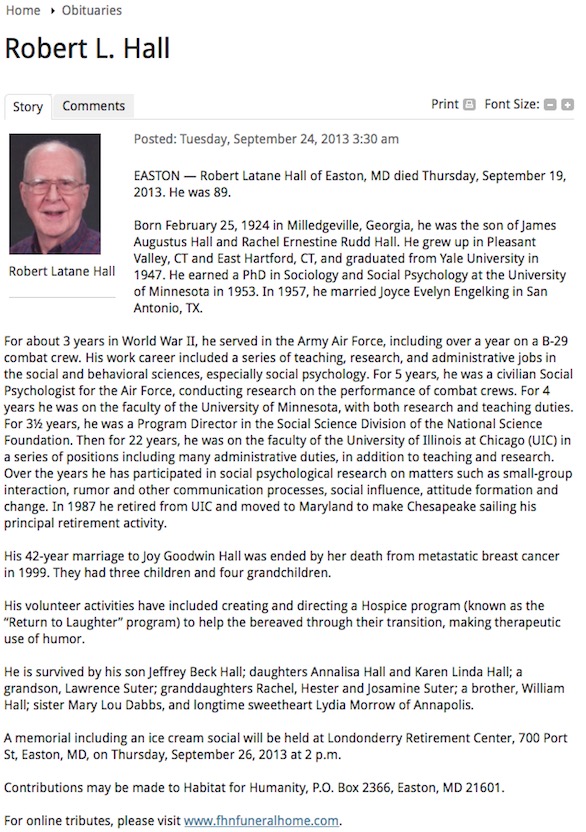
UFO Sociologist Robert L. Hall, Brother of Ufologist Richard, Died in 2013


The news sometimes takes a long time to reach a speciality community, especially if the local obituaries do not list that someone rather accomplished also did unusual research, such as on UFOs. This is the case in learning that Robert L. Hall has passed away on September 19, 2013.

"This news did not make the rounds of ufology," at the time of his death, noted one* ufologist to others, yesterday. Allow me to fill in the picture of Robert's life, in ufology and outside of it.

Robert Hall, a Ph.D. in Sociology and Social Psychology, working in his last position for 22 years at the University of Illinois in Chicago, found himself testifying before the U.S. House Committee on Science and Astronautics - Symposium on UFOs, in 1968. (The complete statement by Dr. Robert L. Hall at the 1968 hearings can be found here.)

Hall contributed and saw his paper, “Sociological Perspectives on UFO Reports,” published in Carl Sagan and Thornton Page, eds., UFO's: A Scientific Debate (New York: Norton, 1972: 213-222).

Robert Hall's paper, therefore, was read widely, as it appeared in various editions of that anthology (as shown above and below):


Robert L. Hall was also the brother of famed ufologist Richard Hall, who worked for the National Investigations Committee on Aerial Phenomena, from 1958 to 1969.


In 1964 Hall researched, edited, and wrote much of The UFO Evidence, a compendium of the best UFO sightings and incidents of the 1940s, 1950s, and early 1960s. A copy of The UFO Evidence was sent to every member of Congress in 1964, and the book is still regarded by many UFO researchers and historians as one of the best UFO books ever published. 


On the morning of July 17, 2009, Richard Hall passed away due to a long battle with cancer. (See my obit on Richard Hall here.)

Richard's brother, Robert L. Hall's formal obituary is posted below. It does not mention his links to UFOs, nor is that connection noted in his more formal resume, also shown below.

Our condolences to the Hall family and friends, for their dual losses.


Vitae (prepared for Congress in 1968)

DR ROBERT L. HALL
Born February 25, 1924, at Atlanta, Georgia. Married; 3 children.

EDUCATION
Yale University, 1941-42. B.A. 1947.

University of Stockholm, Sweden, 1947-48.

University of Minnesota, 1949-52. M.A., 1950. Ph.D., 1953.

PROFESSIONAL EXPERIENCE
1. Instructor, Extension Division, University of Stockholm, Sweden, 1948.

2. Research Assistant, University of Minnesota, 1950-52.

3. Social Psychologist in the Air Force Personnel & Training Research Center, 1952-1957. Engaged in research on performance of bomber crews, the role of the aircraft commander, and processes of evaluation of small teams.

4. Assistant Professor (1957-1960) and Associate Professor (1960-62) of Sociology. Teaching social psychology, especially the processes of mass communication and opinion change. Conducting research on social psychological aspects of higher education and effects of social interaction on the learning process.

5. Program Director for Sociology and Social Psychology, National Science Foundation, 1962-1965. Administered a program of research grants and related activities to strengthen Sociology and Social Psychology in universities in the United States and to bolster understanding in these fields through basic research.

6. Associate Professor of Sociology and Psychology (1965-66) and Professor of Sociology and Head of the Department of Sociology (since 1966), University of Illinois at Chicago Circle.

PUBLICATIONS
A number of articles in Sociological and Psychological journals and chapters in professional books. A few selected publications are listed below:

Social influence on the Aircraft Commander's role, "American Sociological Review" 1955,20,292-299.

Military Sociology, 1945-1955. "Chapter in Sociology in the United States of America," ed. by Hans Zetterberg, Paris: UNESCO, 1966.

Group performance under feedback that confounds responses of group members. "Sociometry," 1957,20,297-305.

The informal control of everyday behavior. Chapter in "Controlling Human Behavior," ed. by Roy Francis, Social Science Research Center, University of Minnesota; 1959.

Two alternative learning in interdependent dyads. Chapter 12 in "Mathematical Methods in Small Group Processes," ed. by Joan Criswell, H. Solomon, and P. Suppes, Stanford Univ. Press: 1962.

The educational influence of dormitory roommates. "Sociometry," 1963,26,294-318 (with Ben Willerman).

The effects of different social feedback conditions upon performance in dyadic teams. Chapter in "Communication and Culture," ed. by A. G. Smith, 1966, 353-364.


+++

My thanks to the following people for discovering this news and informing me, via the informal network of informants: Patrick Huyghe, Walt Webb, and *Rob Swaitek.


+++

Other ufologists’ obituaries for 2016.


Sunday, April 17, 2016

"Space Critters" Ufologist Trevor James Constable Has Died


Another early researcher and writer in ufology has passed away. Native New Zealander Trevor James Constable, 90, died on March 31, 2016, in California.


This news comes after only recently learning of the death of Albert K. Bender, 94.

Not too surprising, because Bender and Constable were from a special era, there's an overlap between their lives.

Ufologist Nick Redfern points out in a communique to me:
Constable contributed a letter to the book Bender Mystery Confirmed. Not many people know of this book. It was a follow-up to Bender's Flying Saucers and the Three Men. It was published by Gray Barker. The Confirmed book is a collection of about 20 letters from people who had read Bender's book and who wanted to comment on it.

UFOs

Trevor Constable was an early foundation proponent that UFOs were actually "space animals," and wrote about his theories beginning in the 1950s.

Trevor James Constable began reading, intensively about "flying saucers" in 1957. Using the name "Trevor James," as the author of They Live in the Sky (1958), he tells of having attended George Van Tassel's Giant Rock convention and learned techniques to contact a mysterious entity called "Ashtar." Some in ufology link Constable to Men-in-Black through these learning experiences, although this merely appears to be his youthful introduction to the field. His direction found him going elsewhere in his exploration of UFOs.


Writing 24 years ago about Constable's role in ufology, historian Jerome Clark observed:
In two books (They Live in the Sky [1958] and The Cosmic Pulse of Life [1976]) Trevor James Constable, an aviation historian, occultist, and contactee, has offered comparable theories [to other writers of creatures living in the upper atmosphere] but gone beyond them to produce infrared photographs of aerial entities he calls "critters," which resemble one-celled life forms "complete in some cases with nuclei, nucleoli, vacuoles, and all the rest," in the words of the late biologist and anomalist Ivan T. Sanderson, a proponent of space animals [Uninvited Visitors: A Biologist Looks at UFOs, New York: Cowles, 1967]. Constable says that these phenomena are visible to the eye only under certain circumstances, when they are perceived as meteors or UFOs. Even those skeptical of space animals have not questioned Constable's sincerity, evidenced in his long commitment to his work, or accused him of faking his photographs. Though the photographs have never been explained, replications have been few, but not nonexistent. ~ Jerome Clark, The Emergence of a Phenomenon: UFOs from the Beginning through 1959 ~ The UFO Encyclopedia - Volume 2 (Chicago: Omnigraphics, 1992: 317)
A summary of his theory appears in Wikipedia:
After reading about radionics and Wilhelm Reich's orgone, Constable became convinced that supposed UFOs were in fact living organisms. He set out to prove his theorem by taking a camera with him, fitted with an ultra-violet lens and high-speed film. The processed pictured showed signs of discolouration, which Constable insisted were proof of amoeba-like animals inhabiting the sky.
Reviewing his new found 'evidence', Constable was moved to write in two books that the creatures, though not existing outside of the "infrared range of the electromagnetic spectrum," had been on this Earth since it was more gaseous than solid. He claimed that the creatures belonged to a new offshoot of evolution, and that the species should be classified under macrobacteria. According to Constable, the creatures could be the size of a coin or as large as half a mile across.
The biology of the creatures supposedly meant that they were visible to radar, even when not to the naked eye. To explain supposed cattle (and occasionally human) mutilations, Constable theorised that the use of radar angered the organisms, who would become predatory when provoked. Source.
So what we find is that "inspired by Wilhelm Reich's orgone energy, Ruth Drown's radionics, the writing of Charles Fort and Arthur Conan Doyle's story The Horror of the Heights, Constable became convinced that the UFOs he heard so much about in the 1950s weren't alien spacecraft, but living beings," wrote frequent Fortean Times contributor Mark Pilkington in The Guardian in 2005.

But is it not a zoologist who would have these supposed creatures as Amoebae constablea, named after their discoverer, as Pilkington writes. Nor is it "crypto-zoologists" [sic], as Wikipedia would have you consider the basis of that Latin name.

No, the author of Ablaze! is the source of this piece of Constable lore.  The Fortean researcher "Larry Arnold believes that these plasmamoeboids--whom he dubs in gratitude to Mr. Constable with the scientific name Amoebae constablea--emit energies that may be a cause of Spontaneous Human Combustion if they are in close proximity to a human being," notes Andrew Gaze.


Trevor Constable took the photograph directly above, on May 17, 1958, at Giant Rock, California, the object above the ridge was not seen by witnesses at the time. 


The Cosmic Pulse of Life was revised and reissued at Sky Creatures: Living UFOs, in 1978.

Trevor Constable was still taking photographs that he said were of living UFOs into the 21st century.

++++++++++++++++


++++++++++++++++


In lectures early in the 2000s, Constable would use NASA's own space infrared films to show evidence of space animals, as can be seen five minutes into the video posted above. Constable would also make appearances on radio programs.

Cloud busting


Constable, after becoming interested in the cloud busting work of Wilhelm Reich, studied the field.
Trevor James Constable, originally from New Zealand, worked in the merchant marines for over 31 years as a merchant marine radio officer, he travelled on enormous ships crossing the north eastern pacific ocean over 300 times, this gave him the opportunity to experiment with his research based on Wilhelm Reich's work.
 Constable (left), LeMay (right)
After Trevor retired from the Merchant Marines, Trevor launched the world's first Airborne Etheric (another name for Orgone) Weather Engineering Operation based in Singapore from the late 1980s to the 2000; Trevor worked with US Air Force retired Colonel W.A."Willy" Schauer, Chairman & Chief Executive Officer George K. C. Wuu and US Air Force General retired Curtis Emerson LeMay [November 15, 1906 – October 1, 1990]. Trevor has proven rain records, radar and federal filling showing his success. Source.
Aviation Histories


Trevor Constable was also a military historian and author, having written eleven non-fiction books, many well known to aficionados of famous fighter aces. Mostly coauthored with Colonel Raymond F. Toliver, Trevor J. Constable's titles included Fighter Aces of the Luftwaffe, The Blond Knight of Germany: A Biography of Erich Hartmann, and many similar books. In 2015, a volume appeared combining his interest in little-known military histories, UFOs, and rainmaking, entitled Hidden History, Rain Engineering and UFO Reality.
.


Life

Trevor James Constable had a long and varied life. 

Living in San Pedro, California, at the time of his death on March 31, 2016, he was born September 17, 1925, in Wellington, New Zealand. 

Wikipedia (unaware that Constable had died earlier, as of 4.16.2016), nevertheless, have online a thoughtful entry on the man, and recalled Constable "served 31 years at sea, 26 of them as a radio officer in the U.S. merchant marine."

Constable is remembered in his official obituary as "a prolific author of WW2 aviation histories, and pioneer in the subjects of ufology, and rain engineering. Professionally, he enlisted in the Merchant Marines at age 17 and worked for most of that time as the radio-electronics officer. Later he was employed by Matson Shipping and served as the Communication's Officer aboard the U. S. Maui for nearly two decades.
Besides his writing and research work, Mr. Constable was known to have a great understanding of homeopathy and good health, a love for cats, a remarkable vocabulary, and a wonderful sense of humor."

He is survived by his wife Gloria of 35 years, and his daughter Diana (Neroni) currently of Las Vegas, and grandson Maximilian Constable now living in Flagstaff, Arizona.

Trevor James Constable has many admirers in ufology.

(h/t to Patrick Huyghe for this sad news.)

Thursday, April 14, 2016

The Man Who First Saw "The Men in Black" Dies


The man who brought the ufo silencers, the men in dark clothing, into modern consciousness, Albert K. Bender, 94, died on March 29, 2016, in California.


"Men in Black" (MIBs) are what appear to be male humans dressed in black suits who claim to be government or paramilitary (or even alien) agents and who harass or threaten UFO witnesses to keep them quiet about what they have seen.


From portrayals in The X-Files, appearances in movies, references in popular culture and points of debate in UFO conspiracy theories, the MIBs have become part of our 21st Century culture.
In April 1952, Albert K. Bender, a factory worker from Bridgeport, Connecticut, announced the formation of International Flying Saucer Bureau (IFSB), whose purpose was to "gather flying saucer information" and to "get all Flying Saucer minded people acquainted with each other...."
At the time he established the IFSB, Bender was a 31-year-old bachelor who lived with his stepfather. He was obsessed not only with UFOs but with occultism, horror movies, and science fiction. Bender transformed his part of the house into what he called a "chamber of horrors." Jerome Clark, The Emergence of a Phenomenon: UFOs from the Beginning through 1959 ~ The UFO Encyclopedia - Volume 2 (Chicago: Omnigraphics, 1992: 73) 
Ufology historian Jerry Clark told of how Bender took "out-of-body trips into deep space," but also worked hard on the IFSB's publication, Space Review. Bender built up the 1952-1953 membership to 1500 people from around the world. "One of the most active was a West Virginia man named Gray Barker."


In early September 1953, Bender, who is acknowledged as one of the first pioneers of UFO research, was visited at his home in Bridgeport, Connecticut, by three men dressed in black who warned him in threatening terms to cease his investigations or else. 


The "silencers," as he called them, scared Bender to the point where he did not publish a report he said was going to answer all the mysteries of the UFO question. Instead, Bender left a warning: "We advise those engaged in saucer work to please be very cautious." Bender's organization - the IFSB - closed down.


After pressing Bender for more details about the "whys" behind the shutdown, Barker wrote his first book, They Knew Too Much About Flying Saucers, which was published by University Books in 1956. The book was the first to describe the Men in Black (MIBs). Barker recounted Bender's own alleged encounters with the MIBs, who were said to travel in groups of three, wear black suits, and drive large black automobiles. In 1962, Barker and Bender collaborated on a second book on the topic, called Flying Saucers and the Three Men. Published under Barker's own imprint, Saucerian Books, this book proposed that the MIBs were, themselves, extraterrestrials.

These "ufo silencer" experiences of this one individual, Albert K. Bender, promoted in later years by Gray Barker (May 2, 1925–December 6, 1984), created an enduring legacy beginning over 60 years ago - the MIBs. 


Besides Bender and Barker, Men in Black researchers and writers have included the late John A. Keel, Jerome Clark, the late Jim Keith, and Nick Redfern.  Nick Redfern, who passed on the news of Bender's passing to me, has written many books on MIBs, including his 2006 book, On the Trail of the Saucer Spies: UFOs and Government Surveillance (which contains information on Bender).


Now Albert K. Bender has passed away.  


Bender was born on June 16, 1921, and served in the United States Air Force during World War II.  In Bridgeport, Connecticut, he was a supervisor at the Acme shear factory. 

After Bender's 1962 book was published, and before Bender moved to Los Angeles, in 1965, while in Bridgeport, Bender started the Max Steiner Music Society, which was later renamed the Max Steiner Memorial Society, dedicated to the famed music composer of theater and film hits.

Steiner (May 10, 1888 – December 28, 1971) composed over 300 film scores, and was nominated for 24 Academy Awards, winning three: The Informer (1935), Now, Voyager (1942), and Since You Went Away (1944). Steiner's popular works include King Kong (1933), Little Women (1933), Jezebel (1938), Casablanca (1942), The Searchers (1956), A Summer Place (1959), and Gone with the Wind (1939), the film score for which Steiner is best known.

Thanks to Albert Bender's Max Steiner Memorial Society, collections of Steiner's music have been preserved, discussed, and disseminated. Bender's Society was responsible for obtaining a Hollywood Walk of Fame Star for Max Steiner, as well as Steiner's name being written in the Golden Book of the State of Israel. Bender's Steiner collection was donated to the Brigham Young University manuscript collection.

This little known part of Albert K. Bender's life, beginning in 1965, is noted in Max Steiner: Composing, Casablanca, and the Golden Age of Film Music by Peter Wegele (2014):


Albert K. Bender and Max Steiner.


Albert K. Bender at the announcement of the Max Steiner commemorative stamp, 1999.


At the time of his death, Bender was residing in Los Angeles, and his funeral was held in Manhattan Beach, California, on April 9, 2016. His known sibling survivors are Fred Bender, Shirley Audugar, and Joseph Kevlin.


Albert K. Bender and his wife.

The only known recording of Albert K. Bender can be found here. He also wrote a volume of recollections, Five Slices of Life: A Collection of Short Stories.

(Confirmation: Besides the Wikipedia page that was apparently written by a source close to Bender, the death is verified by the page on his funeral arrangements.)

+++

See also: 
Synchromystic Men In Black

Nick Redfern has posted his comments on the
death of Albert K. Bender at Mysterious Universe.