Showing posts with label Buildings of Disaster. Show all posts

Sunday, March 31, 2019

Hotel Taj Mahal: The Replica


The new movie Hotel Mumbai opened first at the Toronto International Film Festival on September 7, 2018; on March 14, 2019, in Australia; on March 22, 2019, and widely on March 29, 2019, in US theaters; and finally in India on March 29, 2019. The fiction film, based on true events, depicts the 26/11 attacks in Mumbai, India, that took place in 2008.


At the time, in 2008, I wrote extensively on Twilight Language of this incident here.

It is a film I wanted to see. I saw Hotel Mumbai this weekend, and was surprised the theater was almost full for an afternoon screening.

Tarrun Verma and Anupam Kher

On March 29, 2019, I noticed, via Facebook, that fellow Souvenir Building Collectors Society member Tarrun Verma attended the opening of Hotel Mumbai at NYC's AMC Empire 25. The showing he attended included a Q/A panel with Anupam Kher. Kher plays Hemant Oberoi, the hotel's heroic and celebrated executive chef, in the motion picture.

I wondered aloud to Verma whether there was a replica of the Taj Matah Palace Hotel of Mumbai. I wanted to add such a souvenir building to my informal buildings of disaster collection. He quickly answered that the Boyms themselves had created a new edition to their landmark Buildings of Disaster series in 2009. (I had placed this on the list I had compiled in 2018, but had forgotten.) 

Verma had attempted to obtain a copy but they were all sold out, a few years ago.

A quick internet search revealed the image of this replica when it was first on sale, and the background story.


Chor Bazaar wrote:
I recently came across this replica of the Taj Mahal Hotel in Mumbai (aka Bombay). It is designed and manufactured by a company called Boym Partners Inc. They have a series of what they call the "Buildings of Disaster".

This one in particular is called, "Hotel Taj Mahal, Mumbai, November 26, 2008. The date might sound familiar to you as it commemorates the recent Mumbai attacks. Source.

An old posting by Boym gives these details:
Our collection of Buildings of Disaster continues with a new edition, Hotel Taj Mahal, to commemorate the first anniversary of the terrorist attack in Mumbai on November 26, 2008.

Over ten years ago, we made our first buildings for the catalogue Souvenirs for the End of the Century. Produced in a limited edition of 500, many monuments are no longer available. Every piece is individually cast of specially formulated bonded metal, hand-finished, and consecutively numbered. The new building is 4.5” long. Source.

I have been unable to find one of these replicas for sale, so if you find or have any you wish to sell, please let me know. Contact Loren Coleman.

+++
Buildings of Disaster is a project begun by Boym Design Studio in 1998. This thoughtful project is described by the creative director, Constantin Boym:
The end of a century has always been a special moment in human history. While we no longer expect the world to come to an end, we all still share a particular mood of introspection, a desire to look back and to draw comparisons, and a sense of closure and faint hope. Above all, the end of the century is about memory. We think that souvenirs are important cultural objects which can store and communicate memories, emotions and desires. Buildings of Disaster are miniature replicas of famous structures where some tragic or terrible events happened to take place. Some of these buildings may have been prized architectural landmarks, others, non-descript, anonymous structures. But disaster changes everything. The images of burning or exploded buildings make a different, populist history of architecture, one based on emotional involvement rather than on scholarly appreciation. In our media-saturated time, the world disasters stand as people's measure of history, and the sites of tragic events often become involuntary tourist destinations.

Saturday, May 26, 2018

Thanatourism: Disaster and Dark Tourism

It is almost taken for granted nowadays that another school, workplace, mall, restaurant, movie, or related site will have a mass shooting incident or major terrorist attack again soon. 

Out of these disasters we have seen the rise of collecting disaster buildings, from elegant replicas made by Boym Designs and Mike Merwine's InFocusTech, to the less exacting ones, as I mentioned recently regarding securing a Waffle House model


For today, I wish to ponder a prediction that mass shootings will lead to a form of thanatourism that includes locations of mass violence. Few in the synchromystism field have examined the rather recent, and yet large movement in this direction. 


People may hesitate going to their local or distant school to visit a shooting site. But we will begin observing folks stopping at Louie's by the Lake at Lake Hefner near Oklahoma City or by Trolley Square Mall in Salt Lake City, in some fashion similar to how thanatourists have sought out the University of Texas tower or how ultrathanatourists beat a path to Pompeii. 

Dates for some thanatourism pilgrimages are important, of course, such as the 50th anniversary of the assassination of Robert F. Kennedy in 2018. While the building where he was killed has been torn down, the Ambassador Hotel exists in a high quality replica building by InFocusTech


Here's an overview of thanatourism:


Thanatourism is derived from the ancient Greek word thanatos for the personification of death. (Not to be confused, directly, with the Marvel character Thanos, but you can imagine how creators Mike Friedrich and Jim Starlin came up with that name.)


Disaster tourism is the act of traveling to a disaster area for pleasure, usually out of curiosity.

Disaster Tourism is used for leisure travels to zones whipped by natural disasters or traumatic events known as "traumascapes." 


Dark tourism (also black tourism or grief tourism) has been defined as tourism involving travel to places historically associated with death and tragedy.

Example destinations in the specific form of thanatourism more generally known as "dark tourism" include:
Destinations of dark tourism include castles and battlefields such as Culloden in Scotland and Bran Castle and Poienari Castle in Romania, former prisons such as Beaumaris Prison in Anglesey, Wales, the Jack the Ripper exhibition in the London Dungeon, sites of natural disasters or man made disasters, such as Hiroshima Peace Memorial Park in Japan, Chernobyl in Ukraine and the commercial activity at Ground Zero in New York one year after September 11, 2001. It also includes sites of human atrocities and genocide, such as the Auschwitz concentration camp in Poland, the Nanjing Massacre Memorial Hall in China, the Tuol Sleng Genocide Museum in Cambodia, the sites of the Jeju Uprising in South Korea and the Spirit Lake Internment Camp Centre near La Ferme, Quebec as an example of Canada's internment operations of 1914–1920.
On Bali "death and funeral rites have become commodified for tourism ..., where enterprising businesses begin arranging tourist vans and sell tickets as soon as they hear someone is dying." In the US, visitors can tour the Holocaust Memorial Museum in Washington, DC "with an identity card which matches their age and gender with that of a name and photo of a real holocaust victim. Against a backdrop of video interpretation portraying killing squads in action, the pseudo holocaust victim enters a personal ID into monitors as they wander around the attraction to discover how their real-life counterpart is faring." 
In late 2017, the online journal Current Issues in Dark Tourism Research was launched. The aim of the online journal is to bring affordable 'dark tourism' scholarship direct to students, researchers, and the media. The journal is unique in that it pays royalty fees to authors and, as a result, is a new model for contemporary academic publishing. Authors and scholars may submit their own related research for publication in the journal. A broad range of 'dark tourism and difficult heritage' research will be available in the journal, in the form of articles, case studies, and commentaries. The editor of the journal is Dr Philip Stone.
Popular Mechanics published a list of "8 Disaster Tourism Sites," by Laura Kiniry, August 30, 2013, "for your next family vacation." They include:

1. Chernobyl Power Plant (site of the radioactive accident, April 26, 1986), in the restricted Chernobyl Exclusion Zone situated in the Ivankiv Raion of northern Kiev Oblast, near Ukraine's border with Belarus.
2. Naval Air Engineering Station Lakehurst (where the Hindenburg caught fire, May 6, 1937) Lakehurst, New Jersey.
3. Exxon Valdez Oil Spill (where 30 million gallons of oil leaked, March 24, 1989) Bligh Reef, Prince William Sound, Alaska.
4. Chelyabinsk Meteor (where it struck on February 15, 2014), Chelyabinsk, southern Urals; Lake Chebarkul; and Ilmen Reserve, Russia.
5. Bikini Atoll Nuclear Test Site (site of the tests in 1946-1958), Marshall Islands, Pacific Ocean.
6. Hanford Site (built in 1943, decommissioned 1964-1971), Benton County, along the Columbia River, Washington State.
7. Hurricane Katrina (hit the Gulf Coast on August 29, 2005), especially the Lower Ninth Ward, New Orleans, Louisiana.
8. Pompeii (due to the eruption of Mt. Vesuvius in 79 AD), at the base of the volcano, Italy. Popular Mechanics calls it the "mother of all disaster tourism sites."


A couple other examinations of this phenomena include:

"The Disaster Tourist," by Kent Russell, Highline/HuffPost, January 25, 2018, about Otto Warmbier's terrible adventure that ended in his death via North Korea.
"JFK and dark tourism: A fascination with assassination" by Malcolm Foley and J. John Lennon, International Journal of Heritage Studies, 2007, about three JFK assassination sites. 

Sunday, May 06, 2018

Disaster Buildings: Waffle House

As readers of the Twilight Language know, there is a long history of violence at Waffle Houses. This fact was reinforced by the recent Antioch, Tennessee Waffle House killings of April 22, 2018 (see "Naked Comes The Waffle House Shooter").

Therefore, due to the significance of these locations, I've added a small generic replica of a Waffle House building to my "Buildings of Disaster" collection. (See the previous posting, "The Boyms and Beyond: Collecting Disaster Buildings.")


An American dime for scale.


This example is from the train buildings hobby, and not exactly at the level of the museum quality standard I routinely maintain. But it will do, for now.


I am a member of the Souvenir Building Collectors Society. Most of my 500+ buildings in my collection are metal and/or are other kinds of official souvenirs.


A landmark commemorating the first Waffle House in Avondale Estates Georgia. Photo: Erik S. Lesser. Source, "What Waffle House Means to Southerners," by Bob Moser,  Rollingstone, April 25, 2018.


Thursday, February 01, 2018

The Boyms and Beyond: Collecting Disaster Buildings


Is this a building of disaster?

It certainly appears to be.

With the "Buildings of Disaster" series (begun in 1997 and continuing today), Constantin Boym and Laurene Leon Boym (i.e. Boym Designs) created replicas of famous and infamous structures where some tragic or terrible events took place. They offered them as "souvenirs" for our time. Souvenirs of human tragedy, even violent events, are a part of our "object-history," as they termed them. Each year crowds of people visit the battlefield of Gettysburg, as well as the site of the car crash which killed Diana, Princess of Wales. Source.

Ten years ago, the "Building Collector" blog wrote about the Boym Partners' Buildings of Disaster (see here). As that essay notes, Constantin Boym described them as an "alternative history of architecture."

The original series are only available in resale, for often a thousand dollar each, separately, or several thousands together. They originally sold for about $95 each. Nevertheless, we have photographs of the offerings and related buildings. Here is a record of the Boym buildings, and followed by associated candidates for collectors of building souvenirs of disaster.

Boym's list of the originals:


Using the list above, as a way to organize the images, here are the offerings, as found throughout the Internet.


Texas School Book Depository, Nov 22, 1963 (by Boym Designs).


Texas School Book Depository, Nov 22, 1963 (by InFocusTech). 


World Trade Center, Feb 26, 1993


The Unabomber Cabin, 1997


The Boyms also issued a bird house based on the cabin.


Triangle Shirtwaist Company, March 25, 1911 


Texas A&M Bonfire Tower, November 8, 1999 


The World Trade Center, September 11, 2001 


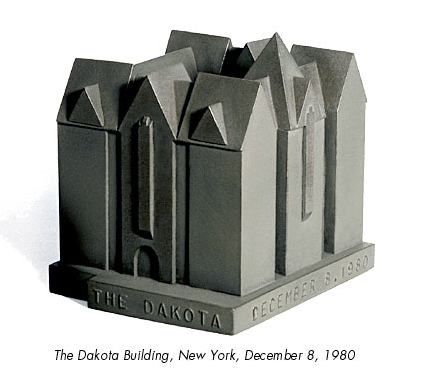
The Dakota Building, December 8, 1980 (by InFocusTech.)


The Hands of Victory, Baghdad 1989-2003 


The Empire State Building, July 28, 1945 


The Obama White House, 2009 [not a Building of Disaster, but aligned to the series because of President Obama occupying the White House in 2009].


The UT Tower, Austin, TX, August 1, 1966 


Hotel Taj Mahal, Mumbai, November 26, 2008 


Not on the list, but apparently a Boym Designs "Building of Disaster" is the Greenwich Village Townhouse.

The Greenwich Village Townhouse explosion occurred on March 6, 1970, in the Greenwich Village neighborhood of the New York City borough of Manhattan. It was caused by the premature detonation of a bomb that was being assembled by members of the Weather Underground, an American radical left group. The bomb was under construction in the basement of the 1845-built Greek Revival townhouse at 18 West 11th Street, when it accidentally exploded; the blast reduced the four-story townhouse to a burning, rubble-strewn ruin. The two persons preparing the bomb were killed instantly (Diana Oughton and Terry Robbins), as was a third "Weatherman" who happened to be walking into the townhouse (Ted Gold); two others were injured but were helped from the scene and later escaped (Kathy Boudin and Cathy Wilkerson).

$$$

The Boyms issued a limited gold-plated Buildings of Disaster in 2007 (see here). The eight buildings in this series were Neverland Ranch, WTC 9/11, OJ Car Chase, Pentagon 9/11, Watergate, Oklahoma City Federal Building, Unabomber, and Waco, Texas.

$$$

 
Unfortunately for my collecting, the original series of the Boym's Buildings of Disaster appeared during a time when I could not financially afford any of them. Try as I might in recent years, I have been unable to find any for sale at any price that could be called reasonable nowadays. But the search will go on for me. 

So what is a collector who admires the idea to do? 

Step One: In the new century, Boym Designs decided to re-visit the Buildings of Disaster concept with more ideas. The first one in their new series is the Osama Bin Laden House. I picked it up at their new, modest price.


My copy, with an American quarter for scale.


BUILDINGS OF DISASTER REDUX
Osama Bin Laden House, Abbottabad, Pakistan, May 2, 2011
Following numerous requests by our collectors, we resume the series of Buildings of Disaster, miniature replicas of structures related to tragic or violent events. The first building in the new collection is Osama Bin Laden’s house in Abbottabad, a place where he was killed by US Navy SEALs on May 2, 2011.
Every object is individually cast of specially formulated material, bonded metal. The building is 4.5” by 3.5” by 1.5” high. No more than 500 pieces will be made. Each one is hand-finished and consecutively numbered. Source.


Step Two: As noted, other companies have produced buildings that could be obtained to secure one's own "disaster buildings" collection.


Needless to say, New York City's Twin Towers made before and after 9/11/2001 are sought as collectibles by many people. None have the damaged floors like the Boyms' ones do, but the non-Boym models are purchased by many collectors when they are seen.


Other examples exist, such as the Dakota and the Texas Book School Depository buildings, obtainable from InFocusTech.

Here are a few others that come to mind:


The Ambassador Hotel stood at 3400 Wilshire Boulevard, between Catalina Street and Mariposa Avenue, Los Angeles, from 1921 until it was demolished in 2005. The famed Cocoanut Grove Nightclub was the place to rub elbows with the biggest names in Hollywood for more than four decades. After the assassination of Robert Kennedy in 1968 and the decline of the neighborhood, the Ambassador's fate was sealed. It is an excellent replica. Source.


The Alamo Mission near San Antonio de Béxar (modern-day San Antonio, Texas) is the site of The Battle of the Alamo (February 23 – March 6, 1836). The conflict was a pivotal event in the Texas Revolution. Following a 13-day siege, Mexican troops under President General Antonio López de Santa Anna, overran the Alamo and killed all of the Texian (vs Texans, who are residents of modern Texas) defenders. These are relatively easy to find as souvenirs.


Fort Sumter is the location of the beginning of the American Civil War on April 12, 1861. It also is a relatively obtainable souvenir.


The Hindenburg was involved in the disaster of May 6, 1937, as the German passenger airship LZ 129 Hindenburg caught fire and was destroyed during its attempt to dock with its mooring mast at Naval Air Station Lakehurst in Manchester Township, New Jersey, United States. Of the 97 people on board (36 passengers and 61 crewmen), there were 35 fatalities (13 passengers and 22 crewmen). One worker on the ground was also killed, raising the final death toll to 36. (This is an InFocusTech building; click on the name above for further info.)


Certain buildings, bridges, and other structures have become magnets for suicides. One such building, Chicago's Aqua is an architectural wonder, and one of the classic buildings produced by InFocusTech (link here). Suicides by jumping from the Aqua on December 20, 2017, and on August 4, 2014, have cemented its sinister reputation. (This too is an InFocusTech building; click on its name above for further info.)


The Golden Gate Bridge is a marvel, and available as a souvenir, especially in San Francisco. InFocusTech's replica is "out of stock." Since it opened in 1937, over 1500 people have died by suicide from jumping from the bridge. Souvenirs of the Golden Gate Bridge are fairly common in San Francisco.


Suicide bombers destroyed more than the Twin Towers on September 11, 2001. Building 7 was located at the World Trade Center Complex in New York City. Completed in 1987 and destroyed on September 11th 2001. This building was designed by Emery Roth & Sons and stood 570 feet tall with 47 floors. InFocusTech makes this replica.


Some buildings are tied to disasters by their history. Take, for example, the Cliff House that was located at Ocean Beach in San Francisco, California, and in the above incarnation, as a 8-story Victorian palace, was completed in 1896. This building was designed by architects Lemme & Colley and burned down in 1907. (This is InFocusTech's pewter replica.)


The Green Man is a stylish green resin mannequin, guardian of my 500+ small building souvenirs and other items, such as the vintage St. Augustine banner, from all of my trips and collecting.

If you would like to join the Souvenir Building Collectors Society, please visit their website here. I am a member only, not a director nor board member. I get no fiscal kickback from this recruitment endorsement of the SBCS.