Showing posts with label Tom Slick. Show all posts

Monday, April 02, 2012

JFK: Cinema Kills

Films have a strange way to foreshadow events. Or at least, the human mind thinks this may be so. No one knows how or why, but the visual component of having a permanent record of a fictional incident collides across time and space, infrequently, with the reality of an unforgettable disaster, tragedy, or assassination.


Raymond Shaw (Laurence Harvey) in the sniper's nest.

In the case of the death of John F. Kennedy, chroniclers, researchers, and theorists have often pointed to the intriguing timing and plot of one specific motion picture, The Manchurian Candidate. The 1962 film directed by John Frankenheimer, stars Frank Sinatra (a close friend of JFK), Laurence Harvey, Janet Leigh and Angela Lansbury. The central plot of the film is that the son of a prominent, right-wing political family has been brainwashed to be an unwitting assassin for an international Communist conspiracy. 

The Manchurian Candidate was nationally released on Wednesday, October 24, 1962, at the height of the Cuban Missile Crisis. It thus appeared thirteen months before JFK was killed in Dallas on November 22, 1963. 

There is a bit of the name game in the film. The actor Laurence Harvey played the assassin, which was "played" in the 1963 Dallas event by Lee Harvey Oswald. (Two names also used by Lee Harvey Oswald, allegedly, were O. H. Lee and Alek J. Hidell.) 


In another name game in The Manchurian Candidate, director Frankenheimer acknowledged the climax's connection with Hitchcock's The Man Who Knew Too Much (1934 and 1956) by naming the Presidential candidate "Benjamin Arthur." Arthur Benjamin was the composer of the cantata "Storm Clouds" used in both versions of Hitchcock's film.

But have other films been overlooked?


One assassination researcher, Bruce Campbell Adamson, points out two other movies that need to be examined more closely than they have been in the past. Adamson writes that one is a Howard Hughes film, His Kind of Woman, that has a "story plot, which sounds like Oswald being set up in Mexico 'as a patsy.'"


His Kind of Woman is a black-and-white 1951 film noir starring Robert Mitchum and Jane Russell. The film features supporting roles by Vincent Price, Raymond Burr, and Charles McGraw. The movie was directed officially by John Farrow and based on the unpublished story Star Sapphie by Gerald Drayson. (John Farrow, a filmmaker who was introduced to the craft by Robert Flaherty of Nanook of the North fame, went on in 1938, to marry Maureen O'Sullivan ~ who played Jane in several Tarzan films, including in Farrow's 1936 Tarzan Escapes. Farrow and O'Sullivan had seven children together, including Mia Farrow of Rosemary's Baby infamy.)


Post-production on His Kind of Woman was rife with problems and Howard Hughes was dissatisfied with John Farrow's work, and a number of scenes were cut, added, and re-shot by the uncredited Richard Fleischer. Hughes also organized a screenwriting team which extensively rewrote the film and added many pages to the first script. Despite the turmoil surrounding the film's production, the film was commercially successful and has developed a cult following, despite its lack of widespread distribution in the decades since its release.


The plot focuses on the down-on-his-luck, professional gambler Dan Milner (Robert Mitchum) who accepts a mysterious job for $50,000. He is told to take a charter flight to Morro's Lodge, an isolated Mexican resort, where he will receive further instructions. Milner is attracted to the only other passenger, Lenore Brent (Jane Russell).


When he arrives, Milner finds that several guests at the luxurious Baja California resort have hidden agendas. He is disappointed to find that Lenore is the girlfriend of famous movie actor Mark Cardigan (Vincent Price). Milner overhears two guests, self-proclaimed author Martin Krafft (John Mylong) and a man named Thompson (Charles McGraw), planning something which he suspects involves him. When Milner confronts them, he is given $10,000 and told that someone is on his way to Baja to see him.


Seemingly drunk Bill Lusk (Tim Holt) flies in, despite warnings of very dangerous storm conditions. Milner thinks he must be the contact, but when the two are alone, Lusk claims to be an undercover agent for the Immigration and Naturalization Service. He tells Milner that the U.S. government suspects that underworld boss Nick Ferraro (Raymond Burr), deported to Italy four years earlier, is scheming to get back into the country posing as Milner. The two men are a close physical match and Milner is a loner, so no one is likely to miss him. Krafft turns out to be a plastic surgeon.


Meanwhile, Cardigan's wife Helen (Marjorie Reynolds) and his personal manager Gerald Hobson (Carleton G. Young) show up. She had gone to Reno to get a divorce, not really intending to go through with it, as she is still fond of her husband. Hobson also thinks it is a poor idea because Cardigan's film contract is expiring and the bad publicity would make it hard to get a new one. With her own plans ruined, Lenore confesses to Milner that she is really just a singer looking to hook a wealthy spouse. Milner shows his softer side when he helps unhappy newlywed Jennie Stone (Leslie Banning) by cheating at poker to win back her husband's gambling losses from investment broker Myron Winton (Jim Backus).


Lusk sneaks into Thompson's room, but is caught and killed. Milner and Lenore stumble upon his body dumped on the beach. Milner is convinced that the dead man must have been telling the truth. That night, Thompson and his men take Milner to a newly arrived yacht. Milner is able to pass along a veiled plea for help to Lenore. She persuades Cardigan, who is tired of just pretending to be a hero, to help out. While the actor keeps the pursuing mobsters pinned down with his hunting rifle, Milner sneaks back onto the boat, knowing that the only way out of his mess is to deal with Ferraro once and for all. He is caught and brought to the crime lord. After killing two of the thugs and wounding and capturing Thompson, Cardigan mounts a rescue with the reluctant assistance of the Mexican police and a couple of the more adventurous guests. A gunfight breaks out aboard the boat, followed by a melee. Milner manages to break free and shoot Ferraro dead.


The film has weird twists and turns that remind many of David Ferrie's involvement in the JFK conspiracy theories and his alleged links to Lee Harvey Oswald.  The House Select Committee on Assassinations stated that "An unconfirmed Border Patrol report of February 1962 alleges that Ferrie was the pilot who flew Carlos Marcello back into the United States from Guatemala after he had been deported in April 1961 as part of the U.S. Attorney General Robert Kennedy's crackdown on organized crime."


Another Robert Mitchum film has a very real link to the chain of personalities involved with the JFK assassination: The Wrath of God.


The Wrath of God is an offbeat Western genre film released in 1972. It starred Robert Mitchum (as Father Oliver Van Horne), Frank Langella (as Tomas de la Plata), Rita Hayworth (as Senora de la Plata), Ken Hutchison (as Emmet Keogh), Paula Pritchett (as Native woman), and Victor Buono (as Jennings) and was directed by Ralph Nelson.


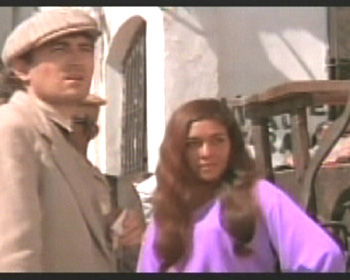
(1) Paula Pritchett with director Ralph Nelson on location in Mexico.
(2) Pritchett sharing a laugh with (l to r) Rita Hayworth, Robert Mitchum, and Ken Hutchinson.
(3) Pritchett plays Chela, a mute indian girl who is about to raped by a gang of soldiers. However, she is saved by Hutchinson and Mitchum.

Irish adventurer Emmett Keogh finds himself partnered with a hard-drinking priest named Van Horne in 1922 revolutionary Central America. Tricked into delivering guns by smuggler/con man Jennings, the three end up joining forces against despot Tomas de la Plata, who treats his subjects ruthlessly and who has a special hatred for priests. Van Horne, who seems to be a priest in costume only, decides to stand up to de la Plata and lead a revolt against him. 


The film marks the final screen appearance by Rita Hayworth, whose health worsened as Alzheimer's disease took hold.


Adamson noted, "In 1972, Robert Mitchum was in a film with George de Mohrenschildt's daughter Alexandria in The Wrath of God. Mitchum was great in this film and Alexandra was an extra. Looking as good as Paula Pritchett, if not better." 


Alexandra de Mohrenschildt


"G. H. W. Bush and de Mohrenschildt were all friends of Howard Hughes," wrote Adamson. "De Mohrenschildt claimed to be friends with Howard Hughes since 1938. Hughes was also from Houston and a Texas oilman and tied to George H.W. Bush."


Tom Slick's name was in George de Mohrenschildt's address book, the same one that interested the Warren Commission so much, which also contained "George Poppy Bush."


Alexandra's father, George de Mohrenschildt (April 17, 1911 – March 29, 1977) was a petroleum geologist and professor who befriended Lee Harvey Oswald in the summer of 1962 and maintained that friendship until Oswald's death two days after the assassination of U.S. President John F. Kennedy. He had personal acquaintance with the Bush family, including George H. W. Bush, with whose nephew, Edward G. Hooker, he had been roommates at Phillips Academy at Andover, Massachusetts. He also had personal acquaintance with the Bouvier family, including Jacqueline Bouvier Kennedy, the president's wife, when she was still a child. His testimony before the Warren Commission investigating the assassination was one of the longest of any witness.

Dresser Industries was a multinational corporation headquartered in Dallas, Texas, United States, which provided a wide range of technology, products, and services used for developing energy and natural resources. In 1928 the Wall Street investment-banking firm of W. A. Harriman and Company, Inc., converted the firm into a public company by issuing 300,000 shares of stock. H. Neil Mallon was selected as president and chief executive officer; holding that position until his retirement in 1962.

George H. W. Bush got his start in the Texas oil business through his father's friend Henry Neil Mallon, the president of Dresser Industries. Mallon offered George his first job at Dresser subsidiary International Derrick and Equipment Company (Ideco), in Odessa, Texas. Brown Brothers Harriman had underwritten Dresser’s transition from a private company to a publicly traded one. Years later, George named a son after Mallon (Neil Mallon Bush).

In 1953, Bush got money from Brown Brothers Harriman and, with partners Hugh and Bill Liedtke, formed Zapata Petroleum. By the late 1950s they were millionaires. Bush bought subsidiary Zapata Off-Shore from his partners and went into business on his own in 1954. By 1958, the new company was drilling on the Cay Sal Bank in the Eastern Gulf of Mexico. These islands had been leased to Nixon supporter and CIA contractor Howard Hughes the previous year and were later used as a base for CIA raids on Cuba. Tom Slick and Howard Hughes became such close friends that they had adjoining cottages at the Beverly Hills Hotel. Slick was Director on the Board for Dresser, until his death on October 6, 1962.

In 1998, Halliburton merged with Dresser Industries, which included Kellogg. Prescott Bush and Tom Slick were directors of Dresser Industries, which is now part of Halliburton.


Tuesday, March 20, 2012

Obama, Cushing, and Tom Slick


Why is President Barack Obama going to Cushing, Oklahoma? What makes Cushing a pinpoint location for a discussion of the energy issues of our day? What twilight language is being served by this visit?


The answer rests squarely within the history of the site, and with a name very familiar to my research: Tom Slick.


On Wednesday, March 21, 2012, President Obama will fly into Cushing. The next morning, on Thursday, as part of an extended trip for his energy strategy, President Obama is scheduled to officially visit Cushing, Oklahoma, home to the world’s biggest oil storage complex. There he will tour a yard where TransCanada is storing pipes to be used in building the southern leg of the Keystone XL pipeline. The line will stretch from Cushing down to refineries on the Texas gulf coast.

What makes Cushing so special?


Cushing is a city in Payne County, Oklahoma, United States. The area that would become Cushing was part of the Sac and Fox Reservation. With the Land Run of 1891, government trader for the tribe Billy Rae Little built a house, established his claim, and laid out town lots. The town got a post office late that year and was named for Marshall Cushing, private secretary to U.S. Postmaster General John Wanamaker. In 1902, the Eastern Oklahoma Railway line to Cushing was built. The Missouri, Kansas and Texas Railway added service on its own line built in 1903.


Wildcatter Thomas Baker Slick started an oil boom on March 17, 1912, when he brought in a gusher east of the town. Oil production became based in nearby Drumright, Oklahoma, and Cushing became a refining center. Today, Cushing is a major trading hub for crude oil and a famous price settlement point for West Texas Intermediate on the New York Mercantile Exchange.

On St. Patrick's Day 1912, Thomas "Dry Hole" or "Mad Tom" Slick (above) brought in the Wheeler No. 1 well about 12 miles east of Cushing, Oklahoma – the discovery well for the prolific Drumright-Cushing oilfield. The well produced for the next 35 years. At its peak, the oilfield would produce 330,000 barrels of oil a day.

Knowing that oilmen and speculators would descend on Cushing when the word got out, Slick posted guards at his well – and took other measures to protect his investment. How he did so is best described by a frustrated competing lease man (who was working for Harry Ford Sinclair; another competitor was John D. Milliken):


I got a call yesterday at the hotel in Cushing from a friend who said they had struck oil out there. A friend of his was listening in on the party line and heard the driller call Tom Slick at the farm where he’s been boarding and said they’d hit.

Well, I rushed down to the livery stable to get a rig to go out and do some leasing and damned if Slick hadn’t already been there and hired every rig. Not only there, but every other stable in town…Some other scouts had already gotten the wagons on the first farms I hit. Soon as I got one I beat it back to town to pick up a notary public to carry along with me to get leases – and damned if Slick hadn’t hired every notary in town, too.


After his success in Cushing, Slick began an incredible 18-year streak of drilling successful wells. By 1930 in the Oklahoma City field alone, he drilled 45 wells with the capacity to produce 200,000 barrels of oil daily. ”Dry Hole Slick” became known hereafter as "The King of the Wildcatters."

This man, Tom Slick, would also be called Tom Slick, Sr., four years later, when on May 6, 1916, his son Tom Slick, Jr. was born.

Tom Slick, Jr., is the subject of my two books, Tom Slick: True Life Encounters in Cryptozoology, Fresno: Craven Street/Linden Press, 2002, and Tom Slick and the Search for the Yeti. Boston: Faber and Faber, 1989. 


Tom Slick, as I would discover, was involved with what it meant to be an oil and beef millionaire who used his money to support and explore his mindscience interests, Yeti and Bigfoot expeditions, world peace objectives, intelligence network connections, and other forms of cryptozoology and cryptopolitics.


I wonder if President Obama realizes the direct linkage between Cushing and the legacy of Tom Slick? Of course, then again, he doesn't care. But the timing (so close to the 100th anniversary of Slick Sr's important first oil well) and the location do not seem to be a casual choice. Or coincidence.


Is something special going to happen in Cushing on March 21-22, 2012?

Friday, March 16, 2012

Tom Slick & JFK?


March 17th and the CIA

The date of March 17th is important in intelligence circles, and especially as associated with Tom Slick. It does not seem to be a coincidence this is the date covertly known as the anniversary of the CIA's removal of the Dalai Lama from Tibet. (See here.)

Tom Slick and his family worked closely with the OSS and the CIA for years, anywhere there was oil, air freight to ship, or adventures to serve as covers (like hunting for Yetis in Nepal/Tibet).  But was there more sinister activities afoot? Ones that Slick might have tried to stop?


You all know there are books where you can find out more about the cryptozoological part of his life. Today, let's explore a segment of the Yankee-Cowboy Texan's adventures that are a bit more covert, the cryptopolitics of Tom Slick.


Slick Airways (a CIA proprietary airline, per US Supreme Court, 1993 case: "Until 1956," Mr. [Erwin] Rautenberg explained, "the C.I.A. proprietary worked through a company called Slick Airways.")


Tom Slick had an interesting circle of friends.


Another man mentioned in the correspondence between Prescott Bush, Neil Mallon and Allen Dulles has also been linked to U.S. intelligence. Tom B. Slick of San Antonio, an oil heir and mutual friend of Mallon and Prescott Bush, Slick was entered in [George] de Mohrenschildt's address book in 1954-55.


The correspondence touts Slick as a potential government or political appointee in late 1952 and early 1953. In a reply to Bush to Allen Dulles, before the founding of Zapata, Dulles wrote Prescott Bush, Dec. 10, 1952: "If Slick should be interested in our line of
work here, I will be glad to talk with him."
* * *
Slick was a world traveler and adventurer and was also a member of Dresser's board of directors. Like John Mecom, Slick was known to sell his specially-bred cattle to Senator Robert Kerr of Oklahoma. Democrat Senator Kerr, as a favor to his Republican Senator colleague Prescott Bush, asked W.C. "Jim" Savage to give George a tour of Kerr-McGee's offshore oil rigs.  ~
Bruce Campbell Adamson


George de Mohrenschildt (April 17, 1911 – March 29, 1977) was a petroleum geologist and professor who befriended Lee Harvey Oswald in the summer of 1962 and maintained that friendship until Oswald's death two days after the assassination of U.S. President John F. Kennedy. He had personal acquaintance with the Bush family, including George H. W. Bush, with whose nephew, Edward G. Hooker, he had been roommates at Phillips Academy at Andover, Massachusetts. He also had personal acquaintance with the Bouvier family, including Jacqueline Bouvier Kennedy, the president's wife, when she was still a child. His testimony before the Warren Commission investigating the assassination was one of the longest of any witness.


Dresser Industries was a multinational corporation headquartered in Dallas, Texas, United States, which provided a wide range of technology, products, and services used for developing energy and natural resources. In 1928 the Wall Street investment-banking firm of W. A. Harriman and Company, Inc., converted the firm into a public company by issuing 300,000 shares of stock. H. Neil Mallon was selected as president and chief executive officer; holding that position until his retirement in 1962. 


George H. W. Bush got his start in the Texas oil business through his father's friend Henry Neil Mallon, the president of Dresser Industries. Mallon offered George his first job at Dresser subsidiary International Derrick and Equipment Company (Ideco), in Odessa, Texas. Brown Brothers Harriman had underwritten Dresser’s transition from a private company to a publicly traded one. Years later, George named a son after Mallon (Neil Mallon Bush).

In 1953, Bush got money from Brown Brothers Harriman and, with partners Hugh and Bill Liedtke, formed Zapata Petroleum. By the late 1950s they were millionaires. Bush bought subsidiary Zapata Off-Shore from his partners and went into business on his own in 1954. By 1958, the new company was drilling on the Cay Sal Bank in the Eastern Gulf of Mexico. These islands had been leased to Nixon supporter and CIA contractor Howard Hughes the previous year and were later used as a base for CIA raids on Cuba. Tom Slick and Howard Hughes became such close friends that they had adjoining cottages at the Beverly Hills Hotel. Slick was Director on the Board for Dresser, until his death on October 6, 1962.


The CIA was using companies like Zapata to stage and supply secret missions attacking Fidel Castro’s Cuban government in advance of the Bay of Pigs invasion. The CIA’s codename for that invasion was “Operation Zapata.” In 1981, all Securities and Exchange Commission filings for Zapata Off-Shore between 1960 and 1966 were destroyed. In other words, the year Bush became vice president, important records detailing his years at his drilling company disappeared. In 1969, Zapata bought the United Fruit Company of Boston, another company with strong CIA connections. The history of Dresser is an intriguing one. 

In 1998, Dresser merged with its main rival Halliburton. (Dick Cheney was chairman and CEO of Halliburton Company from 1995 to 2000, and later served as the 46th Vice President of the United States, 2001–2009, under George W. Bush.)


Tom Slick and the JFK Assassination?

How deeply was Tom Slick involved with the people who may have circled around the conspiracy leading to the assassination of John F. Kennedy?

One wonders if Slick's peace work was rubbing people the wrong way. After all, President John F. Kennedy would be killed in Texas, Slick's home state, only fourteen months after Slick died. Maybe the conservative forces in America were trying to send someone a message with a special Texas flare?


One of the more interesting linkages Slick had was through his role as a member of the Advisory Board of the United World Federalists,(Coleman, 1989). Founded in 1947, the United World Federalists' was the intellectual Cord Meyer. Suddenly, in 1950 around the time China was advancing on Tibet, Meyer left the organization's head post in the hands of liberal Alan Cranston [formerly the senior United States Senator from California] and joined the CIA's covert operations division. A close associate was quoted as saying: "It was a great surprise to all his friends. He was not the CIA type. He was a world government man." (Smith, 1972) 

In 1954, Meyer was named Chief of the CIA's Covert Action operations. Hardened by political battles with Joseph McCarthy and by personal tragedies, years later a friend would say that Cord Meyer "got Cold Warized" (Smith, 1972).


JFK and Mary Pinchot Meyer

Tragedies haunted Cord Meyer. One of Meyer's sons died in an automobile accident. Then there's the story of his former wife, Mary Pinchot Meyer, JFK's last lover. Mary Meyer was killed by an unknown assailant on October 12, 1964 on a C&O towpath in Washington D.C. 

Mary Pinchot Meyer, in life (above) and in death (below)


Much darkness surrounds Mary Pinchot Meyer's death, but it appears dozens of people connected to the JFK inner and outer circles were killed. JFK Assassination researcher John Gooch III of New Orleans has wondered aloud if perhaps Tom Slick was in on some early planning meetings regarding the Kennedy killing, backed out and was killed for knowing too much.Then theres that mysterious meeting of 14 individuals and Tom Slick that the FBI was watching in 1962. There's the hints and informants claims that "everyone knew Slick was helping run guns to Cuba." A deeper level of involvement between Slick and several figures in the JFK drama keep cropping up.  

~ excerpt from Loren Coleman's chapter, "Tom Slick - Mystery Man." in Kenn Thomas' Popular Alienation: A Steamshovel Press Reader, 1995 (pp. 305-19). Source "Smith" refers to OSS: The Secret History of America's First Central Intelligence Agency by R. Harris Smith (Berkeley: University of California Press, 1972).

In 1954 a disillusioned Meyer was trying to leave the CIA and Operation Mockingbird. In the summer of that year Meyer family's golden retriever was hit by a car on the curve of highway near their house and killed. The dog's death worried Cord. He told colleagues at the CIA he was afraid the same thing might happen to one of his children. 

Meyer continued to try and get out of the CIA by joining a publishing firm. He had made some good contacts in this field during Operation Mockingbird. On 18th December, 1956, Cord's nine-year-old son, Michael, was hit by a car on the curve of highway near their house and killed. It was the same spot where the family's golden retriever had been killed two years earlier. Meyer got the message and he stopped applying for other jobs. This incident also made Mary Pinchot Meyer extremely hostile to the CIA. ~ John Simkin, The Education Forum


Who Was Tom Slick?


SLICK, THOMAS BAKER, JR[b]. (1916-1962). Thomas Baker Slick, Jr., oilman, rancher, philanthropist, and founder of the Southwest Research Institute and the Southwest Foundation for Biomedical Research in San Antonio, was born at Clarion, Pennsylvania, on May 6, 1916, the son of Thomas Baker and Berenice (Frates) Slick. His father, one of the most famous independent oil operators in the Southwest, was known as "Lucky Tom" and "King of the Wildcatters." When Tom Slick, Sr., died in 1930 at the age of forty-six, he left his children approximately $15 million. Tom, Jr., used his wealth to support activity in a variety of fields, including scientific research, oil drilling, cattle breeding, exploration, and collections of modern art. When Slick was twelve, his family moved from San Antonio to Oklahoma City. He attended Phillips Exeter Academy from 1931 to 1934. In 1938 he earned a premedical degree in biology from Yale University, where he was a Phi Beta Kappa. He later took graduate courses at Harvard University and Massachusetts Institute of Technology. During the first part of World War II, he was a "dollar-a-year" man for the War Production Board in Washington and a cargo officer in Chile for the Board of Economic Warfare. He later served in the U.S. Navy in the Pacific and Japan.

Slick established a number of research organizations, beginning in 1941 with the Foundation of Applied Research (now the Southwest Foundation for Biomedical Research; see also Argyle Hotel). He also founded the Institute of Inventive Research (1944; liquidated 1953), designed to develop and promote the ideas of independent inventors; the Southwest Research Institute (1947); the Southwest Agricultural Institute (1957); the Mind Science Foundation (1958), which investigates the human mind; and the Human Progress Foundation (1960), was intended to promote better conditions through science, education, and the advancement of peace. The first three of these-the SFRE, IIR, and SR-became units of the Southwest Research Center, which Slick endowed with 3,800 acres of land and $2 million. Slick helped to develop Brangus cattle, and his herd of registered Anguses was one of the three largest in the country. His oil activities included the discovery in 1947 of the Benedum Field in West Texas, one of the most significant oil finds in the United States after World War II. Slick was co-inventor of the lift-slab method of building construction. He wrote The Last Great Hope (1951) and Permanent Peace: A Check and Balance Plan (1958). He was a collector of modern art and sculpture. As an avid adventurer and world traveler, he spent two weeks with a Waiwai tribe in the jungles of British Guiana in 1956, after his plane made a forced landing during a diamond-hunting trip. He also organized several expeditions to search for the "Abominable Snowmen" in the Himalayan Mountains and led one of the expeditions himself, in 1957. Later his attention shifted to the Pacific Northwest, where there were reports of Bigfoot/Sasquatch, and Giant Salamanders.

Slick was a trustee and governor of the Texas Research Foundation, the Worchester Foundation for Experimental Biology (Massachusetts), the Stanford Research Institute (Palo Alto), Trinity University, and the San Antonio Medical Foundation. He was a member of numerous organizations, including the United World Federalists, the National Planning Association, the American Association for the Advancement of Science, and the Explorers Club. He also served on the board of directors of a number of companies, including Slick Airways (associated with the CIA) and Dresser Industries (sponsored by Preston Bush and Neil Mallon for membership), and was a founder of the TexStar Corporation. In 1953, he received an honorary doctor of science degree from Trinity University. Slick was married and divorced twice and had four children. He died in a private airplane crash (an air explosion) on October 6, 1962, near Dell, Montana, and was buried in Mission Burial Park, San Antonio.

Sources: Loren Coleman, Tom Slick and the Search for the Yeti (Boston: Faber and Faber, 1989). Loren Coleman. Tom Slick: True Life Encounters in Cryptozoology (Fresno: Craven Street Books, 2002). Robert Lubar, "The Adventures of Tom Slick," Fortune, July 1960. San Antonio Express, October 8, 1962. San Antonio Express-News, December 24, 1989. Harold Vagtborg, The Story of Southwest Research Center (San Antonio: Southwest Research Institute, 1973). Vertical Files, Barker Texas History Center, University of Texas at Austin. 

Thursday, March 17, 2011

March 17th: War In Libya?

Update: 
On the evening of March 17th, the U.N. Security Council approved (10-0, 5 abstainees) measures including a no-fly zone to try to halt Libyan leader Moammar Gadhafi's advances and the use of any other measures necessary to protect Libyans. Canada immediately noted they were ready to send 6 fighter jets to Libya to help enforce the no-fly zone. News services reported that the first strikes will be unilateral ones by British and French aircraft. Those countries' fighters could be in the air within hours of the resolution's approval. It is likely five Arab air forces will take part. US Secretary of State Hillary Clinton had earlier said it will mean bombing Libyan air defenses. 
On the morning of March 18, 2011, New York time, Libya's foreign minister declared a cease-fire after the U.N. Security Council approved the no-fly zone to protect civilians. Later reports, however, note that twenty-five people, including several children, were killed during heavy bombardments by forces loyal to Gaddafi on the western city of Misrata on Friday, a doctor in the city told Reuters.

++++

The following was posted early on March 17th, 2011. Also, I had mentioned a month ago (here) that this date would have some significance.


Stay with me here. These are games that boys into men play, deadly, yes, but happening on a strange landscape that takes into account Oklahoma, Texas, Tibet, Nepal, Iraq, and Libya - and some characters all too familiar to you.

Libya? March 17th? Yes, the American involvement in Libya is tied to that specific date. In 1957, from March 17 to 20, in the wake of the 1956 Suez Crisis, Ambassador James P. Richards, Special Assistant to President Eisenhower, visited Libya. His mission resulted from the President’s earlier address to Congress, in which Eisenhower promised that the United States would defend countries in the Middle East against communist aggression and would supply development and security assistance as needed (the Eisenhower Doctrine). Richards made a second visit to Libya on May 4. A joint U.S.-Libyan communiqué announced that the United States was prepared to assist in a survey of Libyan development needs, development of broadcasting and telecommunications, assistance in education, electric power development, and domestic water supplies. 

  
James Richards of South Carolina served in World War I and played professional baseball before his election to his first of twelve terms in the House in 1932. 

Also in March 1957, Vice President Richard M. Nixon visited Libya. Then on June 30, 1957, the United States and Libya signed a military assistance agreement, and a Military Assistance Advisory Group was later established in Libya. Two years later, on April 9, 1959, Standard Oil of New Jersey discovered oil in Zelten. By 1961, Libya had 10 fields producing oil for export. By 1965, Libya was the sixth-largest oil exporting nation. 


In 1957, on March 17th, an Abominable Snowman expedition was creating media attention. Who was the head of that expedition? Tom Slick, of course. The date March 17th keeps surfacing in an almost ritualistic way as a "chosen" date for activities that has ties to oil, Tom Slick, Abominable Snowmen, and more.

Wonder and wander with me in this temporal stream of consciousness on this St. Patrick's Day.

First, always intriguing to me has been the fact that March 17th is seen as a pivotal date in the history of the wealthy Oklahoma/Texas oil family of the cryptozoologist Tom Slick.
Tom Slick's father was also named Tom Slick, and history remembers him as the "King of the Wildcatters." Wildcatting was the practice of going about the dry, harsh farm lands of Oklahoma and Texas, buying up oil lease rights, and drilling for oil, on pure speculation. For years, his nickname was "Dry Hole Slick" and "Mad Tom."

But then in 1912, Tom Slick, Sr. made the "biggest discovery of his life" when the Wheeler Well Number 1 in the Cushing Field of Oklahoma struck oil with a giant gusher on March 17th, St. Patrick's Day. Slick controlled the information about the discovery, however. He rushed to the Cushing farm, and cut the telephone lines. He hired out all the horse and rigs thereabouts so the news would not travel out. Slick also bought up all the nearby leases for one dollar an acre. Two weeks later, Harry Sinclair had to buy up leases for $200 an acre. The Cushing Field has been called one of the greatest oil fields ever found. Think James Dean as Jett Rink in the 1956 motion picture Giant.

From March 17, 1912, henceforth, "crazy ole Tom" Slick was called "Lucky Tom Slick." He made millions from the Cushing leases. Slick's family moved to Texas to follow the oil boom of the 1920s. When Tom Sr. died at the early age of 46, his estate was estimated to be worth seventy-five million dollars in 1930 dollars!

Tom Slick, his son (who really never used the "Jr." too often), was to inherit his parts of the principal of his father's money when he reached 30, 45, and 55 years of age. But the will stated Tom could live off the interest and he did, as an investor, jetsetter, playboy, friend of Howard Hughes and Jimmy Stewart, and adventurer. By the year 1960, Tom Slick had inherited 15 million dollars. By 1962, Tom Slick was dead in a mysterious air crash, at 46 - the same age his father died.

While Slick had decided to invest in oil and beef, he had creative ideas for what else he wanted to do with some of his money. Part of his inheritance went into his search for cryptids. I document in my Slick biography his quests for the Loch Ness Monster, Sumatran rhinos, Trinity Alps' Giant Salamanders, Bigfoot, and Orang Pendek.

Tom Slick (above, after his March 15, 1957, near-death accident in Nepal) was most famous, of course, for his expeditions in search of the Abominable Snowmen, the Yeti of the Himalayan Mountains.

In 1957, Tom Slick personally headed his first of many sponsored expeditions to Nepal in search of the Yeti, with Peter Byrne and Sherpa guides along for his deadly serious initial reconnaissance. From noting the timeline for Slick's trek, remarkably, I discovered that Slick began his actual search in earnest in the Arun Valley on March 17, 1957.

On March 18th and 19th, 1957, the Government of Nepal issued press releases and answered reporters' questions that they officially forbade all foreign mountaineers from "killing, injuring, or capturing a Yeti." Slick's party was allowed to carry guns for their self-defense. But they also had steel traps to capture a Yeti, and the new law was specifically targeted at Slick's expedition.

Abominable Snowman

Especially interesting to me is a question I have never had fully answered: Was the character in the movie The Abominable Snowman of the Himalayas of the American Yeti hunter and exploiter "Tom Friend" (shown above next to the film's Yeti body) based, in some part, on the real Texan Yeti hunter Tom Slick?

What was one of the other missions of Tom Slick's 1957 expedition? Apparently, it may have been spying on the Chinese in Tibet. Certainly that was what the Russians thought.


This April 27, 1957, article (above) in The New York Times carried the claims that Tom Slick was behind an effort to subvert the Chinese and free Tibet. (It would be revealed years later that Tom Slick and his Slick Airways were working closely with the OSS and the CIA.)

Two years later, what date would the CIA pick to begin the exit of the Dalai Lama from Tibet? March 17, 1959. Who may have been helping with that trek? Tom Slick and Peter Byrne. Perhaps it was Tom Slick that picked the date, not the CIA?

Colonel Fletcher Prouty has written about this secret mission to Tibet. In 1955, Prouty was appointed the first "Focal Point" officer between the CIA and the Air Force for Clandestine Operations per National Security Council Directive 5412. He was Briefing Officer for the Secretary of Defense (1960-1961), and for the Chairman of the Joint Chiefs of Staff.

Prouty, in his 1973 book about the CIA, Secret Team, writes: "This fantastic escape and its major significance have been buried in the lore of the CIA as one of those successes that are not talked about. The Dalai Lama would have never been saved without the CIA."
On March 17, 1959, three groups, the Dalai Lama, his immediate family and senior advisors, escaped from Lhasa, Tibet.

John Prados writing in The Presidents' Secret Wars: CIA and Pentagon Covert Operations Since World War II (New York: Morrow, 1986), notes: "Tenzin Gyatso [the Dalai Lama] was disguised as a common soldier of the guard.... The best information [about the fleeing Dalai Lama] came from the CIA.... The CIA was so well informed because it had furnished an American radio operator, who traveled with the Dalai Lama's party...There may have been other CIA agents with the party as well."

Who were these individuals? Who helped the Dalai Lama's party get out of Tibet? None other than Peter Byrne, Tom Slick's man in Nepal. He may forget it, but he told me so in 1988, when I was interviewing him about his years of work, overt and covert, with Tom Slick of San Antonio, Texas. I go into further details in my book, Tom Slick: True Life Encounters in Cryptozoology (Fresno: Linden Press, 2002).


Is it a coincidence that on this date, seven years ago, some view this same calendar date as being the one that another Texan, linked to oil, began the present Iraqi War? While most historians use the date of March 20, 2003, as the start of the Iraqi War, others point to March 17, 2003. On that special date, the start of the US invasion of Iraq is keyed to President George W. Bush's announcement in a televised speech that Iraqi President Saddam Hussein and his sons had 48 hours to leave Iraq, or the United States will initiate preemptive military action against Iraq.

On March 17, 2003, Robin Cook, Leader of the British House of Commons, resigned from the UK cabinet over the plan to invade Iraq. The UK and the USA withdrew a proposed UN Security Council resolution on Iraq. The United States advised UNMOVIC and the IAEA to withdraw all weapon inspectors out of Iraq. This all occurred on March 17, 2003. 


What will happen on March 17, 2011? Will be even know it happened on the 17th? In Libya? In Japan?
Texas, Tibet, Nepal, Iraq, Egypt?
Oil, Yeti, Espionage?
Once is happenstance.
Twice is coincidence.
Three times is enemy action.

- Ian Fleming, Goldfinger