Showing posts with label Authors. Show all posts

Saturday, June 28, 2014

Controversial Authors Terry Hansen and Louis A. Frank Die

Two revolutionary intellectuals, both authors of books that made people think, passed away recently this Spring.

Terry Hansen


Overnight on June 20, into June 21, 2014, nearing the Summer Solstice, journalist and researcher Terry Hansen died. Hansen was a ufologist and author of The Missing Times: News Media Complicity in the UFO Cover-up.


Hansen died quietly in his sleep. His wife Jessica reported the doctor said her husband had a massive coronary, and felt no pain.

The site The UFO Chronicles first shared the news, and quoted Hansen's wife as saying:
He was the most honest person with the greatest sense of integrity I have ever known. My first impression of Terry was one of nobility of spirit and he never let me down He had a lot of wonderful adventures the last few years of his life and I am so grateful for that.
Terry Hansen was a former magazine editor and then became an independent journalist with a special interest in scientific controversies and the politics of knowledge. He followed the UFO controversy for much of his life and had occasionally written about it for various media, including National Public Radio and the Minneapolis Star & Tribune. He was a guest on various regional and national broadcast programs, including Dreamland, the History Channel, and Strange Days. He had spoken before various groups about UFO-related censorship and propaganda.

Hansen organized and moderated two symposiums about "The Science and Politics of UFO Research" for the Science Museum of Minnesota in St. Paul. His one book was The Missing Times: News Media Complicity in the UFO Cover-up. Find excerpts from the book by clicking here.

Hansen held a bachelor's degree in biology and a master's degree in science journalism, both from the University of Minnesota.
Terry Hansen was a founding partner of KFH Publications, Inc., a Seattle computer-magazine publishing company. He was also an active private pilot with ratings for single-engine aircraft and gliders, and the skipper of the converted diesel-powered wooden fishing trawler, New Rosa. He had lived on the Canadian Gulf Islands, and on Bainbridge Island, Washington State, with his wife, Jess, and two parrots.

^^^^^^^^^^^^^^^^^^^^^^^^^^^^^^^^^^^^^^^^^^^^^^^^

Louis A. Frank


Word has also reached me, via Patrick Huyghe, that the revolutionary thinker Louis A. Frank died over a month ago. Frank thought outside the box, often, and was Patrick's coauthor on The Big Splash.


Frank, an experimental physicist, was often on the breaking edge of science, as he made the first measurements of the plasma ring around Saturn, was the first to measure solar-wind plasma funneling directly into the Earth’s polar atmosphere and was the first to observe with a scientific instrument the belt of ions around the Earth known as the “ring current.” Frank also discovered the theta aurora, a light phenomenon that looks like the Greek letter theta hovering above the polar cap.


As a young scientist, when he was 42, Louis Frank got in the most hot water (no pun intended) when he started talking about small comets and their importance in the history of Earth. The grueling nature of Frank's battle with other scientists was even briefly highlighted in The New York Times.


The Des Moines Register summarized Frank's concept and what happened because of the controversy this way:
Louis A. Frank, a retired University of Iowa scientist who believed small comets made of ice and water crashed into the Earth to create the planet’s lakes, rivers and oceans, died Friday. He was 75.
In 1981, Frank and his UI colleagues analyzed data from the NASA satellite Dynamics Explorer I, which looked at Earth in ultraviolet light. Frank and his team were interested in small black dots found in the images.
While some believed the dots were transmission errors, Frank and his team concluded the spots were caused by the disintegration of small comets — each weighing about 20 to 40 tons.
In 1986, Frank published his findings in Geographical Research Letters, a scientific journal. He argued that as many as 25,000 small comets disintegrated in the Earth’s atmosphere each day.
Eleven other researchers published responses refuting Frank’s claims, and Frank and his co-other responded to 10 of them.
In 1990, he and science writer Patrick Huyghe published the book The Big Splash: A Scientific Discovery That Revolutionizes the Way We View the Origin of Life, the Water We Drink, the Death of the Dinosaurs, the Creation of the Oceans, the Nature of the Cosmos, and the Very Future of the Earth Itself.
In 1999, Frank, a Chicago native, compared his earlier research to images from NASA’s Polar satellite, which he believed supported his theory. However, again, scientists in the field objected to his findings.
In an opinion piece published by the Washington Post and The Des Moines Register, Frank described the painful experience of advocating for an unpopular idea in the scientific community.
“The science game can be brutal,” he wrote. “I was shunned by almost everyone. … I paid a stiff price. Perhaps I shouldn’t have been so naive, but the behavior of some former friends and colleagues amazed me. It went far beyond what I expected.”


Here is his formal obituary:
Dr. Louis A. Frank, Professor Emeritus of Physics & Astronomy from the University of Iowa died Friday, May 16, 2014.
Memorial services will be held 10 a.m., Tuesday, May 20th at the Gay & Ciha Funeral and Cremation Service in Iowa City with visitation from 4-7 p.m., Monday at the funeral home. Private family interment will take place at Oakland Cemetery. In lieu of flowers, donations can be made to the Van Allen Physics Scholarship Fund at the University of Iowa Foundation.

Louis was born in Chicago, IL and graduated from high school in Fort Madison, Iowa. He enjoyed nurturing trees and wildlife as well as automobiles. His passion in life was science.
Dr. Frank was a Professor of Physics at The University of Iowa, where he had been a member of the faculty since 1964. His first professional research activities occurred in 1958 when he assisted Professor Van Allen in the calibration of the first U. S. lunar probes, Pioneers 3 and 4, as an undergraduate student. Since then he had been an experimenter, co-investigator, or principal investigator for instruments on forty-two spacecraft. Dr. Frank was the principal investigator for the auroral imaging instruments for the Dynamics Explorer Mission, the plasma instrumentation for the Galileo Mission to Jupiter, the U. S. plasma instrumentation for the Japanese Geotail spacecraft, and the camera for visible wavelengths for the Polar spacecraft of the International Solar Terrestrial Physics (ISTP) Program. His publications encompassed such topics as the first direct measurements of the terrestrial ring current and of the polar cusp, the current systems in Earth's magnetotail, the plasma tori at Jupiter and at Saturn, and global imaging of Earth's auroral zones and atmosphere. His research interests were directed toward magnetospheric plasmas in the vicinity of Earth, wave-plasma instabilities, active experiments in the ionosphere, interpretation of auroral images in terms of global convection and current systems, the Jovian magnetosphere and its relationship with the Galilean satellites, computed tomography, geocoronal hydrogen, comets, and optics. He served on various NASA and NAS/NRC committees and as a Fellow of the American Physical Society, a member of the American Astronomical Society, American Association for the Advancement of Science and the International Academy of Astronautics. He was a Fellow of the American Geophysical Union and a recipient of the National Space Act Award.
His family includes his two daughters, Jessica Frank of Iowa City and Suzanne Frankof Waterloo; brother, Clyde Frank of Virginia; sister, Emilou Woods of Colorado, and grandson Taylor Bergstrom of New York.

Friday, December 18, 2009

Close Encounters of Fourth Kind Author Dies


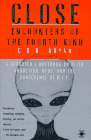
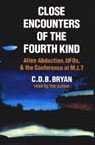
The death of author C. D. B. Bryan, 73, who wrote his last book about an academic symposium that examined claims of alien visitations, Close Encounters of the Fourth Kind: Alien Abductions, UFOs and the Conference at Massachusetts Institute of Technology (NY: Alfred A. Knopf,1995), has been detailed in an obituary by Bruce Weber at The New York Times.

C. D. B. Bryan, a novelist and journalist whose 1976 book, "Friendly Fire," about the accidental death of a soldier in Vietnam, the consequent anguish of his family and their rage at the Army and the federal government, became one of the enduring works of reportage on the Vietnam War, died Tuesday [December 15, 2009] at home in Guilford, Conn....The cause was cancer, said his son, St. George Bryan.


Bryan's own military career involved serving in the U.S. Army in South Korea (1958–1960), but not happily, according to source material. He was mobilized again (1961–1962) for the Berlin Crisis of 1961. He was an intelligence officer, according to his profile at Wikipedia.

Bruce Weber notes later in the Times obituary:

Courtlandt Dixon Barnes Bryan, known as Courty, was born in Manhattan on April 22, 1936, and grew up in various locations, but mostly in Doylestown, Pa. His father, Joseph Bryan III, was a magazine writer and editor who had a fascination with unidentified flying objects, a subject C. D. B. Bryan would explore himself in his final book....


His father was a major actor in the study of UFOs, actually, especially regarding his role in the relatively mainstream workings of the Washington D. C.-based organization, the National Investigations Committee On Aerial Phenomena.

[Donald Keyhoe, Maj USMC (Ret.)]became NICAP’s director. He established a monthly newsletter, The U.F.O. Investigator. Another prominent figure joined NICAP’s board of governors: Keyhoe's Naval Academy classmate VADM Roscoe H. Hillenkoetter, USN (Ret.) He had been Director of Central Intelligence and first head of the Central Intelligence Agency. Another important name on the letterhead was that of Gen. Albert Coady Wedemeyer USA (Ret.)....

By 1969, Keyhoe turned his focus away from the military and focused on the CIA as the source of the UFO cover up. By December 1969, NICAP's board, headed by Colonel Joseph Bryan III, forced Keyhoe to retire as NICAP chief. Bryan was actually a former covert CIA agent who had served as founder and head of the CIA's psychological warfare division. Under Bryan's leadership, NICAP disbanded its local and state affiliate groups. Source


The New York Times concludes with the following personal information:

His parents divorced when he was in his late teens, and his mother, Katharine Lansing Barnes, married the novelist John O'Hara, who was especially influential in turning the young man toward writing fiction.

Young Courty Bryan was educated at several private schools and was thrown out of two of them, one for cheating, an incident central to an early short story, "So Much Unfairness of Things," which appeared in The New Yorker and grew into his first novel, "P.S. Wilkinson." It won the Harper Prize, given by the publisher Harper & Row to the finest manuscript turned in by an unknown writer, in 1965.

In spite of his spotty academic career, he was admitted to Yale. After graduation he served in the Army in South Korea in the late 1950s, an unhappy episode that also found its way into the novel.

* * *

Mr. Bryan was a smoker, a drinker and an avid and gifted conversationalist who effortlessly commanded the attention of people around a dinner table, his son said. He will be cremated in advance of a memorial service early next year, St. George Bryan added; until then, his remains are to be stored in martini shakers.Source.


The Fourth Kind

zamora5 tag

It is to be noted that the movie The Fourth Kind opened on Friday, November 6, 2009. It is a science fiction/thriller/horror film directed by Olatunde Osunsanmi, and starring Milla Jovovich. The film is purported to be a documentary reenactment set in Nome, Alaska, and deals with alien abductions. The film's promotional material says the title is derived from J. Allen Hynek's classification of close encounters with aliens, in which the fourth kind denotes an alien abduction.

As researcher S. Miles Lewis points out in personal correspondence, this is technically incorrect.

A close encounter of the fourth kind is said to be when a "human is abducted by a UFO or its occupants." But this type was not included in Hynek's original close encounters scale.

Jacques Vallee, Hynek's associate, argued in "Physical Analysis in Ten Cases of Unexplaind Aerial Objects with Material Samples." (Journal of Scientific Exploration, Vol. 12, No. 3., pp. 359-375, 1998) that a CE4 should be described as "cases when witnesses experienced a transformation of their sense of reality," so as to also include non-abduction cases where absurd, hallucinatory or dreamlike events are associated with UFO encounters.

Lonnie Zamora, famed historical UFO eyewitness who was a member of law enforcement when he had his experience, also recently died, on November 2, 2009. Zamora had encounters of the first, second, and third kind, but not the fourth kind.

C. D. B. Bryan's book, Close Encounters of the Fourth Kind, actually does involve the academic analyses of those level of claims of alien visitations. The five-day conference that Bryan covered was chaired by M.I.T. Professor of Physics David Pritchard and Harvard Professor of Psychiatry John Mack. John Mack, M.D. (who was killed when hit by a car in London, on September 27, 2004) was a historically significant figure in abduction studies, who gave much credibility to the field, especially after Bryan's book appeared.

Saturday, October 24, 2009

Mystery Death: Mac Tonnies, 34

Why do some people die so young, and all we hear is that they passed away of "natural causes"? The two pieces of information do not compute.


Mac Tonnies, 34, a rising intellectual presence in Fortean thought, the "Posthuman Blues" blogger, and the author of the forthcoming book, The Cryptoterrestrials (Anomalist Books, 2010), has departed this plane. He was found dead in his apartment on Thursday afternoon, October 22, 2009. Reports indicate that there was no foul play or suicide involved, and "natural causes" are being blamed for his sudden and unexpected death. There is some indication that he may have been feeling "faint" in the days leading up to his death.

nessie tag

I never met Mac, but he did correspond a few times with me. In April 2008, he was curious about a mysterious graffiti artist that had popped up in his town, who was leaving iconic Nessie stencils around and about. He wrote me and asked if I'd heard about any other incidents like it happening around the country. I posted a brief note on CryptoZooNews about the cryptoart.


The title of Mac's forthcoming book, The Cryptoterrestrials, also, of course, interested me. In talks I had with his publisher, Patrick Huyghe, I understood it would be a book that extended the thoughts of John Keel's ultraterrestrials. I looked forward to seeing what new take Tonnies had on it all, and was open to hearing if cryptozoology played into his intellectual ponderings.

Mac Tonnies had the potential to ask some challenging questions. That seemed to have scared some people.

Strangely, Mac's name appeared at the end of the "death list" of people that a group of extremely youthful ufologists placed in their infamous posting of March 22, 2008, 19 months or so, before the day of Tonnies' death. The so-called "RRRGroup," in their "UFO PROVOCATEUR(S)" blog entry entitled "Death(s) will clean the UFO palate," listed the names of people whom they almost seemed to be wishing would die more quickly so the "future" of the field could dawn more quickly.

They wrote:

When ufology’s old-guard passes on – Dick Hall, Stan Friedman, Kevin Randall, John Schuessler, and even the 60ish Jerry Clark to name a few – taking hangers-on and sycophants with them (and you know who they are), the UFO palate will be cleansed.

That is, the mummified concepts of ufology will be washed away, and new paradigms will be allowed to flourish.

Standing in the wings already is a group of middle-agers who, while not particularly astute about the UFO history and inclined to be cavalier with their observations and characterizations of ufology and UFOs themselves, think they are the news faces of ufology, which is a mantle they hope to change.

Those people include Paul Kimball, Nick Redfern, Greg Bishop, and Mac Tonnies.

...Once the old-guard is gone, and the mid-lifers dismissed because of their foolishness, the young crop of UFO mavens’ newer ideas will hold sway with the public and media....


Blood mixed with ink.

I wrote in their comment section at the time:

It seems incredible to really read these words: "...the young crop of UFO mavens’ newer ideas will hold sway with the public and media, because this new generation isn’t conscripted by former old-think about UFOs, presenting instead original thought and pursuit of the UFO mystery..."
Being a radical Fortean observer watching the coming and going of all matter of writers, researchers, and theorists in the last four decades, you have given me a good chuckle.

Every "new" generation sees themselves as having the "real" solutions or the next best outside-the-box suggestions. Of course, it will only be something you will reflect upon when the next generation after you, the new group of "Young Ones" start nibbling at your aging heels, [and] says something similar to you.

It's always been that way, and it will continue so into the future.


Besides being intellectually dishonest, such a critique as the one from the RRR group has no sense of history or reality. But in terms of karma, frankly, I think it is bad form to put names out there of people you almost seem to be wishing were dead. I am shocked, therefore, to see that Mac Tonnies, the last name on the RRR list, along with Dick Hall, the first one, both now have died. Sad indeed.


The tributes for Tonnies, as often happens in a surprising death like this are pouring in from his deep friends. I recommend those of Nick Redfern, Greg Bishop, and many other of his true friends.

Mac's last tweet was on October 18th, 2009, and he pointed to "sculptural manifestations of audio footage."

I want to leave you with Mac's own words, as he has summed up his own life, here below, from his self-authored biography. Good-bye, Mac:

I'm a Kansas City, Missouri-based author and essayist. I blog daily at Posthuman Blues and tweet religiously. My latest book is After the Martian Apocalypse (Paraview Pocket Books, 2004), a speculative and generally well-received examination of extraterrestrial intelligence on the Red Planet. I'm presently at work on a new non-fiction book titled The Cryptoterrestrials: Indigenous Humanoids and the Aliens Among Us, excerpts of which I've posted on my blog. If you're in the mood for a multiplex Fortean anthology, my essay "The Ancients Are Watching" is included in 2008's Darklore Vol. II. (My first book, Illumined Black, is a collection of naively "Blade Runner"-ish science fiction short-stories. It can still be found in used-book stores and on Amazon.com.)

I've been a guest panelist at ConQuest, Kansas City's premiere science fiction convention. More recently, I've lectured in the United States and Canada on subjects ranging from exoarchaeology to transhumanism and have appeared on programs such as Coast to Coast AM, Strange Days . . . Indeed, 21st Century Radio, The Paracast, Binnall of America, and Radio Misterioso. My first play, produced and directed by Paul Kimball, debuted in Halifax, Nova Scotia in late 2007. In early 2009 I appeared as the "investigator" in an episode of "Supernatural Investigator," a Canadian program covering fringe beliefs and esoteric science. I also make an appearance in "Best Evidence," an award-winning UFO documentary.

I spend an inordinately large portion of my time pursuing unpopular ideas and esoteric theories with what I sincerely hope is balanced skepticism. I'm a member of the Society for Planetary SETI Research, a group that seeks to use scientific methodology to explore the possibility of extraterrestrial artifacts in our solar system. I read voraciously; preoccupations include cosmology, nonhuman intelligence, UFOs, consciousness studies, and futurism. Writers I admire include William Gibson, Philip K. Dick and William S. Burroughs.

I tend to think in the future-tense. I'm a skeptic, agnostic and existentialist; I perceive reality as a kind of consensual hallucination that forces us to define our sense of identity without recourse to faith or superstition. I have a deep affinity for 80s pop music; some of my favorite bands are The Cure, R.E.M., Portishead, Talking Heads, and The Smiths. Favorite film-makers include David Cronenberg and David Lynch. I can regularly be found haunting the Country Club Plaza, taking pictures, reading cyberpunk novels, and marinating my synapses in espresso. And I'm a voracious doodler.

Statement:

Consciousness is a potential technology; we are exquisite machines, nothing less than sentient patterns. As such, there's no convincing technical reason we can't eventually upload ourselves into matrices of our design and choosing. It's likely the phenomenon we casually call "intelligence" will cease to be strictly biological as we begin to merge with our machines more meaningfully and intimately. (Philip K. Dick once wrote that "living and nonliving things are exchanging properties." I suspect that in a few hundred years, barring disaster, separating the animate from the inanimate will probably be an exercise in futility.) Ultimately, we have two options: self-mutate by venturing off-planet in minds and bodies of our own design, or succumb to extinction.