Showing posts with label Ax. Show all posts

Tuesday, August 11, 2015

Hickory Again, Ax Again, Clown Again


The name "Hickory" has been associated with three violent outbreaks this summer. Axes and hatchets are being more frequently involved. And, of course, clowns are nothing new to readers of this blog.

(1) On July 16, 2015, Muhammad Youssef Abdulazeez opened fire on two military installations in Chattanooga, Tennessee. He first committed a drive-by shooting at a recruiting center, then traveled to a U.S. Navy Reserve center and continued firing. He was killed by police in a gunfight. Four Marines were killed immediately. This all occurred near an area named Hickory Valley. The Derby Downs Subdivision off of Hickory Valley Road in Chattanooga placed its neighborhood flag at half mast and lined the entrance way with small American flags, as an act of respect for the four Marines who lost their lives.


(2) On August 5, 2015, a predicted theater incident occurred exactly two weeks after a shooting at a showing of Trainwreck in Lafayette, Louisiana. The Mad Max: Fury Road hatchet attack and air pistol shooting resulted in the death of the attacker. That incident took place at the Carmike Hickory 8 Cinema in Antioch, Tennessee. The gunman at the Hickory Hollow Cinema, Vincente David Montano was allegedly armed with a hatchet, pepper spray, an Airsoft gun, and a fake bomb. He reportedly was wearing a surgical mask. Later reports said he actually was dressed up as a clown.


Another clown?

(3) Now comes word of an incident Friday, August 7, 2015, from Hickory, North Carolina. A woman living in the 1300 block of 20th Avenue NE in Hickory, reported to police that at 4:32 a.m. Friday a clown with an ax knocked at her residence. The suspect then began swinging an ax and attempted to cut the victim. The clown was wearing a mask and a multicolored wig. She was able to remove his mask and recognized him as an acquaintance before he left, according to the Hickory Daily Record. An arrest warrant was issued. The suspect, still at large, is Jimmy Daniel Raybon (pictured above) and he has an outstanding warrant for the charge of assault with a deadly weapon.


(4 - Not Hickory-related) Eight people were found dead inside a home in north Houston on the night of August 8, 2015. Police officers entered the home after receiving a call asking them to perform a "welfare check" on the residents. Harris County (Texas) Sheriff’s Office (HCSO) deputies entered the home after seeing a dead child lying on the floor when looking through the windows of the home. The murders happened at 2211 Falling Oaks Road in Houston, Texas. Another tree-related, oak-related mass slaying. Five adults and three children were found dead. The suspect was arrested with a Batman shirt on. See more here.


(5 – Not Hickory-related) Meanwhile, in another theater related incident, on Saturday, August 8, 2015, in Newport Beach, California, three moviegoers were injured as panicked patrons fled a screening of the psychological thriller, The Gift, after someone opened an emergency exit door and began to shout while starting a handheld leaf blower above their head. Authorities received multiple 911 calls about a disturbance at the Edwards Big Newport 6 movie theater complex in the 300 block of Newport Center Drive beginning about 10:51 p.m. Saturday, the Newport Beach Police Department stated in a news release. The callers reported that at least two men had entered a theater with the loud machine.


Why Hickory?

The naming of some locations is related to the hickory tree, but for others, a more Masonic origin is directly involved. The name game for Hickory is linked to the nickname for Andrew Jackson, the face of the president on the U.S. twenty dollar bill.

Andrew Jackson's service in the War of 1812 against the United Kingdom was conspicuous for bravery and success. When British forces threatened New Orleans, Jackson took command of the defenses, including militia from several western states and territories. He was a strict officer but was popular with his troops. They said he was "tough as old hickory" wood on the battlefield, and he acquired the nickname of "Old Hickory." In the Battle of New Orleans on January 8, 1815, Jackson's 5,000 soldiers won a decisive victory over 7,500 British. At the end of the battle, the British had 2,037 casualties: 291 dead (including three senior generals), 1,262 wounded, and 484 captured or missing. The Americans had 71 casualties: 13 dead, 39 wounded, and 19 missing.

During the 1832 campaign, the Democratic presidential candidate was Andrew Jackson and the National Republican Party candidate was Henry Clay; both were well-known Masons. The Anti-Mason party ran William Wirt of Maryland and Amos Elmaker of Pennsylvania. Jackson was a Freemason, having been initiated at Masonic Lodge, Harmony No. 1 in Tennessee; he also participated in chartering several other lodges in Tennessee. He was the only U.S. president to have been a Grandmaster of a State Lodge until Harry S. Truman in 1945. Jackson's Masonic apron is on display in the Tennessee State Museum. An obelisk and bronze Masonic plaque decorate his tomb at The Hermitage. Andrew Jackson Masonic Lodge No. 120, in the Jurisdiction of Virginia, is named for him.

Andrew Jackson (March 15, 1767 – June 8, 1845) was the seventh President of the United States of America (1829–1837).

There are many locations in the United States of America directly named for Andrew Jackson. Some others are named in his honor, via his nickname and homestead, and include the following:

Hermitage, Pennsylvania (formerly Hickory Township), after his homestead
Hermitage, Tennessee, after his homestead
Hickory County, Missouri, after his nickname, "Old Hickory"
Old Hickory, Tennessee, after his nickname
Old Hickory Lake and Dam, Tennessee

The HickoryShelby and Oak name games and the Fayette Factor seem very hot this summer. The common denominator in all of these names: trees. Hickory = obviously, hickory tree. Falling Oaks / Oak Creek = oak trees. Shelby = willow trees, from willow groves and willow farm. Fayette/Lafayette = little fairy, little enchantment, the fairy tree. But more than that, the beech tree, literally, the "fairy tree," la fayette, is historically lexilinked to Joan de Arc.

Hickory Tree

Oak Tree

Willow Tree

Beech Tree


Are tree-linked locations worth watching for future risks?

What's next? What happens tomorrow? Or more likely, on August 19, exactly four weeks after the July 22nd Trainwreck shooting? That fits into the copycat effect pattern, specifically.


h/t Enki King, Travis Vaughn, and Chris Woodyard.

Friday, May 24, 2013

London Bridge Incident: The Fortean View


A "major incident" has been reported at London Bridge with reports suggesting that a man was wielding an axe in the train station. (This follows closely in time, but not space, the bridge incident yesterday in Washington State.)

IBTimes UK reporter Ewan Palmer, who was at the scene, said armed police and ambulance teams were at the scene, and that no one was being let in or out of the station.

He said an officer described it as a "major incident" but could not specify what had happened.

But Twitter feeds give more details:

"London Bridge station evacuated amid reports of man with axe, meanwhile M6 shut junc 2-4 bcs of suspicious vehicle. Jittery times."

"A guy with an axe was on my train"

The fact this may be a copycat fiction seems real. No "axe man" was found. No arrests were made. And it seems to be a false alarm at best, and a hoax at worst.

Drawing at top, London Bridge, 1616, Claes Van Visscher.
+++

Bob Rickard, the editor of Fortean Times, sends along this:
Ohhh Loren ... you have opened another bag of tricks with this one!
London Bridge is also a pretty ancient children's game-song.
The Wikipedia for London Bridge has much interesting info ... but I think your eyes will be drawn to the theory (lower down the page) put forward by the folklorist Alice Gomme and "perpetuated by the usually sceptical Iona and Peter Opie" that the words referred to "child sacrifice," in particular, live burial in the foundations.
Note also that one of the proposed identities of the Fair Lady immortalised in the song rhyme is "A member of the Leigh family of Stoneleigh Park, Warwickshire, who have a family tradition that a human sacrifice lies under the building."
Note too, that the song and game's actions and verses are believed by some to be related to another children's rhyme-game called Oranges and Lemons and what should we find but a gruesome last verse...
"Here comes a candle to light you to bed,
Here comes a chopper to chop off your head.
Chop chop chop chop
The last man's dead!"
As far as I know, Woolwich, while south of the Thames, has never been regarded as part of Cockney land (as celebrated by the song). But then, in multicultural London we are all Cockneys now!
* muffled laughter echoes along Thames bank *
~ bR            =====================
+++

London is jumpy due to a violent attack that took place earlier this week.

Two suspected killers, British men of Nigerian descent, aged 22 and 28, are under guard in hospitals after being shot and arrested by police following the murder of 25-year-old Afghan war veteran Lee Rigby on Wednesday, May 22, 2013, in broad daylight.


One of the assailants, filmed justifying the killing as he stood near the body holding a knife and meat cleaver in bloodied hands, was named by acquaintances as 28-year-old Londoner Michael Adebolajo, a British-born convert to Islam.


Friday, September 18, 2009

Enigmas of Ansbach

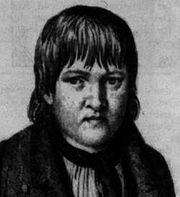
A Bavarian town famous for its werewolf and site of the death of the mysterious Kaspar Hauser has been hit by a school attack.


Kaspar Hauser

An 18-year-old student armed with an ax, knives and Molotov cocktails wounded eight fellow students and a teacher at his high school in the Bavarian town of Ansbach on Thursday, September 17, 2009, the German police said. The police arrived at the scene minutes after the rampage began, opening fire on the attacker, who was not identified, and arresting him.

Two children were seriously wounded, as was the 18-year-old attacker. Seven other children were slightly wounded.

Ralf Koch, a spokesman for the Bavarian police, said between 600 and 700 students attend the school, which includes grades seven through 13. The attacker was in the 13th grade.

Police said they received an emergency call at 8:35 a.m. (2:35 a.m. ET). When they got to the school, they immediately smelled smoke in the building, and they then encountered the attacker in a hallway.

The teenager had lobbed two Molotov cocktails into classrooms, one of which caused a fire, said Udo Dreher of the local police. He had also attacked several students with the ax and knives.

Police shot the teenager several times because he threatened the police officers, said Joachim Herrmann, the minister of the interior for the state of Bavaria, where Ansbach is located. The siege ended at 8:46 a.m.

The attacker suffered life-threatening wounds and is now being treated at a hospital.

(See here for Todd Campbell's straightforward take on this event.)

Apocalypse Today

Ansbach State Prosecutor Juergen Krach said the attacker remained hospitalized after he was shot by police during his arrest. Doctors plan to bring him out of a medically induced coma on Friday, September 18, 2009.

Krach said a search of the student's home turned up the calendar on which he had marked September 17, 2009, with the words "apocalypse today," and a handwritten will.

State Prosecutor Gudrun Lehnberger said the will was dated September 11, 2009. She added that the search turned up no threats against specific students or people. The attacker's motive remains unclear.

"I can confirm that the perpetrator was undergoing psychotherapeutic treatment," Lehnberger said. The teenager's name has not been released because of German privacy laws. Krach said police have questioned the student's parents.

The episode was the second attack at a German school in less than a year.

In March 2009, 17-year-old Tim Kretschmer fatally shot 12 people (mostly females) at his former school in the southwestern town of Winnenden, a town near Stuttgart, Germany. He fled the building and killed three more people before turning the gun on himself.

Ansbach: A place of strange wonders

The Wolf of Ansbach was a man-eating wolf that attacked and killed an unknown number of people in the Principality of Ansbach in 1685, then a part of the Holy Roman Empire. Initially a nuisance preying on livestock, the wolf soon began attacking women and children.


The citizens of Ansbach believed the animal to be a werewolf. After it was killed, a human mask was placed on the carcass. The wolf's body was then hanged from a gibbet for all to see until it underwent preservation for permanent display at a local museum.

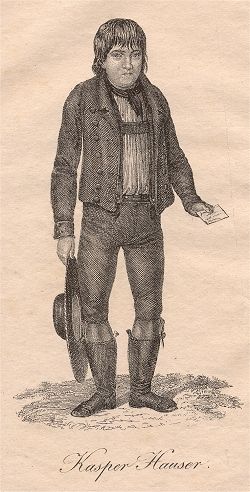
Kaspar Hauser (30 April 1812? – 17 December 1833) was a mysterious "lost child" found in 19th century Germany famous for his claim to have grown up in the total isolation of a darkened cell, raised like a half-wild human, in the tradition of feral or wolf children. Hauser's stories, and his likewise mysterious death by stabbing, sparked much debate and controversy. Hauser lived in Ansbach from 1830 to 1833. He was murdered in the palace gardens there.


Hauser was buried in a country graveyard; his headstone reads, in Latin, "Here lies Kaspar Hauser, riddle of his time. His birth was unknown, his death mysterious." A monument to him was later erected in the Court Garden which reads Hic occultus occulto occisus est: "Here a mysterious one was killed in a mysterious manner."

Forteans have been interested in the mystery of Kaspar Hauser for some time. Fortean Society member and famed science fiction author Eric Frank Russell, in his 1943 novel Sinister Barrier, described Kaspar Hauser as a person who originated from a non-human laboratory. Robert A. Heinlein, in his 1963 Glory Road, referred to "Kaspar Hausers" as an analogue to persons popping in and out of metaphysical planes.

In the 1966 film Fahrenheit 451, the protagonist Guy Montag discreetly puts a copy of a book entitled Gaspard Hauser into his bag before the rest of the books in that residence are torched.

In the American TV series "Smallville," (2001) Clark Kent finds a boy who does not to remember who he was or where he came from, except his name. Chloe refers to the boy as a "modern day Kasper Hauser."

In the Japanese horror movie Marebito (2004), the lead character Masuoka refers to a girl he found chained up underground as his "little Kaspar Hauser."

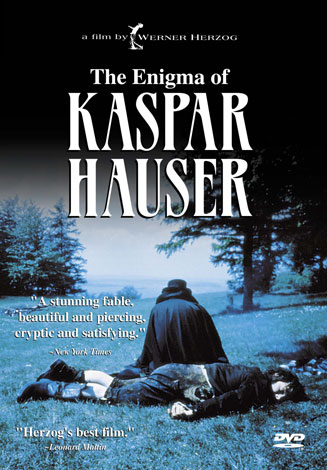
The Enigma of Kaspar Hauser


In 1974, the German filmmaker Werner Herzog made Hauser's story into the film, Jeder für sich und Gott gegen alle (Every Man for Himself and God Against All). In English the film has become known by that translation, or by the title The Enigma of Kaspar Hauser.

The bizarre nature of the movie is a metaphor for the human condition, the mystery of the Hauser melodrama, and, as it turns out, the strange things that still happen in Ansbach.