Showing posts with label Werewolf. Show all posts

Tuesday, March 07, 2017

Werewolf, Vampire, Beheading and Mothers


These are bizarre times....

The cover of Germany's Der Spiegel, dated 4.2.2017, which is the European style for February 4, 2017, would read as April 2, 2017, to Americans. "42" again.

A werewolf. A vampire. A stabbing. A beheading. Two mothers dead. It has been a strange two days.

Bellingham, SE London, was the site of a car ramming on February 26, 2017.

Readers immediately recalled that Bellingham, Washington State, was a site of frequent murders. And that in The X-Files episode "Jose Chung's From Outer Space" the Air Force pilot, dressed as an alien, was shown as being from Bellingham, Washington.

Now Bellingham, Washington, has been revisited in a horrific fashion. A son, who thought he was a werewolf, kills his mother, who he thinks was a vampire.

Officers and firefighters were called to a home in the 1500 block of McKenzie Avenue, Bellingham, Washington, on Sunday, March 5, 2017.

Aurora's son, the suspect.

When they arrived shortly after 2 p.m., they found the body of 57-year-old Aurora Buol-Smith. Police found Sheaen Smith, the woman’s 29-year-old son, in an upstairs bedroom of the home. Bellingham police say Smith made several statements, including one to the effect of "I stabbed her," and told officers he had called 911. The man was transported to the police department for an interview. Based on information he provided, a knife believed to be the one used in the stabbing was found in the home. Police say Smith made numerous statements to officers and detectives about why he stabbed his mother, including a statement that he was a werewolf and his mother was a vampire. Source.
Police said later that the attack was sexually motivated.

The woman killed was identified as Aurora Buol-Smith, 57, The Bellingham Herald reported. The same newspaper has said that the suspect, Sheaen Emmette Smith, 29, placed "a nonsensical 911 call about werewolves and vampires around 2 p.m. Sunday from his mother’s duplex."


Aurora = Dawn.


Meanwhile, on Monday, March 6, 2017, another son killed his mother, also under bizarre circumstances.


The suspect, 18-year-old Oliver Funes-Machado (pictured above), was arrested after greeting police with a butcher’s knife and his mother’s severed head.

Media reports say the first deputy on the scene saw the teen walking out of the house, holding the head in one hand and what appeared to be a butcher knife in the other. When Funes-Machado saw officers, he reportedly placed the head on the ground and was arrested, officials have said.

The son killed his mother in front of two other children in the family, young girls ages 2 or 3.

The killing of Yesenia Funes Beatriz Machado happened about noon Monday, 190 miles east of Charlotte in the small Pilot community of Franklin County. The closest town is Zebulon, an eastern Wake County town of 4,400 people. Source.


Zebulon is the sixth son of Jacob and Leah in the Hebrew Bible. The North Carolina town of Zebulon is said to be named after Zebulon Baird Vance (1830–1894), American Confederate Colonel and North Carolina Governor on Wikipedia. However, in the Illustrated Dictionary of Place Names, Zebulon, North Carolina, is reportedly named after Zebulon Pike (1779–1813), American soldier, and explorer and eponym of Pikes Peak in Colorado.

Zebulon is part of the (North Carolina) Research Triangle metropolitan region.
(h/t R.S.)

Read more here: http://www.charlotteobserver.com/news/local/article136980518.html#storylink=cpy

Read more here: http://www.charlotteobserver.com/news/local/article136980518.html#storylink=cpy

Read more here: http://www.charlotteobserver.com/news/local/article136980518.html#storylink=cpy

Friday, July 10, 2015

Known for The Werewolf of Ansbach, Killing Spree Visits Area


A suspect has been caught by police after allegedly shooting to death two people in a killing spree in Ansbach in northern Bavaria, Germany, on Friday morning, July 10, 2010.

The area is known as the site of famed werewolf account, in many ways, a German version of the Beast of Gévaudan (La Bête Du Gévaudan).

Coat of Arms of Anspach.

The name of the town was originally Onolzbach, meaning "On'z Brook". It was also formerly known as Anspach.


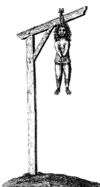
The Wolf of Ansbach was a man-eating wolf that attacked and killed an unknown number of people in the Principality of Ansbach in 1685, then a part of the Holy Roman Empire. Initially a nuisance preying on livestock, the wolf soon began attacking women and children. The citizens of Ansbach believed the animal to be a werewolf, a reincarnation of their late and cruel Bürgermeister, whose recent death had gone unlamented. During an organized hunt the locals succeeded in driving the wolf from a nearby forest and chasing it down with dogs until it leaped into an uncovered well for protection. Trapped, the wolf was slain, and its carcass paraded through the city marketplace. It was dressed in a man's clothing and, after severing its muzzle, the crowd placed a mask, wig, and beard upon its head, giving it the appearance of the former Bürgermeister. The wolf's body was then hanged from a gibbet for all to see until it underwent preservation for permanent display at a local museum. (See also, The Book of Werewolves by Sabine Baring-Gould, and The Werewolf by Montague Summers).

Franz Ritter von Kobell and other writers wrote poems about the wolf and its actions.

The man arrested in conjunction with the July 10, 2015, Ansbach shooting is thought to be around 47 years old, is alleged to have driven in a silver Mercedes convertible to the village of Tiefenthal, where he stopped and had a brief exchange of words with an 82-year-old woman before shooting her dead.

Tuefebthal literally translates as "the deep valley." The municipality lies in a small hollow with northern slopes between the Eisbach and Eckbach valleys in the Palatinate. Tiefenthal belongs to the Verbandsgemeinde of Hettenleidelheim, whose seat is in the like-named municipality. Until 1969, the municipality belonged to the now abolished district of Frankenthal.

The German blazon reads: In Rot ein goldenes Tatzenkreuz. (A golden cross in red.)
Tiefenthal’s arms might in English heraldic language be described thus: Gules a cross pattée humetty Or. The arms were approved by the now defunct Regierungsbezirk administration in Neustadt and date from a 1724 seal. They are borrowed from the arms once borne by the Counts of Leiningen-Westerburg, to whom Tiefenthal belonged.

The suspect fled the scene before shooting and killing a 72-year-old male cyclist 5km away in Rammersdorf.

Another man was threatened with a gun, and shortly afterwards a tractor driver was shot at, but was unhurt, police said.


Two mechanics working at a petrol station in Bad Windsheim overpowered the man after he entered the shop and threatened employees with a gun, police said.

Police said the man, named as Bernd G, was not previously known to the authorities.

Gerhard Neuhof, a senior public prosecutor in Ansbach, said there was no indication the gunman knew his victims and the incident appeared to have been a random killing spree.

The mayor of Leutershausen, Siegfried Hess, said he was shocked by the attack, according to the newspaper the Süddeutsche Zeitung.

Crime scene investigators in Leutershausen, near Ansbach (EPA)

Hess told the Süddeutsche Zeitung that he was "totally shocked".

Hess described the killings as "probably the worst crime in the history of the town." He said he had already sent his condolences to the family of the 82-year-old victim, and said he believed the suspect did not know the woman.

Apparently Herr Hess is unaware of the werewolf history of Ansbach!

Friday, September 18, 2009

Enigmas of Ansbach

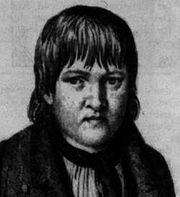
A Bavarian town famous for its werewolf and site of the death of the mysterious Kaspar Hauser has been hit by a school attack.


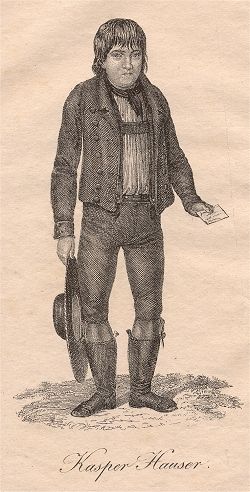
Kaspar Hauser

An 18-year-old student armed with an ax, knives and Molotov cocktails wounded eight fellow students and a teacher at his high school in the Bavarian town of Ansbach on Thursday, September 17, 2009, the German police said. The police arrived at the scene minutes after the rampage began, opening fire on the attacker, who was not identified, and arresting him.

Two children were seriously wounded, as was the 18-year-old attacker. Seven other children were slightly wounded.

Ralf Koch, a spokesman for the Bavarian police, said between 600 and 700 students attend the school, which includes grades seven through 13. The attacker was in the 13th grade.

Police said they received an emergency call at 8:35 a.m. (2:35 a.m. ET). When they got to the school, they immediately smelled smoke in the building, and they then encountered the attacker in a hallway.

The teenager had lobbed two Molotov cocktails into classrooms, one of which caused a fire, said Udo Dreher of the local police. He had also attacked several students with the ax and knives.

Police shot the teenager several times because he threatened the police officers, said Joachim Herrmann, the minister of the interior for the state of Bavaria, where Ansbach is located. The siege ended at 8:46 a.m.

The attacker suffered life-threatening wounds and is now being treated at a hospital.

(See here for Todd Campbell's straightforward take on this event.)

Apocalypse Today

Ansbach State Prosecutor Juergen Krach said the attacker remained hospitalized after he was shot by police during his arrest. Doctors plan to bring him out of a medically induced coma on Friday, September 18, 2009.

Krach said a search of the student's home turned up the calendar on which he had marked September 17, 2009, with the words "apocalypse today," and a handwritten will.

State Prosecutor Gudrun Lehnberger said the will was dated September 11, 2009. She added that the search turned up no threats against specific students or people. The attacker's motive remains unclear.

"I can confirm that the perpetrator was undergoing psychotherapeutic treatment," Lehnberger said. The teenager's name has not been released because of German privacy laws. Krach said police have questioned the student's parents.

The episode was the second attack at a German school in less than a year.

In March 2009, 17-year-old Tim Kretschmer fatally shot 12 people (mostly females) at his former school in the southwestern town of Winnenden, a town near Stuttgart, Germany. He fled the building and killed three more people before turning the gun on himself.

Ansbach: A place of strange wonders

The Wolf of Ansbach was a man-eating wolf that attacked and killed an unknown number of people in the Principality of Ansbach in 1685, then a part of the Holy Roman Empire. Initially a nuisance preying on livestock, the wolf soon began attacking women and children.


The citizens of Ansbach believed the animal to be a werewolf. After it was killed, a human mask was placed on the carcass. The wolf's body was then hanged from a gibbet for all to see until it underwent preservation for permanent display at a local museum.

Kaspar Hauser (30 April 1812? – 17 December 1833) was a mysterious "lost child" found in 19th century Germany famous for his claim to have grown up in the total isolation of a darkened cell, raised like a half-wild human, in the tradition of feral or wolf children. Hauser's stories, and his likewise mysterious death by stabbing, sparked much debate and controversy. Hauser lived in Ansbach from 1830 to 1833. He was murdered in the palace gardens there.


Hauser was buried in a country graveyard; his headstone reads, in Latin, "Here lies Kaspar Hauser, riddle of his time. His birth was unknown, his death mysterious." A monument to him was later erected in the Court Garden which reads Hic occultus occulto occisus est: "Here a mysterious one was killed in a mysterious manner."

Forteans have been interested in the mystery of Kaspar Hauser for some time. Fortean Society member and famed science fiction author Eric Frank Russell, in his 1943 novel Sinister Barrier, described Kaspar Hauser as a person who originated from a non-human laboratory. Robert A. Heinlein, in his 1963 Glory Road, referred to "Kaspar Hausers" as an analogue to persons popping in and out of metaphysical planes.

In the 1966 film Fahrenheit 451, the protagonist Guy Montag discreetly puts a copy of a book entitled Gaspard Hauser into his bag before the rest of the books in that residence are torched.

In the American TV series "Smallville," (2001) Clark Kent finds a boy who does not to remember who he was or where he came from, except his name. Chloe refers to the boy as a "modern day Kasper Hauser."

In the Japanese horror movie Marebito (2004), the lead character Masuoka refers to a girl he found chained up underground as his "little Kaspar Hauser."

The Enigma of Kaspar Hauser


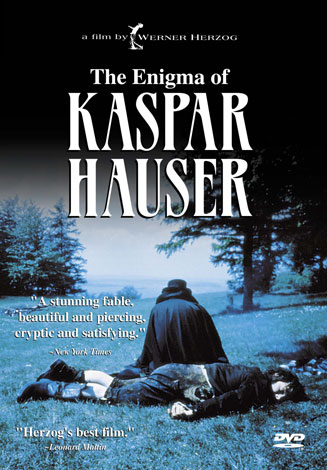
In 1974, the German filmmaker Werner Herzog made Hauser's story into the film, Jeder für sich und Gott gegen alle (Every Man for Himself and God Against All). In English the film has become known by that translation, or by the title The Enigma of Kaspar Hauser.

The bizarre nature of the movie is a metaphor for the human condition, the mystery of the Hauser melodrama, and, as it turns out, the strange things that still happen in Ansbach.