by Loren Coleman

I was in the heart of Fayette County, Pennsylvania, on June 26-27, 2011, while on a 3000 mile trek, re-investigating the sites of the 1960s-1970s' best inexplicable reports. In this land of laurels and legendary locations, I quickly discovered, once again, things are not always as they seem when I went to seek out a famous Frank Lloyd Wright landmark. (Once again, click to read more on the significance of the "Fayette Factor.")
No house
should ever be on a hill
or on anything. It should be of the hill.
Belonging to it. Hill and house should live
together each the happier for the other. ~ Frank Lloyd Wright
should ever be on a hill
or on anything. It should be of the hill.
Belonging to it. Hill and house should live
together each the happier for the other. ~ Frank Lloyd Wright
Frank Lloyd Wright Background
Wright picked Spring Green, Wisconsin to create a new beginning for himself, away from his first marriage of over 20 years and the Chicago suburbs. The land he bought on April 10, 1911, was adjacent to land held by his mother's family, the Lloyd-Joneses. Wright began to build himself a new home, which he called Taliesin, in May 1911. The recurring theme of Taliesin came from his mother's side: Taliesin in Welsh mythology was a poet, magician, and priest. The family motto was Y Gwir yn Erbyn y Byd which means "The Truth Against the World"; it was created by Iolo Morgannwg who also had a son called Taliesin, and the motto is still used today as the cry of the druids and chief bard of the Eisteddfod in Wales.
Taliesin became the source of much joy and horror for Wright, as his living workshop involved in his "organic architecture" movement. (More about Taliesin, in a moment.)
Also, it is worthy of noting that Frank Lloyd Wright (like his architect genius peer, Bucky Fuller) was a member of the original Fortean Society. See more about the lengthy list of people associated with that Fortean organization founded in 1931, here.
Fayette and Fallingwater

Also, it is worthy of noting that Frank Lloyd Wright (like his architect genius peer, Bucky Fuller) was a member of the original Fortean Society. See more about the lengthy list of people associated with that Fortean organization founded in 1931, here.
Fayette and Fallingwater
So, a year ago, what did I find in Fayette County?
First, the photograph. I have the feeling that no one can take a bad picture of this site. I certainly surprised myself with what I was able to capture with my older model iPhone.
Yes, I'm talking about Frank Lloyd Wright's Fallingwater. Wright's organic architecture philosophy was best exemplified by his design for Fallingwater, which has been called "the best all-time work of American architecture."

The place known by one simple name today is downright beautiful and breathtaking. Additionally, as I discovered, the mystical roots of this wonderful manmade house are revealed with a little digging. First, there is the "coincidence" that it is located in Fayette County.
But were you aware that this famous Frank Lloyd Wright site was built where a former Masonic Lodge once stood?
The beginnings of the masterpiece are linked to Freemasonry and Taliesen. The well-to-do Kaufmann family owned a Pittsburgh department store, and they also owned a huge tract of land and cabin an hour-and-a-half southeast of Pittsburgh, which they had bought from a Masonic lodge. The family's elder son, Edward Kaufmann, Jr., had studied at Taliesen under Frank Lloyd Wright. In 1937, when the Kaufmanns wanted to upgrade their "rustic cabin" into a comfortable weekend getaway, they naturally turned to Wright for a design. Wright went beyond their expectations, and created his acknowledged magnum opus. People have since traveled from around the world, as I did from Maine, to visit this piece of art disguised as a house, in the Laurel Highlands of Pennsylvania.
Decatur's Millikin Place Houses
During my trip last summer, I also stopped to check out the three Wright-related houses in Decatur, Illinois (my hometown).
 The Edward P. Irving House, designed by Frank Lloyd Wright and built in 1911, is located at #2 Millikin Place, Decatur, Illinois.
 In addition, the Robert Mueller Residence, 1 Millikin Place...
 and the Adolph Mueller Residence, 4 Millikin Place, have been attributed to Wright's assistants Hermann V. von Holst and Marion Mahony.
Frank Lloyd Wright's influences were nature, the landscape, and music, as well as Mayan-Aztec and Japanese art. His creations involved several prominent pieces that would become synchromystically linked to a variety of remarkable events.
Taliesins and Tragedies

Wright's beloved Taliesin would be the source of one of the worst heartbreaks of his life. In 1909, Wright and his new lover Mamah Borthwick Cheney went to Europe. They returned a year later, and began building Taliesin, in earnest in 1911, where they soon lived and worked.
Then tragedy struck. On August 15, 1914, while Wright was working in Chicago, Julian Carlton, a recently hired male servant and cook from Barbados, set fire to the living quarters of Taliesin and used an axe to kill seven people as the fire burned. The dead included Mamah; her two children, John and Martha; a gardener; a draftsman named Emil Brodelle; a workman; and another workman's son.
Two people survived the mayhem, one of whom helped to put out the fire that almost completely engulfed the residential wing of the house. Carlton tired to kill himself by swallowing muriatic acid [lye, says K.B.] immediately following the attack but lived. He was nearly hanged on the spot when he was taken into custody, but was taken to the Dodgeville jail. Carlton died from starvation seven weeks after the attack.
Another fire destroyed the bungalow at Taliesin on April 20, 1925. Wright rebuilt it and called it "Taliesin III."
First, the photograph. I have the feeling that no one can take a bad picture of this site. I certainly surprised myself with what I was able to capture with my older model iPhone.
Yes, I'm talking about Frank Lloyd Wright's Fallingwater. Wright's organic architecture philosophy was best exemplified by his design for Fallingwater, which has been called "the best all-time work of American architecture."
Fallingwater by Loren Coleman, 2011
The place known by one simple name today is downright beautiful and breathtaking. Additionally, as I discovered, the mystical roots of this wonderful manmade house are revealed with a little digging. First, there is the "coincidence" that it is located in Fayette County.
But were you aware that this famous Frank Lloyd Wright site was built where a former Masonic Lodge once stood?
The beginnings of the masterpiece are linked to Freemasonry and Taliesen. The well-to-do Kaufmann family owned a Pittsburgh department store, and they also owned a huge tract of land and cabin an hour-and-a-half southeast of Pittsburgh, which they had bought from a Masonic lodge. The family's elder son, Edward Kaufmann, Jr., had studied at Taliesen under Frank Lloyd Wright. In 1937, when the Kaufmanns wanted to upgrade their "rustic cabin" into a comfortable weekend getaway, they naturally turned to Wright for a design. Wright went beyond their expectations, and created his acknowledged magnum opus. People have since traveled from around the world, as I did from Maine, to visit this piece of art disguised as a house, in the Laurel Highlands of Pennsylvania.
Decatur's Millikin Place Houses
During my trip last summer, I also stopped to check out the three Wright-related houses in Decatur, Illinois (my hometown).


Frank Lloyd Wright's influences were nature, the landscape, and music, as well as Mayan-Aztec and Japanese art. His creations involved several prominent pieces that would become synchromystically linked to a variety of remarkable events.
Taliesins and Tragedies

Taliesin by David Sullivan, 2011
Wright's beloved Taliesin would be the source of one of the worst heartbreaks of his life. In 1909, Wright and his new lover Mamah Borthwick Cheney went to Europe. They returned a year later, and began building Taliesin, in earnest in 1911, where they soon lived and worked.
Then tragedy struck. On August 15, 1914, while Wright was working in Chicago, Julian Carlton, a recently hired male servant and cook from Barbados, set fire to the living quarters of Taliesin and used an axe to kill seven people as the fire burned. The dead included Mamah; her two children, John and Martha; a gardener; a draftsman named Emil Brodelle; a workman; and another workman's son.
Two people survived the mayhem, one of whom helped to put out the fire that almost completely engulfed the residential wing of the house. Carlton tired to kill himself by swallowing muriatic acid [lye, says K.B.] immediately following the attack but lived. He was nearly hanged on the spot when he was taken into custody, but was taken to the Dodgeville jail. Carlton died from starvation seven weeks after the attack.
Another fire destroyed the bungalow at Taliesin on April 20, 1925. Wright rebuilt it and called it "Taliesin III."
Marin County Courthouse

One of the strangest of many weird events happening at a location designed by Frank Lloyd Wright occurred after he died. In August 21, 1971, Black Panther George Jackson was killed (some say "assassinated") in a shootout with police at the Marin County Courthouse, the last commissioned building designed by Frank Lloyd Wright.


The Marin County Civic Center was prominently featured in 1997's Gattaca, as a futuristic space port. [Thanks RPJ.]
John Sowden House and the Black Dahlia


The house's owners have experienced an overwhelming number of difficulties and sudden death. Death almost struck in 1912, when after visiting Europe, the family booked passage on the maiden voyage of the White Star liner Titanic, but when a member of its party fell ill, the family decided to return at a later date, by another boat.
The 1920s proved to be unhappy years for the Westcott family. Orpha died suddenly at the age of 46, on April 12, 1923, following what should have been a routine sinus operation, in Philadelphia. The tragedy stunned both her family and her friends. Funeral services were held for her in the living room of her beautiful home on East High Street. At the same time Burton’s company was failing. He resigned as treasurer of the American Seeding Machine Company in order to invest more time for the failing Westcott Motor Car Company. Attempts to save the ailing car company had exhausted his finances. With no other option Burton sold out. The severe stress in his life took its toll on his health. In 1926, thrown into further depression by his wife's death, at 57 years of age, Burton died in his home on East High Street while under the care of his sister from Richmond, Indiana. Funeral services were held at the Westcott residence.
Following the death of Burton in 1926, the Westcott House was sold to Roscoe Pierce. He lived in the house until his death in 1941. Eva Linton bought the house in 1944. She subsequently sub-divided the main house into five apartments. Over the next 37 years the house fell into a state of disrepair and decline. Eva Linton died in 1980, and her estate was passed to her niece Dorothy Jane Snyder. Dorothy inherited the property in 1981 and maintained it until 1988 when she sold it to her son Ken Snyder and his wife Sherri.
In 1991, Ken died unexpectedly in a car accident, and Sherri sold the house in 2000. The non-profit The Westcott House Foundation owns and maintains it today.[Thank I.]
Wright's Friends and Designs
If Frank Lloyd Wright's organic location legacy and his friends weren't enough, we should take into consideration his close heirs. (See Frank Lloyd Wright's family tree.)
Anne Baxter: Wright's Granddaughter
Let's stay with the Hollywood stream of consciousness, and take a peek at Anne Baxter.
Anne Baxter (May 7, 1923 – December 12, 1985) was an American actress known for her performances in films such as The Magnificent Ambersons (1942), The Razor's Edge (1946), All About Eve (1950) and The Ten Commandments (1956).


Anne Baxter's Grants, New Mexico home (above) sold for $895,000 in 2009. It is the one in which she lived, with second husband Randolph Galt, beginning in 1963. Here is how it was listed:


Baxter married for her third time, in 1977 to David Klee, a prominent stockbroker. It was a brief marriage; Klee died unexpectedly from an illness. The newlywed couple had purchased a sprawling property in Easton, Connecticut, which they extensively remodeled; however, Klee did not live to see the renovations completed. Aspects of the house were redesigned to be architecturally reminiscent of Frank Lloyd Wright's Prairie School Architecture. The living-room fireplace was remodeled to resemble the famous stone structure in the living room of her grandfather's masterpiece, Fallingwater. Vaulted ceilings were lowered to embrace Wright's essential design protocol against soaring ceilings.
Baxter never remarried. Although she maintained a residence in West Hollywood, Baxter considered her Connecticut home to be her primary residence.
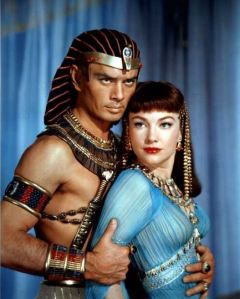
Anne Baxter's most famous role was of Nefertari (meaning "Beautiful Companion"), one of the royal wives of Pharaoh Rameses II, in the 1956 epic Exodus film, directed by Cecile B. DeMille, The Ten Commandments.


Baxter suffered a brain aneurysm on December 4, 1985, while hailing a taxi on Madison Avenue in New York City. She died 8 days later at Lenox Hill Hospital on December 12, aged 62. Her last film role was the TV movie The Masks of Death (1984), which starred Peter Cushing as Sherlock Holmes.
Baxter is buried on the estate of Frank Lloyd Wright at Lloyd Jones Cemetery in Spring Green, Wisconsin. She was survived by her three daughters.

Buildings, too, are children of Earth and Sun.


The Marin County Civic Center was prominently featured in 1997's Gattaca, as a futuristic space port. [Thanks RPJ.]
John Sowden House and the Black Dahlia
 From 1945 through 1951, the John Sowden House was owned by Dr. George Hodel, a Los Angeles physician who was a prime suspect in the infamous Black Dahlia murder, although he was not publicly named as such at the time. The house was designed by Frank Lloyd Wright's oldest son, Lloyd Wright. Its design was based on the Mayan Revival movement, embraced by Frank Lloyd Wright, for example, in the Ennis-Brown House.  The design of the Sowden House was reportedly inspired specifically by the Mayan site, Palenque. (As it happens, when I was at Southern Illinois University-Carbondale, I worked for part of a summer with archaeologist Robert L. Rands, on cleaning and cataloguing Palenque artifacts.) When Lloyd Wright died in 1978, the Los Angeles Times hailed that the Sowden site "as the apogee of his residential work."  Dr. George Hodel's own son, Steve Hodel, himself a retired City of Los Angeles homicide detective, argued in his 2003 book Black Dahlia Avenger that the Black Dahlia victim, Elizabeth Short, was actually tortured, murdered and dissected by his father inside of the Sowden House, in January 1947. 
The John Sowden House was used as a shooting location to depict the home of Ava Gardner in Martin Scorsese's The Aviator (2004), a film about Howard Hughes.
 
The Black Dahlia was identified as Elizabeth Short, and a photograph of her compares favorably with the appearance given to the Sean Young character in Ridley Scott's Blade Runner (1982).
The Ennis-Brown House       Additionally, the Ennis-House House was briefly the home of famed esoteric author Manly P. Hall, (see here). Also the Ennis-Brown House was used in the Disney film The Rocketeer as the home of Neville Sinclair, Nazi spy. Howard Hughes was a prominent character in the film. [Thanks M.]   
Governor's Palace at Uxmal

The Ennis-Brown House was in shambles before the 2007 restoration began.

Newly restored.
Author Robert Schneck also shared the following with me about this building: "The Ennis-Brown House was used for exerior shots in the William Castle (born 'Schloss' = 'castle') movie House on Haunted Hill. It featured an eccentric millionaire named Frederick Loren (played by Vincent Price), a death by hanging (the incredibly beautiful Carol Ohmart), a decapitation, an acid pit, and various morbid touches, including dripping bloodstain on the ceiling, guests arriving for a party in funeral cars, a little row of coffins containing guns, and lots of ghosts. A remake appeared in 1999 but they didn't use a Wright house." "William Castle, incidentally leads to Rosemary's Baby (he produced the movie), which leads to the Dakota, which leads to John Lennon's murder, and who knows where else?"
Below is a replica of the Dakota; see more about the synchromystic links to the Dakota, here. 
Meanwhile in Japan
|

Imperial Hotel, Frank Lloyd Wright's second design/construction.
The Mayan Revival style (surprisingly) was also used in the Frank Lloyd Wright design of the second Imperial Hotel (shown above) of Tokyo, Japan. (He also insisted on being in charge of designing the luggage labels too.) The opening of the hotel is often directly associated with a massive 8.3 earthquake. Construction of the hotel began in 1917 and on July 4, 1922 the first section of Wright’s Imperial Hotel opened. In August 1923 the hotel was completed. On September 1, 1923 a major earthquake destroyed Tokyo. The Imperial Hotel stood, and was discussed in the media of the time as a tribute to Wright. However, in reality, despite the positive press, the hotel, which had been built to float on mud, received major internal damage. On November 15, 1967 the doors were closed on the Imperial Hotel, forever, and Wright’s Japanese masterpiece was demolished, another great loss to humanity. [Thanks to LMcR.]
Wright's, his relatives' and students' buildings and houses are so unique they have become centerpieces of Hollywood magic.
Solomon R. Guggenheim Museum
Wright's, his relatives' and students' buildings and houses are so unique they have become centerpieces of Hollywood magic.
Solomon R. Guggenheim Museum

Take, for instance, the Solomon R. Guggenheim Museum, founded in New York City, which was designed by Frank Lloyd Wright. The building has become a cultural icon and can be seen widely throughout popular culture. It is featured in Matthew Barney's The Cremaster Cycle, Bye Bye Birdie, Men in Black, When in Rome, Downtown 81, Ugly Betty and prominently in The International, where a major shootout occurs in the museum. In fact, a life-size replica of the museum was built for The International's dramatic final scene.
I earlier noted the "coincidences" tied to the Guggenheim family and the tragedy of the sinking of the Titanic, here.
Westcott House

The Westcott House
The Titanic figured in another story connected to another Frank Lloyd Wright-designed site. The Westcott House is a Frank Lloyd Wright-designed Prairie Style house in Springfield, Ohio. The house was built in 1908 for Mr. Burton J. Westcott, his wife Orpha, and their family. The Westcott property is the only Prairie style house designed by Wright in the state of Ohio. The house's owners have experienced an overwhelming number of difficulties and sudden death. Death almost struck in 1912, when after visiting Europe, the family booked passage on the maiden voyage of the White Star liner Titanic, but when a member of its party fell ill, the family decided to return at a later date, by another boat.
The 1920s proved to be unhappy years for the Westcott family. Orpha died suddenly at the age of 46, on April 12, 1923, following what should have been a routine sinus operation, in Philadelphia. The tragedy stunned both her family and her friends. Funeral services were held for her in the living room of her beautiful home on East High Street. At the same time Burton’s company was failing. He resigned as treasurer of the American Seeding Machine Company in order to invest more time for the failing Westcott Motor Car Company. Attempts to save the ailing car company had exhausted his finances. With no other option Burton sold out. The severe stress in his life took its toll on his health. In 1926, thrown into further depression by his wife's death, at 57 years of age, Burton died in his home on East High Street while under the care of his sister from Richmond, Indiana. Funeral services were held at the Westcott residence.
Following the death of Burton in 1926, the Westcott House was sold to Roscoe Pierce. He lived in the house until his death in 1941. Eva Linton bought the house in 1944. She subsequently sub-divided the main house into five apartments. Over the next 37 years the house fell into a state of disrepair and decline. Eva Linton died in 1980, and her estate was passed to her niece Dorothy Jane Snyder. Dorothy inherited the property in 1981 and maintained it until 1988 when she sold it to her son Ken Snyder and his wife Sherri.
In 1991, Ken died unexpectedly in a car accident, and Sherri sold the house in 2000. The non-profit The Westcott House Foundation owns and maintains it today.[Thank I.]
Wright's Friends and Designs
Wright built wonderful homes, and likewise surrounded himself with interesting wonder-filled people.
Famed author of the original Scarface, writer on 70 other films, and a Fortean Society member, Ben Hecht had his office in Chicago's Rookery Building, in which Frank Lloyd Wright designed the lobby. Hecht and Wright were friends.
My Fortean friend Bill Grimstad, when I told him of my plans to write this essay, mentioned,
There was of course the Svetlana (daughter of Stalin) connection, who was in and out of FLW’s entourage. But most evocative was that of Nicholas (!) Roerich, an artist and Asian adventurer very much on the Aghartha “King of the World” wavelength, who in turn brings in V.P Henry Wallace, Igor Stravinsky, and a host of other 1900s celebs.
Dangerous Minds notes, "It’s commonly known that Frank Lloyd Wright served as inspiration for the Howard Roark character in Ayn Rand's The Fountainhead." Rand and Frank Lloyd Wright became friends for years after her correspondence asking him questions about being an architect. [Thanks C.S.]
Frank Lloyd Wright's wife, Olgivanna Hinzenburg Wright, was a follower of the Russian-Greek-Armenian mystic G.I. Gurdjieff (1872? 1874?-1949), and Wright himself was a good friend of Gurdjieff. The Wrights often visited Gurdjieff together in New York or Paris, and Gurdjieff visited Wright's house Taliesin several times in the 1930s. [Source: James N. Webb, The Harmonious Circle: The Lives and Work of G.I. Gurdjieff, P.D. Ouspensky, and Their Followers (New York: G.P. Putnam's Sons, 1980), pp. 424-425. Thanks TPP.]
Anne Baxter: Wright's Granddaughter
Let's stay with the Hollywood stream of consciousness, and take a peek at Anne Baxter.
Anne Baxter (May 7, 1923 – December 12, 1985) was an American actress known for her performances in films such as The Magnificent Ambersons (1942), The Razor's Edge (1946), All About Eve (1950) and The Ten Commandments (1956).

Baxter was born in Michigan City, Indiana to Kenneth Stuart Baxter and Catherine Wright; her maternal grandfather was the architect Frank Lloyd Wright.
Anne Baxter married three times, and in each marriage she brought the Frank Lloyd Wright philosophy for organic architecture into her life. Her husbands were:
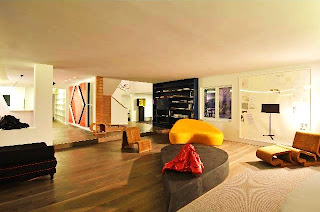


Her Baxter-Hodiak House was originally remodeled by architect John Lautner, a student of Frank Lloyd Wright's, in 1951 for actress Anne Baxter and first husband John Hodiak.
Anne Baxter married three times, and in each marriage she brought the Frank Lloyd Wright philosophy for organic architecture into her life. Her husbands were:
John Hodiak (m. 1946–1953)(divorced) 1 child
Randolph Galt (m. 1960–1969)(divorced) 2 children; and
David Klee (m. 1977–1977) (his death).


Baxter-Hodiak House, Pine Tree Place, Los Angeles.

Anne Baxter's Grants, New Mexico home (above) sold for $895,000 in 2009. It is the one in which she lived, with second husband Randolph Galt, beginning in 1963. Here is how it was listed:
"Anne Baxter home" is 3,000 square foot adobe home with 171 acres in the Zuni Mountains;
Architect: Eric Lloyd Wright (grandson of architect Frank Lloyd Wright) Built by: Anne Baxter, Academy Award winning actress (also granddaughter of Frank Lloyd Wright)
Two sides of the property borders Cibola National Forest One side borders NM Highway 53 and El Malpais National Monument.
Located southwest of I-40 on NM Highway 53; near the Ice Caves, El Malpais National Monument, El Morro National Monument, the Zuni-Acoma Trail, and the Continental Divide Trail; 18 miles to Grants.

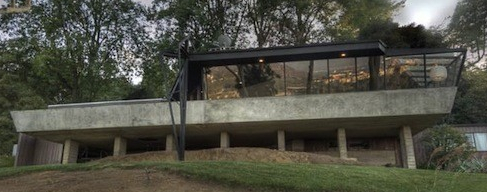
Fallingwater Copycats?
Baxter never remarried. Although she maintained a residence in West Hollywood, Baxter considered her Connecticut home to be her primary residence.
Anne Baxter's most famous role was of Nefertari (meaning "Beautiful Companion"), one of the royal wives of Pharaoh Rameses II, in the 1956 epic Exodus film, directed by Cecile B. DeMille, The Ten Commandments.



Baxter suffered a brain aneurysm on December 4, 1985, while hailing a taxi on Madison Avenue in New York City. She died 8 days later at Lenox Hill Hospital on December 12, aged 62. Her last film role was the TV movie The Masks of Death (1984), which starred Peter Cushing as Sherlock Holmes.
Baxter is buried on the estate of Frank Lloyd Wright at Lloyd Jones Cemetery in Spring Green, Wisconsin. She was survived by her three daughters.

The legacy continues. Melissa Galt, an Atlanta-based interior designer and lifestyle creator, is Anne Baxter's daughter.


++++++
For more Frank Lloyd Wright-related Twilight Language postings,
please see,

and
Buildings, too, are children of Earth and Sun.
~ Frank Lloyd Wright
Frank Lloyd Wright and Synchromysticism
by Loren Coleman ©2012


