Showing posts with label Vincent Gaddis. Show all posts

Wednesday, September 12, 2018

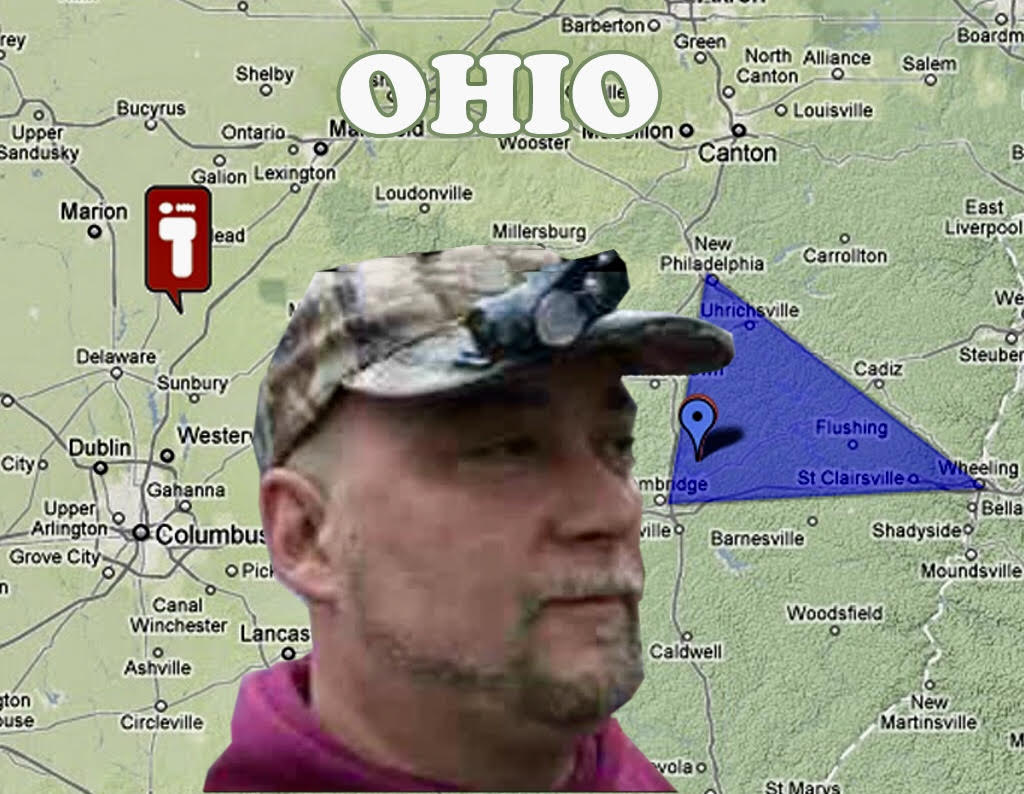
Ohio's Sasquatch Triangle


Ten years ago, on June 18, 2008, Don Keating, the head of the Eastern Ohio Bigfoot Investigation Center, appeared on MonsterQuest to detail his investigations of local sightings. The creatures were known as the Ohio Grassman and where they lived was called the Sasquatch Triangle.


The Sasquatch Triangle of Ohio is a well-established research area of Bigfoot sightings, although some investigators may disagree on the exact borders of the "triangle."

As Guy Edwards notes in his Bigfoot Lunch Club, January 28, 2012: "This triangle, including sections of Tuscarawas, Guernsey, Muskingum and Coshocton counties, is home to the most frequent Bigfoot sightings in the state."

Don Keating is generally given credit for coining the word, although you will find internet mention of a "newspaper" having come up with the term in 1987. I find this a misunderstanding of the stories that began to appear about Keating's search groups.

For example, in the following article published on April 19, 1987, in the Dover Times Reporter, Dover, Ohio, the content centers on Don Keating and his associates.


Below, on the right is Donald Keating, who first published in 1987, The Sasquatch Triangle, about this specific area in Ohio. Keating began the concept of large Bigfoot conferences in Newcomerstown, Ohio; they evolved into the Ohio Bigfoot Conference today run by Marc DeWerth.


In 2001, Keating self-published his The Sasquatch Triangle Revisited, a revised edition of his original work.


When Finding Bigfoot broadcast their episode on Sunday, January 29, 2012, about the Sasquatch Triangle and Ohio Grassmen, they focused on local hunter Tim Stover.


In recent years, Don Keating is known and respected in East-Central Ohio, as a television weatherman. 


Sometimes you do need a weatherperson to know which way the wind blows...

++++++++++++++++++++++

About other "Triangles":

See also "Top Ten American 'Bridgewater Triangles'" in Twilight Language, August 30, 2015. 


I first wrote about the “Bridgewater Triangle” in Boston Magazine in 1980, and in my book Mysterious America in 1983. Vincent Gaddis coined the name “Bermuda Triangle” in Argosy, February 1964. There is some thought that Ivan T. Sanderson worked with Gaddis on the concept from the beginning.

Sanderson died February 19, 1973, at 62. Gaddis died February 25, 1997, at 83. Keating and Coleman, needless to say, are still alive and active.

Wednesday, February 18, 2015

The Bermuda Triangle Syndrome


This year, 2015, is the 40th anniversary of the publishing of my first book (with Jerome Clark). The Unidentified appeared in 1975, from Warner Books. It was republished in combination with its 1978 sister book, Creatures of the Outer Edge, in 2006; see here.


Down through the years, there are over a 100 books that I have contributed to (through introductions, prefaces, forewords), authored, coauthored, and/or edited. That's a good number of books to have seen published, released, reprinted, and revised in old and new editions with your name attached to them.

Seeing that sentence, you probably don't believe it when I say that authors never really ever get rich. Oh, okay, maybe one percent do, if they write 50 Shades of whatever, but most of us are poor and using free sites like blogger to keep writing, waiting to pull things together for our next book. But there is a truth to the fact that the more books you have out there, the less "original" your next publisher thinks you are. That is especially if you specialize in the nonfiction field of unexplained natural and human mysteries, it seems.

Let's look at one truth of what happens to an established writer like myself.

So much has been recycled on the web by others from my books, articles and blogs, today publishers think I'm "borrowing" from others' work when a search of the contents of a new manuscript shows up seemingly similar sections via an online search. This is a troubling trend for authors, of course.

The reality is you can find anything and everything on the net, and everyone seems to use your stuff, as they please, without original attributions.

But it is nothing new. It use to be done by the hard work of collecting all the works on one topic, and extracting what worked for your next "masterpiece." What's new, of course, is that "Google," "Yahoo," and other forms of online searching are available Internet wide of a vast body of written material. There is even a term for this acquiring of material from others and its use by Forteans in books about "Fortean phenomena" or "Forteana."

It's called the "Bermuda Triangle Syndrome."


Photo credit: Fortean Picture Library.

Author Dave Goudsward, in an article he wrote in 1978, coined this practice the "Bermuda Triangle Syndrome," after Berlitz's reuse of the same stories in his various books. This was because intermediate authors had "borrowed" and modified Berlitz's own material to the point where Berlitz himself didn't recognize it when he went looking to "borrow" material. 

In academia, such borrowing occurs all the time, as in scholarly citing of others' work and the revision and inclusion of the material in new writings. In the world of popular literature, it is often done, but more casually and with an understanding it happens often between colleagues in, for example, the Fortean field.

Basically, what Goudsward did in his examination was to put all the "Bermuda Triangle" books in publication order and then he traced the evolution of various snippets and stories about various ships and aircraft used, from title to title. He ended up with one of Berlitz's later books with a story unrecognizable from the original. As Goudsward pointed out in his analysis, Richard Winer was probably the most successful of the revisionists, but, of course, Berlitz was too, even of his own work.

While Charles Berlitz would become the most famous, and by extension, make the most money from his books on the topic, the actual coining of the term "Bermuda Triangle" seems to point to Vincent Gaddis, a Fortean friend of Ivan T. Sanderson. In the February 1964 issue of Argosy, Vincent Gaddis' article "The Deadly Bermuda Triangle" used the phrase widely for the first time.

Most of us try to be very careful about the incorrect of use of our old material, especially as seen through the eyes of ours. But then, sometimes it has evolved so far from your own writings, if you try to quote or paraphrase your own investigated case to give it new clothing, via another source, you probably will be accused of inappropriately using a turn of a phase from someone else, when ultimately, it might have been yours in the first place.

What a world.


++++++++++++++++++


Please support my work by simply clicking on the following button to give $5, $10, $50, $100, $1000, or a couple bucks, whatever you can send. I'm a starving writer. Thank you.

Saturday, January 26, 2013

Happy Birthday, Fortean Society and Forteans

If you are a Fortean or want to be one, take delight today in the first beginnings of a uniquely intellectual American and global movement. 

We measure a celebration, beginning anywhere. This one seems as good as any other.

The Fortean Society was founded on January 26, 1931:  1-26-1931 - 1-26-2013 = 82 years. 


Charles Hoy Fort (August 6, 1874 – May 3, 1932)
Fort's four published nonfiction books are: The Book of the Damned (1919), New Lands (1923), Lo! (1931), and Wild Talents (1932).
But my liveliest interest is not so much in things, as in relations of things. I have spent much time thinking about the alleged pseudo-relations that are called coincidences. What if some of them should not be coincidence?
~ Charles Fort, the first modern synchromystic
The Fortean Society was started in the United States in 1931 during a meeting held in the New York flat of Charles Hoy Fort in order to promote the ideas of American writer Charles Fort. The Fortean Society was primarily based in New York City. Its first president was Theodore Dreiser, an old friend of Charles Fort, who had helped to get his work published. Founding members of The Fortean Society included Booth Tarkington, Ben Hecht, Alexander Woollcott (and many of NYC's literati such as Dorothy Parker), and Baltimore writer H. L. Mencken. Other members included Vincent Gaddis, Ivan T. Sanderson, A. Merritt, Frank Lloyd Wright and Buckminster Fuller. The first 6 issues of the Fortean Society's newsletter Doubt were each edited by a different member, starting with Theodore Dreiser. Tiffany Thayer thereafter took over editorship of subsequent issues. Source.

Thayer contacted American author Charles Fort in 1924, and Thayer moved to New York City in 1926.

Thayer founded the Fortean Society (FS), but placed as its first president Theodore Dreiser, an old friend of Fort who had helped to get Fort's books published. Fort's involvement was minor. The first six issues of the FS's newsletter were each edited by a different member, starting with Dreiser. After those first six, Thayer took over editorship of all issues. 

The mission of the FS, as noted by Thayer, was:
(1) To perpetuate the name of Charles Fort;
(2) To promote the reading of Charles Fort's books;
(3) To preserve Fort's notes and papers;
(4) To continue the work of gathering Fortean data; and
(5) To encourage dissent.

The FS regularly met at the Yorkville restaurant, the Brauhaus.

Here is what Fort wrote, famously, about his involvement in the FS: "I had nothing to do with this plan. I wouldn't join it, any more than I'd be an Elk." ~ Charles Fort to Theodore Dreiser, correspondence, November 19, 1930, as per Damon Knight's Charles Fort: Prophet of the Unexplained (Garden City, NY: Doubleday, 1970; page 181).

The first members of the Fortean Society were the thoughtful, radical writers, actors, screenwriters, actors and thinkers of the early 1930s, before the darkness of Nazism and the Depression engulfed their lives. But even that would not stop the addition of important members; for example, Bucky Fuller was a founding member, who was made a life member after the publication of his Nine Chains to the Moon in 1938.

That the FS survived World War II spoke to an underlying appeal of the Fortean skepticism that it reinforced. 


See below some images of the early founders.
Dorothy Parker

The founding members of Algonquin Round Table: (l-r) Art Samuels, Charlie MacArthur, Harpo Marx, Dorothy Parker and Alexander Woollcott.


Alex Woollcott, Heywood Bron, Frankn Asams, John Peter Tooley, Robert Benchley, George Kaufmann, Mark Connely, Robert Sherwood, Harold Ross and Dorothy Parker.

Theodore Dreiser

Booth Tarkington

Ben Hecht

H. L. Mencken 

 Vincent Gaddis

Ivan T. Sanderson

Abraham Merritt


Frank Lloyd Wright
FLW
FLW
FLW
FLW
Frank Lloyd Wright
 Youthful Bucky Fuller

R. Buckminster Fuller

The Fortean Society ended in 1959, with the death of Tiffany Thayer. The legacy of the organization has mostly lived on in the lives of Forteans, like myself (the first Vietnam-era CO to base my alternative service on being a Fortean, with letters of support from Ivan T. Sanderson and Bucky Fuller directly addressed to my draft board).  The experience of being a Fortean can be a very personal one. There are today hundreds of nonfiction authors and science fiction writers worldwide who call themselves Forteans


Books like mine, dedicated to Charles Fort and Fortean thought, 
populate the globe in 2013. 

Various organizational incarnations of the FS have resurfaced, thanks to John A. Keel and Keel blog chronicler Doug Skinner, and in Edinburgh, Gordon Rutter. Publications, like the International Fortean Organization's INFO Journal of the Washington D. C. area and Fortean Times of London, England, follow in the direct footsteps of Doubt. Online Fortean news sites, the wave of the future, include the early weblocations The Anomalist, The Daily Grail, and The Fortean Times. There is a Fortean Wiki too. Even mildly skeptical but clear-headed locations, such as WhoForted and IDoubtIt, honor Fort in their content.


One measures a circle, beginning anywhere. ~ Charles Fort


Interested in more? I will be speaking about Bucky Fuller as a Fortean at the Fuller Future Festival in Carbondale, Illinois in April 2013.