The twilight language explores hidden meanings and synchromystic connections via onomatology (study of names) and toponymy (study of place names). This blog further investigates "name games" and "number coincidences" found in news and history. Examinations are also found in my book The Copycat Effect (NY: Simon and Schuster, 2004).
Showing posts with label Bermuda Triangle. Show all posts
Showing posts with label Bermuda Triangle. Show all posts
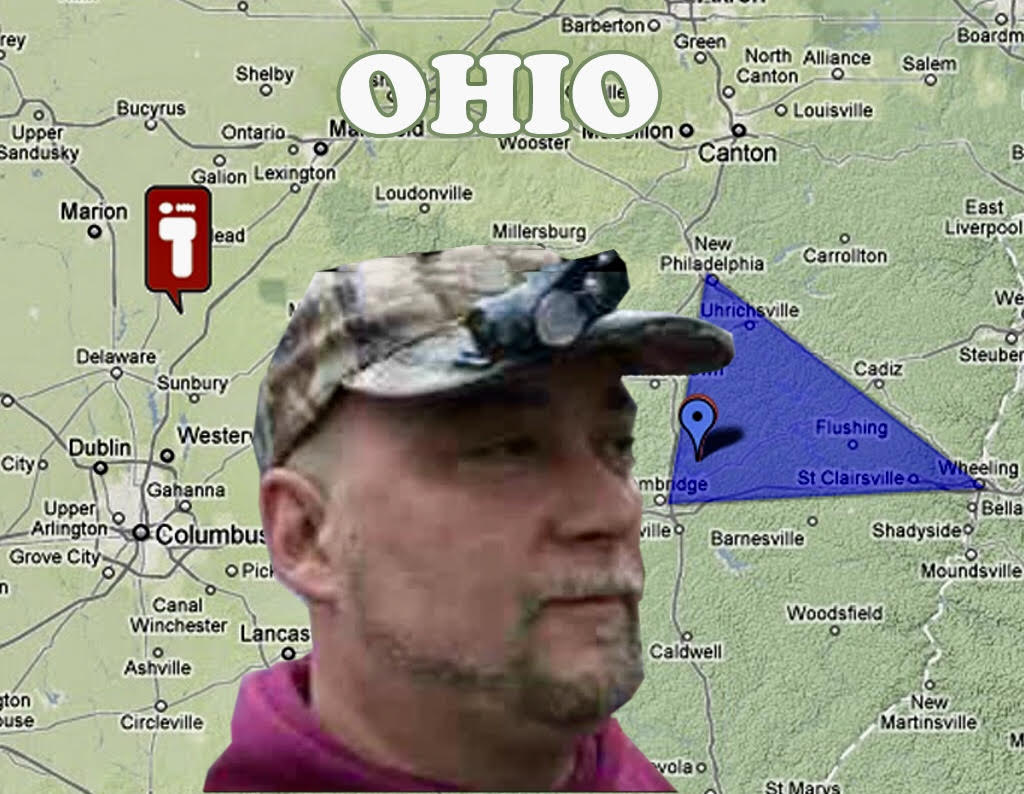
Ten years ago, on June 18, 2008, Don Keating, the head of the Eastern Ohio Bigfoot Investigation Center, appeared on MonsterQuest to detail his investigations of local sightings. The creatures were known as the Ohio Grassman and where they lived was called the Sasquatch Triangle.
The Sasquatch Triangle of Ohio is a well-established research area of Bigfoot sightings, although some investigators may disagree on the exact borders of the "triangle."
As Guy Edwards notes in his Bigfoot Lunch Club, January 28, 2012: "This triangle, including sections of Tuscarawas, Guernsey, Muskingum and Coshocton counties, is home to the most frequent Bigfoot sightings in the state."
Don Keating is generally given credit for coining the word, although you will find internet mention of a "newspaper" having come up with the term in 1987. I find this a misunderstanding of the stories that began to appear about Keating's search groups.
For example, in the following article published on April 19, 1987, in the Dover Times Reporter, Dover, Ohio, the content centers on Don Keating and his associates.
Below, on the right is Donald Keating, who first published in 1987, The Sasquatch Triangle, about this specific area in Ohio. Keating began the concept of large Bigfoot conferences in Newcomerstown, Ohio; they evolved into the Ohio Bigfoot Conference today run by Marc DeWerth.
In 2001, Keating self-published his The Sasquatch Triangle Revisited, a revised edition of his original work.
When Finding Bigfoot broadcast their episode on Sunday, January 29, 2012, about the Sasquatch Triangle and Ohio Grassmen, they focused on local hunter Tim Stover.
In recent years, Don Keating is known and respected in East-Central Ohio, as a television weatherman.
Sometimes you do need a weatherperson to know which way the wind blows...
I first wrote about the “Bridgewater Triangle” in Boston Magazine in 1980, and in my book Mysterious America in 1983. Vincent Gaddis coined the name “Bermuda Triangle” in Argosy, February 1964. There is some thought that Ivan T. Sanderson worked with Gaddis on the concept from the beginning.
Sanderson died February 19, 1973, at 62. Gaddis died February 25, 1997, at 83. Keating and Coleman, needless to say, are still alive and active.
As a slightly renamed documentary, The Bridgewater Triangle will make its national television debut on Saturday, September 5, 2015, at 10:00 PM Eastern Time, on the cable network Destination America. The channel will be airing a condensed broadcast hour (42 minute) cut of the film, with their newly created subtitle, America's Bermuda Triangle. The repeats will exist for years, and the awareness of the Bridgewater Triangle will expand.
The addition of the subtitle to this edited version of the documentary occurred weeks ago, perhaps even months before Wednesday, August 26, 2015's major media eruption of the name "Bridgewater," in conjunction with the first ever, on air, live shooting of two journalists. It was not lost on me that the shooting event happened at the Bridgewater Plaza in Virginia.
Bridgewaters, wherever they are, needless to say, have had a long history of strange happenings and phenomena. In the 1830s, in Bridgewater, Pennsylvania, a small hairy upright hominoid creature was confronted by a man picking berries; the beast ran off when chased. In December 1969, and then again in March-April 1970, near Bridgewater, Massachusetts, in the midst of the future named Bridgewater Triangle, many sightings of a Bigfoot, including by a police officer, took place. In the summer 1976, near Bridgewater, New Jersey, three teens saw a Bigfoot while they were playing in the woods and then found three-toed footprints. On July 27, 2015, a UFO sighting occurred in Bridgewater, New Jersey. There are also reports of a blond ghost around Bridgewater, New Jersey.
Bridgewater - a bridge over a body of water - evokes the challenge of the terrestrial over the aquatic.
America's Bermuda Triangle
Of course, the new subtitle given to the documentary by the cable network did seem relatively silly, when the first announcement was made.
The actual coining of the term "Bermuda Triangle" seems to point to Vincent Gaddis, a Fortean friend of Ivan T. Sanderson. In the February 1964 issue of Argosy, Vincent Gaddis' article "The Deadly Bermuda Triangle" used the phrase widely for the first time. Sanderson wrote the well-known followup article, "The Twelve Devil's Graveyards Around the World," in 1972, for Saga magazine.
The real Bermuda Triangle is partially in America, since Florida makes up the eastern side of that "triangle," so why change the perfectly good name from The Bridgewater Triangle to America's Bermuda Triangle? As it turns out, it was a subtitle and the use of that moniker acknowledges this is a new edit, and not the directors' cut.
Destination America is also referring to what they feel is the better known "Bermuda Triangle" name, although they might be surprised by how many people know about the Bridgewater Triangle, nowadays. Plus, most of the other "Triangles" have been labeled with those names because I began this practice in the 1970s, with the Bridgewater Triangle.
Therefore, since they gave The Bridgewater Triangle the subtitle America's Bermuda Triangle, let's switch this back around a bit and look at...
America's Bridgewater Triangles
#1. Bridgewater Triangle, Massachusetts
The Bridgewater Triangle was coined in the late 1970s (circa 1976) by yours truly, Loren Coleman, who published the phrase for the first time in the April 1980 article of the same name in Boston Magazine, and in the 1983 book, Mysterious America (Faber and Faber, 1983; now in a completely revised 2007 Simon & Schuster edition). A local newspaper published the name "The Bridgewater Triangle" after I gave a library lecture using the phrase in the late 1970s, in the Bridgewater area.
The Bridgewater Triangle is the focus of decades of weird activity (UFO sightings; cattle mutilations; Hell Hound encounters; Black Panther accounts; Giant Snake tales; people disappearances; little creature folklore, plus the 1969-1970s Bigfoot activity, mentioned above) in a 200-square-mile area in southeastern Massachusetts. The Bridgewater Triangle is roughly defined by the towns of Abington in the north, Freetown in the southeast, and Rehoboth in the southwest, an area that encompasses the Hockomock Swamp and the “infamous” Freetown/Fall River State Forest. (See at bottom, for more information on The Bridgewater Triangle.)
#2. The Bennington Triangle, Vermont
The Bennington Triangle was coined by writer Joseph A. Citro in 1992. According to Citro, the area shares characteristics with the Bridgewater Triangle in neighboring Massachusetts, and so he used a similar name.
This Vermont location has many of the same phenomena found in the Bridgewater Triangle. Citro related the disappearances of Middie Rivers (1945), Paula Weldon (1946), James Tedford (1949), Paul Jepson (1950), and Frieda Langer (1950), to the Bennington Triangle.
One of the more bizarre legends associated with this Vermont site is the man-eating stone of Glastonbury Mountain, which made its first appearance in Citro’s book The Vermont Monster Guide (2009). The man-eating stone is exactly what it sounds like…a rock that eats people.
A Wikipedia editor rather harshly noted that "precisely what area is encompassed in this hypothetical 'mystery triangle' is not clear."
But Citro is rather clear about where The Bennington Triangle is. It is centered on Glastenbury Mountain and includes some or most of the area of the towns immediately surrounding it, especially Bennington, Woodford, Shaftsbury, and Somerset. Glastenbury and its neighboring township Somerset were both once moderately thriving logging and industrial towns, but began declining toward the late 19th century and are now essentially ghost towns, unincorporated by an act of the state legislature in 1937.
Update: In response to this article, Joseph Citro shared the following thoughts on August 30, 2015,
Thanks, Loren Coleman. The problem with triangles, I think, is that people expect their boundaries to be rigidly defined -- straight lines and measurable angles. The phrase is simply a metaphor. The lines can undulate, and the angles can open and close. We could as easily and as accurately say, The Burmuda Square, or The Bridgewater Rectangle, but Triangle (i.e. three) has always had stronger metaphysical impact. It is a convenience word, but it surely has taken root in our language.
#3. The Coudersport Triangle, Pennsylvania
Thunderbirds have been seen in northern Pennsylvania, in an area known as the "Coudersport Triangle," which overlaps with the spooky Black Forest of the same location. Most of the Thunderbird sightings come from the Black Forest region of Clinton, Potter, Lycoming, Tioga, Cameron, and McKean counties, sparsely populated areas of mainly state forests and gamelands. Besides the Thunderbirds, tales of Black Panthers are part of the traditions here.
The earliest chronicler of the variously named Coudersport Triangle, Black Forest, or Forbidden Land accounts is the late Pennsylvania writer Robert Lyman, who penned a series of volumes in his Amazing Indeed, Strange Events in the Black Forest booklets. Extending Lyman's work, cryptozoologist and author Mark A. Hall captured more Thunderbird sightings in his chapter on the Pennsylvania accounts in his book, Thunderbirds: America's Living Legends of Giant Birds.
In 2004, I traveled to the Coudersport Triangle, on location for an episode of a Discovery science program for young people on the Coudersport Triangle/Black Forest's Thunderbird reports. Other programs have dealt with the same topic.
The Animal X program on the Black Forest contains eyewitness accounts from the Coudersport Triangle. Then it drifts into showing the "Chief John Huffer" footage from Illinois of what appears to be turkey vultures, but places the Huffer video incorrectly from Pennsylvania.
#4. The Virginia Triangle, Virginia and North Carolina
The Great Dismal Swamp is a marshy wetland that goes from Norfolk, located on the Elizabeth River, through southeastern Virginia's Coast Plain into northeastern North Carolina. It has been known as a miniversion of the Bermuda Triangle, on the level of other states' mystery triangles, like the Coudersport Triangle (linked to the Black Forest) in Pennsylvania or the Bridgewater Triangle (aligned with the Hockomock Swamp) in Massachusetts. Reports of ancient mysteries, as well as sighting of giant snakes and Bigfoot, have been associated with the Great Dismal Swamp.
Lake Drummond, a 3,100-acre lake, is located in the heart of the swamp, and only one of two natural lakes in Virginia. It was discovered in 1655, by former Scottish indentured servant William Drummond. Drummond went on to be governor of North Carolina, and was later hanged in Virginia. Lake Drummond is almost a perfect circle, and some thought has been given to it having been formed by a meteorite, a peat fire, or a tectonic shift. Native American tradition talks of "the Fire Bird" creating the freshwater lake.
#5. The Great Lakes Triangle and Michigan Triangle, Wisconsin, Michigan, Canada
Jay Gourley's book The Great Lakes Triangle first appeared on May 12, 1977. The focus was the disappearance of planes and ships throughout the entire region of the Great Lakes, as shown on the map below. The area was too large for it to be seen as a popular topic for research discussions by the mainstream media.
On the television program In Search Of…, the late Leonard Nimoy narrated the episode entitled "The Great Lakes Triangle," which aired on November 2, 1978.
Author Hugh Cochrane thanks Jay Gourley in his own book, Gateway To Oblivion: The Great Lakes' Bermuda Triangle. And from there, he expands upon the idea that the Great Lakes are host to vile vortices, UFO hotspots, Earth energies, and an entire catalog of unproven phenomena.
The Michigan Triangle, where many planes, ships, and people go missing, stretches from the town of Ludington to Benton Harbor in Michigan; another links from Benton Harbor to Manitowoc, Wisconsin; the final side connects Manitowoc back to Ludington. The Michigan Triangle is an extension but concentration of Jay Gourley's original idea, earlier, of The Great Lakes Triangle.
The Lake Michigan Triangle has been mentioned on Willian Shatner's Weird or What?, it has a place entry on the Atlas Obscura, and the Travel Channel's Mysteries at the Museum reported on it.
#6. The Big Lick Triangle, Indiana and Kentucky
In 2013, a clever blogger named Ben did his homework, and came up with this:
Children, have you ever heard of “The Bridgewater Triangle?”
Go and google it … I’ll wait.
OK, as we all now know, “The Bridgewater Triangle” refers to this vague geographic area in southeast Massachusetts. Weighing in at about 200 square miles, the Bridgewater Triangle is claimed to be a hotbed of paranormal activity — like every X-File you can image: UFOs, ghosts of all kind, Bigfoot, Thunderbirds, cattle mutilation, satanic activity, black helicopters, phantom pumas …
Back in the 1980s, a paranormal researcher was looking at a map and noticed that a lot of his ghost, Bigfeet and flying saucer reports happened in southern Mass, a few hundred miles around a town called Bridgewater. So he got his magic marker / sharpie, drew the rough borders on the map, and BAM! Instant paranormal fame.
Well, since that Fortean researcher was me (Loren Coleman) and I didn't use a magic marker in the 1970s (not the 1980s), I am honored by this cute passage, anyway.
Ben* goes on to notice the strange coincidences of his own area's phenomena - in a rough shape configured with three towns named Lick on each corner. Then he coined the name The Big Lick Triangle.
His body of linking evidence shows he had fun, especially since his area is "roughly 2269.9 square miles of weird" compared to 200 square miles of the Bridgewater Triangle. He surprisingly found much more that was strange in this Triangle that he reckoned for, and he appears to have been overjoyed with his discoveries.
My personal favorite in The Big Lick Triangle - and one that I have mentioned in my books - is the green, 10-foot-tall monster with glowing red eyes, seen in March 1965, by teenagers in the woods south of French Lick, Indiana. It grew to be called “Fluorescent Freddie." Unfortunately, it never became as famous as that other local tall native - Larry Bird.
*Update: "Ben" read this selection and got in contact. He identifies himself as Ben Schneider, and pointed out the fact "The Big Lick Triangle" has a curious name game to note. There is a "Bridgewater" name inside the configured area. It's the Bridgewater Cemetery in Scottsburg, Indiana, a town near the northern border of the Big Lick Triangle. Quoting from Ben's blog, the Bridgewater Cemetery is "haunted by an entity called 'Old Red Eyes.' It is often seen glowing at the back of the cemetery. A black form or object will often circle around cars, and handprints will appear on the windows. A white phantom horse sometimes chases gawkers away at night, and there is also the glowing tombstone of a man who awakens at night and guards the front gate."
Ben's comedic relief is apparent in his creation of this Triangle, but there's no reason to leave it off the list of Triangles, even if we know he's somewhat doing this exercise with his tongue firming in his cheek. He may have been hiding his Fortean wit behind his sarcasm, but the end result was pure satisfaction and enjoyment. And good research.
#7. The Nevada Triangle, Nevada and California
The disappearance of maverick aviator and daredevil entrepreneur Steve Fossett in 2007 brought into focus an area called The Nevada Triangle. Observers have documented more than 2,000 planes having crashed there in the past 60 years, including reports of UFOs and alien abduction, in the area that encompasses Reno, Fresno, China Lake, Las Vegas, and Groom Lake, a/k/a Area 51. Any location with Area 51 appears destined to be an enigmatic area, right?
The Mystery of the Nevada Triangle was a 2010 Channel 4 (UK) production about the location and the disappearance of Steve Fossett. Several news outlets, such as Fox News, reported on The Nevada Triangle in 2010.
#8. The Alaska Triangle, Alaska
The Alaska Triangle is also called Alaska's Devil's Graveyard, because so many ships and airplanes have disappeared there.
Planes go down, hikers go missing and Alaskan residents and tourists seem to vanish into the largely untouched backdrop.
The so-called Alaska Triangle slices through four of the state's regions, from the southeastern wilderness and fjords to the interior tundra and up to the arctic mountain ranges. Its points include the large swath of land from Juneau and Yakutat in the southeast, the Barrow mountain range in the north, and Anchorage in the center of the state.
#9. The Little Egypt Triangle, Illinois
The Southern Triangle of Illinois forms an area also given the name "Little Egypt" or "Egypt." The Triangle forms nicely from the southern third of the state of Illinois. With the area code 618, the southern part of Illinois is geographically, culturally, and economically distinct from the rest of the state. The region is bordered by the most voluminous rivers in the United States: the Wabash and Ohio rivers to the east and south, and the Mississippi River and its connecting Missouri River to the west.
Southern Illinois' most populated city is currently Belleville (see The Bell Name) at 44,478. Other principal cities include Alton, Centralia, Collinsville, Edwardsville, O'Fallon, Harrisburg, Mt. Vernon, Marion, and Carbondale, where the main campus of Southern Illinois University is located. It also has a campus at Edwardsville. Residents travel to amenities in St. Louis and Cape Girardeau, Missouri; Memphis, Tennessee; Evansville, Indiana; and Paducah, Kentucky. The region is also home to a major military installation, Scott Air Force Base.
I completed my undergraduate studies in anthropology/zoology at SIU-C. While there, and often not going to classes, I would investigate many Fortean and cryptozoological wonders in this area, from Black Panthers (Shawnee National Forest) to small red apes (swamps around Mt. Vernon and other towns), large birds (especially in the Alton area) to stone walls (across the Triangle). Several passages in my books, especially in Mysterious America, are about the cases in The Little Egypt Triangle.
The name game is strong in Little Egypt, with Thebes, Karnak, New Memphis, Dongola, and Cairo having lexilinks to ancient Egypt. SIU-C's students attending Little Egypt's leading university read The Daily Egyptian and call their athletic teams "The Salukis" (Egyptian hunting dogs). In nearby states, you find West Memphis and Memphis. Some have related these names to the strong Egyptian influences in the Supreme Council, 33°, Scottish Rite of Freemasonry, Southern Jurisdiction, which had a sway over this area, technically south of the Mason/Dixon Line.
Little Egypt's Fayville (see the Fayette Factor), Illinois, is an unincorporated community in Alexander County, Illinois, located along the Mississippi River south of Thebes.
#10. The Ossipee Triangle, New Hampshire
First appearing in print as "The Ossipee Triangle" in Info Journal, Vol 12-13, 1987, the label was inspired by The Bridgewater Triangle. The name was coined by investigator Ken Moak. The Ossipee Triangle includes most of Carrol County in eastern New Hampshire, and at the center is Ossipee Lake. The Ossipee Triangle is the home of Mystery Pond (now called Snake Pond), UFOs, Indian mounds, ghost stories, disappearances of boats and planes, and other oddities.
The map was created by the Mandate Interstate 93 (see below) folks, and they note The Ossipee Triangle "would include Mounts Shaw, Sentinel, Cannon, and Lafayette. Mystery Hill and Lake Winnipesaukee." The latter lake syncs with the fictional site of the movie, What About Bob? and the Bridgewater Plaza shootings.
+++
The following (slightly revised) press release on The Bridgewater Triangle: America's Bermuda Triangle is from Bristol County Media.
Triangle Documentary to See National Audience
In October of 2013, The Bridgewater Triangle documentary premiered to a sell-out crowd of over 750 people at the University of Massachusetts Dartmouth. One year later, the exclusive US broadcast rights to the film were licensed to Discovery Communications’ Destination America network. The channel will air a 42-minute (broadcast hour) version of the documentary under the title, The Bridgewater Triangle: America’s Bermuda Triangle, a name which they hope will help to draw-in a broader national audience. The film will broadcast on Saturday, September 5th at 10:00 PM Eastern Time. Viewers are encouraged to check with their local cable and satellite providers for availability and channel number. To celebrate the occasion, a free viewing party will be held that same night at Christopher’s Lounge at 1285 Broadway in Raynham, Massachusetts. The event is open to the public and will begin at 8:00 PM with a screening of the original 90-minute directors’ cut of The Bridgewater Triangle. At 10:00 PM, Christopher’s many televisions will be tuned in to Destination America as The Bridgewater Triangle (airing as The Bridgewater Triangle: America’s Bermuda Triangle) makes its debut on national television. A number of the film’s cast and crew members will be present at the event.
First named and defined, in 1978, by world-renown cryptozoologist and author Loren Coleman, the 200-square-mile Bridgewater Triangle sits within the Southeastern portion of Massachusetts, and includes a number of locations known for unexplained occurrences; the most prominent of which include the legendary Hockomock Swamp and the infamous Freetown-Fall River State Forest. The triangle’s traditional boarders are revealed by connecting the dots between the town of Abington to the North, the town of Freetown to the Southeast, and the town of Rehoboth to the Southwest. The area hosts an unusually high volume of reports involving strange happenings, baffling mysteries and sinister deeds. From ghostly hauntings and cryptid animal sightings, to UFO encounters and evidence of satanic ritual sacrifice, the Bridgewater Triangle serves as one of the world’s most diverse hotspots for paranormal activity. The first-ever feature-length documentary on the subject, The Bridgewater Triangle explores the history of this fascinating region. The film features a number of local residents providing first-hand accounts of unexplained occurrences. In addition, an all-star assembly of paranormal researchers, folklorists and authors provide expert analysis regarding the many mysteries of the triangle. Among the film’s on-screen personalities are Loren Coleman, and Ghost Adventures writer and author Jeff Belanger.
During its twenty-two month long run, the independently produced documentary, which was filmed entirely in Massachusetts, has been featured on the nationally-syndicated Coast to Coast AM radio show, on WCVB’s Chronicle, on Fox 25’s Zip Trips, and in a segment on WJAR in Providence. The film has also been covered in a number of publications including the nationally-distributed Rue Morgue magazine and the Boston Globe. On the festival circuit, the documentary received the Audience Award at the 2014 Terror Con Film Festival, in Providence, won Best Documentary at the Winter 2015 Macabre Faire Film Festival on Long Island, New York, and won Best Local at the 2015 Granite State Film Festival, in Manchester, New Hampshire. Reviews of the movie have been positive, including eight favorable write-ups from independent critics, and an 8.0 out of 10 stars rating on the Internet Movie Database. In late 2014, The Bridgewater Triangle became available on UltraFlix, NanoTech Entertainment’s 4k movie streaming service.
The film’s producers hope that a successful run on Destination America will lead to additional opportunities, including a chance to be shown on Discovery Communications’ flagship network, the Discovery Channel, and the possibility of generating an international interest in The Bridgewater Triangle with overseas broadcast and distribution deals. The producers will also retain the film’s exclusive Blu-ray, DVD and Internet On-Demand distribution rights, and the original 90-minute feature will remain available through their website.
This early 2000s map of the Bridgewater Triangle was created for a Boston Globe article about the area, and gave a decidedly more humanlike than cryptozoological slant to the traditions.
+++
Do you know of more "Bridgewater Triangles" in America? If so, let me know (here).
Enjoy....
and purchase Mysterious Americato read more about the Bridgewater Triangle.
This year, 2015, is the 40th anniversary of the publishing of my first book (with Jerome Clark). The Unidentified appeared in 1975, from Warner Books. It was republished in combination with its 1978 sister book, Creatures of the Outer Edge, in 2006; see here.
Down through the years, there are over a 100 books that I have contributed to (through introductions, prefaces, forewords), authored, coauthored, and/or edited. That's a good number of books to have seen published, released, reprinted, and revised in old and new editions with your name attached to them.
Seeing that sentence, you probably don't believe it when I say that authors never really ever get rich. Oh, okay, maybe one percent do, if they write 50 Shades of whatever, but most of us are poor and using free sites like blogger to keep writing, waiting to pull things together for our next book. But there is a truth to the fact that the more books you have out there, the less "original" your next publisher thinks you are. That is especially if you specialize in the nonfiction field of unexplained natural and human mysteries, it seems.
Let's look at one truth of what happens to an established writer like myself.
So much has been recycled on the web by others from my books, articles and blogs, today publishers think I'm "borrowing" from others' work when a search of the contents of a new manuscript shows up seemingly similar sections via an online search. This is a troubling trend for authors, of course.
The reality is you can find anything and everything on the net, and everyone seems to use your stuff, as they please, without original attributions.
But it is nothing new. It use to be done by the hard work of collecting all the works on one topic, and extracting what worked for your next "masterpiece." What's new, of course, is that "Google," "Yahoo," and other forms of online searching are available Internet wide of a vast body of written material. There is even a term for this acquiring of material from others and its use by Forteans in books about "Fortean phenomena" or "Forteana."
It's called the "Bermuda Triangle Syndrome."
Photo credit: Fortean Picture Library.
Author Dave Goudsward, in an article he wrote in 1978, coined this practice the "Bermuda Triangle Syndrome," after Berlitz's reuse of the same stories in his various books. This was because intermediate authors had "borrowed" and modified Berlitz's own material to the point where Berlitz himself didn't recognize it when he went looking to "borrow" material.
In academia, such borrowing occurs all the time, as in scholarly citing of others' work and the revision and inclusion of the material in new writings. In the world of popular literature, it is often done, but more casually and with an understanding it happens often between colleagues in, for example, the Fortean field.
Basically, what Goudsward did in his examination was to put all the "Bermuda Triangle" books in publication order and then he traced the evolution of various snippets and stories about various ships and aircraft used, from title to title. He ended up with one of Berlitz's later books with a story unrecognizable from the original. As Goudsward pointed out in his analysis, Richard Winer was probably the most successful of the revisionists, but, of course, Berlitz was too, even of his own work.
While Charles Berlitz would become the most famous, and by extension, make the most money from his books on the topic, the actual coining of the term "Bermuda Triangle" seems to point to Vincent Gaddis, a Fortean friend of Ivan T. Sanderson. In the February 1964 issue of Argosy, Vincent Gaddis' article "The Deadly Bermuda Triangle" used the phrase widely for the first time.
Most of us try to be very careful about the incorrect of use of our old material, especially as seen through the eyes of ours. But then, sometimes it has evolved so far from your own writings, if you try to quote or paraphrase your own investigated case to give it new clothing, via another source, you probably will be accused of inappropriately using a turn of a phase from someone else, when ultimately, it might have been yours in the first place.
What a world.
++++++++++++++++++
Please support my work by simply clicking on the following button to give $5, $10, $50, $100, $1000, or a couple bucks, whatever you can send. I'm a starving writer. Thank you.
The search for missing Flight 370 is now focused on the Vile Vortex Ivan Sanderson pinpointed in the southern Indian Ocean.
Did you know there is a southern form of the Bermuda Triangle?
One of the most popular posting I've written for this Twilight Language blog (with over 12,000 readers as of today) is "Terrorism, Aliens, Vile Vortices: The Mysteries of Missing Flight 370," published on March 9, 2014. Today, I want to explore more deeply aspects of that essay.
Why "No Little Green Men"?
Speaking about his thoughts on the vanished Malaysia Airlines Flight 370, John Goglia, independent air safety consultant and a former NTSB board member, spoke freely on CNN on March 13, 2014. He said, "The only thing we know for sure is that little green men didn't come down and take it."
So, I must ask, how does anyone know this?
John Goglia (above) served as a member of the U.S. National Transportation Safety Board (NTSB). With more than 30 years experience in the aviation industry, he was the first NTSB Board Member to hold an FAA aircraft mechanic's certificate.
The mystery of Flight 370 continues to evolve. The strange Chinese satellite photo of three objects east of the location of where the transponder was turned off is now said to have been a "mistake." New information from the USA government, has led now to the possibility of opening a new search area in the Indian Ocean for the missing Malaysia Airlines plane, White House spokesman Jay Carney said on March 13th. Many countries are partnering in the search and "following leads where we find them," he said.
The area has continued to expand to now include the Indian Ocean.
Certainly, the cause of this disappeared flight is probably due to terrorism, bad weather, catastrophic structural failure, pilot suicide, engine failures, being shoot down, an internal bomb, a hijacking gone wrong, or something else rather terribly mundane in our modern era. Little green men, ufos, and vile vortices? How silly, right?
However, logic dictates that there is no reason to take anything off the table, from twilight dimensions to an area of known missing ships and planes. Lists of aerial disappearances are being scanned and stories like the 1937 Amelia Earhart disappearance are being dusted off, by television news programmers, to decide what ones should be highlighted. For example, on March 13, CNN News will be broadcasting a special on the History of Missing Planes at 10 PM Eastern. Clearly, this mystery has captured the public's interest, and historically fits into a well-studied Fortean field.
The entire popularization of "triangles of vanishings," is to be credited to Fortean writer Vincent Gaddis, who put the Bermuda triangle "on the map" in a February 1964 Argosy feature, which he said extended Florida to Bermuda, southwest to Puerto Rico and back to Florida through the Bahamas. In 1965, Gaddis' book, Invisible Horizons, furthered his thesis with more accounts of disappearances.
One of the most popularly known Bermuda Triangle stories is of the disappearance of Flight 19, consisting of five TBM Avenger torpedo bombers that disappeared on December 5, 1945, while over the Atlantic.
Gaddis' friend Ivan T. Sanderson was behind the scenes in the conceptualization and came up with his own theories about a worldwide grid of such locations he called "Vile Vortices." Indeed, I appeared, in 2006, on the History' Channel's UFO Files' episode "Pacific's Bermuda Triangle," talking of my knowledge of Sanderson's interest in the subject.
Another Vile Vortex is called "The Devil's Sea" or "Dragon's Triangle" or "Ma-no Umi"
off Japan, in an area that extends as a triangle between Japan and the Islands of Bonin, including a major portion of the Philippine Sea.
One of the most celebrated stories of Dragon's Triangle missing ships is that of USS Cyclops which disappeared in March of 1918. Few realize that the various theories as to why the Cyclops went down lead to the famed novel and resulting movie, The Poseidon Adventure (1972).
Is there a Vile Vortex in the most recent direction that Flight 360 is said to have been flying?
Yes, one of Sanderon's Vile Vortices is in the Indian Ocean, where some planes and more have vanished.
The following ships may have disappeared in the Indian Ocean:
København 1928-1929 somewhere between Buenos Aires and Australia Madagascar 1853 somewhere between Port Phillip and London Neva 1887 somewhere between Banyuwangi and Lisbon Shannon 1885 somewhere between London and Calcutta Burmah 1859/60 somewhere between London and New Zealand HMS Stonehenge 1944 somewhere in Bay of Bengal or Andaman Sea
Some of the planes include...
During World War II, on July 7-9, 1943, a famed Japanese aviator and explorer Kenji Tsukagoshi flying a prototype Tsukagoshi Ki-77, from Singapore to Sarabus (now Hvardiiske, Crimea) to over the Indian Ocean, was lost with a crew of 5 and 3 Imperial Japanese Army passengers.
On March 25, 1986, K2729, an Afghan Air Force cargo plane, an Antonov An-32 flight, disappeared over the Indian Ocean, 450km off Jamnagar, India. It was operated by the Indian Air Force.
Not missing, but a mystery, in 2004, a Beechcraft 200 Super King Air left Perth, Australia, on a 600 kilometre journey and eventually flew 2,840 kilometres before crashing in Queensland.
Will the mystery of Flight 360 ever be solved or join the annals of other Fortean mysteries?
Credit sources: Wikipedia, the books of Vincent Gaddis and Ivan T. Sanderson, my files, and online maps.