Saturday, February 07, 2009

De Gelder's Divine Dove

Early this morning in England, Robert Rickard, the founder and former editor of Fortean Times, tossed and turned. He struggled to wake up and get warm. He drifted in and out of sleep, and then, he later told me, something "popped into" his mind.

He got up and wrote me:

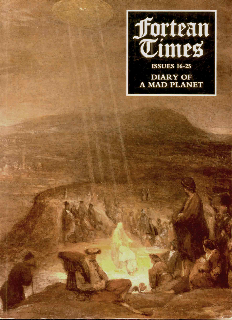
"For some strange reason I woke up with a UFO link to the Dendermonde case. On the cover of the FT compilation Diary of a Mad Planet (FT issues 16-25), we featured a painting of what looks like a UFO hovering over a crowd surrounding St John baptising Jesus. The UFO is in fact a Divine Dove with an elliptical halo, but four beams of light shine down from it onto the scene below. The painting is by Aert de Gelder."

The cover of the compilation is shown here:


The "Dendermonde case" is code for the event involving the daycare nursery killer, Kim de Gelder, the Dendermonde Joker. (I've web logged several recent entries about the subject, for example, here, here, here, here, and here.)

Rickard pointed out to me that the image is now seen throughout the Internet, often in relationship to it being "ancient proof" for UFOs. I notice, for example, that the image is sometimes flipped, incorrectly (see below), thus changing its symbolism.
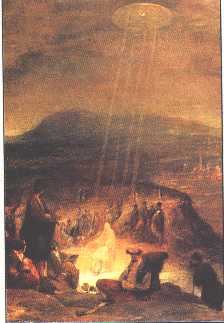


Rickard further shared that FT had permission, in 1991, from the owner, Fitzwilliam Museum, Cambridge, to use it. He wasn't so sure that today all the sites showing it have the Fitzwilliam's permission.

The painting is The Baptism of Christ, c. 1710, by Aert de Gelder (1645-1727), which was given to the Fitzwilliam Museum by Lord Alwym Compton, Bishop of Ely, in 1905. Apparently the previous owner, Marianne, the Countess of Alford, had bequeathed it to the donor in 1888. It is oil on canvas, 48.3 x 37.1 cm.

Aert de Gelder (Oct 26, 1645, Dordrecht – Aug 27, 1727, Dordrecht) was one of Rembrandt’s last pupils while in Amsterdam, studying in his studio from 1661 to 1663. The general consensus is that de Gelder was not only one of the most talented of Rembrandt’s pupils, but also one of his most devoted followers, for he was the only Dutch artist to paint in the tradition of Rembrandt's late style, into the 18th century.

The subject of de Gelder's painting, John the Baptist died around 30 A.D. The prophet is most remembered having headed a baptism movement at the Jordan River in expectation of a divine apocalypse that would restore occupied Israel. Christians, Jews, and Muslims regard John as a prophet, as do Bahá'ís and Mandaeans.

The painting that flashed into Rickard's mind this morning depicts John's baptism of Jesus in the River Jordan. The dove overhead in de Gelder's painting is the disputed UFO/dove.

Christian scholars and writers for hundreds of years have used the dove as a symbol of the Holy Spirit. This symbolism was inspired by the Bibical account of Christ's baptism (Luke 3, 21-22). The dove, as a symbol of the Holy Spirit, may be seen in churches, on priestly vestments, on altars, tabernacles, sacred utensils, and in many religious paintings.

June 24th & Beheadings

Needless to say, among Forteans, the feast day of John the Baptist's birth (June 24) is a major milestone in anomalistic history. The Knights Templars displayed the “Mysterious Head” at Poitiers on June 24, 1308. The "modern age of flying saucers" began on June 24th, 1947. I and many others have written much about St. John's Day, June 24th. (See a list of anomalistic events associated with this date, here.)

The overlapping decapitation symbolism to various events such as the recent VA Tech beheading can be rather directly viewed, via metaphor, in the beheading of John the Baptist, a significant event that is often also painted.

The biblical account portrays the beheading of Saint John the Baptist by Herod Antipas. On Herod's birthday, Herodias' daughter (traditionally named Salome) danced before the king and his guests. Her dancing pleased Herod so much that in his altered state of consciousness he promised to give her anything she desired, up to half of his kingdom. When the daughter asked her mother what she should request, she was told to ask for the head of John the Baptist on a platter. Although Herod was appalled by the request, he reluctantly agreed and had John executed in the prison.
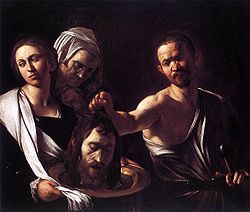

Salome With the Head of John the Baptist (London), by Caravaggio, c. 1607.

The beheading date is generally given as August 29th. The Roman Catholic Church celebrates the feast on August 29 as the "Martyrdom of St. John the Baptist" in the ordinary form and as "The Beheading of Saint John the Baptist" in the extraordinary form, or traditional Latin Mass. The Church of England and many other national provinces of the Anglican Communion celebrate the feast on August 29. In the Church of England, the day is referred to as "The Beheading of John the Baptist."

The Divine Dove

Aert de Gelder's "Divine Dove" is a frequent motif in religious paintings, and is, as noted, an earthly representation of the "Holy Spirit."



In this painting, The Descent of the Holy Ghost, the disk form is similar to what is shown in de Gelder's art.

Sometimes, however, the Divine Dove is shown as part of the Trinity of Signs.



Fridolin Leiber (1853–1912) painted an example in his The Holy Trinity. Note that the iconography of "triplets" may not be accepted by all modern Christian groups. (The Holy Trinity is more usually depicted with God the Father as an elder, God the Son as Jesus Christ, and the Holy Spirit as a Divine Dove.) The persons of the trinity are identified by symbols on their chests: The Son has a lamb (agnus dei), the Father an Eye of Providence, and the Spirit a dove.

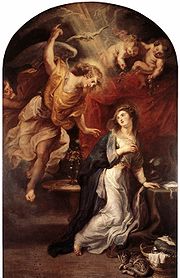
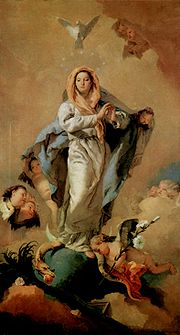
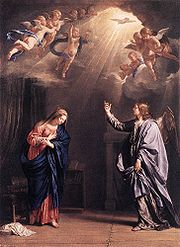
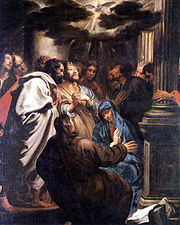
But in general, the "Holy Spirit" as a dove is painted above the religious figures in the scene, as can be viewed in the following several examples (which may be identified and keyed from this reference, "Holy Spirit").






Doves, UFOs and Loch Ness

One could say that metaphoric UFO landings were re-enacted routinely within religious settings.

In medieval times the figure of a dove was widely used to enact in a dramatic way the descent of the Holy Spirit on Pentecost Sunday. When the priest had arrived at the sequence, he sang the first words in a loud and solemn voice: 'Veni Sancte Spiritus' (Come, Holy Ghost). Immediately there arose in the church a sound 'as of a violent wind blowing' (Acts 2, 2). This noise was produced in some countries, like France, by the blowing of trumpets; in others by the choirboys, who hissed, hummed, pressed windbags, and rattled the benches. All eyes turned toward the ceiling of the church where from an opening called the 'Holy Ghost Hole' there appeared a disc the size of a cart wheel, which slowly descended in horizontal position, swinging in ever-widening circles. Upon a blue background, broken by bundles of golden rays, it bore on its underside the figure of a white dove. Source


I want to note that the Loch Ness Monster can be added into this mix too.

The "dove" is found in a fairly common word and its many forms: Columba, Columbia (!), Columbine (!).
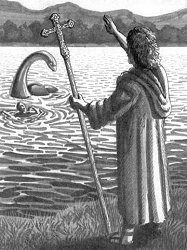

St. Columba, a warrior saint, has become the living "dove," for in Old Irish, he is known as Colum Cille (meaning "Dove of the Church"). It is said Clan Robertson are heirs of Columba, and to some extent, Clan MacKinnon too.
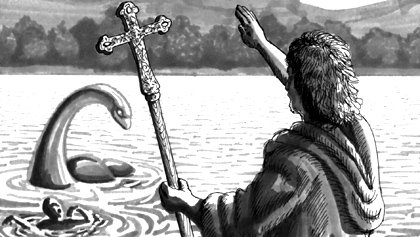
Art by Bill Rebsamen.


On August 22, in 565 AD, St. Columba came across a group of Picts who were burying a man killed by a monster that today is linked to the Loch Ness Monster. St. Columba supposedly brought the man back to life. In another version, he is said to have saved the man while the man was being attacked, driving away the monster with the sign of the cross.


Several St. Columbas have been recorded, all having been beheaded.

St. Columba of Sens suffered towards the end of the third century, probably under the Emperor Aurelian. She is said to have been beheaded in 273, near a fountain called d'Azon; and the tradition is that her body was left by her murderers on the ground, until it was buried by a man called Aubertus, in thanksgiving for his restoration to sight on his invoking her.

St. Columba the Virgin is a female saint with dedications in Cornwall and other Celtic regions. She probably lived in the 6th century. She became a Christian when the Holy Ghost appeared to her in the form of a dove. The Latin word for dove is 'columba'. She was beheaded by a pagan prince she refused to marry.

The Celtic saints of St. Columba of France and St. Columba of Spain have similar legends in that they were all maidens who were pursued and killed by pagans. All suffer decapitation where springs or wells then miraculously gushed forth from the spot, as was said to have happened with St Columba the Virgin too.

St. Columba of Cordova was a Spanish nun who was martyred by being beheaded by the Moors, at the monastery of Tabanos in 853.

St. Columba Kim Hyo-im (1813-1839) was a native of Pam-som, Korea. As the persecution of Korea’s Catholics continued, Columba and her younger sister (Saint) Agnes were brought before a pagan police commissioner. Upon refusing to apostatize, Columba was tortured in various ways. Only about five days after this ordeal, her wounds inexplicably healed so completely that her captors attributed the apparent miracle to an evil spirit. On September 26, Columba was beheaded for her faith, three and a half weeks after her sister Agnes had suffered the same fate.

^ ^ ^

"On the instant when a picture of the dove, or even the shadow of the suspended bird, was pierced by a sword, the dove itself was beheaded, although it had not been disturbed....This experiment, called 'Theophrastus Paracelsus,' recalls an old superstition, namely, that evil can be wrought by a spoken incantation." - The Old and The New Magic by Henry Ridgely Evans

Friday, February 06, 2009

Suicidal Dwarfs, Jokers And All That

A subtle pivotal point in the case unfolding in Dendermonde hit me soon after the authorities had searched through the little old Flemish streets and then took Kim de Gelder into custody. The revelation, not too surprisingly, came to me that the entire scenario had literally unfolded like a film.


The events of the Joker killer who came calling at the "Fabeltjesland" (fairyland) crèche (daycare) took a twist into the phantasmagoria between reality and cinema at one specific temporal spot in the news.

Perhaps you caught it too?

The police arrested the assumed killer, who worn makeup like Heath Ledger's Joker from The Dark Knight (Gelder = Ledger). Then they placed him in custody in Bruges.

What? A joker kills kids in a daycare nursery named "Fabeltjesland" and the authorities take the supposed baby killer to the "fairytale-like" city of Bruges.


My stream-of-consciousness flowed roaring along much like the rumblings heard in the River Dender. Hairy waters, indeed.

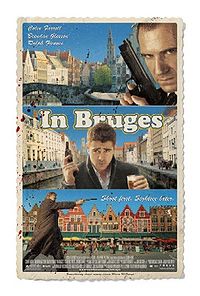
The 2008 movie In Bruges served as a flashpoint, instantly, for me. I had to re-visit this cinematic masterpiece.


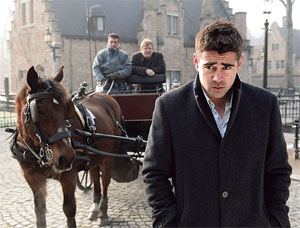
The film stars Colin Farrell (as Ray), and he won the 2008 Golden Globe Award for Best Actor in a Musical or Comedy for his role. Brendan Gleeson, who was also nominated, is Farrell's hitman partner (as Ken) in hiding, with Ralph Fiennes (Harry Waters, yes, pay attention throughout this film) as their mobster boss.

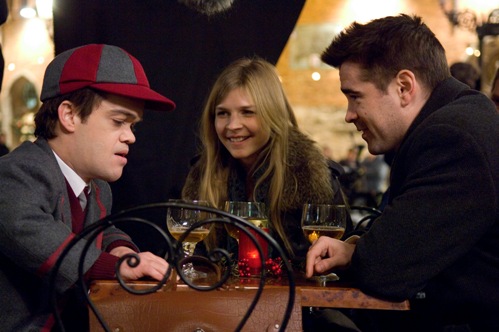
Ray's quick girlfriend, Chloë (Claacémence Poaacésy) and the little person movie-within-the-movie actor, Jimmy (Jordan Prentice), are important too. The film takes place, needless to say, within the Belgian city of Bruges, which is perhaps the film's other most significant character.

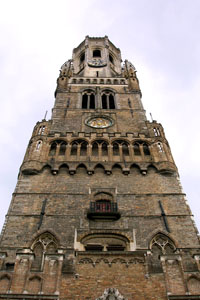
Belfry, the belltower (!), in Bruges.

For anyone who has watched In Bruges, in depth, you will appreciate the various levels that screenwriter Martin McDonagh has embedded into this film. He both wrote and directed it, so he seems to have known what he wanted us to see. I think there's even more there too. Obviously, the man is a genius, which has already been proven from his plays. For filmgoers and critics, his full-length movie screenwriting and directing debut may be appreciated more and more, with each repeated viewing.


But before I mention some symbolic items of note within In Bruges, let me bring your attention to the film's biographical overlap with Heath Ledger. The film's acclaimed Anglo-Irish playwright Martin McDonagh is the brother of John Michael McDonagh. The two lads use to have writing contests of their own making.

Paul Byrnes' powerful Australian review of In Bruges shares biographical insights.

"Martin McDonagh is living proof of the power of Australian television soaps. That is what he watched every day during the year of intense writing that produced his first six plays," writes Byrnes in The Sydney Morning Herald.

One can reflect with wonder on parts of people's biographies.

Byrnes continues: "McDonagh is the London-born son of Irish parents. They went back to the west of Ireland when he was 16 (about 1986). He and his brother stayed in London, visiting their parents during the summers. In London the two brothers lived mostly on the dole, challenging each other to writing competitions. They would watch Australian soaps in the morning, then go to separate rooms to write for the rest of the day."

What resulted was rather remarkable. Martin produced two trilogies: the Leenane trilogy, and the Aran Islands trilogy. His brother, John Michael McDonagh, today, we know, adapted Robert Drewe's book for the later film version of Ned Kelly.

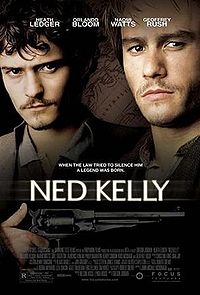
Ned Kelly is an Australian film directed by Gregor Jordan. The movie portrays the life of Ned Kelly who was a well-known bushranger in Australia, and is mainly based on Robert Drewe’s book Our Sunshine.

And who starred as Ned Kelly in that film? The poster tells the story, doesn't it? Or your memory of that film may? The answer is Heath Ledger. There, in one short leap we are back to Ledger, and the whole continuing synchrometaphor that is In Bruges.


More from Byrnes: "McDonagh is a huge fan of Nic Roeg's classic 1973 film Don't Look Now, which was set in Venice. That film was about a couple grieving after the death of a child; in a strange kind of way, that's also the subject of In Bruges."

(Colin Farrell's been "here" before, so to speak. The Irish feature film Intermission, starring Colm Meaney and Colin Farrell, references Don't Look Now's chase of a small figure in a red coat several times in that film.)

In Bruges's homage to Don't Look Now is a thread in the film in various ways, like the hints, now and then, of a child jumping in the square, dressed in red, or in the movie's final chase scene among the canals, old buildings, and such. McDonagh even writes it into the dialogue.

There's a scene when Ray is meeting Chloë, for the first time. Chloë says the Belgian film that is shooting there is like "Nic Roeg's Don't Look Now."

The film-within-a-film is said to have dream sequences, and the costumed fairies, trolls, and all are shown. Jimmy is one of the characters being filmed in that Don't Look Now-like motion picture or "Euro-trash," as his character calls it. (For recent links I've made between The Wicker Man and Don't Look Now, click here.)

McDonagh is hiding most all of this in plain sight.

And here, now, sitting literally, in Bruges today is Kim de Gelder, admitted killer of children in a fairyland daycare in Belgium.

In Bruges has a scene showing the two lead characters visiting an art museum. Byrnes comments on this, as has a lot of movie critics. "The second primary influence is a painting - The Last Judgement by Hieronymus Bosch. The two men look at it in a museum, musing on the meaning of hell and purgatory," notes Byrnes.

But does anyone notice what painting the film shows right before The Last Judgement at the Groeninge Museum? It is one with the vivid scenes of at least two decapitations. Kim de Gelder's killing of a boy and a girl, plus their caregiver, in Dendermonde was proceeded, in reality, by the decapitation at Virginia Tech. The Commonwealth of Virginia beheading also served as a harmonic link to the last wave of killings that occurred in the fall of 2006 at Dawson College (by Kimveer Gill) and the Amish school (among others), seemingly ending in the spring of 2007 at VA Tech.

In Bruges, at its core, it is about the killing of the "little boy," a phrase often stated that serves as a sort of framing around the entire tale. Reality and fantasy, the news and movie fiction, merge back and forth with In Bruges. And sitting in Bruges was Kim de Gelder after the fairytale daycare killings.

Ken: [looking at a surreal Bosch painting] It's Judgment Day, you know?
Ray: No. What's that then?
Ken: Well, it's, you know, the final day on Earth, when mankind will be judged for the crimes they've committed and that.
Ray: Oh. And see who gets into heaven and who gets into hell and all that.
Ken: Yeah. And what's the other place?
Ray: Purgatory.
Ken: Purgatory... what's that?
Ray: Purgatory's kind of like the in-betweeny one. You weren't really shit, but you weren't all that great either. Like Tottenham.
[pause]
Ray: Do you believe in all that stuff, Ken?
Ken: About Tottenham?

What about Tottenham?

The down and out north London location may be a sort of Purgatory to folks there, and certainly in history it is known for a notable mirror of this movie.

The Tottenham Outrage was the name given to an armed robbery and double murder in Tottenham, north London on January 23, 1909. Two Latvian anarchists, both armed with pistols, stole the wages as they were being delivered to Schnurmann's Rubber Company on Chestnut Road, almost literally across the street from the Tottenham Police Station.

In their attempts to get away the two robbers, Paul Hefeld and Jacob Lepidus (or Lapidus), started a chase and shooting spree that resulted in two deaths, police officer William Tyler and a 10-year-old boy named Ralph Joscelyne.

The robbers fired more than 400 bullets as they were being pursued along a river bank, through a marshy area, and among old buildings. When they were cornered, they turned the guns on themselves, dying by suicide.

The "Outrage," whether Martin McDonagh knew it or not, sounds an awfully lot like In Bruges. Finally, in a moment of one can start a circle, beginning anyway, the Tottenham Outrage events were commemorated long ago in a silent film.

Clearly, McDonagh knows and loves film.

In Bruges, Farrell's character is out of the hotel room, and Gleeson's Ken is watching a small television, that is playing Touch of Evil (1958). (The civil rights classic was written, directed and co-starred Orson Welles.) What is shown is the famed three-minute long continuous opening take at the beginning of Touch of Evil, where a bomb is placed in a car. During this In Bruges scene, Harry (Ralph Fiennes) has a long conversation with Ken (Brendan Gleeson) about the fairytale that is Bruges, murders, and suicides. Surreal.

The film travels into darkness and back in the fairyland and the so-called "shithole" of Bruges, depending on your point of view. Murder, yes, is there, but more subtly and yet overtly is suicide.

The use of "little people" in the dialogue and in character in the movie is brilliantly strategic, actually. This basically turns on a copycat effect/suicide cluster discussion that Ray seems to be having mostly as an internal dialogue, which he externalizes with Jimmy and Chloë.
===
Ray: A lot of midgets tend to kill themselves. A disproportionate amount, actually. Hervé Villechaize off of "Fantasy Island." I think somebody from the Time Bandits did. I suppose they must get really sad about like... being really little and that... people looking at them, laughing at them, calling them names. You know, "short arse". There's another famous midget. I miss him but I can't remember. It's not the R2D2 man; no, he's still going. I hope your midget doesn't kill himself. Your dream sequence will be fucked.

Chloë: He doesn't like being called a midget. He prefers dwarf.

Ray: This is exactly my point! People going around calling you a midget when you want to be called a dwarf. Of course you're going to blow your head off.
===
Ray is talking of a certain level of reality here, at least in terms of the elementary facts, but not in terms of the motivations, perhaps, which may have more to do with his own projections.


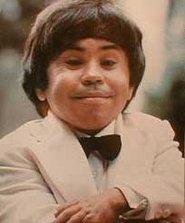
Hervé Jean-Pierre Villechaize (April 23, 1943 - September 4, 1993; pictured above) was a French actor who achieved worldwide recognition for his role as Mr. Roarke’s assistant, Tattoo, in the television series "Fantasy Island" (1978 - 1984). He was also well known for playing the evil henchman Nick Nack in the James Bond film The Man with the Golden Gun.

In the early morning hours of September 4, 1993, Hervé shot himself at his home in the Los Angeles area, and died later that day as a result of his injuries.

Is there a little person actor in Time Bandits who has died by suicide, as Ray mentions? Yes, actually, there is.

Time Bandits is a 1981 fantasy film, produced and directed by Terry Gilliam. It starred several little people or dwarfs.


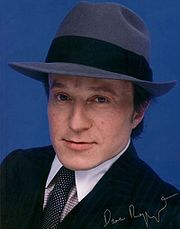
David Rappaport (above) played "Randall" in Time Bandits. David Stephen Rappaport (November 23, 1951 – May 2, 1990) was an English actor, one of the better known dwarf actors in television and film. At one point in his life, he became a resident of the squatter “nation” of Frestonia, acting as Foreign Minister under the name David Rappaport-Bramley - all inhabitants adopted the surname "Bramley," so in case the Greater London Council were to succeed in an eviction, they would have to rehouse them as one family.

On May 2, 1990, Rappaport died by suicide, shooting himself in the chest at a park in the San Fernando Valley, California, with a .38 calibre revolver he had bought 15 days earlier. His body was returned to the UK, and he was buried in a Jewish cemetery in Waltham Abbey, Essex.

Just before his death, he had been cast and began filming for the role of Kivas Fajo in the "Star Trek: The Next Generation" episode “The Most Toys.” Scenes he had completed were later discarded, when actor Saul Rubinek was hurriedly brought in by producers to replace Rappaport and complete the episode. Rappaport’s death and the accident which left Jack Purvis, his co-star, a quadriplegic were the main reasons why Terry Gilliam decided to shelve the intended sequel to Time Bandits, as their characters were two of the most heavily featured in the film.


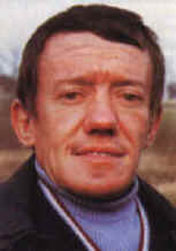
Ray, during his dwarf suicide monologue In Bruges, mentions the actor who played R2-D2, as still being around. Indeed, Kenneth "Kenny" Baker (born August 24, 1934; above) is still alive. The British dwarf actor and occasional musician, known as the "man inside R2-D2" in the popular Star Wars film series, was also in Time Bandits.

A third suicide victim is alluded to, but the person's name can't be remembered by Ray.

Perhaps this was a play on "never forget the 5th of December," the date the third dwarf killed himself?


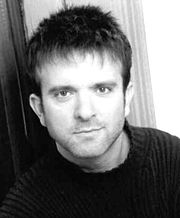
Michael Gilden (above) was an American actor (with dwarfism) born September 22, 1962, in Los Angeles, California, who died on December 5th, in Los Angeles, California.

Gilden, a familiar face in recent years, performed in a variety of television series and film including, “NCIS,” “Charmed,” “CSI: Crime Scene Investigation,” “Family Law,” “Cybill,” as well as a role as an Ewok in the film Star Wars Episode VI: Return of the Jedi. In Pulp Fiction, Gilden played the Phillip Morris Page at Jack Rabbit Slims.

Besides being an actor, Gilden was also a stock broker.

He married the now-famous short-stature actress Meredith Eaton ("Family Law," "Boston Legal") on May 20, 2001. He had a previous marriage to a woman named Elena Fondacaro, Verne Troyer's manager. Gilden and Eaton remained together until his death in a suicide by hanging (credit: Emps) at his Los Angeles home on December 5, 2006.

Little people are just people and don't seem to kill themselves at a higher rate than the general population. But In Bruges is merely a movie, right? And the dialogue was placed in the mouth of a murderer. One measures a circle, beginning anywhere, correct?

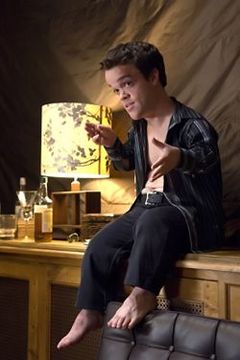
The humor-filled, balanced, horse-tranquilizing dwarf in In Bruges is Jordan Prentice (born January 30, 1973; pictured at the top of this posting), a Canadian actor. When he was 13, he began his film acting when he played Howard the Duck, in the movie of the same name. Perhaps it is fitting that Prentice (playing "Martin") also most recently starred in Weirdsville (2007). Part of the plot is about dumping a body in the basement of a drive-in movie theater where a satanic cult performs ritual sacrifices.

[Upon seeing Martin, the dwarf mall security guard]
Treena: That's so cute!
Martin: Something funny?
Treena: [talking in a little kid's voice] Hi! Who are you supposed to be? You're like the little chief of police of Munchkin Land or something!
Martin: [sarcastically] A Wizard of Oz joke. That's very original. I never hear those.

If we find ourselves going further into Oz (an alternative name for Heath Ledger's Australia, I must note), then we shall be going down that yellow brick road for some time. Enough for us to have visited Bruges today.


Children being killed, dwarfs, suicides, fairy tales, chase scenes through cobblestoned narrow streets, little people in hoods, canals, masks, and a confessed killer sitting in Bruges. What is real and fantasy, film or breaking news?

It all merges into a mind-boggling vortex that would make even a seasoned psychiatric professional question someone telling him these events were actual versus the creations of merely magical thinking.


Wiki-sources, regarding various short-stature actors mentioned:


Monday, February 02, 2009

Nain Rouge


Is any of this even true? The following is taken and summarized from Wikipedia.

The Nain Rouge, French for "red dwarf" or "red gnome" is a mythical creature that originated in Normandy, France, as a type of lutin (the French name, male, for a type of hobgoblin (an amusing goblin), in French folklore and fairy tales; females are called lutines).

The hobgoblin of Normandy is similar to house-spirits of England, Germany and Scandinavia. It sometimes takes the form of a horse, and in this shape is called Le Cheval Bayard.

Lutin is generally translated into English as: brownie, elf, fairy, gnome, goblin, hobgoblin, imp, leprechaun, pixie, pixy, puck, or sprite.

In a French fairy tale, "Le Prince Lutin," written in 1697 has a description of the air, water and terrestrial lutin: "You are invisible when you like it; you cross in one moment the vast space of the universe; you rise without having wings; you go through the ground without dying; you penetrate the abysses of the sea without drowning; you enter everywhere, though the windows and the doors are closed; and, when you decide to, you can let yourself be seen in your natural form."

In this story a red hat with two feathers makes the Lutin invisible.

Lutins also assist Père Noël in Lapland.


Ah, again, the Wildman, Saint Nicholas, Santa Claus...and the Elves.


In the United States, Nain Rouge haunts Detroit, Michigan, and is feared by its residents as "the harbinger of doom." (Skinner 1896) Its appearance is said to presage terrible events for the city [like a banshee]. The Nain Rouge appears as a small child-like creature with red or black fur boots. It is also said to have "blazing red eyes and rotten teeth." (Skinner 1896)

The creature is said to have been attacked in 1701 by the first white settler of Detroit, Antoine de la Mothe Cadillac, who soon after lost his fortune. The creature is also said to have appeared on July 30, 1763 before the Battle of Bloody Run, where 58 British soldiers were killed by Native Americans from Chief Pontiac's tribe.The small tributary of the Detroit river, which still flows through what is now Elmwood Cemetery, turned red with blood for days after the battle. It is said he was seen dancing on the banks of the Detroit river.
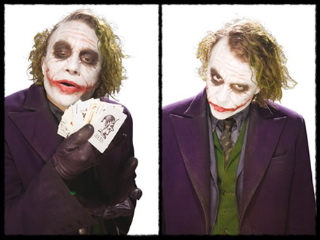
Famous multiple sighting occurred in the days before the 1805 fire which destroyed most of Detroit. General William Hull reported a "dwarf attack" in the fog just before his surrender of Detroit in the War of 1812.

A woman claimed to have been attacked in 1884, and described the creature as resembling, "a baboon with a horned head...brilliant restless eyes and a devilish leer on its face." Another attack was reported in 1964.

Other sightings include the day before the 12th Street Riot in 1967 and before a huge snow/ice storm of March 1976, when two utility workers are said to have seen what they thought was a child climbing a utility pole which then jumped from the top of the pole and ran away as they approached.

More recently, in the autumn of 1996, according to an article in the Michigan Believer, the Nain Rouge was spotted by two admittedly drunken nightclub patrons, who claimed to both have heard a strange "cawing sound, similar to a crow," coming from a "small hunched-over man" who was fleeing the scene of a car burglary. The creature was described as wearing "what looked like a really nasty torn fur coat."

Detroit Beer Co., a brewpub in downtown Detroit, has as its signature brew a "Detroit Dwarf" lager, named in honor of the Nain Rouge.


Various alleged sources: "Le Prince Lutin" by Marie Catherine d'Aulnoy in her Fairy Tales (Les Contes des Fees, 1697); Myths and Legends of our Lands, vol. 6, by Charles M. Skinner, 1896; Legends of Le Détroit by M.C.W. Hamlin, 1884.


Have you heard any of these stories of the "Nain Rouge"? The crimson threads between the Nain Rouge and the imagery in the film Don't Look Now (1973) and the allied cinema reflective references are certainly there. But the hairs on the back of my neck stand up. Are such stories merely gamer fantasies or created fictions based on a few threads of folklore?
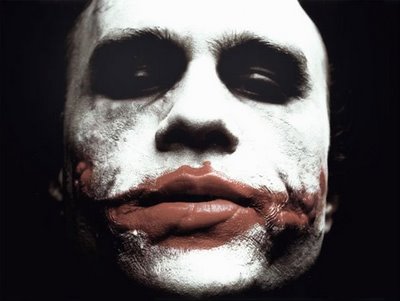


Well, at least the brewery is real and so is the brew, allegedly based on the tale of the Nain Rouge:

The Detroit Dwarf
Copper/amber in color, cloudy, strong in alcohol (6.8% ABV). Clean lager character with some fruity ale notes. Earthy with flavors of tea and forest nuts. Distinct balance between malt and hops allows the creamy texture to really come through. We earned a medal at the Great American Beer festival in our first year of business with this one and it remains our house specialty to this day.


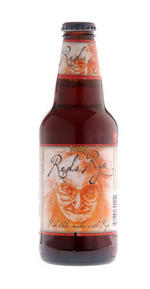
Red's Rye (bottle pictured below) appears to be a Michigan ale that also is related to the Nain Rouge folklore tied to Detroit.


If you are from Michigan, have you ever heard of any of these stories, in addition to the beer and ale?

Source: Nain Rouge.

Thanks to Dr. Benway for mentioning the name. Thanks to Ben Fairhall for the scarlet imagery metaphor.

Sunday, February 01, 2009

Jesters, Clowns & Tramps

Has the recent wave of Joker copycats demonstrated the contagion effect beyond any doubt?

Needless to say, with the growing insights from a wider spectrum of researchers, I have to credit several of you out there with "eyes wide open," who are making the evidence more clearly seen.

There are several folks' optic nerves firing on the Joker news of which we now find ourselves in the midst, helping gathering the data. Nevertheless, I am always careful of what I call the "reflective factor" in our investigations.

These events happen in waves, appearing to occur several times a year, in various guises. It's just that there are rare moments when we all join forces, watch them, catch them, and record them.

But that said, yes, something very strange appears to be happening now. For this last one week period, regarding this Heath Ledger "celebrity"/ The Joker-The Dark Knight "film referencing" copycat wave, it is rather noteworthy.

Of course, in terms of copycat events, when I began mapping out the patterns displayed in workplace violence cases, murder-suicides, and school shootings in my book, they were in patterns, beyond randomness.

In recent memory, for example, the flash-point of the Bailey, Colorado to Amish school hostage-killings in the fall of 2006, then the twinning mirror in the bubble burst of the spring of 2007, with the exclamation point of Cho at VA Tech, is worth recalling.

At some level, this new "Joker" week might have been foreshadowed by the horrific beheading at VA Tech (thus giving it the near-perfect harmonic re-tuning and reawakening from April 2007).

In and of itself, the twilight language does seem to be speaking to us all.

If there are enough "watchmen" to watch this, then perhaps it will be seen. After all, you don't need a copycat author to tell you from which way the next wave of violence is coming, now do you?

While keeping your eyes open, one resource worthy of further reading more deeply, while researching the Joker's kin, is "The Jester's Mask."

Examples of some material there include lists of names, historical items, popular cultural mentions from film, television, comics, music, and games.

The images are quite good.


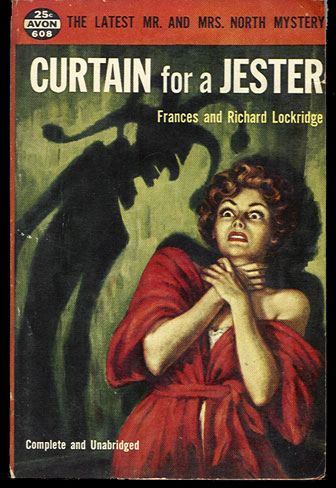
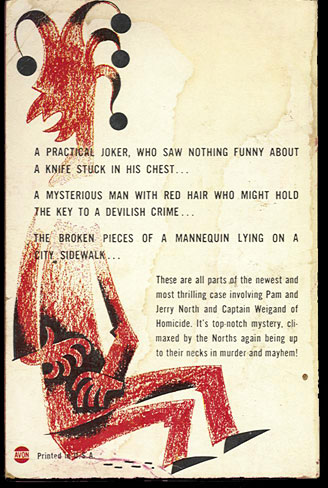
The front and back covers of the paperback edition of the murder mystery Curtain for a Jester by Frances and Richard Lockridge (Philadelphia/New York: J. B. Lippincott, 1953).


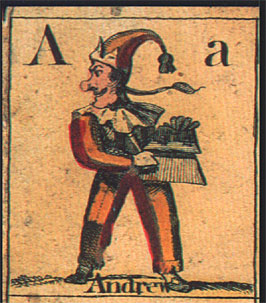
From A Fancy Battledore, 1806, in the Opie Collection of Children's Literature: "Andrew" was taken from "Merrie-Andrew" and means clown.


The page on names is enlightening. For example, for America, this is given about "Tramp":

Origins of the Tramp Character

James McIntyre ( - Aug. 18, 1937) and Tom Heath ( - Aug. 19, 1938) created the tramp clown characterization in 1874. They portrayed African Americans made homeless by the Civil War. They based their characters on blackface minstrel clowns which is the origin of the white mouth used by tramp clowns. They studied African American culture attempting to accurately portray it. McIntyre is credited with introducing an African American dance called the Buck and Wing to the American stage. The dance later became known as tap dancing.


Today, of course, "tramps" and "hobos" are called the "homeless," often, and reports of crimes against the homeless is what is heard more these days than accounts of violence by "hobos." Unless, of course, the "hobos" is a cover for "assassins" arrested near Dealey Plaza, but then, that's an entirely different story, altogether.

Friday, January 30, 2009

Wisconsin: New Joker Attack

In the space of one week, there have been three violent incidents involving Joker copycats. Besides the Belgium and Indiana incidents, tonight there is new information about an attack earlier in Wisconsin.

On Friday, January 23, 2009, Kim de Gelder, reportedly with his face painted like the Joker, invaded the "Fairyland" daycare in Dendermonde and allegedly killed three people.

The day after the Dendermonde incident, it now turns out, in Reseburg, Clark County, Wisconsin, a man who had painted his face like the Joker in The Dark Knight invaded a home in an attempt to beat up his former girlfriend's boyfriend.


Cole Vetterkind


Joshua Kane

Here is the primary news item about the incident, as run in the Marshfield News-Herald, Marshfield, Wisconsin, on January 30, 2009:

No Joke: Clark Co. intruder's face painted like Batman villain by Jacob Miller

A 26-year-old Thorp man who broke into a town of Reseburg home allegedly wore face paint to resemble The Joker while assaulting his ex-girlfriend's boyfriend, according to a Clark County criminal complaint.

Cole Vetterkind broke into Alecia Swensen's boyfriend's home at N12458 Gorman Ave., Thorp at about 5:30 a.m. Saturday [January 24, 2009], sheriff's officials said. Vetterkind was shot in the leg when he attacked Jason Benzschawel, 23.

According to the criminal complaint:

Vetterkind entered the home with Joshua Kane, 22, of Stanley and began jumping on, hitting and choking Benzschawel while he was asleep in a bed with Swensen.

Benzschawel thought he was being hit with brass knuckles and said Vetterkind was wearing a ski mask. When the mask was pulled off during the altercation, he saw it was Vetterkind, who had his face painted like The Joker, played by Heath Ledger in the recent Batman movie, "The Dark Knight."

Swensen, 18, told police she dated Vetterkind, but they recently broke up because he would get violent. She said Vetterkind harassed her by calling and text messaging her, and he once waited for her at her parents' home.

While being attacked, Benzschawel grabbed a loaded 20-gauge pistol grip shotgun and shot Vetterkind in the leg.
Benzschawel said the shotgun only had one round in it, and he kept it loaded next to his bed. When investigators arrived, the shotgun was unloaded and laying on a towel in the bathroom.

Swensen managed to exit the house and call 911 during the assault.

The mattress and areas throughout the house were covered in blood.

Benzschawel told the sheriff's department that Vetterkind began to harass and threaten him when he started to date Swensen. He said Vetterkind claimed he has connections to the Hell's Angels motorcycle gang, who would come and "do things to him."

During the altercation, Benzschawel received bruises on his face and his hands were cut and bruised. After the shooting, Swensen helped Kane get Vetterkind into a white 1999 Oldsmobile Alero, which the two intruders had driven to the home. Kane took Vetterkind to Our Lady of Victory Hospital in Stanley. He was airlifted to Saint Joseph's Hospital in Marshfield, where he was in fair condition Wednesday, a hospital spokesperson said.

Vetterkind faces three felony charges that include strangulation and suffocation; intimidation of a victim; and use or attempt of force and burglary of a building or dwelling. He also faces a misdemeanor battery charge. His initial court appearance has not been set.

Kane faces a felony charge of intimidating a victim and the use or attempt of force, and two misdemeanor charges of criminal trespassing to a dwelling and battery. Kane, who is in the Clark County Jail on unrelated charges, had his initial appearance at the Clark County Courthouse, Neillsville, moved to 1:05 p.m. Thursday, according to online court records.


One local newspaper, the Leader-Telegram in Eau Claire, Wisconsin, noted on January 30, 2009, that "Cole C. Vetterkind, 26, of Thorp and Joshua J. Kane, 22, of Stanley face multiple criminal counts for reportedly breaking into a home where Vetterkind's cousin Jason P. Benzschawel, 23, was staying with Alecia Swensen, 18."

What is intriguing is that the suspect apparently is the victim's cousin. One translation of the name "Vetterkind" is literally "cousin child."

One of the officers involved in the incident was a female noted in the criminal complaint as "Sgt. Campbell." The teacher attacked yesterday in Clinton, Indiana, was "Ms. Campbell."

Thanks to Richard Hendricks who pointed to the breaking news on this Wisconsin event, and then quickly to Todd Campbell's posting alert about it too.

Indiana: New Joker Attack

Clinton, Indiana, was the site of a Joker-copycat attack at a South Vermillion High School on January 29, 2009. This comes in the wake of the Dendermonde Joker incident of January 23, 2009, in Belgium.

The Vermillion County Sheriff's Department reported a 17-year-old female student went to the bathroom where she painted her face to look like “The Joker.” She also made cuts on her face with a knife that she had hid in her backpack.


“She was attempting to attack a teacher in a classroom,” said Chris MacLaren, a deputy with the Vermillion County Sheriff’s Department. “The class was already in session and the student rushed in the door and pulled the knife out” and tried to attack the teacher.

The teacher used a cart to keep the student at a distance, and all of the students were able to escape the classroom safely.

Eventually school staff was able to convince the student to put down the knife.

No one was injured in the incident, which occurred at about 1:50 p.m.

McLaren estimated the incident lasted about five to 10 minutes.

He described the knife as a steak or carving knife with about a 5-inch blade. The student had kept the knife, and two other (small folding) knives, in a bag, MacLaren said.

The school was placed on lockdown until the end of the school day, and the student was taken to the Vermillion County Sheriff's Department where she was questioned. Charges were pending against the student. The Sheriff’s Department was consulting with the county prosecutor to determine whether the case should be pursued in adult or juvenile court, MacLaren said.

(Later in the day, a student went online and posted specific details of the attack. This individual has now requested - well, actually through threats of "pressing charges" - for sites to take his or her quotations down from blogs. Those sourced statements have now been removed here too, not because of the legal threats but because the individual seems to have placed their material online without any awareness that it obviously would be read and copied. Everyone can make foolish mistakes like this, once or twice.)

Several primary media sources were consulted to confirm this event, which did, indeed, involve a Joker copycat event, here, here, and here.

Clinton is a city in Vermillion County, Indiana, United States. The city is named after DeWitt Clinton (March 2, 1769 – February 11, 1828), who served as 6th governor of New York from 1817 to 1823, and was responsible for the building of the Erie Canal (at the time called "Clinton's Ditch").

Clinton, Indiana is the birthplace of Colonel Charles Edward ("Chuck") Jones (November 4, 1952 – September 11, 2001), a United States Air Force officer, a computer programmer, and an astronaut in the USAF Manned Spaceflight Engineer Program, who was killed in the attacks of September 11, 2001, while aboard American Airlines Flight 11, when it hit one of the Twin Towers.

Full credit and thanks to Behemoth blogger Ben Fairhall for sending along the initial alert on this event.

The Wicker Man Burns


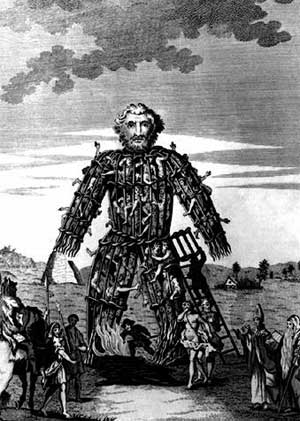
The Wicker Man is set on fire to pay tribute to the gods. The sacrifice of the humans inside is part of a religious ritual to increase fertility, crops, commerce, or merely to re-ignite the chances that bad times will disappear.

According to Julius Caesar in his Commentarii de Bello Gallico (Commentary on the Gallic Wars), the Wicker Man was a large wicker statue of a human used by the ancient Druids (priests of Celtic paganism) for human sacrifice by burning it in effigy. Other records talk of people being placed inside.

Despite any debunking of Caesar's accounts by modern skeptics, the imagery of the burning of the Wicker Man lives on and its use cannot be denied in modern neo-pagan rituals. Whether the Wicker Man exists in historic Pagan accounts, in modern neo-Pagan events (such as at Nevada's Burning Man), or in movies and contemporary events, the symbolism is very real and powerful.

And quite obvious.

For those interested in deciphering the unfolding of the sacrifices (including murder-suicides and costumed violence of late) during these difficult times, please pay attention to these signs, noticed already by those to whom the twilight language is being directed.

As I already have mentioned in these pages, it goes beyond coincidence to find the moniker of the Wicker turning up during incidents from the Son of Sam killings to last year's Chicago area "Phantom Clown" sightings and near-abductions of children. Keep your eyes open.


^^^^^^^^^^^^^^^^^^

From an article published this morning, comes news of this celebration:

A 12-foot tall Wicker Man will be set on fire tonight [Friday, January 30, 2009] in a pagan winter ritual close to the Fermanagh border [Northern Ireland].

[The name Fermanagh is an Anglicization of Fhear Manach which means "Men of the Manacháin tribe," so named after their chief O'Manacháin (Anglicized as O'Monaghan), the famous warrior monk. Contae Fhear Manach or Fear Manach = "Men of Monach" in Irish.]

The folk ceremony at Aughakillymaude Mummers Centre near Derrylin will celebrate the loosening of winter’s grip and the impending return of spring as it marks February 1, known as a Quarter Day in the Celtic agricultural calendar.

At 10 pm [local time] the straw mummers hats worn all winter by the troupe performing their traditional drama will be set on fire to mark the close of the mumming season and the Wicker Man will then be lit.

The huge figure has been created by model maker Gordon Johnston from flexible sally rods — willow rods used for wicker furniture and fencing. According to Jim Ledwith of the Mummers Foundation, little is known about the origins of the Wicker Man, apart from Julius Caesar’s second hand accounts of druidic winter rituals of human sacrifice during the Gallic wars.

These alleged that female slaves and criminals were burned alive inside effigies 100 times the size of the Fermanagh one.

“While the details of the wicker man ritual may have become coloured with the telling, it represents a tradition of sacrifice by burning practiced by the continental Celts.

“Indeed, the practice of human sacrifice was still prevalent in fifth and sixth century Ireland,” Jim said.

“Throughout Celtic Europe the wicker man legend lives on and the effigy is still burned ceremoniously as a mock sacrifice in themed ceremonies, especially at Beltaine (May) to mark the rite of spring — notably without the human sacrifice element.”

Mummers will light a gas beacon at Aughakillymaude to symbolise the sun’s return.

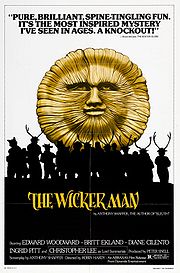
The 1973 movie The Wicker Man, starring Edward Woodward and Christopher Lee, is regarded as one of the finest horror films of all time, and it ends with Woodward, playing a police detective, being burned alive inside the chest of the effigy.

vvvvvvvvvvvvvvvvvvv

Don't Look Now an Anglo-Italian thriller, directed by Nicolas Roeg, was released in 1973. In the double-billing that took place back then, 1973's The Wicker Man was the "A" feature on their original UK theatrical dual release.

The figure of the "little person" in the red rain gear in Don't Look Now serves as a trigger or key. As Wikipedia notes, the "spiraling vortex of coincidences, recurring themes and motifs (light on water, breaking glass, the colour red)...reaches a dramatic conclusion in an old bell tower. John [Baxter, the lead character, played by Donald Sutherland] confronts the mysterious figure in red, realizing too late that his visions were premonitions of a grisly end."

A less well-remembered American remake of The Wicker Man, with Nicolas Cage in the lead, was released in 2006 with the film's tale being set on a private island in Puget Sound, Washington. In this 2006 version, a little girl is seen running around in a red coat. As well, there is a pair of twins, old women, both of whom are blind.

In the feature film Flatliners, Kiefer Sutherland is tormented by a small childlike figure in a red hooded coat in an homage to his father's film.

The theme of the little red-clad Venetian figure is used in a dream sequence in the "Book Clubbin'" episode of television series "Absolutely Fabulous," Series 5.

The Irish feature film Intermission (starring Colm Meaney and Colin Farrell) references Don't Look Now's chase of a small figure in a red coat several times.

Don't Look Now's drowning scene is referenced by the 2005 film The Dark starring Sean Bean and Maria Bello in which their daughter drowns wearing a bright red sweater.

In the 2005 film Hostel, a figure fleetingly glimpsed wearing a red raincoat is pursued through narrow alleyways.

The end chase scene of Don't Look Now is referenced in the 2006 release of Casino Royale where James Bond is pursuing Vesper through Venice while she is wearing a red coat.

The Wicker Man burns red.


************************************
Sources: "Fired up Fermanagh all set to torch Wicker Man," by Linda McKee, Belfast Telegraph, Friday, January 30, 2009; Film Facts by Patrick Robertson, Billboard Books, 2001; Wikipedia; my files.

Thursday, January 29, 2009

Lam's Sacrifice


This event exudes elements requiring some in-depth twilight language decoding. First there are the overt names that catch one's attention: "King" (as in the county), "Queen Anne" (being the apartment complex), and "Gross" (the prosecutor's graphic moniker which vividly describes the scene itself).

In almost a revelation of the process, even "an unidentified language" is found in this tale.

More twilight-dwelling, perhaps, but needless to say much more covertly, there is this ritual sacrifice's suspect with the given name of "Oumar Lam." It is a name that allows various anagrams, of course, but it should be mentioned that one is "Amoral MU," alluding to the vanished continent, located in the Pacific Ocean but now, like Atlantis and Lemuria, said to have sunk beneath the sea.

More significantly, researcher Richard Hendricks, whom I fully credit for passing word of this incident to me, notes the following:

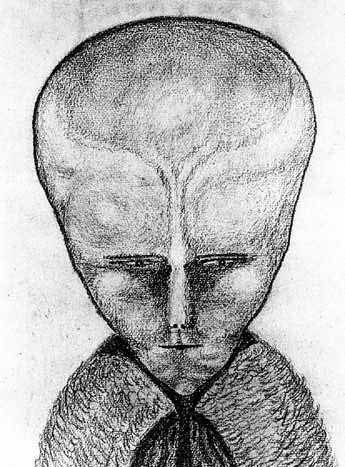
"Between January & March, 1918, Aleister Crowley performed a series of magickal rituals, the Amalantrah Workings, while in New York. One of his goals during this series of rituals was to bring an intelligence into physical manifestation. He claimed he did, and drew a celebrated portrait of the being he said he conjured. That intelligence, of course, was Lam, whose resemblance to alien greys and other paranormal entities has been noted since. At any rate, the story below caught my eye: rituals; chanting; the man 'yelling in an unidentified language.' his last name, Lam."


It is quite easy to find more about the overlap between the facial features of "Lam" and the "greys," if you wish, e.g. here and here.

But for the moment, however, merely read the following, which took place this week, kindly shared by Mr. Hendricks:

King County prosecutors filed assault charges Wednesday [January 28, 2009] against a Seattle man accused of attempting to "sacrifice" his live-in girlfriend.

According to police, Oumar Lam's 26-year-old girlfriend arrived at their Queen Anne apartment Sunday to find him lying naked on a couch near a candle-lit altar. The woman told police she was seated on a bed when Lam attacked her from behind, pulling a pillowcase over her head and attempting to suffocate her.

Pulling her head back, Lam, 31, allegedly sliced the woman's throat while yelling in an unidentified language, according to court documents. She told police she attempted to break away from him as he pulled her toward the altar, at which he had apparently been praying for hours before her arrival.

Police assert that Lam continued stabbing her during the struggle, cutting her chest, back and shoulder before she was able to dial 911. The woman, police said in court documents, "was extremely fearful that Lam was trying to kill her as part of a sacrifice."

The woman told police he was ranting to himself throughout the attack.

"Die, die and go alone," Lam said repeatedly, according to police reports. "You have to go by yourself."

The woman fled the apartment, pursued by a still-nude Lam, according to police. Lam dragged her back to the apartment.

Weakened from blood loss, the woman was still able to rush to the door when officers knocked. According to police, Lam continued to chant when confronted by officers.

On Wednesday, prosecutors filed a first-degree assault charges against Lam, with sentencing enhancements for domestic violence and the use of a deadly weapon. Requesting that bail be set at $1 million in the attack, Deputy Prosecutor David Gross described the incident in court documents as a "vicious attack (that) shows that the defendant is an immeasurable threat to the community."

The woman underwent emergency surgery at Harborview Medical Center after the incident and is expected to survive.

Bail has not been set in the case because Lam, who remains in the King County Jail, has refused to attend two hearings. He is scheduled to be arraigned Feb. 11 and faces 10 to 13 years in prison if convicted.


Source: "Charges filed in man's attempted 'sacrifice': Girlfriend survives stabbing attack on Queen Anne," by Levi Pulkkinen, Seattle Post-Intelligencer, January 29, 2009.

Monday, January 26, 2009

Anagram: Gelder = Ledger

Discussions - and broader attention from the Drudge Report to the English media - regarding the Dendermonde Joker killer - continued on January 26, 2009. There were new speculations of a possible 4th killing, more on the suspect's copycat behavior, and continued interest in the strange links between Heath Ledger's and Kim de Gelder's names.

Belgian police now believe the man they are holding for the January 23rd daycare killings in Dendermonde may also have stabbed to death a 73-year-old woman who lived nearby on January 16th.

"There are very clear indications of links between the murders in Dendermonde and the death of the elderly woman," said spokesman Christian du Four. No details were forthcoming, although the suspect is due in court on Tuesday. (Update: Kim de Gelder has admitted to the court that he killed three at the daycare, but says he was not the person who killed the elderly woman, earlier.)


By Monday, the earlier links that had been being detailed first in the Belgian media, at The Copycat Effect, and throughout the blogosphere by Todd Campbell, Ben Fairhall, The Anomalist, SMiles Lewis, Theo Paijmans, and others, were being acknowledged by the UK and American press and then even by the Drudge Report (who seemed later than usual in picking up the copycat thread on this one, curiously).

The UK's Telegraph wrote on Monday: "Belgium's Le Soir newspaper has even speculated on the significance of the fact that the name Gelder is an anagram for Ledger."

This had Todd Campbell wryly observing over at "Through The Looking Glass": "Our trade gone mainstream???"

A comment maker (unnamed) left the remark noting that "Gelder" is an anagram of "Ledger" on this blog at 9:41 PM ET on Saturday, January 24, 2009.

I must add, the spooky links to the decapitation death of Tim McLean, who was beheaded on the Greyhound bus in Alberta on July 30th, allegedly by Vince Weiguang Li, 40, may rest in onomatology someday. If we ever decipher the ties between "Ledger," "Gelder," and the perhaps purely operational name "Badger," in the vortex of these events, no telling where this might lead us.

300beheading11.jpg

Vince Weiguang Li is taken into custody after police found "Badger" carrying McLean's head (box).

A police officer at the scene of the fatal stabbing on the Canadian bus saw Li hacking off pieces of McLean's body and eating them, according to a police tape leaked on the Internet on August 2nd. In the tape of radio transmissions, officers referred to the attacker, who also beheaded the victim, as "Badger." They said he was armed with a knife and scissors and was "defiling the body."

"Badger's at the back of the bus, hacking off pieces and eating it," an officer with the Royal Canadian Mounted Police said on the tape.

The RCMP described the tapes as "operational police communications and, as such, are not meant for public consumption." The tape was posted on YouTube among other sites.

Further news is now being revealed that the suspect in the Belgian creche stabbings is said to have quoted Heath Ledger from The Dark Knight when he was arrested.

When he was arrested, Kim de Gelder's only words were: "I have a question."

According to the Telegraph, picking up their information from Belgian media, they report:

The words echo a scene in Batman: the Dark Knight when the Joker violently gatecrashes a party looking for a the fictional attorney general of Gotham City, Harvey Dent.

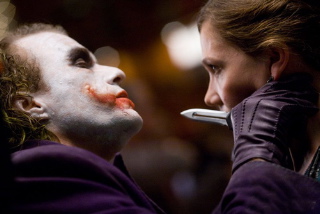
"I only have one question: where is Harvey Dent? I'll settle for his loved ones," says the character played by Ledger, before threatening a woman with a knife.


Patrick De Mey, the police officer who arrested Mr De Gelder, described the suspect as being in a passive and trance-like state.

"When I asked him to step off his bicycle and put his backpack on the ground he obeyed perfectly," he told the Gazet Van Antwerpen.

"But in answer to my questions, he clearly had no understanding. He continued to stare at me all the time with wide open eyes and a large grin on his face."


A wide grin? Like the Joker?

A trance-like state? We've certainly heard that before.

The most repeated reference to that kind of trance is the "Manchurian Candidate" state of being mentioned when Sirhan Sirhan was arrested after allegedly shooting RFK. I've noted others in my writings, of course.


Belgium's state-run media has issued more widely the high school photograph of Kim de Gelder.

As mentioned in early postings, according to witness statements and police drawings, the suspect had painted his face white, blackened his eyes and had colored his hair red, apparently to mirror the Joker in The Dark Knight.

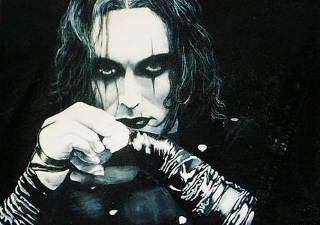
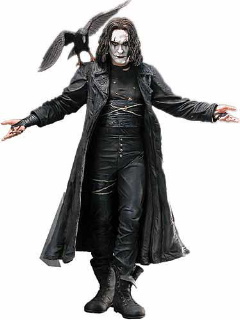
Police have addeded another film inspiration, as well. His (so-called) "gruesome and bizarre" garb naturally caused investigators to note the Joker comparison, but then they made a link to another (to quote them) "cult Goth film," The Crow, which they say inspired Ledger in his Batman role.


Perhaps The Crow (1994) was important to de Gelder, but I'm not sure about its influence on Ledger. Actually, from my reading of contemporary Heath Ledger interviews, to prepare for the role, Ledger lived alone in a hotel room for a month researching the character and developing his performance. Ledger claimed he was basing his characterization upon Sid Vicious and the charismatic delinquent Alex DeLarge (played by Malcolm McDowell) in A Clockwork Orange (1971). (BTW, "DeLarge" = "A Ledger," "A Gelder," as pointed out in the Bibliophile's comment below.)

clockwork

Former classmates at the Roman Catholic Sint Carolus school, in the town of Sint Niklaas [= Saint Nicholas], described Kim de Gelder as "a fan of Goth music who could sometimes behave oddly."

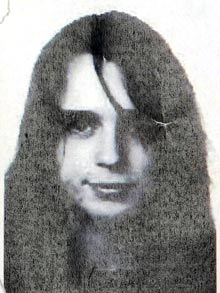
He was nicknamed "Satan" because of his long black hair, notes the Belgian and UK press.

De Gelder studied to become a chemist's assistant (humm, an "alchemist"?) and successfully completed his exams in 2006.

ledger joker long

Update:

Prosecutor Christian Du four has said that there are "very concrete elements" linking the nursery attack to the murder of the elderly woman, De Gelder has said he knows nothing about the latter incident.

Flemish newspaper Het Laatste Nieuws reported that investigators had found a document on De Gelder's computer with precise information about the elderly woman, which was created several days before the murder.

Next to her name, Elza Van Raemdonck, was written: "Result of the action: one," according to the newspaper.

The newspaper said that the computer file also left no doubts that the nursery attack had been planned in detail in advance and that he targeted other day-care centres as well.

Other recent posting on this topic, here, are:

Joker Copycats

Dendermonde Joker

Belgian Crèche Attacked By "Joker"

Decapitation, Death and the Damned


Mad Butcher

The reign of terror ranks up there with Jack the Ripper's, but few today have heard of the decapitating legacy of the "Mad Butcher."

January 26, 1936

On this day 73 years ago, police found the third dismembered victim of the so-called Mad Butcher, sparking a citywide panic in Cleveland.

The body of Florence Polillo, 42, was discovered in a basket and several burlap sacks behind a downtown business. Like the others, she was beheaded and cut with precision.

The official count is 12 victims between 1935 and 1938, although the lead Cleveland detective believed the Mad Butcher could have been responsible for more than 40 deaths around Cleveland, Pittsburgh and Youngstown, Ohio.

The victims were usually drifters whose identities were never determined. Sometimes the torso was cut in half; in many cases, the cause of death was the act of decapitation itself.

One suspect, an actual butcher named Frank Dolezal, was interrogated for 40 straight hours until he confessed to killing Polillo. However, he changed his story and killed himself in his cell. Few authorities believed Dolezal was actually the killer.

The true identity of the Mad Butcher remains a mystery.


Washington D. C. Examiner, January 26, 2009.

Saturday, January 24, 2009

Dendermonde Joker

The Joker was at the door, and they let him in.

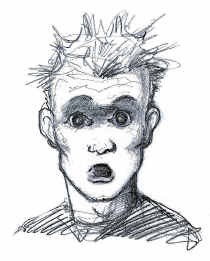
The painted face of the alleged Belgian killer has been drawn by an eyewitness and has now been published. His face and name have now also been revealed (new update for 01.25.09 below).


This drawing was made based on data provided by Rudi Brusselmans who was a witness of the arrest of the crèche attack suspect now being held. (See here for more details on the attack.) The attack happened in the "Fairytale-land" or "Fabeltjesland" creche or daycare.


More comparisons with the Joker have surfaced in the Belgian media.

Correctly, the press there is noting that although the alleged attacker's face was painted white and his eyes were made black, and his distinctive pink/red hair was cut in spikes, "as if he had cut his hair himself," his mouth was apparently not painted, as was Heath Ledger's Joker in The Dark Knight.


Incorrectly, the European media said that the day (January 23, 2009) of the Dendermonde crèche or daycare attack was on the same date as the death of Heath Ledger. The first anniversary of Ledger's death, however, was January 22, 2009. To be exact, Heath Ledger was declared dead at 3:36 pm Eastern DST in Manhattan, New York, on January 22, 2009, and hit the news that night and the next morning. The attack on the nursery occurred at 10:00 a.m. CET (9:00 a.m. UTC) on January 23, 2009.


Nevertheless, there appears to be strong evidence the Dendermonde Joker reflects the copycat effect in this instance.

A police officer confirmed: “He had his face painted like Heath Ledger playing The Joker.”

The comparisons are clearcut in terms of mode of violence (knives), outward appearance, and even the arrest behavior. For example, in a headline and subheadline published on Saturday, January 24th, in the UK's Telegraph, the copycat imagery is summed up:
"Belgium 'joker' creche killer snorted with laughter in police interrogation: Belgium's suspected 'joker' killer snorted with laughter when interrogated by police about a frenzied knife attack that left a woman and two babies, aged six months and nine months, dead."
The two infant victims of the attack on a creche in the Belgian town of Dendermonde on Friday, January 23, 2009, have been named as Leon a baby boy aged six months and Corneel, a girl aged nine months.

Marita Blindeman, the 54 year old childcare worker who was killed, raised the alarm before being killed.

Police and prosecution sources have said that the 20-year-old man, dubbed "the Joker" because of his painted white face, eye shadow and ginger hair, has no history of mental illness.

He tricked his way into the Fabeltjesland ("land of fairy stories") day care center at 10 am local time by claiming to have a meeting with one of the members of staff. He then drew a 12-inch-long knife and began to slash at children aged between a few months and two years old.

There were 21 infants in the creche and six supervisors. All of the victims were stabbed in the throat or head. Parents gathered in the Dendermonde town hall and, with psychologists in support, identified the victims using photographs.

The addresses of three daycare locations were found on the suspect ("Kim D") when he was arrested.

+++
Update Sunday, January 25, 2009:

The alleged attacker, now under arrest, and his victims have been fully identified.


The man in custody for the stabbings is Kim de Gelder, 20, originally of Sint Niklaas (= Saint Nicholas), which is eight miles from Dendermonde. His colleagues described the Flemish man as being "crazy about movies."

De Gelder would translate, in English, as "the gelder" = "one who gelds or castrates." But there appears to be an alternative explanation for the name in Belgian (see the comments below), which is related to the word for "gold."

The Church of Saint Nicholas was founded in the 13th century and gave its name to de Gelder's former hometown. The history of Sint-Niklaas proper starts in 1217, when the bishop of Tournai, following advice from the local clergy, founded the church to Saint Nicholas there. The city keeps seven giants: Janneken, Mieke, Santa Claus and Zwarte Piet, and the three Magi: Caspar, Melchior, and Balthasar.

Sinterklaas (also called Sint-Nicolaas or De Goedheiligman in Dutch and Saint Nicolas in French) is a traditional Winter holiday figure in the Netherlands, Aruba, Netherlands Antilles and Belgium, celebrated every year on Saint Nicholas' eve, December 5, or, in Belgium, on the morning of December 6. (Ah, the day after, just as the attack in Belgium was the day after Heath Ledger/The Joker's death day.) The feast celebrates the name day of Saint Nicholas, patron saint of, among other things, needless to say, children.

The young victims of Dendermonde's ("Rumble or Thunder World's") Fabeltjesland ("Fairytale Land") were nine-month-old Leon Garcia and six-month-old Corneel Vermeir. Marita Blindeman, 54, a daycare worker lost her life attempting to save others.

See comments below for a discussion of what "Fabeltjesland" may or may not mean.

The Belgian and Dutch media and the UK's Telegraph began publishing the photograph of the suspect on January 24-25, 2009. The image being published is the high school year book picture of self-confessed mass-murderer Kim de Gelder. Reports indicate that he cut his hair short soon after finishing high school.

De Gelder is on suicide watch in his undisclosed location in Bruges, Belgium. He has gone on a hunger strike and was moved to the medical section of the Bruges jail.

Sunday media report that "some 7,000 of Dendermonde's 43,000 residents walked in a silent march past the creche Fabeltjesland (Fairytale Land)."

Thanks to Dutch/Belgian translations from Theo Paijmans.