Showing posts with label Abraham Lincoln. Show all posts

Friday, May 29, 2020

George Floyd: Syncs, Coincidences, and Name Games


Los Angeles Lakers’ Kobe Bryant, center, and his teammates warm up before an NBA basketball game against the Sacramento Kings, Tuesday, December 9, 2014, in Los Angeles. Several athletes have worn “I Can’t Breathe” shirts during warm ups in support of the family of Eric Garner, who died July 17, 2014, after a police officer placed him in a chokehold when he was being arrested for selling loose, untaxed cigarettes.


LeBron James (above) and Kyrie Irving (below) showed solidarity with people protesting the Staten Island Grand Jury decision not to indict the police office who killed Eric Garner with a chokehold on July 17, 2014, donning a black t-shirt with Garner's last words (on Monday, December 8, 2014).


Divided House

On June 16, 1858, Abraham Lincoln delivered an important speech to 1000 delegates at the Springfield, Illinois, statehouse for the Republican State Convention. The Republicans of that time were the party of the North, of the abolitionists, and of the "all people are created equal" point of view.

In Lincoln's speech, he uttered the memorable lines:
"A house divided against itself cannot stand."
I believe this government cannot endure, permanently half slave and half free.
The title, "House Divided Speech," reflects part of the speech's introduction, "A house divided against itself cannot stand," a concept familiar to Lincoln's audience as a statement by Jesus recorded in all three synoptic gospels (Matthew, Mark, Luke). Source.

In Abe Lincoln in Illinois, John Brown, comforts his dying son at Harper's Ferry, as he is arrested by Robert E. Lee. Brown was played by John Cromwell, the director of the film.


I watched Raymond Massey's Abe Lincoln in Illinois (1940) in the wake of having viewed the three-night History Channel's mini-series Grant this week (May 25-27, 2020).  Massey's tour-de-force performance as Lincoln shows him struggling with the decision to fight slavery. Grant does equally well demonstrating the pre-Civil War Grant grappling with the fact he finds he owns a slave he inherited because he married into a slave-owning family. "Timely" seems the least I can say about both of these docudramas based on a legacy of slavery in the USA that continues in today's events.


As reviewer Nick Schager points out:
Grant is an active attempt to rehabilitate the historical record, positing Confederate adversary Robert E. Lee as a symbol of the intolerant, aristocratic, treasonous old guard, and Grant as an emblem of a more open, just, unified modern America. Grant’s disgust for the Confederacy and the rancidness it stood for is on full display throughout this series, which pointedly contends that—good ol’ boy revisionism be damned—it was slavery, not simply the more euphemistic “states’ rights,” which drove the South to secede and take up arms against the Union. At the same time, Grant’s compassion and levelheadedness also remains front and center, epitomized by the lenient terms of surrender he ultimately offered to the defeated Lee, which helped him secure support throughout the South in the years following the end of the war.
George Floyd is Killed

The Incident: A Summary


The death of George Floyd occurred on May 25, 2020, when Derek Chauvin, a white Minneapolis police officer, kneeled on Floyd's neck for 8 minutes and 46 seconds, with 2 minutes and 53 seconds of that occurring after Floyd was unresponsive, according to the criminal complaint filed against Chauvin. Floyd was handcuffed and lying face down on the road, while Chauvin had his knee on his neck.
The incident occurred during Floyd's arrest in Powderhorn, a neighborhood south of downtown Minneapolis, Minnesota, and was recorded on cell phone video by several bystanders. The arrest was conducted after Floyd, an African-American, [shortly after 8:00 pm] attempted to use a $20 bill that a grocery store employee identified as counterfeit. Police alleged that Floyd "physically resisted" after being ordered to exit his vehicle, a claim that has been contradicted by available video recordings. The video recordings of the arrest, showing Floyd repeatedly saying "I can't breathe", were widely circulated on social media platforms and broadcast by the media.
The four officers involved were fired the next day. The Federal Bureau of Investigation (FBI) is conducting a federal civil rights investigation into the incident at the request of the Minneapolis Police Department. The Minnesota Bureau of Criminal Apprehension (BCA) is also investigating possible violations of Minnesota statutes. On May 29, Chauvin was arrested and charged with third-degree murder and manslaughter for Floyd's death, with Hennepin County attorney Michael O. Freeman saying he anticipated charges to be brought against the other three officers at the scene of Floyd's death.
After Floyd's death, demonstrations and protests in the Minneapolis–Saint Paul area were initially peaceful on May 26, but later that day turned destructive as windows were smashed at a police precinct, two stores were set on fire, and many stores were looted and damaged. Some demonstrators skirmished with law enforcement officers, who fired tear gas and rubber bullets. Source.

Videos Record Floyd's Death 
Part of the arrest was recorded by a bystander and streamed to Facebook Live, which went viral.
When the video starts, Floyd is already pinned chest down to the ground, and Officer Chauvin is kneeling on his neck. Floyd repeatedly tells Chauvin "Please" and "I can't breathe", while also moaning, groaning, and sobbing. A bystander tells police, "You got him down. Let him breathe."
Another bystander says, "One of my homies died the same way", and after Floyd responds "I'm about to die the same", Chauvin tells Floyd to relax.  The police ask Floyd, "What do you want?" Floyd answers, "I can't breathe." Floyd states: "Please, the knee in my neck, I can't breathe." Someone tells Floyd to "get up and get in the car" (which Agence France Presse, CBS News and WVLT-TV identify as one of the officers, while Buzzfeed News says it is "unclear" whether it was an officer speaking), to which Floyd replies, "I will ... I can't move." Floyd cries out, "Mama!" Floyd says, "My stomach hurts, my neck hurts, everything hurts", and requests water. The police do not audibly respond to Floyd. Floyd begs, "Don't kill me."
One bystander points out that Floyd is bleeding from the nose. Another tells the police that Floyd is "not even resisting arrest right now". The police tell the bystanders that Floyd was "talking, he's fine"; a bystander replies that Floyd "ain't fine". The bystander protests that the police were preventing Floyd from breathing, urging them, "Get him off the ground ... You could have put him in the car by now. He's not resisting arrest or nothing. You're enjoying it. Look at you. Your body language."
Floyd goes silent and motionless, but Chauvin does not lift his knee from Floyd's neck. The bystanders protest that Floyd is "not responsive", and repeatedly ask the police to check Floyd's pulse.  A bystander questions, "Did they f*cking kill him?"
An ambulance eventually arrives, and Chauvin does not move his knee until emergency medical services put Floyd's unresponsive body on a stretcher. Floyd was initially found pulseless by HCMC paramedics, but CPR was not initiated by the paramedic crew. Floyd is loaded into the ambulance and taken away to 36th Street and Park Avenue, according to an incident report by the Minneapolis Fire Department. A male bystander says that the police "just really killed" Floyd. Chauvin knelt on Floyd's neck for at least seven minutes, including around four minutes after Floyd stopped moving.
Medics in the ambulance checked Floyd's pulse several times, but found none. He was pronounced dead at the hospital. Source.

"I Can't Breathe"

Floyd's death has been compared to the 2014 death of Eric Garner, an unarmed black man who also repeated "I can't breathe" eleven times after being placed in a choke hold by a New York police officer during an arrest.


On July 17, 2014, Eric Garner died in the New York City borough of Staten Island after Daniel Pantaleo, a New York City Police Department (NYPD) officer, put him in a chokehold while arresting him. Video footage of the incident generated widespread national attention and raised questions about the appropriate use of force by law enforcement.

Syncs, Coincidences, and the Name Game

As the George Floyd incident unfolded, I was sent or directed to various "twilight language" segments of the event and the people surrounding it.


George Floyd Name Game

From Greek, the meaning of the name George is from georgos meaning tiller of the soil, or farmer. Famous bearer: St George, patron saint of England, who struggled with a fire breathing dragon symbolizing the devil.
The name Floyd means gray or gray-haired, and is of English origin, from a Welsh byname, llwyd. Floyd is from Lloyd, a name originating with the Welsh adjective llwyd, most often understood as meaning "grey" but with other meanings as well.
Floyd and Coronavirus

 A widely circulated photograph of George Floyd at his job as a security guard shows him next to a poster of Corona beer. Floyd was laid off due to the novel coronavirus pandemic.


Kobe Bryant


"I can't breathe" was a slogan that Kobe Bryant began using in 2014, due to the Garner episode. Bryant was able to convince his teammates to all wear "I can't breathe" teeshirts. 

Both George Floyd and Kobe Bryant were successful basketball players in their own tiers, and about the same height. Floyd was 6 feet, 7 inches in height. Kobe Bryant was 6 feet, 6 inches tall.

Bryant died on January 26, 2020. Floyd died on May 25, 2020, almost exactly five months later, and one day after his birthday.

Kobe Bryant, 41, died with his 13-year-old daughter, Gianna, in the helicopter crash. George Floyd, 46, is survived by two daughters, one is 6-year-old Gianna. 


Chauvin Name Game


The police officer's name who is seen in the video with his knee on George Floyd's neck is Derek Chauvin. The roots of Chauvin are the same as for chauvinistChauvin's meaning is derived from the French diminutive of Chauve, a nickname for "a bald man," from Old French chauf "bald" (Latin calvus).

Derek Michael Chauvin, a 44-year-old Caucasian man, had been an officer in the Minneapolis Police Department since around 2001. Chauvin had 18 complaints on his official record, two of which ended in discipline from the department including official letters of reprimand. He had been involved in three police shootings, one of which was fatal.

Floyd and Chauvin Both Worked As Security Guards at El Nuevo Rodeo 


A bizarre twist in the murder of George Floyd was reported on Thursday night, as a former club owner in south Minneapolis revealed that Floyd worked at her club as a security guard, alongside recently fired police officer Derek Chauvin, the man who killed him.
Club owner Maya Santamaria says that the two both worked the same security shift at El Nuevo Rodeo club on Lake Street, before the business was sold a few months ago.
“Chauvin was our off-duty police for almost the entirety of the 17 years that we were open. They were working together at the same time, it’s just that Chauvin worked outside and the security guards were inside,” Santamaria told KSTP.
However, Santamaria said that she can’t be certain that Chauvin and Floyd knew each other, because often over a dozen security guards working at the club on any given night.
Still, they did work overlapping shifts, and the fact that one man ended up killing the other should justify further investigation into whether or not the two had a prior relationship.
If Chauvin and Floyd were not meeting for the first time in the moments before Floyd’s death, that could potentially mean that there was a deeper motive behind the murder. Source.

Floyd and Chauvin both worked as security guards and had overlapping shifts at the Latin nightclub, El Nuevo Rodeo. Owner Maya Santamaria said Chauvin had worked there for 17 years and Floyd had worked at about a dozen events. She said it was not clear if they knew each other but that she did not believe so. Santamaria described Chauvin as using overly aggressive tactics in her club, which she had asked him to tone down. Source.
Dakota syncs?

Synchromystic Ed Lin is working on research of "Minneapolis (Longtitude W 93 Thelema) where the Floyd riots began on May 26, 2020 and the history of the Twin Cities (11), which told of the mass execution (38 / 11 lynched in one day) and expulsion of Dakota Sioux Indians who spoke Dakota dialect. Then suddenly I saw a new article about new photos surfaced around the time John Lennon met his killer Mark David Chapman in front of the Dakota Building (where Rosemary's Baby was shot). Trying to connect the current situation with the Native American curse (The Shining / Dakota oil pipeline that ends in Stanley)." Source: Kitchen Sync Facebook.


See "Dakota" here at Twilight Language, August 3, 2011.

This souvenir building replica of the Dakota is produced by InFocusTech. 


Freeman


Michael Orville Freeman (born May 7, 1948) is an American attorney and politician from the state of Minnesota. He is currently the county attorney for Hennepin County, the most populous county in the state, of which the county seat is Minneapolis, and the person in charge of investigating the police officers involved with George Floyd's death...He is the son of Orville Freeman, who was a former Minnesota governor and Secretary of Agriculture under presidents John F. Kennedy and Lyndon B. Johnson. Source.
In July 1960, Orville Freeman (Michael's father) nominated U.S. Senator John F. Kennedy of Massachusetts for president at the Democratic National Convention.

By coincidence, "Freeman" was a surname taken by freed slaves, before and after 1863's Emancipation Proclamation of Abraham Lincoln.


See also:


Fayette Factor: Buffalo (June 7, 2020).

Take Heed on June 17 (June 8, 2020).

+++

Update

June 10, 2020

Matthew Bell has posted an extension of several of the themes above and more here: "The Strange Case of Jekyll and Floyd."


Also, Bell passes along the following:

(1) The February 23, 2020 shooting of Ahmaud Arbery occurred in Brunswick, Georgia right across from... Jekyll Island -- and just north of the "Floyd's Neck" location I identified in the video.

(2) Arbery had apparently been jogging on Holmes Road. Of course, in 2012, you extensively covered James Holmes, the man convicted of murdering 12 people and wounding 70 at the Aurora, Colorado Century 16 theater at the premier of... you'll recall... the Dark Knight Rises.

(3) And, unless my map is mistaken, Holmes Rd. is just south of the Jekyll Island Causeway, designated U.S. Route 17 -- which seems to fit into the Nicolas-Chauvin / Derek-Chauvin "17" numerical pattern.

(Possible secondary addition: U.S 17 apparently also connects up the State Route (SR) 520 just East of I-95. 520 is 6 short from the number of seconds in 8 minutes, 46 seconds, i.e., 526.)

Monday, April 15, 2019

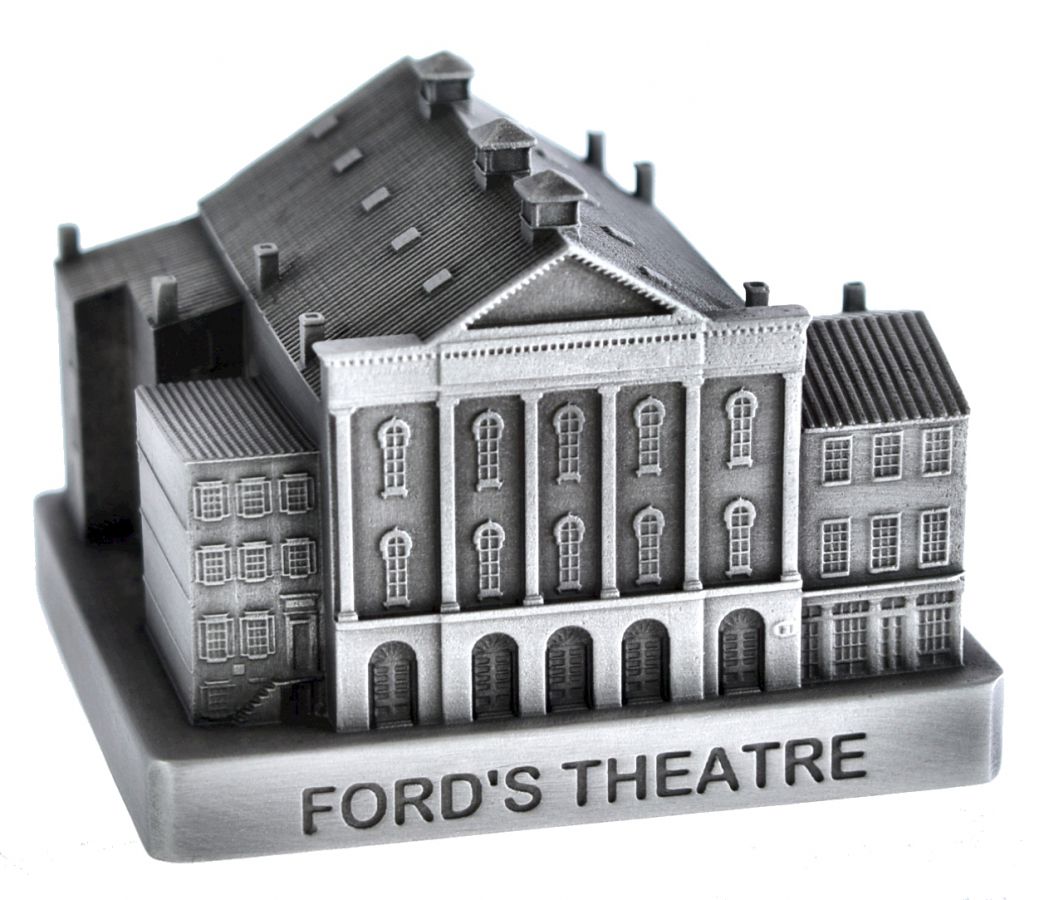
Ford's Theatre: An Amazing Replica for 2019


A Historic Building

On April 14, 1865, U.S. President Abraham Lincoln, 56, was shot in Ford's Theatre, Washington, D.C., by the actor John Wilkes Booth. The same evening, U.S. Secretary of State William H. Seward and his family were attacked at home by Lewis Powell. 

Lincoln died the next day at 7:22 a.m. in the Petersen House (10th Street, NW), across the street. The Petersen House was purchased by the U.S. government in 1896 as the "House Where Lincoln Died," being the federal government's first purchase of a historic home. The rooms of this house are furnished as they were on the day Lincoln passed away.

Ford's Theatre is a natural location to have memorialized as a replica building. The site was originally a house of worship, constructed in 1833 as the second meeting house of the First Baptist Church of Washington, with Obadiah Bruen Brown as the pastor. In 1861, after the congregation moved to a newly built structure, John T. Ford bought the former church and renovated it into a theater. He first called it Ford's Athenaeum. It was destroyed by fire in 1862, and was rebuilt.

On June 9, 1893, the front part of the building collapsed, killing 22 clerks and injuring another 68. This led some people to believe that the former church turned theater and storeroom was cursed. The building was repaired and used as a government warehouse until 1911.

It languished unused until 1918. In 1928, the building was turned over from the War Department Office to the Office of Public Buildings and Parks of the National Capital. A Lincoln museum opened on the first floor of the theater building on February 12, 1932—Lincoln's 123rd birthday. In 1933, the building was transferred to the National Park Service. 

On January 21, 1968, Vice President Hubert Humphrey and 500 others dedicated the restored theater. The theater reopened on January 30, 1968, with a gala performance. The presidential box is never occupied.

The theater was again renovated during the 2000s. It has a current seating capacity of 665. The re-opening ceremony was on February 11, 2009, which commemorated Lincoln's 200th birthday.

It is intriguing to observe that with the seating at 665, with the addition of John Wilkes Booth to the picture (not seated), the capacity is at 666.

A Unique Replica

On the occasion of the 154th anniversary of the assassination, Mike Merwine of InFocusTech (replicabuildings) has finally replicated in metal the site of Lincoln's political murder. As Merwine noted, "Events and places sometimes create legends that span centuries."


Replicas of these events are an important way to recall this incident and the links to it. For readers of this blog, you are well-aware of the special relationship that special names and incidents have in the past, present, and future with specific locations. Those linked to "Lincoln" certainly fall into this category.

Ford's Theatre As A Replica

Copies of Ford's Theatre come in a few rare selections, but the Merwine model is unique, for being detailed and solid metal. Order here by clicking on Ford's Theatre.

Paper Models, Inc. has a model kit, oriented to schools, of Ford's Theatre. It is made from paper.


In terms of high-end design replicas, several people know about and collect Constantin Boym's and Laurene Leon Boym's Ford's Theater (sic, the actual spelling is "Ford's Theatre"), from the series Buildings of Disaster, 1998-2008. 

Buildings from the series, originally priced as low as $110, today are valued from $200-$600. The stylized artifacts are a "design object" made from a cast resin-type material with bonded nickel in the mixture.


InFocusTech's 2019 example is detailed to reflect an authentic study of Ford's Theatre, from all sides. For a reasonable price: $85. (I would predict this piece will leap in value within a year or two. In 2065, this will be a rare collectible on the 200th anniversary of the assassination.)

The specifics are:

511 Tenth St, NW, Washington, DC

Architect Charles Lessig - restoration

Date Completed 1863 - Originally a church from 1833-59

Height in Feet 78

Floors 3

Replica Height 2 inches

Scale1" = 50'

Finish Shown Antique Pewter

It may be ordered directly from here.


++++
This critique of the replica of Ford's Theatre is done without any fiscal remuneration to the reviewer. I am a member of the Souvenir Building Collectors Society, and encourage interested parties to join the SBCS organization. ~ Loren

Sunday, January 07, 2018

Name Game: Lincoln

The twilight language explores hidden meanings and synchromystic connections via onomatology (study of names) and toponymy (study of place names). The “Name Game” paints a picture, and it has been a major part of my writings since the 1970s.

The Name Game is about the relationship between proper names and the sync, Fortean, and harmonic power found in these special monikers. One example cited by Jim Brandon, Matt Bell and myself is "Lincoln."

Something tells me, let's call it a hunch, that Lincoln will be one of the names giving us pause in 2018.


Lincoln: From a surname which was originally from the name of a city in England, derived from Brythonic lindo "lake, pool" and Latin colonia "colony.” Found written by Romans in the 7th century, administratively significant. Name often used in honor of Abraham Lincoln, 1809-1865.

“Lincoln” has been a power name for a long time in Fortean and sync literature.

Matthew Bell notes in "Hue of Lincoln," the following, with links to Cryptokubrology:

"The earliest origins of Lincoln can be traced to the remains of an Iron Age settlement of round wooden dwellings (which were discovered by archaeologists in 1972) that have been dated to the 1st century BC. This settlement was built by a deep pool (the modern Brayford Pool) in the River Witham at the foot of a large hill (on which the Normans later built Lincoln Cathedral and Lincoln Castle)...The origins of the name Lincoln may come from this period, when the settlement is thought to have been named in the Brythonic language of Iron Age Britain's Celtic inhabitants as Lindon 'The Pool'..." (Source);
cf. Stanley Kubrick's "Barry Lyndon."
...
And we see a connection, therefore, the names "Lincoln" and "Hugh." This sort of connection has been called a "Lexi-Link." Lexical nodes for "Linkin'" symbol patterns. Especially in the present context, then, we might instead call these "Lexi-Links" Lincoln Words/Names. Curiously, the inventor of "Lincolns Logs" was John Lloyd Wright: "John Lloyd Wright (December 12, 1892–December 20, 1972) was an American architect and toy inventor. ... He was the son of Frank Lloyd Wright and brother of Lloyd Wright." (Source)
Frank Lloyd Wright was "born Frank Lincoln Wright" (Source) Loren Coleman has recently written about Frank Lloyd-Lincoln Wright here and here (including Wright's connection to the word "Phoenix", FLW's place of death).

Read more from Bell's Lincoln discussion, here.

Furthermore, Bell connects other dots, here:

Coleman lists the movie "Killing Lincoln (2013)" as part of Tony Scott's filmography - and the predicted release date possibly "could be assumed to be 'characteristic' of, or symbolically identical with 23" (The Rebirth of Pan, p. 170). Of course, the killing of JFK has already been mentioned. And the parallels between the assassinations of Lincoln and Kennedy are legendary. Downard and Hoffman are also known for the monograph "King-Kill-33."
Of course, the Lincoln power name hooks up to Fayette too.


"Now I would like to consider some examples of a more ominous character," Jim Brandon in The Rebirth of Pan (1983) wrote, "We find 'the Lafayette factor' in the Abraham Lincoln assassination of the 1860s...A slippery character named Lafayette Baker had been brought in to head the Secret Service by the enigmatic Edwin M. Stanton, President Lincoln's arrogant Secretary of War. Otto Eisenschiml, the pioneer revisionist historian of this amazingly crude murder conspiracy, delved into the story as far as the surviving records would allow.""His findings suggest that Lafayette Baker and Stanton had maneuvered to facilitate the escape into the South of assassin John Wilkes Booth, and when that proved impossible (owing to Booth's broken leg) to ensure that the killer was not brought back and that his evidently-incriminating diary did not survive intact."
"At the same hour Lincoln was shot at Ford's Theatre, Secretary of State William Seward "was attacked and savagely knifed by a deranged giant named Lewis Paine, who had forced his way into the Seward home. This house fronted upon Lafayette Square, just across Pennsylvania Avenue from the White House."


"The Name Game" was written by U.S. singer Shirley Ellis with Lincoln Chase, and Ellis's recording, produced by Charles Calello, was released in late 1964 as "The Name Game." That record went to number 3 on the Billboard Hot 100, and number 4 on the magazine's R&B charts in 1965. The record was re-released in 1966 and again in 1973.

The first few lyrics make use of the songwriters' own names.

The name game. Shirley! Shirley, Shirley
Bo-ber-ley, bo-na-na fanna
Fo-fer-ley. fee fi mo-mer-ley, Shirley!
Lincoln! Lincoln, Lincoln. bo-bin-coln
Bo-na-na fanna, fo-fin-coln
Fee fi mo-min-coln, Lincoln!


A word chain game assumed musical history when Lincoln Chase and Shirley Ellis wrote a 1964 song. And it is intriguing that a "Lincoln" was right there in the middle of its creation.


Sources: 
Why Was Lincoln Murdered? by Otto Eisenschiml, Little, Brown & Co., Boston, Mass., 1937.

"Fateful Fayette" by Bill Grimstad, Fortean Times No. 25, Spring 1978.

Weird America by Jim Brandon, E.P. Dutton Co., New York, N.Y., 1978.

The Rebirth of Pan by Jim Brandon, Firebird Press, Dunlop, Illinois, 1983.

"The Fayette Factor," by Loren Coleman, Twilight Language, June 10, 2012.

"Tony Scott, etc.," by Matthew Bell, Bell Curve, August 21, 2012.
"Hue of Lincoln," by Matthew Bell, Bell Curve, October 13, 2012.

Tuesday, May 05, 2009

The Masonic Image of Napoléon

Napoléon Bonaparte died on May 5, 1821. The 5 feet, 7 inches of his height was normal for his time, but the British newspaper cartoonists had him shown as much smaller for political reasons.

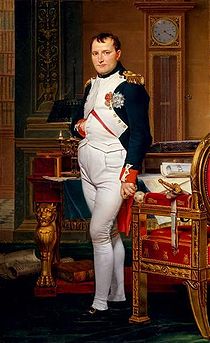
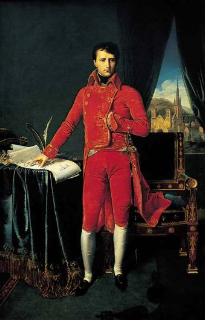
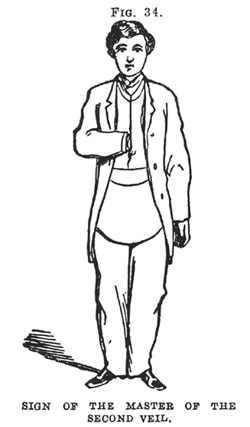
His famous "hidden hand" images were a broadcast signal of his links to the Freemasonry Brotherhood.


The Emperor Napoleon in His Study at the Tuileries, by Jacques-Louis David, 1812. Below, when he was younger.


The following drawing demonstrates the "Sign of the Master of the Second Veil," (7th Degree Mason) from Duncan's Masonic Ritual and Monitor, 1866.


View other "hidden hand" examples, here and here.


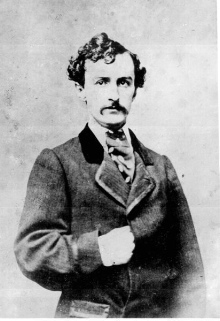
John W. Booth, whose membership among Masons is today mostly expunged.


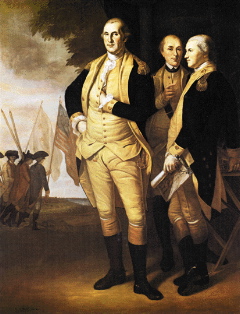
George Washington, whose Freemasonry membership is celebrated.

"The evidence in favor of a Masonic initiation previous to Napoleon’s assumption of the imperial title is overwhelming:
The initiation took place in the body of an Army Philadelphe Lodge of the — Ecossais — Primitive Rite of Narbone, the third initiation of the 'Ecole Communique' being an advancement in that Rite. These initiations took place between 1795 and 1798." ~ J.E. S. Tucket, "Napoleon I and Freemasonry," Ars Quatuor Coronatorum vol. xxvii (1914)

Thursday, April 09, 2009

Passover 1865: Lincoln Assassination

Events out of context often float adrift in time. April 14, 1865 has become important as the day that John Wilkes Booth shot Abraham Lincoln. For Americans of the Jewish faith, it was also Passover.

I share the following snippet to revisit how it felt during these under-discussed moments of the War Between the States.

Chapters in American Jewish History

Of Civil Seders in the Civil War

For American Jewry during the Civil War, the Passover story was especially powerful. Northern soldiers saw clear parallels between the Union freeing the South's slaves and Moses leading the ancient Hebrews out of Egypt. However, creating a seder during in a war zone requires flexibility and creativity.

In 1862, the Jewish Messenger published an account by J. A. Joel of the 23rd Ohio Volunteer Regiment of a seder celebrated by Union soldiers in Fayette, West Virginia. Joel and 20 other Jewish soldiers were granted leave to observe Passover. A soldier home on leave in Cincinnati shipped matzot and hagaddot to his colleagues. Joel wrote:

We . . . sen[t] parties to forage in the country [for Passover food] while a party stayed to build a log hut for the services. . . We obtained two kegs of cider, a lamb, several chickens and some eggs. Horseradish or parsley we could not obtain, but in lieu we found a weed whose bitterness, I apprehend, exceeded anything our forefathers "enjoyed.?"?

We had the lamb, but did not know what part was to represent it at the table; but Yankee ingenuity prevailed, and it was decided to cook the whole and put it on the table, then we could dine off it, and be sure we got the right part.

The necessaries for the choroutzes we could not obtain, so we got a brick which, rather hard to digest, reminded us, by looking at it, for what purpose it was intended.


Yankee ingenuity indeed! Historian Bertram Korn observes, "It must have been quite a sight: these twenty men gathered together in a crude and hastily-built log hut, their weapons at their side, prepared as in Egypt-land for all manner of danger, singing the words of praise and faith in the ancient language of Israel."

The seder proceeded smoothly until the eating of the bitter herbs. Joel recounted:

We all had a large portion of the herb ready to eat at the moment I said the blessing; each [ate] his portion, when horrors! What a scene ensued . . . The herb was very bitter and very fiery like Cayenne pepper, and excited our thirst to such a degree that we forgot the law authorizing us to drink only four cups, and . . . we drank up all the cider. Those that drank more freely became excited and one thought he was Moses, another Aaron, and one had the audacity to call himself a Pharaoh. The consequence was a skirmish, with nobody hurt, only Moses, Aaron and Pharaoh had to be carried to the camp, and there left in the arms of Morpheus.


More problematic was the situation of Union soldiers who, unable to form their own seders, were forced to "fraternize" with local Jews. Myer Levy of Philadelphia, for example, was in a Virginia town one Passover late in the war when he saw a young boy sitting on his front steps eating a piece of matzo. According to Korn, when Levy "asked the boy for a piece, the child fled indoors, shouting at the top of his lungs, "Mother, there's a damn Yankee Jew outside!" The boy's mother invited Levy to seder that night. One wonders how the Virginian family and the Yankee soldier each interpreted the hagadah portions describing the evils of bondage.

On the eve of the fifth day of Passover (April 14), 1865, Abraham Lincoln was shot and died of his wounds in the early morning of April 15th, which had already been scheduled as a national day of prayer to mark the end of the Civil War. Jews across the land were gathering in synagogues to give thanks. When news of Lincoln's death arrived, Korn notes, the synagogue altars were quickly draped in black and, instead of Passover melodies, the congregations chanted Yom Kippur hymns. Rabbis set aside their sermons and wept openly at their pulpits, as did their congregants. Lincoln had been protective of American Jewry, overturning General Grant's infamous General Order #11 expelling Jews from the Department of the Tennessee and supporting legislation allowing Jewish chaplains to serve in the military. The Jewish Record drew the analogy between Lincoln not having lived to see the reconciliation of North and South and Moses dying on Mount Pisgah before he saw the Israelites enter the Promised Land.

When no American armed forces are in combat anywhere in the world, it is easy to forget how difficult it can be for Jewish soldiers to serve their country while maintaining the traditions that beautify Judaism. Nevertheless, for Jewish Union soldiers fighting between 1861 and 1865 to free others from slavery, the Passover parallels must have made each seder particularly sweet and meaningful.