Showing posts with label Golden Dawn. Show all posts

Sunday, December 11, 2016

Pondering the Ghost Ship Fire


On December 2, 2016, a tragic fire occurred at a site in Oakland, California, known simply as "Ghost Ship."


The death toll was first reported to be 9, then 24, 30, 33, and finally 36. The numbers were always reported in multiples of three, for some strange reason.

On December 2, 2016, at approximately 11:30 p.m. PST, a fire broke out in a warehouse, known as Ghost Ship, that was converted into an artist collective and into unpermitted dwelling units in the Fruitvale neighborhood of Oakland, California. At the time of the fire, the warehouse was hosting a concert without a permit promoted by the house music record label 100% Silk.
A total of 36 people were killed in the fire, the deadliest in the history of Oakland. It was also the deadliest building fire in the United States since The Station nightclub fire in 2003, the deadliest in California since the 1906 San Francisco earthquake and the deadliest mass-casualty event in Oakland since the 1989 Loma Prieta earthquake....
The 10,000-square-foot (930 m2) (160 by 48 feet, or 49 m × 15 m) converted warehouse, known as Ghost Ship, was home to an artist collective known as Satya Yuga*, which worked there. At the time of the fire it was hosting a concert promoted by the house music record label 100% Silk, and featuring musicians from its roster. It took five hours for 52 firefighters, using 14 pieces of equipment, to extinguish the blaze. Source.
Yuga in Hinduism is an epoch or era within a four age cycle. A complete Yuga starts with the *Satya Yuga, via Treta Yuga and Dvapara Yuga into a Kali Yuga. Our present time is a Kali Yuga, which started at 3102 BCE with the end of the Mahabharata war.


As of December 11, 2016, all 36 victims had been identified. Seventeen-year-old Draven McGill, who sang in the Pacific Boychoir, was the youngest fatality of the fire. The identities of all 36 people who died in the December 2, 2016 fire at a converted warehouse in Oakland known as the Ghost Ship have been released. They are:


Cash Askew, 22, Oakland


Em B (a.k.a. Em Bohlka), 33, Oakland


Jonathan Bernbaum, 34, Oakland


Barrett Clark, 35, Oakland


David Cline, 24, Oakland


Micah Danemayer, 28, Oakland


Billy Dixon, 35, Oakland


Chelsea Dolan, 33, San Francisco


Alex Ghassan, 35, Oakland


Nick Gomez-Hall, 25, Berkeley


Michela Gregory, 20, South San Francisco


Sara Hoda, 30, Walnut Creek


Travis Hough, 35, Oakland


Johnny Igaz, 34, Oakland


Ara Jo, 29, Oakland


Donna Kellogg, 32, Oakland


Amanda Kershaw, 34, San Francisco


Edmond Lapine, 34, Oakland


Griffin Madden, 23, Berkeley


Joseph Matlock, 36, Oakland


Jason McCarty, 36, Oakland


Draven McGill, 17, Dublin


Jennifer Mendiola, 35, Oakland


Jennifer Morris, 21, Foster City


Feral Pines (a.k.a. Riley Fritz), 29, Berkeley


Vanessa Plotkin, 21, Lakewood (Los Angeles County)


Wolfgang Renner, 61, Oakland


Hanna Ruax, 32, Helsinki


Benjamin Runnels, 32, Oakland


Nicole Siegrist, 29, Oakland


Michele Sylvan, 37, Oakland


Jennifer Kiyomi Tanouye, 31, Oakland


Alex Vega, 22, San Bruno


Peter Wadsworth, 38, Oakland


Nick Walrath, 31, Oakland


Brandon Chase Wittenauer, 32, Hayward

+++

Some have thought of this as a blood sacrifice.

This is surely an event that is "hiding in plain sight" with its twilight language.

The building that burned is known as the "Oakland Ghostship"

Looking at many photographs of the inside gives a riddle within a maze. And the maze so on the minds of those following the Westworld drama was not far from these events. "To Hell and Back" (by fire) and "Die Well" ring out from that series.

" . . . while as many as 100 people were inside for a performance by the Golden Donna 100 Percent Silk touring electronic dance music show."

Golden Donna is an obvious word play on "Golden Dawn"

Modern coinage of Donna used as a feminine form of Donald (world ruler) or as a borrowing from the Italian donna (lady).
If one had to select a quote that would aptly sum up the "Occult David Bowie," it would probably be this one:
“I’m closer to the Golden Dawn
Immersed in Crowley’s uniform
I’m not a prophet or a stoneage man
Just a mortal with potential of a superman”
– Quicksand


The media spin game has turned the Ghost Ship's collective of artists, gays, lesbians, and trans folks into the focus to blame. But that appears misplaced.

Micah Allison and Derick Ion Almena. Photo: Facebook

Derick Ion Almena, 46, the warehouse's manager (not owner) has opened the door to thoughts of his leadership being cult-like, with elements of mind control involvement. Source.

The East Bay Times has done their own brief profile of Almena, taking out of context a few things he said on Facebook in recent months, including calling himself "the thriller love child of Manson, Pol Pot and Hitler." Referring apparently to past drug use and mandatory drug testing because of the CPS situation, Almena wrote, "Addictions never admitted armed me as revolutionary… as long as i seek help and healing, have current registration, pay my insurance, piss in a cup twice weekly … i can proverbally (sic) get away with murder."
A former neighbor described Almena in the last decade as having "a way about him like he was founding a new religion." Source.
Almena's "get away with murder" quote was similar to candidate Donald Trump's January 2016 statement in Iowa: “I could stand in the middle of Fifth Avenue and shoot somebody and I wouldn’t lose any voters."

Trump then said on September 9, 2016, of Hillary Clinton, that she "is so protected right now, she could walk into this arena right now and shoot somebody with 20,000 people watching––right smack in the middle of the heart––and she wouldn’t be prosecuted.”


The Ghost Ship fire fades from the public's consciousness quickly as the age of social media moves to other tragedies and melodramas.


H/T to Steve and Tom.

Tuesday, June 05, 2012

First MIBs Novel?


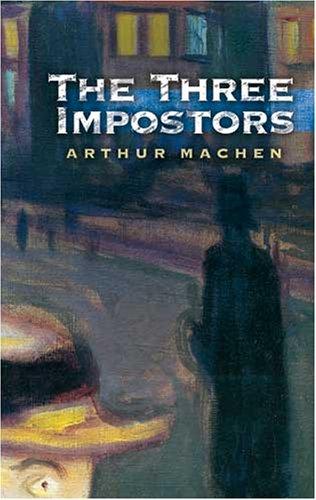
Was one of the earliest "men in black" fictional tales, about three MIBs, published five years before the turn of the 20th century? Perhaps so. This is a significant book written about three men in a secret organization in pursuit of a man "with spectacles" who possesses a vanished Roman coin denoting important mystic symbolism.

The Three Impostors "is the story of three men too absorbed by their own literary interests to realize the truth, or otherwise, of the events unfolding around them. These are Dyson, in thrall to his own imagination, Phillipps, an adherent to science, and Russell, who simply considers himself a realist," writes critic Mark Anderson.
Dyson, the man without a first name, lives in a "couple of rooms in a moderately quiet street in Bloomsbury," nevertheless, and is interested in what happened in the streets "beyond Whitechapel" (known infamously for the Jack the Ripper killings). Charles Phillipps lives "in a quiet square not far from Holborn," in the "calm retirement of Red Lion Square," and makes appointments with Dyson at "the shop in Queen Street." Edgar Russell "occupies a small back room on the second floor of a house in Abington Grove, Notting Hill."
In one tale told by Phillipps, the description imparted to him seems familiar to all who have read about the Men in Black:
I noticed that this man was leading my brother rather than walking arm-in-arm with him; he was a tall man, dressed in quite ordinary fashion. He wore a high bowler hat, and, in spite of the warmth of the day, a plain black overcoat, tightly buttoned, and I noticed his trousers, of a quiet black and grey stripe. The face was commonplace too, and indeed I cannot recall any special features, or any trick of expression; for though I looked at him as he came near, curiously enough his face made no impression on me -- it was as though I had seen a well-made mask. They passed in front of me, and to my unutterable astonishment, I heard my brother's voice speaking to me, though his lips did not move, nor his eyes look into mine. It was a voice I cannot describe, though I knew it, but the words came to my ears as if mingled with plashing water and the sound of a shallow brook flowing amidst stones. I heard, then, the words, "I cannot stay,"....
The Three Impostors is an episodic novel by British horror fiction writer Arthur Machen, first published in 1895 in The Bodley Head's Keynote Series. Its importance was recognized in its later revival in paperback by Ballantine Books as the forty-eighth volume of the celebrated Ballantine Adult Fantasy series in June 1972.

In Things Near and Far, Machen wrote:
It was in the early spring of 1894 that I set about the writing of the said Three Impostors, a book which testifies to the vast respect I entertained for the fantastic, New Arabian Nights manner of R. L. Stevenson, to those curious researches in the byways of London which I have described already, and also, I hope, to a certain originality of experiment in the tale of terror.
Partly in response to criticism of the Stevensonian style of the book, Machen altered his approach in writing his next book, The Hill of Dreams. Following the death of his first wife in 1899, Machen developed a greater interest in the occult, joining the Hermetic Order of the Golden Dawn. He noted that a number of events in his life seemed to mirror events in The Three Impostors, most notably a conflict in the order between William Butler Yeats (a "young man with spectacles") and Aleister Crowley, which reached its height around this time. These experiences are reflected on in Alan Moore's Snakes and Ladders.

The novel incorporates several inset weird tales and culminates in a final denouement of deadly horror, connected with a secret society devoted to debauched pagan rites. The three imposters of the title are members of this society who weave a web of deception in the streets of London—retailing the aforementioned weird tales in the process—as they search for a missing Roman coin commemorating an infamous orgy by the Emperor Tiberius and close in on their prey: "the young man with spectacles".

Two of the novel's inset tales, "The Novel of the Black Seal" and "The Novel of the White Powder," have been cited as major influences on the work of H. P. Lovecraft. In his survey Supernatural Horror in Literature, Lovecraft suggested that these stories "perhaps represent the highwater mark of Machen's skill as a terror-weaver." They have been frequently anthologized.

"The Novel of the Black Seal" has been cited as a model for some of Lovecraft's best-known stories: "The Call of Cthulhu," "The Dunwich Horror," and "The Whisperer in Darkness". "The Novel of the White Powder," which Lovecraft said "approaches the absolute culmination of loathsome fright," is pointed to as an inspiration for Lovecraft's stories of bodily disintegration, such as "Cool Air" and "The Color Out of Space".

The story "Rx... Death!" in Tales from the Crypt #20 is an adaptation of "The Novel of the White Powder," with the change made that the poisonous "medicine" contains digestive enzymes, rather than a witch's brew.

Mark Anderson looks for clues to Machen's message in the novel he released in the wake of The Three Imposters:
The novel The Hill of Dreams (1897) may be the longest suicide note in history, in its part-autobiographical depiction of a failing writer whose talent and unique personal vision is overlooked to the point where madness fatally perverts whatever it was he’d earlier harboured. Here, the author seems to be predicting his own fate; what may – and may yet – happen to him if he listens to all those who think he should give up his art and get a ‘proper job.’

Arthur Machen (March 3, 1863 – December 15, 1947) was a Welsh author and mystic of the 1890s and early 20th century. He is best known for his influential supernatural, fantasy, and horror fiction. His novella The Great God Pan (1890; 1894) has garnered a reputation as a classic of horror (Stephen King has called it "Maybe the best [horror story] in the English language"). He is also well known for his leading role in creating the legend of the Angels of Mons.

Machen was born Arthur Llewelyn Jones in Caerleon, Monmouthshire, though he usually referred to the county by its Welsh name Gwent. The house of his birth, opposite the Olde Bull Inn in The Square at Caerleon, is adjacent to the Priory Hotel and is today marked with a commemorative blue plaque. The beautiful landscape of Monmouthshire, with its associations of Celtic, Roman, and medieval history, made a powerful impression on him, and his love of it is at the heart of many of his works.

In 1887, the year his father died, Machen married Amy Hogg, an unconventional music teacher with a passion for the theatre, who had literary friends in London's bohemian circles. Hogg had introduced Machen to the writer and occultist A. E. Waite, who was to become one of Machen's closest friends. Machen also made the acquaintance of other literary figures, such as M. P. Shiel and Edgar Jepson.

In 1899, Machen's wife Amy died of cancer after a long period of illness. This had a devastating effect on Machen. He only gradually recovered from his loss over the next year, partially through his close friendship with A. E. Waite (famed for his Tarot card deck today). It was through Waite's influence that Machen joined at this time the Hermetic Order of the Golden Dawn.

Arthur Machen's influence may have waned today, but his influence remains in modern horror writers, and myths and motifs he created, from partially the Men in Black to the Angel of Mons.

The way we view Pan today may have as much to do with Machen as it does with the Greeks. "The Great God Pan" is a novella written by Arthur Machen.

In Supernatural Horror in Literature (1926; revised 1933), H. P. Lovecraft praised the story, saying: "No one could begin to describe the cumulative suspense and ultimate horror with which every paragraph abounds"; he added that "the sensitive reader" reaches the end with "an appreciative shudder." Lovecraft also noted, however, that "melodrama is undeniably present, and coincidence is stretched to a length which appears absurd upon analysis." The Encyclopedia of Science Fiction (1993) notes "The story begins with an sf rationale (brain surgery) which remains one of the most dramatically horrible and misogynistic in fiction."

The story's depiction of a monstrous half-human hybrid inspired the main plotline of Lovecraft’s The Dunwich Horror, which refers by name to Machen’s story. According to Lovecraft scholar Robert M. Price, "'The Dunwich Horror' is in every sense an homage to Machen and even a pastiche. There is little in Lovecraft's wonderful story that does not come directly out of Machen's fiction." It also inspired Peter Straub's Ghost Story.

The book was translated into French by Paul-Jean Toulet (Le grand dieu Pan, Paris, 1901). It was a major influence on his first novel, Monsieur du Paur, homme public.

Stephen King wrote in the endnotes for his story collection Just After Sunset (2008) that his newly published novella N. was "strongly influenced" by Machen's piece, which he noted, "surmounts its rather clumsy prose and works its way relentlessly into the reader's terror-zone. How many sleepless nights has it caused? God knows, but a few of them were mine. I think 'Pan' is as close as the horror genre comes to a great white whale." In another interview he stated: "Not Lovecraft; it’s a riff on Arthur Machen’s “The Great God Pan,” which is one of the best horror stories ever written. Maybe the best in the English language. Mine isn’t anywhere near that good, but I loved the chance to put neurotic behavior—obsessive/compulsive disorder—together with the idea of a monster-filled macroverse."