Showing posts with label Pan. Show all posts

Monday, September 02, 2019

Seth, Odessa, Osiris, and Pan


A gunman - begrudgingly identified on September 1, 2019, as Seth Aaron Ator, 36  - driving from Midland to Odessa, Texas, killed seven people while firing from his golden vehicle and then from a hijacked mail truck. He was fatally shot by police in a gun battle at an Odessa movie theater, the Cinergy, parking lot on Saturday, August 31, 2019. (Read more here.)

John E.L. Tenney shares: Twin Peaks site of shooting in Odessa.


There are several pieces of twilight language to be examined.

Odessa means "wrathful," and is the feminine version of Odysseus, which has taken on the connotative meaning of wandering, traveling adventure in honor of the famous voyage in Homer's epic The Odyssey.

Seth

The meaning of Seth is: Murdered Osiris. The meaning of Seth is: Anointed; compensation.

Set /sɛt/ or Seth /sɛθ/ (Egyptian: stẖ; also transliterated Setesh, Sutekh, Setekh, or Suty) is a god of chaos, fire, deserts, trickery, storms, envy, disorder, violence, and foreigners in ancient Egyptian religion. In Ancient Greek, the god's name is given as Sēth(Σήθ). Set had a positive role where he accompanies Ra on his solar boat to repel Apep, the serpent of Chaos. Set had a vital role as a reconciled combatant. He was lord of the red (desert) land where he was the balance to Horus' role as lord of the black (soil) land.

The divine model for the ancient Egyptian pharaoh’s rule was the myth of the death of Osiris at the hands of his brother, Seth, and the subsequent contest between Osiris’s son Horus and Seth for kingship over the earth. Through Osiris is the path to the symbolism of "corn."

Seth lived a total of 912 years, and then he died. Seth was the third son of Adam and Eve. Eve considered him to be a replacement for her dead son, Abel.

See below:


See

and

Corn, Christ and Osiris March 10, 2017


John E. L. Tenney is in the corn.

Aaron = a hellenized Hebrew masculine given name. According to other different theories, the name could be derived from various Hebrew roots meaning "high mountain," "mountain of strength," "exalted," or "enlightened," or "bearer of martyrs."

Ator = Venom.


The final episode of David Lynch and Mark Frost's Twin Peaks Season Three (released on September 3, 2017) takes place partially in Odessa, Texas. Cooper, believing Carrie Page is Laura, drives her to Twin Peaks. The season closes with a visual callback to Laura whispering to Cooper in the Red Room.

The Rebirth of Pan, Jim Brandon, 1983.


Some say the Gods are just a myth
but guess Who I've been dancing with...
The Great God Pan is alive!
in "The Return Of Pan" by Mike Scott, Dream Harder, 1993.


Monday, September 14, 2015

Let's Talk About Pan


Note the panpipe or pan flute around the neck of this new Peter Pan?

I'd like to commence a conversation involving the considered conclusions of Forteans and synchromystics. Specifically, I wonder how we all are feeling about the new Pan film? The movie is placing itself to the forefront with the use of the subtle marketing of the old Greek god of the wild, rustic music, and companion of the nymphs, Pan.


In the world of new movies, Pan is an forecoming synchrocinematic effort, directed by Joe Wright and written by Jason Fuchs. It stars Hugh Jackman, Garrett Hedlund, Rooney Mara, Amanda Seyfried, and Levi Miller as the title character. As an anonymous writer put it, Pan is "an invented origin story for Peter Pan and Captain Hook."


Pan is scheduled for release in the USA on October 9, 2015, and in the United Kingdom on October 16, 2015. I'm assuming worldwide distribution will follow.


I asked the author of The Rebirth of Pan and Weird America, Jim Brandon, to share some thoughts about the forthcoming Pan film:
Looks a bit misleading to me, since it's really about Peter Pan, of which there have been around ten versions, starting with Walt Disney’s in 1953, according to Netflix. Of course some are spinoffs like Hook (1991, with Dustin Hoffman and Robin Williams) and Finding Neverland (2004, with Johnny Depp and Kate Winslet).
The best treatment of the mythological character that I’m aware of would be the Spanish-made Pan’s Labyrinth (2006, with unknown players but good special effects). 


Craig Heimbichner, the co-author of Ritual America, forwards his reaction to Pan:
To the cognoscenti, Pan is not a benign or benevolent member of the Hellenic pantheon--Wiccans to the contrary--but a dark figure and a betrayer. The encoding of Pan symbols in the Group Mind fits the general pattern of the ignorant, seemingly playful, self-destructive behavior of the human race as the Kali Yuga winds down. 


Adam Parfrey, the lead coauthor of of Ritual America, notes that he once wrote about the modern-day manifestation of "Pan" in what I feel is today a classic article, "Pederastic Park?".

Also, he mentions an extension of his "Pan" sense of such cinema by Jimbo X in "Steven Spielberg: The King of Child Exploitation Cinema?"


As far as is known, Steven Spielberg is unattached to this version of the story.

Insights from others are shared by Matthew Bell:

According to the one of the 20th century's leading experts on ancient Rome, R. E. A. Palmer: "In Rome Pan, an old Greek god ..., was thought of as a deity of good health."
(Robert Everett Allen Palmer II, "Northern Campus Martius" [Studies of the northern Campus Martius in Ancient Rome], Transactions of the American Philosophical Society, vol. 80, no. 4, 1990, p. 36)

Here is the famous "Pan is dead," as cited in Hamlet's Mill: "Everyone has once read, for it comes up many times in literature, of that pilot in the reign of Tiberius, who, as he was sailing along in the Aegean on a quiet evening, heard a loud voice announcing that 'Great Pan was dead.' ...On the one hand, it announced the end of paganism: Pan with his pipes, the demon of still sun-drenched noon, the pagan god of glade and pasture and the rural idyll, had yielded to the supernatural. On the other hand the myth has been understood as telling of the death of Christ in the 19th year of Tiberius: the Son of God who was everything from Alpha to Omega was identified with Pan = 'All.'"
(Giorgio De Santillana and Hertha von Dechend, Hamlet's Mill: An Essay on Myth and the Frame of Time, paperback ed., 4th printing, Jaffrey, N.H.: David R. Godine Publisher, 1998, p. 275.)

There is a Socratic angle that is personally interesting to me. In his dialog Phaedrus, Plato has Socrates report that he could not remember his own past remarks on "love" (see also the Symposium): "...I can't remember at all because I was completely possessed by the gods..." (Socrates, Phaedrus, 263d; John M. Cooper and D. S. Hutchinson, eds., Plato: Complete Works, Indianapolis, Ind.: Hackett Publ., 1997, p. 540.)

Which "gods"? "Then I perceive that the Nymphs of Achelous and Pan the son of Hermes, who inspired me, were far better rhetoricians than Lysias the son of Cephalus." (Socrates,Phaedrus, 263d; B. Jowett, ed., Dialogues of Plato: Translated Into English With Analysis and Introductions, 3rd ed., vol. 1, New York and Oxford: Oxford Univ. Press, 1892, p. 472.)


Don't forget James Shelby Downard's "All that is hidden will be made manifest."
"All" in Greek is of course pan. Therefore, we may say: "Pan that
is hidden will be made manifest." ~ Matthew Bell.


In the realm of stream of consciousness linking of one thought to another, where Pan and Peter Pan turn up in the middle, Wayne J. Bush's Tricked by the Light blog captured an array of good illustrations and associations for the 2013 illustrated "Tricksters & the Trickster God."


What are your thoughts?

Wednesday, February 27, 2013

Kronospan: Swiss Workplace Shooting [Updated]


Update: A fourth person has died. Victor Berisha, 42, an ethnic Albanian from Kosovo, has been identified as the Kronospan shooter. He had been with Kronospan for ten years. The weapon used in the attack has been identified as a Sphinx AT 380 handgun, a compact pistol produced by a Swiss company.

+++


Central Switzerland is the latest location of a mass shooting in a canteen. Reports of several people being killed at their Swiss Kronospan workplace on Wednesday, February 27, 2013, are crossing the wires.


Cronus [Kronos] Devouring His Children by Francisco de Goya (1746-1828). 


Greek Pan.

Police in Lucerne canton (state) said in a statement that the shooting occurred shortly after 9 a.m. on the 27th instant at the premises of Kronospan, a wood-processing company in the small town of Menznau, west of Lucerne. They said there were “several dead and several seriously injured people” and that rescue services were deployed and the scene sealed off. They did not elaborate.

The local Neue Luzerner Zeitung newspaper cited a witness as saying that the shooter opened fire in the company canteen. Swiss news website 20min.ch, citing a reporter at the site, said police confirmed three deaths — including the assailant — and said seven people were injured, some of them seriously. Some say five have been killed.

However, police in Lucerne, the local administrative center, said they didn’t yet have figures. No identity or motive for the shooter was given.


Kronospan workers at the Menznau location.

According to the local town council, Kronospan has some 450 employees.Menznau is a municipality in the district of Willisau in the canton of Lucerne in Switzerland. Menznau is first mentioned in 1185 as Menzenowa.

Kronos is a Titan, the father of Zeus, Poseidon, Hades, Hestia, Demeter, and Hera.

Pan is the god of the wild, shepherds and flocks, nature of mountain wilds, hunting and rustic music, and companion of the nymphs. Pan also is linked to panic, behavior contagion, and the copycat effect.

Kronospan is the world’s largest manufacturer of wood panel products and laminate flooring. Kronospan began in 1897 when their first sawmill was founded in Austria. Their Oxford, Alabama plant is the company’s first in the United States, and sits on a 460 acre site in Calhoun County, Alabama.

February 27th is the 80th anniversary of 1933's Reichstag fire, in which Germany's parliament building in Berlin, the Reichstag, was set on fire (which was blamed on Communists by the Nazis, but probably set by Nazis).


In 2001, Friedrich Leibacher walked into the canton’s parliament in Zug armed with an assault rifle, shotgun, pistol, and homemade police vest. He killed 14 people before commiting suicide in an incident that was dubbed the “Zug massacre.”

See also, Cafeteria Carnage.

Thanks to InvInk for heads up.


Tuesday, June 05, 2012

First MIBs Novel?


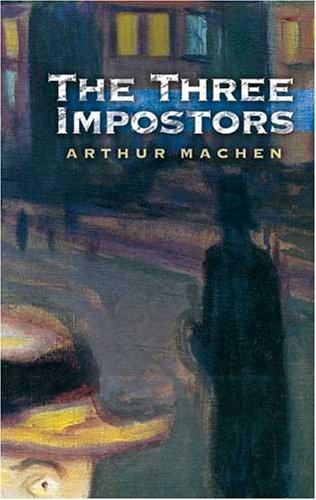
Was one of the earliest "men in black" fictional tales, about three MIBs, published five years before the turn of the 20th century? Perhaps so. This is a significant book written about three men in a secret organization in pursuit of a man "with spectacles" who possesses a vanished Roman coin denoting important mystic symbolism.

The Three Impostors "is the story of three men too absorbed by their own literary interests to realize the truth, or otherwise, of the events unfolding around them. These are Dyson, in thrall to his own imagination, Phillipps, an adherent to science, and Russell, who simply considers himself a realist," writes critic Mark Anderson.
Dyson, the man without a first name, lives in a "couple of rooms in a moderately quiet street in Bloomsbury," nevertheless, and is interested in what happened in the streets "beyond Whitechapel" (known infamously for the Jack the Ripper killings). Charles Phillipps lives "in a quiet square not far from Holborn," in the "calm retirement of Red Lion Square," and makes appointments with Dyson at "the shop in Queen Street." Edgar Russell "occupies a small back room on the second floor of a house in Abington Grove, Notting Hill."
In one tale told by Phillipps, the description imparted to him seems familiar to all who have read about the Men in Black:
I noticed that this man was leading my brother rather than walking arm-in-arm with him; he was a tall man, dressed in quite ordinary fashion. He wore a high bowler hat, and, in spite of the warmth of the day, a plain black overcoat, tightly buttoned, and I noticed his trousers, of a quiet black and grey stripe. The face was commonplace too, and indeed I cannot recall any special features, or any trick of expression; for though I looked at him as he came near, curiously enough his face made no impression on me -- it was as though I had seen a well-made mask. They passed in front of me, and to my unutterable astonishment, I heard my brother's voice speaking to me, though his lips did not move, nor his eyes look into mine. It was a voice I cannot describe, though I knew it, but the words came to my ears as if mingled with plashing water and the sound of a shallow brook flowing amidst stones. I heard, then, the words, "I cannot stay,"....
The Three Impostors is an episodic novel by British horror fiction writer Arthur Machen, first published in 1895 in The Bodley Head's Keynote Series. Its importance was recognized in its later revival in paperback by Ballantine Books as the forty-eighth volume of the celebrated Ballantine Adult Fantasy series in June 1972.

In Things Near and Far, Machen wrote:
It was in the early spring of 1894 that I set about the writing of the said Three Impostors, a book which testifies to the vast respect I entertained for the fantastic, New Arabian Nights manner of R. L. Stevenson, to those curious researches in the byways of London which I have described already, and also, I hope, to a certain originality of experiment in the tale of terror.
Partly in response to criticism of the Stevensonian style of the book, Machen altered his approach in writing his next book, The Hill of Dreams. Following the death of his first wife in 1899, Machen developed a greater interest in the occult, joining the Hermetic Order of the Golden Dawn. He noted that a number of events in his life seemed to mirror events in The Three Impostors, most notably a conflict in the order between William Butler Yeats (a "young man with spectacles") and Aleister Crowley, which reached its height around this time. These experiences are reflected on in Alan Moore's Snakes and Ladders.

The novel incorporates several inset weird tales and culminates in a final denouement of deadly horror, connected with a secret society devoted to debauched pagan rites. The three imposters of the title are members of this society who weave a web of deception in the streets of London—retailing the aforementioned weird tales in the process—as they search for a missing Roman coin commemorating an infamous orgy by the Emperor Tiberius and close in on their prey: "the young man with spectacles".

Two of the novel's inset tales, "The Novel of the Black Seal" and "The Novel of the White Powder," have been cited as major influences on the work of H. P. Lovecraft. In his survey Supernatural Horror in Literature, Lovecraft suggested that these stories "perhaps represent the highwater mark of Machen's skill as a terror-weaver." They have been frequently anthologized.

"The Novel of the Black Seal" has been cited as a model for some of Lovecraft's best-known stories: "The Call of Cthulhu," "The Dunwich Horror," and "The Whisperer in Darkness". "The Novel of the White Powder," which Lovecraft said "approaches the absolute culmination of loathsome fright," is pointed to as an inspiration for Lovecraft's stories of bodily disintegration, such as "Cool Air" and "The Color Out of Space".

The story "Rx... Death!" in Tales from the Crypt #20 is an adaptation of "The Novel of the White Powder," with the change made that the poisonous "medicine" contains digestive enzymes, rather than a witch's brew.

Mark Anderson looks for clues to Machen's message in the novel he released in the wake of The Three Imposters:
The novel The Hill of Dreams (1897) may be the longest suicide note in history, in its part-autobiographical depiction of a failing writer whose talent and unique personal vision is overlooked to the point where madness fatally perverts whatever it was he’d earlier harboured. Here, the author seems to be predicting his own fate; what may – and may yet – happen to him if he listens to all those who think he should give up his art and get a ‘proper job.’

Arthur Machen (March 3, 1863 – December 15, 1947) was a Welsh author and mystic of the 1890s and early 20th century. He is best known for his influential supernatural, fantasy, and horror fiction. His novella The Great God Pan (1890; 1894) has garnered a reputation as a classic of horror (Stephen King has called it "Maybe the best [horror story] in the English language"). He is also well known for his leading role in creating the legend of the Angels of Mons.

Machen was born Arthur Llewelyn Jones in Caerleon, Monmouthshire, though he usually referred to the county by its Welsh name Gwent. The house of his birth, opposite the Olde Bull Inn in The Square at Caerleon, is adjacent to the Priory Hotel and is today marked with a commemorative blue plaque. The beautiful landscape of Monmouthshire, with its associations of Celtic, Roman, and medieval history, made a powerful impression on him, and his love of it is at the heart of many of his works.

In 1887, the year his father died, Machen married Amy Hogg, an unconventional music teacher with a passion for the theatre, who had literary friends in London's bohemian circles. Hogg had introduced Machen to the writer and occultist A. E. Waite, who was to become one of Machen's closest friends. Machen also made the acquaintance of other literary figures, such as M. P. Shiel and Edgar Jepson.

In 1899, Machen's wife Amy died of cancer after a long period of illness. This had a devastating effect on Machen. He only gradually recovered from his loss over the next year, partially through his close friendship with A. E. Waite (famed for his Tarot card deck today). It was through Waite's influence that Machen joined at this time the Hermetic Order of the Golden Dawn.

Arthur Machen's influence may have waned today, but his influence remains in modern horror writers, and myths and motifs he created, from partially the Men in Black to the Angel of Mons.

The way we view Pan today may have as much to do with Machen as it does with the Greeks. "The Great God Pan" is a novella written by Arthur Machen.

In Supernatural Horror in Literature (1926; revised 1933), H. P. Lovecraft praised the story, saying: "No one could begin to describe the cumulative suspense and ultimate horror with which every paragraph abounds"; he added that "the sensitive reader" reaches the end with "an appreciative shudder." Lovecraft also noted, however, that "melodrama is undeniably present, and coincidence is stretched to a length which appears absurd upon analysis." The Encyclopedia of Science Fiction (1993) notes "The story begins with an sf rationale (brain surgery) which remains one of the most dramatically horrible and misogynistic in fiction."

The story's depiction of a monstrous half-human hybrid inspired the main plotline of Lovecraft’s The Dunwich Horror, which refers by name to Machen’s story. According to Lovecraft scholar Robert M. Price, "'The Dunwich Horror' is in every sense an homage to Machen and even a pastiche. There is little in Lovecraft's wonderful story that does not come directly out of Machen's fiction." It also inspired Peter Straub's Ghost Story.

The book was translated into French by Paul-Jean Toulet (Le grand dieu Pan, Paris, 1901). It was a major influence on his first novel, Monsieur du Paur, homme public.

Stephen King wrote in the endnotes for his story collection Just After Sunset (2008) that his newly published novella N. was "strongly influenced" by Machen's piece, which he noted, "surmounts its rather clumsy prose and works its way relentlessly into the reader's terror-zone. How many sleepless nights has it caused? God knows, but a few of them were mine. I think 'Pan' is as close as the horror genre comes to a great white whale." In another interview he stated: "Not Lovecraft; it’s a riff on Arthur Machen’s “The Great God Pan,” which is one of the best horror stories ever written. Maybe the best in the English language. Mine isn’t anywhere near that good, but I loved the chance to put neurotic behavior—obsessive/compulsive disorder—together with the idea of a monster-filled macroverse."