Showing posts with label Stephen King. Show all posts

Saturday, December 14, 2019

Cryptokubrology: 237 in Films of 1980 and Before


The film The Shining was released on May 23, 1980. The importance of finding the number 237 in movies that have appeared before and since The Shining has become a mainstay of #Cryptokubrology.
Cryptokubrology: "A useful methodology for deconstructing cinema, history, and synchronicity." ~ says Alex Fulton (@Crypto-Kubruology), January 31, 2017. 
Cryptokubrology has been defined as "digging through the works of Stanley Kubrick on the premise that its body is a muted mass of coded cabalistic ministrations comparable (in scope) to the works of William Shakespeare, but incomparable (in complexity) to anything in recorded history. In fact, Cryptokubrology has led to an entirely different view of so-called 'history' itself." ~ says Robert Shawn Montgomery (shawnfella)

The work in this realm has come in the wake of The Shining, of course. One of the foundation analyses is Room 237.

Room 237 is a 2012 American documentary film directed by Rodney Ascher about interpretations and perceived meanings of Stanley Kubrick's film The Shining (1980), which was adapted from the 1977 novel of the same name by Stephen King. The film includes footage from The Shining and other Kubrick films, along with discussions by a number of Kubrick enthusiasts. The film has nine segments, each segment focusing on different elements within the film which "may reveal hidden clues and hint at a bigger thematic oeuvre."


As the New York Times stated in 2013, "Like The Shining and its maze within a maze, Mr. Ascher’s movie is something of a labyrinth."

The film was produced by Tim Kirk. The title refers to a room in the haunted hotel featured in The Shining, which a character is warned never to enter. Ascher had a budget of $5,426, and made $296, 359 at the box office. It was a sterling success in the history of documentary film.


Another filmmaker who has studied the craft of Kubrick is Gary Leva. 

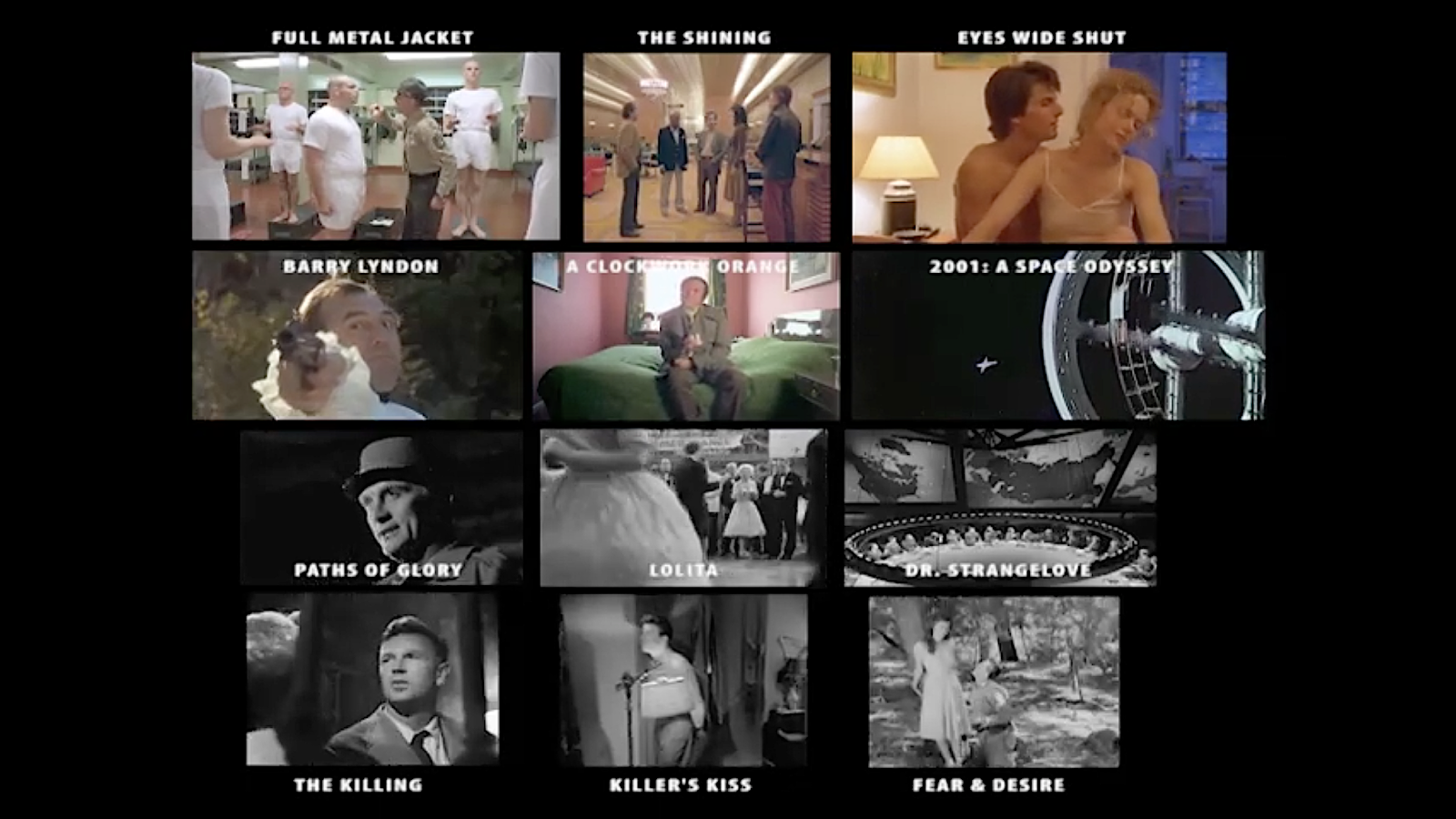
Leva Filmworks' "Stanley Kubrick Collection" includes (each link has a clip from his selection) the following:
Among the practitioners of Cryptokubrology, none are more prominent than Alex Fulton and Robert Shawn Montgomery, who are the co-creators of @Cryptokubrology on Twitter and the co-masterminds behind various cryptokubrology contributions on YouTube and Facebook.


Fulton and Montgomery have produced a series of YouTube videos: 


Who said "237"?


One major criticism I have, regarding a comprehensive understanding of the appearance of "237" in films is that directors - after The Shining (1980) - may be placing the number in their films as homage to Kubrick.

The best evidence for finding true cryptokubrological insights may come from concentrating on the pre-The Shining examples.

The Crypto-K series gives incidents of "237" being found in films. But as opposed to hundreds or thousands of instances, the series only mentions 31 films or television episodes where the number 237 is mentioned or shown (for example as an address or room number).  Of those, I find Fulton and Montgomery include only ten instances of pre-1980 cases of "237."

I have found others, such as in Torn Curtain (1966).
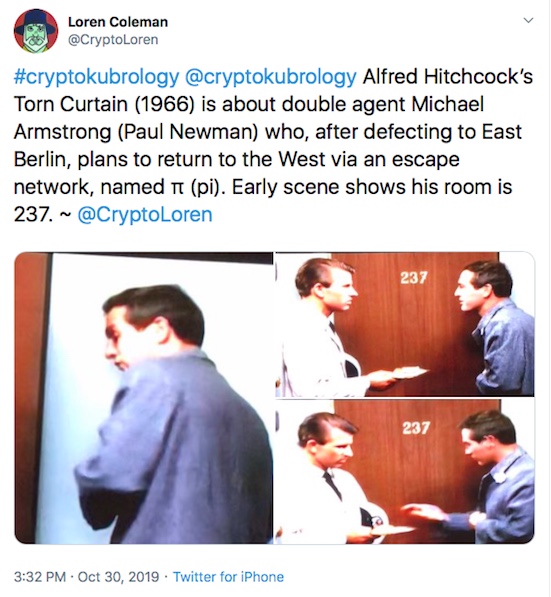

But let us look at those that Fulton and Montgomery cite in their videos from before and up to 1980. From watching their series, here is their complete list. These are enhanced with some of their screenshots, and revealed thus far (unless I missed any) where "237" specifically appears:

Possessed (1931)


Shop Around The Corner (1940)


Possessed (1947)


In the Good Old Summertime (1949)


The Three Faces of Eve (1957)


Sleeper (1973)


Sleeper (1976)

The Big Bus (1976)

The World Beyond (1978)

The Shining (released May 23, 1980)


The Blues Brothers (released June 20, 1980; filming occurred July to October 1979)


Wednesday, July 11, 2018

Thomas Hill Standpipe in Stephen King's Derry


This is a special gift given to me by my wife, Jenny.

Why is it special?

(1) Jenny handmade it for my birthday, July 12th, this year. It was a thoughtful gift.

(2) I collect souvenir buildings, and am a member of the Souvenir Building Collector Society. You might want to join.  

We tried to go to their convention this year, since they are regional and it was in New England in 2018. But as happens, tragedy struck and we had to cancel our reservations. 

Anyway, we have been trying to find a small replica of the Standpipe for awhile. All the building replicas and movie figures in the world, and no Standpipe? Why not?

Well, there is one replica I was able to track down, but since Jenny couldn't obtain it, I like hers better.


This giant replica of the Thomas Hill Standpipe is located at the 
Bangor International Airport.


Forced perspective?

The real thing.

Bangor, Maine = Stephen King's "Derry, Maine."


(3) The building, the Thomas Hill Standpipe, is an architectural marvel of Bangor, Maine, Jenny's hometown. The metal water tank is 50 feet high and 75 feet in diameter, and built in 1897. 


(4) The Standpipe is an important background "character" in the 1986 novel, Stephen King's It; Stephen King's It, the 1990 television miniseries; and Andy Muschietti's It: Chapter One, the 2017 film.


And finally...


(5) Stephen King's It has Pennywise, and you folks know how important Phantom Clowns are to me.


Thomas Hill Standpipe, which holds 1,750,000 US gallons (6,600,000 L) of water, is a riveted wrought iron tank with a wood frame jacket located on Thomas Hill in Bangor, Maine, United States. The metal tank is 50 feet (15 m) high and 75 feet (23 m) in diameter. Built in 1897, it is an architecturally distinctive city landmark, and was listed on the National Register of Historic Places in 1974. Source.


Now back to watching for breaking news of the Fayette name game, Killer Clowns, Waffle House shootings, and Bunnymen!


Friday, March 10, 2017

Corn, Christ and Osiris


In the wake of "Cinematic Corn: Oz, Twister, Signs, Interstellar, and More," here are some additional thoughts on the meaning behind the use of "corn" in films.

Osiris is the Ancient Egyptian Lord of the Dead, King of the Underworld, who was killed by His brother Seth and restored to life by Isis and Anubis. He was associated with the sprouting corn of springtime. ~ Thalia Took, A-Muse-ing Grace Gallery

At the beginning of the Dances With Wolves, Dunbar appears as "a Christ figure and sacrificial lamb" with the Confederate side's cornfield in the background. ~ Roderick Heath, Source.
Because Osiris is the Corn God = Christ on the cross = the scarecrow on the cross, etc. Thus, corn represents death and rebirth.
The ancient Egyptian's regarded their god Osiris as a corn god. For them, the death and rebirth of the god was personified in the annual growth cycle of the corn crops....

...Osiris was a corn god. This brings us to the famous Egyptian myth of Osiris, Set, and Isis.

Osiris and Isis
In short, Osiris' brother Set seals him in a coffin until he suffocates (note: he can't breathe) then throws the coffin in the Nile River. Osiris' wife Isis eventually finds the coffin where it landed in a tree and resurrects him, but then Set kills him again by chopping him up into pieces.  
~ Sibyl Hunter, Source. 
These themes are played out in various movies.

Isis in her bird form "raising" the dead Osiris
Inception: ...Mal wants to trap her husband Dom Cobb (Osiris, the Corn God of the Underworld, played by Leonardo DiCaprio) [Cobb, name game = corn = Osiris] in the dream world of the unconscious. 
~ Mask of God  
The Corn God is found in twilight language locations, such as on boxes of corn starch.


In 1957, the model Bettie Page played the corn god in a series of often-seen photographs from the era. 

Corn is a monoecious plant, meaning that it grows its male and female flowers on the same plant. The male flower of a corn plant is called the tassel, while the ear with its corn silk is the female flower. It is a very sexy plant. But like everything else in the 1950s, no one had to be hit over the head with this fact. It was done more subtly.


"Bettie Page In The Corn Field"

Bunny Yeager, photographer, 1957


As mentioned in my other corn posting, the appearance of "corn" is often subtle, as noted in The Shining (1980) via the maze / maize.


What can be seen, if you look more deeply, is more overt hints of "corn" in The Shining, through "corn flakes" and "frosted flakes." The corn is there.


There is no reason for all of these boxes of Frosted Flakes to be turned towards the camera, unless Stanley Kubrick wanted us to pay attention to them.

Kubrick definitely wished to highlight corn. Frosted Flakes turned up in obvious positioning.


There's Frosted Flakes again.


And Corn Flakes in the background.

Osiris revealed.
My corn I take seriously, because it's mine. And my potatoes and tomatoes and my fence I take note of because they're mine. But this war is not mine and I don't take note of it. ~ Charlie Anderson, played by James Stewart in Shenandoah (1965)


In Interstellar, the Cooper family eats meals consisting of all-corn dishes. But then, as Sibyl Hunter notes, it is almost sacrilegious when the adult Murphy burns the corn fields at the end of the movie. A rejection of the ancient Earth to move on to the Heavens?

In the 2016 film, Passengers, there are Easter Eggs that link to The Shining (1980). Where is the corn?


The space movies are magical mystery tours of these otherworldly mythos. Sometimes this is called "space corn."


As noted in "Cinematic Corn: Oz, Twister, Signs, Interstellar, and More," fiction films are filled with cornfields. In today's reality television, especially in occult programming, don't be surprised to see significant members of the cast placed in surroundings made up of corn. Are they representing Christ or Osiris?


Destination America, Ghost Stalkers, "Farrar School" - Season 1 Episode 6 - First air date:  November 20, 2014, John Tenney.

BTW, in the old (+ ancient) Old World, "corn" means any grain. In the modern movie age, the terms corn & maize are clearly in reference to the New World crop, fields & products.

Thanks to all whose names are mentioned.