Showing posts with label Lexilinks. Show all posts

Sunday, May 11, 2014

Trailers, Twisters, and Twilight Language


Is the chaos of Pan organized?


Folk wisdom says that tornadoes and trailers do not mix well. Some traditions even point to data that "trailers attract tornadoes."

The latter thought is said to be a myth. Or so we have been told.

As general sources like Wikipedia note, the idea that manufactured housing units, or mobile homes/trailers, attract tornadoes has been around for decades. This may appear to be true at first from looking at tornado fatality statistics: from 2000 to 2008, 539 people were killed by tornadoes in the US, with more than half (282) of those deaths in mobile homes. Only around 6.8% of homes in the US are "manufactured/mobile homes."

The skeptics say that it is highly unlikely that single-story structures such as mobile homes can have a substantial effect on tornado development or evolution. More people are killed in trailer parks because mobile homes are less able to withstand high winds than permanent structures, the debunkers remark. Winds which can demolish or roll a mobile home may only cause roof damage to a typical one- or two-family permanent residence. Another likely contributing factor to the continued propagation of this myth is confirmation bias: whenever a new instance of a tornado hitting a mobile home park occurs, media outlets report on it more extensively, ignoring damage to the surrounding area which may not have produced as many casualties, this according to Thomas P. Grazulis (2001: p. 12), "Tornado Myths" in The Tornado: Nature's Ultimate Windstorm. University of Oklahoma Press.

But among Forteans, tornadoes and trailers (a/k/a mobile homes) have been openly discussed since the 1970s.

Through indirect examples in Weird America (New York: EP Dutton, 1978) and then more directly in The Rebirth of Pan (Dunlap, Illinois: Firebird Press, 1983), Jim Brandon discusses the concept that trailers and tornadoes appeared to be tied together in the history of America.


"One of the most obvious and at the same time puzzling occurrences that must be grappled with by the Fortean anomalist are the recurrent outburst of hostile force that seem directed toward mobile homes." ~ Jim Brandon, The Rebirth of Pan, p. 123.

"Incidents of tornado devastation to house trailers...is a factor to be considered....I cannot avoid the feeling that there is a selectivity at work." ~
 Jim Brandon, The Rebirth of Pan, p. 134.

Now comes confirmation that the "myth" may not be a folktale, after all, and the Forteans were correct.

The study, entitled "Land-surface Heterogeneity Signature in Tornado Climatology? An Illustrative Analysis over Indiana 1950-2012," appeared on December 2, 2013, in Earth Interactions, a journal published by the American Metrological Society.

Researchers at an important research university think they have pinpointed areas where tornadoes are more likely to hit, said press accounts.  


Here lies the foundation of a mobile home destroyed in northeast Fayette County, Alabama, by a tornado on November 24, 2001.


Researchers looked at 60 years worth of climatological data from the National Weather Service’s Storm Prediction Center, and found tornadoes touch down most often in “transition zones” – areas where a dramatic change in landscape takes place. In other words, where tall buildings end and farmlands begin, or where a forest stops and the plains start.

Indiana state climatologist Dev Niyogi, who co-authored the study, said the data might explain why mobile home parks are often called tornado magnets, as they are typically located just outside city limits in open fields.

“That essentially goes to the heart of it,” he said. “How do we make settlements or landscape more resilient, and clearly there might be ways that we can make our livelihoods and lives safer.”

The study found tornado touchdowns in urban areas occur approximately 1 to 10 miles from the city center.


Mobile homes were hit hard in Belmont, Fayette County, 
Tennessee on Saturday, April 27, 2013.


“From an average person’s perspective, what the study looks into is what the future cities would look like, in terms of trying to avoid larger high-impact weather,” Niyogi said.

He said city planners might need to pay closer attention to the so-called transition zones when laying out large-scale construction plans in the future.

In an effort to better grasp where exactly tornadoes tend to touch down, the researchers concluded that twisters have a statistical preference for causing the most damage in so-called “transition zones” — geographic areas where two distinct types of landscapes meet and dramatically change. Examples include the fringe areas that fall between built-up suburban sprawl and rural farmland, dense forests and rolling plains. More often than not, these sparsely developed, lowly populated outskirts are where mobile home communities can be found in the greatest numbers.

According to the team's findings, between 1950 and 2012, 61 percent of tornado touchdowns in Indiana occurred within 1 kilometer of built-up urban areas. Forty-three percent of twisters touchdowns fell within a kilometer of heavily forested areas. In other words, primo areas for mobile home settlements.

This is not to say that tornadoes never strike cities and heavily populated urban centers (on occasion, they do) and that trailer parks are always located in transition zones. But the trend does shed light on why when many tornadoes strike, a trailer park or two on the far edge of town always seems to get hit and hit badly (the severity of damage has more to do with the construction of mobile homes and the fact they aren't anchored to the ground than geographic locale).

What university site would we find this research being conducted? In correspondence with Jim Brandon about this, he would write me:
What made me chuckle, though, is the little name game played on these explaining academics. Purdue (Fr. perdue = “lost”) University is located where? Why, West Lafayette, Indiana, of course.
That's right. The study occurred at Purdue University, Indiana State Climate Office, Purdue University, West Lafayette, Indiana.

See also, The Fayette Factor.


History of tornadoes in West Lafayette/Lafayette, Indiana.

At top:
An ithyphallic (“with erect penis”) Pan pursues a shepherd. Behind Pan the ithyphallic herm refers to Pan’s parentage from Hermes, and also to the rural setting. Red-figured vase, c. 470 BC, Museum of Fine Arts, Boston.


Thursday, February 27, 2014

New Hook Death?


You are seeing some of the revelation of the method, the heightened awareness brought to us in the brilliant and successful HBO series True Detective, which mixes the discovery of a ritualistic killer or group of killers and the abuse and murders of young people. (But this posting is not about the show and contains no spoilers.)

As I first reported here in 2010, in The Peter Pan/Hook Deaths, there seems to be taking place several underground child homicides, labeled as suicides and suicide attempts.

"I do not know how to find out anything new without being offensive." ~ Charles Fort

While I fully understand and am skeptical of all of this myself, as it all is beyond belief, I must point out a few things. I extensively studied and worked in the field of suicide for over 30 years, writing the first book to actually look at modern suicide clusters. Next, child suicides do exist, unfortunately, and kids under ten do take their own lives, usually by hanging. But also, we must be aware that there are some rather creepy pedophiles out there, who work in groups, and get jobs in schools, for example, that are filled with emotionally damaged and poor kids to supply their membership with fodder. 


The real "Peter Pan/Hook" incidents, if that's what's really occurring, evidence themselves in a series of relatively unexplained child deaths and near deaths. As I wrote in 2010, "These have been lexilinked by twilight names (Montana, Aquan, Imhotep; Chatham-Chatham), bizarre pedophilia hints (under investigation), and the common factor that the children were found hanged, often on a coat hook, often in bathrooms." These include cloakrooms at schools and youth areas in churches/libraries (where children should feel the safest).

Now word comes of a death which may be another record of one of these "hook" deaths, from Louisiana. In a spooky shadow of True Detective, the show's locale is Louisiana, and via other details for those who view the program.

The New Orleans Times-Picayune published the following on February 22 (updated February 24), 2014:
A sixth grader from St. Jean Vianney Catholic School in East Baton Rouge Parish has died by suicide.
The student, Ethan Rider, was found unconscious in a bathroom at the school on Thursday [Feb 20] and taken to a local hospital, and died early Saturday [Feb 22] morning, according to statements on the school’s website. The coroner’s office confirmed Friday [Feb 21], before Ethan passed away, that it was an apparent suicide.
Reports from locals indicate that the possible hanging was in the school bathroom.

Baton Rouge-Lafayette overlaps with the True Detective film sites. No need to go over the significance of the Fayette Factor. As to Baton Rouge, the Choctaw/Itta Homma name comes from the "red stick" placed at the border between two rival tribal groups.

Ethan, from the Hebrew, means "solid, enduring." Rider generally is referenced as "horseman" (in the Year of the Horse, it should be pointed out).

His middle name, Zane, means "gift from God." Our sincere condolences to the family.


Ethan Zane Rider's school was named for St. Jean Vianney (May 8, 1786 - August 4, 1859), who first established a school, and went on to be known for his priestly and pastoral work in his parish. All visages of him are rather bizarre because apparently the only know representation of St. Jean Vianney is from his death mask.

Who knows what or if any of this means anything? But the data is there. It should not be ignored.

"The tendency that I point out is that of so often rejecting both data and an explanation, simply because one rejects the explanation." ~ Charles Fort

Let me list some of the "hook" deaths, chronologically, which I first mentioned in 2010: 

1. Montana Lance, 9 - Stewart's Creek Elementary School, The Colony, Texas; January 21, 2010; allegedly hanged himself in bathroom; deceased.
2. Unnamed youth ~ Kanpur (old English Cawnpore), India; February 20, 2009; hanged from the hook of the toilet in a train; deceased.
3. Unnamed girl ~ South Side Chicago, Illinois; February 20, 2009; hanged on a clothes hook in home closet; deceased.
4. Unnamed boy ~ Chatham, Illinois; February 4, 2009; hanged by hook; deceased.
5. Aquan Lewis ~ Evanston, Illinois; February 3, 2009; hanged on a school bathroom hook; deceased.
6. Tevin Park-Flowers (a twin) ~ Austin, Texas; January 30, 2008; hanged by a hook in a gymnasium bathroom; pants were down at his ankles; deceased.
7. Unnamed boy ~ New Bedford, Massachusetts; January 30, 2008; found alive, hanging on a hook in a children's room of the New Bedford Public Library; man arrested, charged with child molestation and rape.
8. Unnamed child ~ Philadelphia, Pennsylvania; April 27, 2005; near death, found hanging on a hook in a school coatroom closet.
9. Imhotep Lubin ~ Brooklyn, New York; 2004; found alive hanging by his belt from a hook in a school closet; teacher arrested.
10. Unnamed child ~ Chatham, Ontario; 1998; hanged from a hook in school bathroom; deceased.

Is there a Peter Pan cult working underground? We need a few good true detectives.
I, again, share this comment on my original work:
As for the Peter Pan connection, study the symbolism of Peter Pan as 'the boy who wouldn't grow up' and his gang of 'lost boys' who were 'forgotten by their parents'. The hooks were these tragic children were found hanging from, a reference to Peter Pan's arch nemesis Captain Hook.
J.M. Barrie, the author of Peter Pan, lets him say this about death: "To die will be an awfully big adventure". One author, Kevin Orlin Johnson, has argued that the Pan stories are in the German-English tradition of the Totenkindergeschichte, the "tales of dead children".
And then there is Peter Pan's mythical realm Neverland, the name also given to Michael Jackson's ranch which, as some allege, is a place where one of the darkest kinds of violence against children was been performed. ~ Theo Paijmans.


J.M. Barrie, the author of Peter Pan, technically at 4 ft 10 in tall (question sources that promote an over five ft height), was a dwarf (which had a psychological impact on him). His child molestation-oriented letters and writings have often been overlooked, hidden, and suppressed. The overt story of Peter Pan gives clear hints of the deeper disturbing nature of the author and his followers.

The "Peter Pan" name has sinister links to a modern subculture of child maltreatment and sexual abuse in this country.

Oh, one more creepy factoid: Richard Ramirez was called the "Night Stalker," and an avowed Satanist. On August 18, 1985, moving his serial killing from Los Angeles to San Francisco, Ramirez entered the home of Peter Pan, aged sixty-six, and killed the sleeping man with a gunshot to his temple from a .25 caliber handgun. Pan's wife, Barbara, 62, was beaten and sexually violated before being shot in the head and left for dead. At the crime scene Ramirez used lipstick to scrawl a pentagram and the phrase "Jack the Knife" on the bedroom wall.


Wednesday, September 26, 2012

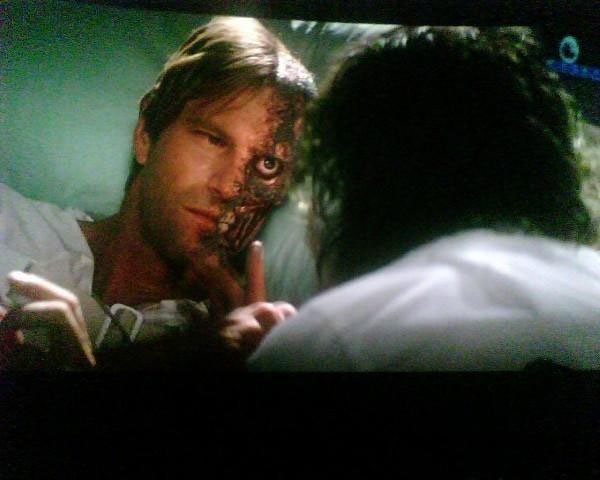
Oklahoma "Red" Suicide: Dressed As Batman's Two Face


Breaking News: Cade Poulos, September 26th's suicide, was dressed as the Batman supervillain Two-Face (Harvey Dent), for his school's "Super Hero Day." This appears to be in the realm of a copycat and continues the outcome we are seeing issuing from the "Bane/Joker" red dawn event in the wake of the Aurora shooting (July 20, 2012), allegedly carried out by James Eagan Holmes.

The comment from the Joker character that I quoted at the beginning of a recent posting, here, was delivered to Harvey Dent/Two Face in The Dark Knight (2008). There is a direct link from Bane/Joker to Harvey Dent/Two Face, Aurora to Stillwater, from Colorado to Oklahoma, from The Dark Knight Rises to The Dark Knight. The duality here is deadly obvious. We are sad to see that Cade Poulos' metaphoric flipping of the Harvey Dent/Two Face coin, to determine his own fate, landed on this tragic side.


The Daily Mail notes:
Several students told KOCO that Cade had gone to school dressed as the fictional character Two-Face, also known as Harvey Dent, for the day of costumes as part of Breast Cancer Awareness week.
***
Approximately 750 to 760 students attend the junior high school with students in grades eight and nine, according to Stillwater Superintendent Ann Caine.
The school sent a statement to parents saying there had been a 'single shooting incident' at the school and that staff and students – eighth and ninth graders – had been moved to a safe location. Parents were told to pick up their children at a nearby shopping center.
With Cade allegedly dressed as a popular Batman villain, the scene may have painted a grisly reminder of this summer's shootings at the Aurora, Colorado movie theatre where accused gunman James Holmes shot and killed 12 while dressed as the Joker.
'Everyone thought it was a joke at first,' ninth-grader Ashlyn Lundholm told the Stillwater NewsPress. 'Then I heard people screaming. Then we went to lockdown for 35 to 40 minutes.'

Cade Poulos


###


The Dark Knight character of Alfred Pennyworth (on right), Bruce Wayne's butler, was played by Michael Caine, in all three Christopher Nolan Batman films. 


Stillwater Superintendent Ann Caine is shown at the September 26th news conference, waiting to answer a question about the costumed Batman Harvey Dent/Two Face suicide event.

Earlier news:


Word has been received (early this a.m.) from the Red Dirt Report in Oklahoma that there's been a death in a school in Stillwater, Oklahoma. The victim of a fatal self-inflicted gunshot wound at Stillwater Junior High School is a student and the shooting occurred at 7:50 a.m. on Wednesday, September 26, 2012. The suicide victim took his own life in a hallway as the school day was beginning.

The dead youth has been identified as Cade Poulos, 13, a natural redhead, who some have compared to the recent images of the "Joker."

According to one legend, Stillwater, Oklahoma got its name because local Native American tribes, the Ponca, Kiowa, Osage, and Pawnee, called the creek “Still Water” because the water was always still. "[H]e leadeth me beside the still waters" (Psalm 23:2b).


The name Oklahoma comes from the Choctaw phrase okla humma, literally meaning red people. Choctaw Chief Allen Wright suggested the name in 1866 during treaty negotiations with the federal government regarding the use of Indian Territory, in which he envisioned an all-Indian state controlled by the United States Superintendent of Indian Affairs. Equivalent to the English word Indian, okla humma was a phrase in the Choctaw language used to describe the Native American race as a whole. Oklahoma later became the de facto name for Oklahoma Territory, and it was officially approved in 1890, two years after the area was opened to white settlers. ~ Wikipedia


++
Thanks AWG, AM, MB and CC.

Wednesday, July 11, 2012

Hockomock Name Game


Hockomock Swamp, Massachusetts.

I have written frequently of the bond between places named Devil and Forteana. Europeans coming to America were quite taken with the sinister experiences they had or they would hear about from the Native Americans already here, and these colonists started giving the name Devil to all the locations that were tied to unexplainable phenomena. Almost four decades ago, I wrote my first article about "Devil Names and Fortean Place," and people are still looking into it. A researcher with a remarkable names database living in the Pacific Northwest, Henry Franzoni, told me that as of August 1998, for example, he had found 2,635 places named (or which were formerly named) Devil, Diablo or Diabla in the United States.

Hockomock Point, Lincoln County, Maine.

In a related vein is the Algonquin Indian word for the Devil - Hockomock. I first mentioned this connection to the word "devil" in my book Curious Encounters and in early columns in Fortean Times. Franzoni found a total of 10 places in the US named Hockomock: six in Maine, where I now live; two in Massachusetts; one in New Jersey (Hockamik); and one in Minnesota (Hockamin Creek).

I once traveled to, explored thoroughly, and wrote about one of the most famous Hockomocks in the country - the Hockomock Swamp in the Bridgewater (Massachusetts) Triangle. It is a place where people vanish and creatures like giant snakes, Bigfoot, Thunderbirds, and Mystery Cats are frequently seen. Also, sinister crimes and cultic activity centers on locations within the area too. I have talked to Hockomock-area residents and Native Americans about the meaning of the name "Hockomock" to first discover its link to the word devil. Then I looked in a Depression-era Writers Project Administration (WPA) guide, the one entitled Massachusetts, and found it defined the variant name for the swamp, "Hoccomocco," as "evil spirit".

WPA guides are wonderful books to use to track down the origins of place names.

Most libraries have a specific reference book that is usually helpful in the playing of this game, George R. Stewart's American Place Names (NY: Oxford University Press 1970). The book contains and defines the meanings of 12,000 place names, and is a wonderful resource. But Stewart does not always get it completely correct.

Stewart, for instance, writes that "Hockanum, Hockamock, and Hocquan" are Algonquian for "the general idea of being hook-shaped." I know from my research about Hockomock in Massachusetts and Maine, that is not the whole story. Stewart goes on, however, and relates the words "Hobomak, Hobbomoc, Hobbomocka [as] Algonquian, with reference to an evil spirit (cf. Medicine, Waban) or the idea of a place being haunted; by the colonists taken to be 'the Indian devil,' [the name is found in connection to] several features in New England." (p. 207)

In Maine, of course, the "Indian devil" (or locally, "Injun Devil") was a Bigfoot-like creature in the mountains, seen up until the turn-of-the-19th-20th-century, or a panther-like beast in sighted in some forests.

Stewart is not to be totally trusted. For example, even though he clearly senses a relationship between the "evil spirit" origins of his "Hobomak" and "Waban," he defines "Waban" elsewhere in his book as "Algonquin, a name for the east wind," (p. 516).

For more, I have written about these lexilinks, of course, in 1983's and later editions of Mysterious America and in 1985's and later versions of Curious Encounters.

Also, you may find more on these name games:

Fayette/Lafayette/Fayetteville/Lafayetteville/LaGrange

Manitou

Bell/Beall

Watts/Watkins

Hopkins/Hopkinsville

Hobbs (plus 33 + 23)

Hemingway

Adamski/Burr Oak

Name Game and Synchromysticism