Showing posts with label Summer of the Gun. Show all posts

Saturday, September 22, 2012

Post-Aurora Lexilinking


By the pricking of my thumbs, 
Something wicked this way comes. 
~ William Shakespeare, Macbeth.

You know what I've noticed? Nobody panics when things go "according to plan." Even if the plan is horrifying! If, tomorrow, I tell the press that, like, a gang banger will get shot, or a truckload of soldiers will be blown up, nobody panics, because it's all "part of the plan." But when I say that one little old mayor will die, well then everyone loses their minds! Introduce a little anarchy. Upset the established order, and everything becomes chaos. I'm an agent of chaos. Oh, and you know the thing about chaos? It's fair!
~ The Joker, in The Dark Knight (2008), written by Jonathan Nolan & Christopher Nolan, story by Christopher Nolan & David S. Goyer, characters created by Bob Kane.

There are many ways to read the Joker's statement.

It is with some simplicity that academic thoughts may consider this summer's mass shootings as distractions from facing deeper societial issues. Harvard student Heather L. Pickerell did write, recently, comparing the 52 wounded and 12 killed in Aurora on July 20th with Iraqi causalities: "Did you know that 82 people were killed and 180 wounded by car bombs in Iraq on the same day as the shootings?"

While tragic and unfortunate, of course, she misses part of the bigger picture herself.


Wars, warzone deaths, systematic civil war causalities, and inner city gang shootings have become background noise in a culture that does experience violence closer to home in raw moments of stark realities. But in a broader context, before the latest homegrown wave of shootings dies down (sincerely, no pun intended), many other people will die, many others will be scarred, emotionally and physically, for life. Mass violence deaths, whether in Aurora, Columbine, and VA Tech, or in lesser remembered locations like Oak Creek, Bailey, and Nickel Mines, are as real, week to week, as the deaths in Afghanistan, Iraq, and Syria.

Believe it or not, the major difference is that the human psyche appears to consider it more understandable, even more rational, to conceptualize the loss of lives in national, regional, and turf wars. It is less within our frames of reference to figure out what is happening within the landscape of the human mind that leads to mass shootings. But both are equally awful.

Part of the rationale for a deeper examination of the copycat effect, an investigation of the behavior contagion among mass killers and spree shooters, has been to find a key to opening that door or window to the comprehension of things like the summer of shootings we have just experienced.

Often, it requires thinking outside the box. Therefore, one avenue of pursuit I have traveled down is seriously noting if lexilinking could be a factor. Let me explain.

First, what is "lexilinking" (for those of you who have never heard the word before)?


Several writers, like myself, began using "lexi-links" or "lexilinks" within articles we wrote for Fortean Times and other publications in the 1970s. 

Bob Rickard reminded me that "lexilink" was coined by Anthony J. Bell in his article, "Lexi-Links: Nature's Play on Words" in Fortean Times 17 (August 1976), pages 5-7.

Bell specifically looked at a new concept, lexilinks, and defined them this way:


Bell examined the "frequency of certain words" to attempt to decode what might be happening. He found that the "phenomenon of link-words" in articles and books is often "mirrored by link-words of events in the physical world." These incidents were, he surmised, related to "various violent events and no doubt have some sort of sociological significance," as he penned in that initial 1976 contribution.

Anthony J. Bell, who penned his letters with a northern English cadence, turned out to be a mysterious figure himself, with a mysterious name (see Bell). He ended up quietly appearing in Fortean Times twice after that. Bell wrote only one other article which developed the theme of puns and lexilinks in "Precession of the Gracious - Fallout of the Damned," in Fortean Times 20 (February 1977), on pages 14-17. He also sent in a brief letter on crop circles, which appeared in Fortean Times 58 (July 1991), in which he accurately predicted that crop circles would increase in complexity from their early simple designs.

Editor Bob Rickard wrote me in September 2012 that after the 1991 letter, at Fortean Times, "We never heard from him again."

Lexilink, as a word, has not actually entered any formal dictionaries. Wikipedia, indirectly, has apparently (in the past?) defined it vaguely this way: "A lexilink is a lexical link. This can be based on etymology, translations from other languages, and Anglicizations and other similar transformations."

Venturing into making some debunking comments related to "lexilinks," we then find this: "Lexilinks can be ascribed to coincidence, hoaxes, and some kind of conspiracy."

Not exactly a well-formed definition, it has vanished from the formal Wikipedia site, but the attempt lives on at Academic Kids.

Lexilinks are used in the twilight language analysis of events, frequently. Let's look at the Summer of the Gun's lexilinks, discovered in conjunction with the Aurora and post-Aurora world of 2012. Finding them brings up the usual questions. 

Are the coincidences found in the lexilinking being mined after Colorado's Aurora red dawn event, in some inexplicable way, part of the copycat effect? In other words, do what we are discovering synchromystically, as "coincidences" and "synchronicities," are variables in these cases that serve as cosmic triggers or programmed stimuli to the individuals involved? Do the shooters suddenly sense they are engaged in some form of theater reinforced by the lexilinking they find themselves in the midst of? Do the "coincidential" lexilinks act as risk factors pushing them over the edge?

The lexilinks found in the Aurora case and the shootings and related incidents that followed have been rather mind-blowing. The visual copycat effect experienced through repeating imagery of colorfully-haired Jokers and body-armored Banes is easier to understand. But the appearance of names in the stories, one linked to the other, is more difficult for the human brain to compute.

Take, for example, the visual linking that may have been overlooked, even though I mentioned it briefly before. The first verbal and written reports of the shooter - before any photographs were published of James Eagan Holmes - told of the Aurora killer having a goatee (even though this apparently did not turn out to be true, we are told). For example, moviegoer Corbin Dates, 23, who was sitting in the second row for the midnight premiere of The Dark Knight Rises, told television news reporters of a man sporting a goatee who, before the film started, answered a cell phone call, then got up and propped open an emergency exit door.

Guess what "look" appeared over and over in the first wave of Aurora copycats? Yes, most of these copycats had scruffy beards and goatees:


Let's look, therefore, beyond the visual, at a few of the specific word lexilinks that have popped up related to the Aurora events. (BTW, this rendering is not comprehensive, but it shows some highlights. Please pass along more, via comments, below.)

During the spring of 2012, the area around Denver, Colorado was swept by wildfires.

The political news was filled with presidential candidate Mitt Romney's Bain (= bones, death, white) Capital involvements.

Excitement was building on the horizon for the release of The Dark Knight Rises: A Fire Will Rise, a film by Christopher Nolan starring Christian Bale as Batman/Bruce Wayne and Tom Hardy as the super-villian Bane (= bones, death, white).

At the July 20, 2012, midnight showing of The Dark Knight Rises in Century 16's Theater 9, a man dressed in a gas mask, body armor, and with automatic weapons - dressed as Bane - opened fire on the movie audience in Colorado (= red), in Aurora (= dawn). The suspect then takes off his Bane costume to reveal himself to have orange hair, and declared himself, "I am the Joker."

The suspect was arrested. His name is James Eagan (= fiery) Holmes. He killed 12, and wounded 52 others.

Several copycat incidents occurred, some reflecting the Aurora incident, alluded to being Jokers or Banes.

For example, one of them on July 31, 2012, resulted the arrest of Thomas Michael Casper for a report of loud music ended up taking Casper making repeated references to "the Joker" and the Colorado theater shooting, telling police he understood the shooter's motives and would embark on his own rampage. The lexilink that became quite obvious was that this incident occurred in Eagan, Minnesota, a town with the same middle name as James Eagan Holmes, the Aurora suspect.

The Sikh Temple shooting took place on August 4, 2012, at Oak Creek, Wisconsin, resulting in seven dead, including the shooter Wade Michael Page (who lived on Holmes Avenue in nearby Cuhady, Wisconsin) and use to live in Littleton, Colorado (location of Columbine). Page, it has been pointed out, is the squire of a knight, and Wade Michael Page, as a neo-Nazi envisioned himself a Dark Knight. On July 20, 2012, a misidentification occurred when another James Holmes living in Littleton, Colorado had his Facebook page flooded with comments.

On the night of September 4, 2012, a gunman shot and killed one person during the Parti Québécois victory rally in Montreal, Quebe, Canada. Guards whisked PQ leader Pauline Marois off the stage as handlers informed the partisan crowd there had been gunfire and an arson fire had been set in the back of the Metropolis concert venue.

The suspect arrested was named Richard Henry Bain, and he owned Les Activités Rick Activities, a fishing camp on Lake Wade in La Conception, near the resort of Mont-Tremblant.

Richard Henry Bain, above, and Bane, the villian, below.

On September 5, 2012, police arrested a man wearing "Joker" makeup at a Florida movie theater after someone reported the man acting suspiciously, the Melbourne Police Department said. When police arrived at the Premiere Theatre, they found 21-year-old Christopher Alex Sides with his face painted like the Joker from the Batman movies and his hair dyed pink (or orange in some lighting). What was soon discovered was his intriguing address.


CHRISTOPHER ALEX SIDES W/M DOB: 05/07/91 ARREST DATE: 09/05/12 ARRESTING AGENCY: BCSO FAILURE TO APPEAR (Booking Photograph)

An earlier arrest is part of the recent public record: "Christopher Alex Sides, 19, of 1802 Aurora Park Circle, Melbourne, was charged April 17 with felony violation of conditional pre-trial release." "Police Report - Melbourne, Brevard County Sheriff's Office," Hometown News, April 29, 2011.

That's right. Sides lived in a trailer at the Aurora Park.


Enough for now. The lexilinks abound.

Oh yes, be alert next summer.

The new Superman film, Man of Steel, is due to be released on June 14, 2013 (Flag Day in the USA).
Oral tradition passed on through multiple generations holds that on June 14, 1908, Theodore Roosevelt was dining outside Philadelphia, when he noticed a man wiping his nose with what he thought was the American Flag. In outrage, Roosevelt picked up a small wooden rod and began to whip the man for "defacing the symbol of America." After about five or six strong whacks, he noticed that the man was not wiping his nose with a flag, but with a blue handkerchief with white stars. Upon realization of this, he apologized to the man, but hit him once more for making him "riled up with national pride." Source.
Man of Steel covertly staged part of their film pre-production and production work from a trailer near the International House of Pancakes, the IHOP, in Aurora, Illinois (pictured), at Orchard Road and Interstate 88, on July 27, 2012.

The production company did some filming later in August 2012, in Illinois, in Plano (the same name of a town in Texas directly associated with waves of suicide clusters and suburban heroin overdoses).


Man of Steel is from Warner Brothers, as are the three The Dark Knight films. The fear of the Superman curse appears to be a cause for concern among a few Warner executives. The hex has haunted Superman films and television programs for decades.

The Dark Knight trilogy's Christopher Nolan produced and cowrote (with David S. Goyer) Man of Steel, which is the first part of an 8-hour long trilogy. The director is
Zack Snyder, whose films, Dawn of the Dead (2004), 300 (2007), Watchmen (2009), and Sucker Punch (2011), are well-known for their graphic-novel-like violence.


American trailer: Kevin Costner narrates.


International trailer: Russell Crowe narrates.


Saturday, September 08, 2012

Cycles: What's Next?

Neo-Nazi/Native Jeff Weise killed nine and 
then himself in Red Lake, Minnesota, on March 21, 2005.

As the Summer of the Gun fades into a Fall of War or an October Surprise event (in Iran, shortly after Israel attacks near the new moons of September 15th or October 15th), we may be then looking at new rounds of shootings next spring. (Of course, others may be correct in saying no hits against the Iranian nuclear facilities will occur at all, or if they do, nothing will happen until next spring, after the US presidential election.)

One becomes keenly aware of the cycles of these phenomena.

Growing violence over the winter of 2005 appeared to predict the coming of a "red danger zone," resulting in the Red Lake Massacre. We should watch closely the indicators forthcoming. I foresaw something happening like that, and wrote of it on March 18, 2005, and it came to pass on March 21, 2005.

Strangely, the Red Lake incident seemed to involve some Bigfoot hints to it. The Randy Lee Tenley event on August 20, 2012, where he dressed ("masked himself") as a Bigfoot to create a hoax, and was struck dead on Highway 93, in Montana, has given many pause to consider "why now"? Nothing like that had ever happened before.

Several threads are coming together, bizarrely.

Monday, September 03, 2012

Running Amok


Will this Summer of the Gun 2012 end during this Fall, or will the mass shootings spread to school and related violence in other countries in Europe, Asia, and Australia? Are people "running amok"?

In the wake of the new killings outbreak in Alabama in 2009, I was asked: "When people 'run amok' in Malaysia and Indonesia does it happen in clusters or cyclically?"

The Amok "cartoon" can be translated as "'Kevin was out of luck: The school was already evacuated. The copycats were faster again…'"
The biting humor in this image illustrates a coincidence of name and reality.

"Running amok" (derived from the Malay word amuk, meaning "mad with rage") is as much a product of the copycat effect, as any other language's similar behaviors. The word was made popular by the colonial tales of Rudyard Kipling (an important Freemason writer whom I discussed once at this blog in conjunction with Slumdog Millionaire).

Star Trek even science-fictionized the concept in the episode "Amok Time" in which Vulcans are said to have periods of irrational behavior. (This episode turned out to be culturally significant, also, for the widely repeated Vulcan hand signal used by Spock, was used for the first time on this episode.)

"Running amok" is merely a culturally-framed phrase to attempt to describe the underlying suicidal behavior that is viewed as a "murder-suicide rampage" today.

For example, here is how Wikipedia approached this topic in 2009:
Behaviour strongly reminiscent of amok is also found in Western societies, and indeed the term is often used to refer to the behaviour of someone who, in the grip of strong emotion, obtains a weapon and begins attacking people indiscriminately, often with multiple fatalities. The slang term going postal is similar in intent and more common today, particularly in North America. Police describe such an event as a killing spree. If the individual is seeking death an alternate method is often suicide by cop.

In contemporary Indonesia, the term amok (amuk) generally refers not to individual violence, but to apparently frenzied violence by mobs. Indonesians now commonly use the term 'mata gelap' (literally 'darkened eyes') to refer to individual amok.

Norse berserkers and the Zulu battle trance are two other examples of the tendency of certain groups to work themselves up into a killing frenzy.

Antonio Canale "created 'Amok', his most famous character, scripted by Cesare Solini. For this series, Canale used the pen-name Tony Chan," notes the Comiclopedia.
The 1911 Webster Encyclopedia comments:
Though so intimately associated with the Malay there is some ground for believing the word to have an Indian origin, and the act is certainly far from unknown in Indian history. Some notable cases have occurred among the Rajputs. Thus, in 1634, the eldest son of the raja of Jodhpur ran amok at the court of Shah Jahan, failing in his attack on the emperor, but killing five of his officials. During the 18th century, again, at Hyderabad (Sind), two envoys, sent by the Jodhpur chief in regard to a quarrel between the two states, stabbed the prince and twenty-six of his suite before they themselves fell.
All of these behaviors, whether of school shootings, going postal, workplace violence, church/temple shootings, rampage killings, or running amok, have usually been all about suicide.

Even the Wikipedia writer agrees:
"Amok episodes of this kind normally end with the attacker being killed by bystanders, or committing suicide."

"Some observers have related this explanation to Islam's ban on suicide, which, it is suggested, drove Malay men to create circumstances in which others would kill them."

Amok is "in fact, the Malay equivalent of suicide."

To ask for firm answers about "amok" is to try to understand the essence of suicide, which, of course, is one of the most mysterious topics about humans that exists.


Monday, August 27, 2012

First Day of School: First School Shooting


It begins. How will it end?

After 2012's Summer of the Gun, no one should express surprise that the first day of the new school year would experience a school shooting. That's how the copycat effect works.


The shooting occurred at Perry Hall High School (established in 1963), located at 4601 Ebenezer Road, Perry Hall, Maryland.


Ebenezar means "stone of help."
This was the memorial stone set up by Samuel to commemorate the divine assistance to Israel in their great battle against the Philistines, whom they totally routed (1 Sam. 7:7-12) at Aphek, in the neighborhood of Mizpeh, in Benjamin, near the western entrance of the pass of Beth-horon. Ebenezer is mentioned three times in the Bible.
On this very battlefield, twenty years before, the Philistines routed the Israelites, “and slew of the army in the field about four thousand men” (4:1,2; here, and at 5:1, called “Ebenezer” by anticipation). In this extremity the Israelites fetched the Ark of the Covenant out of Shiloh and carried it into their camp. The Philistines a second time immediately attacked them, and smote them in a great slaughter, “for there fell of Israel thirty thousand footmen. And the Ark of God was taken” (1 Sam. 4:10). And now in the same place the Philistines are vanquished, and the memorial stone is erected by Samuel.
Source.


Synchromysticism does happen. Between 9:55 am and 10:17 a.m. EDT this morning, Red Dirt Report editor Andrew Griffin and I were discussing films. He said he had just watched Indiana Jones and the Kingdom of the Crystal Skull. To which I replied,
Synchronicity strikes again: I just read the paper. The one thing that struck me was in the movie section. The only IMAX in Maine, ten miles away, which has been playing Dark Knight Rises since July 20, 2012, is mentioning a [new] choice starting September 7th. Indiana Jones and the Raiders of the Lost Ark, on the IMAX. Interesting you should mention the franchise.

The "Lost Ark" noted in the first Indiana Jones movie is about the Ark of the Covenant, not Noah's Ark, as is often mistakenly recalled. The name Ebenezar is a direct link to the Ark of the Covenant. So why would Ebenezar, Ark of the Covenant, and Indiana Jones come into play, here and now? Is the Cosmic Joker pointing out attention to Israel-Iran, even in events like this?

The calls to 911 alerting the police to the school shooting at Perry Hall High School started coming in Monday, shortly before 11 a.m. EDT.

Today was the first day classes for the 2012-13 academic year at Perry Hall High School, located near Baltimore.

Unconfirmed reports published by CBS News indicate the Perry Hall school shooting occurred in the cafeteria and the victim was shot in the back. Parents of Perry Hall High School students also told the local news affiliates that some type of threat about Perry Hall was posted on Facebook, but those claims are also currently unconfirmed.

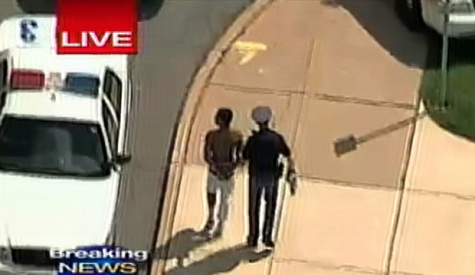
CBS reported the Perry Hall High School shooting victim is 17-years-old and the alleged shooter, 15, was seen being escorted to a waiting police cruiser shirtless and in handcuffs (photos at top). The student shot at the Baltimore high school is reportedly in serious condition.

City council member David Marks, who called the shootings "horrific," lives near the Perry Hall High School and told The Baltimore Sun that he is currently hearing “a lot of helicopters” overhead.

Students are being escorted to the nearby Perry Hall Shopping Center at the corner of Ebenezer Road and Belair Road. "Belair" is from the French, a respelling of French Belleaire, a nickname for someone with a pleasant demeanor, from belle "lovely" + aire "demeanor," "manner." For more about the name "Bell," see here.

Update: The suspected school shooter is 15-year-old Robert Wayne Gladden, Jr., who has been charged as an adult with attempted first degree murder and first degree assault. He is being held without bail at the Baltimore County Detention Center. (For more on the "Wayne" middle name game phenomena, see here, here, and here.)


In 1987, the John Waters movie Hairspray was filmed at Perry Hall High School.

Saturday, August 25, 2012

Summer of the Gun

by Loren Coleman ©2012
Jeffrey T. Johnson will forever be known as the Empire State Building Shooter who disturbed New York City during the Summer of the Gun. A fan of McDonald's breakfasts, of a grey suit, and of painting pirate art for his teeshirt company, we are being told Johnson simmered for a year. Then he committed a murder during a moment of workplace violence at his former job site, Hazan Imports. Johnson was taken out via "suicide by cop." Nine bystanders were injured in seconds, during the firefight across the street from the Empire State Building.

The Empire State Building shooter apparently "opened fire across from the Legends Bar. Of course, Ridley Scott [Tony Scott's brother] directed the 1985 film, Legend. It's a very interesting word from the point of view of ritual sacrifice," writes correspondent Matthew Bell. He further shares the definition below.

"Legend" derives from the Latin "legendus" (from "legō," or "pick out, select") which has an interesting semantic range. From Wiktionary, "legendus" can designate that: 
1. which is to be chosen, selected, appointed; 2. which is to be collected, gathered, brought together; 3. which is to be taken, stolen; 4. which is to be traversed, passed through; or 5. which is to be read (aloud), recited.
How do we put all of this in context? Humans, via their words and media, come up with umbrella terms, of course.
As long ago as early July 2012, Sun News television commentaries in Canada were using the term "Summer of the Gun." Joe Warmington's “summer of the gun” commentary was called "fear mongering," even as Canada's increasing gang fights and gun violence skyrocketed.
The phrase "Summer of the Gun" is a natural one, of course. For example, a Western novel used it as a book title in 2000. Many people have employed it in 2012.

After the red dawn event of Colorado's Aurora on July 20, 2012, the USA, then North America, and finally the world, woke up to the unique period of violence in which we find ourselves. By August 2012, several media outlets, like the Atlantic, began using "The Summer of the Gun."

The non-stop wall-to-wall coverage, however, caused some thoughts on "Going Numb in the Summer of the Gun," as the Atlantic Wire termed it. By the time Secret Sun's Christopher Loring Knowles used it to mention his radio appearance on August 24, 2012, the phrase had gained widespread use.

After the fatal shootings at Aurora (13 dead), Pendleton (2 dead), Oak Creek (8 dead), College Station (3 dead), and Empire State Building (2 dead), combined with a recent rash of "insider" or "green on blue" shootings occurring in Afghanistan and Mexico, you do get the idea that people are being pushed over the edge. Even gang violence, whether in Canada or Chicago or LA, is being highlighted and seems to be increasing. "Summer of the Gun" is a logical moniker for the media to employ. 

During a climate of many media-driven mass shootings, often ending in the death of the shooter, those sitting on the anger-vulnerability-suicidal-homicidal fence fall off and take action via a model for behaving that is presented to these individuals by the mainstream press and news reports. These people then go out shooting. It's called the copycat effect. 

I noted in my 2003 book, The Copycat Effect, that we have seen something like this before. During the warm months of 2001, in the Northern Hemisphere, the "if it bleeds, its leads" media called that period the "Summer of the Shark." It was also the "Summer of the Gators" too, from fatal attacks caused by alligators (mostly in Florida) and by sharks (in several locations). These deaths were all over the news. The shark attacks even got a cover on Time. Strangely, this happened after an intense time of school shootings, from 1999-2001.


Besides the shark attacks, several highly publicized deadly alligator encounters happened during the summer of 2001 in the Sunshine State. Few read of the final fatal alligator attack that year (that we know about). It happened on September 11, 2001, and it was buried in the events of that day outside of Florida.

What occurred to end the "Summer of the Shark" and the "Summer of the Gators"? 9/11 happened. The media changed their focus to the attack on the Twin Towers, and our war in Afghanistan (you know, the one that's still going on). The news organizations did not have energy for sharks and alligators. But also, they quit reporting on school shootings. Actual school shootings, relatively speaking, disappeared for almost 18 months from the American media, and from taking place.

The media gets tired of its own news. The article about "Going Numb in the Summer of the Gun" says as much about the media as it does about people on the street. Ask people in New York City, and they will still tell you they are super-aware of events that might be another terrorist attack. Talk to people going to theaters this week. They are very alert to random noises and who is sitting behind them. The media moves on. People don't, necessarily.

The media is growing bored with the mass shootings. They are looking for a hurricane (Isaac?), a war (Israel vs Iran?), or a political assassination (fill in?) to change their concentration. Watch. It will happen.

I'm not saying this won't be a bad thing (the shift, not the source of the shift). After all, there may be less copycats in the wake of Aurora because of a change in the mainstream focus.  But, frankly, I like to be conscious of how I am being manipulated.
(NY: Simon and Schuster, 2004)