Showing posts with label Albert Pike. Show all posts

Thursday, June 25, 2020

The Anarchy of Toppling Lincoln, Abolitionists, Black, and Jesus Statues


Will President Lincoln and Mr. Alexander Be Toppled on June 25, 2020?

On June 23, 2020, DC delegate Eleanor Norton announced plans to introduce legislation to remove the memorial. That same day, protesters on site vowed to dismantle the statue on Thursday, June 25, 2020, at 7:00 p.m. local time.

The call is now out to a crowd to show up at 7:00 p.m., in Washington D.C., to take down the Emancipation Monument. The statue shows President Abraham Lincoln and a soon-to-be freed slave. There is a claim that the motive to tear this statue down is because it shows a white man subjugating a black man. But the reality is different.

President Trump has said he will "send in the troops" to protect the statue. Stay tuned.

The Emancipation Memorial, also known as the Freedman's Memorial or the Emancipation Group, and sometimes referred to as the "Lincoln Memorial" before the more prominent so-named memorial was dedicated in 1922, is a monument in Lincoln Park in the Capitol Hill neighborhood of Washington, D.C.

Designed and sculpted by Thomas Ball and erected in 1876, the monument depicts Abraham Lincoln holding a copy of his Emancipation Proclamation freeing a male African American slave modeled on Archer Alexander. The ex-slave is depicted on one knee, with one fist clenched, shirtless and shackled at the president's feet.


Archer Alexander (c. 1810 or 1815 – December 8, 1880) was a former slave who served as the model for the emancipated slave in the Emancipation Memorial (1876) located in Lincoln Park in Washington, D.C. He was the subject of an 1885 biography, The Story of Archer Alexander, written by William Greenleaf Eliot.

In 1869, the author Eliot was working with a group to build a statue of Lincoln. Thomas Ball had an acceptable model made, but Eliot's group wanted to have a real freedman pose for it. Eliot gave Ball a photo of Alexander, and he was chosen as the model.

In 1876, the statue was unveiled, with a number of notable people in attendance, including President Ulysses S. Grant, members of his cabinet, Supreme Court justices, other government figures, and Frederick Douglass, another former slave. However, neither Alexander nor Eliot was present.

Confederate Statues Reflect The Defeated

Edward Luce states it simply, on June 25, 2020, in Financial Times' article "Confederate Ghosts Still Haunt America": 
More than a century and a half after the south’s defeat, a Yankee president is sticking up for defeated Confederates. Those wishing to tear down their statues “hate our history, they hate our values and they hate everything we prize as Americans”, Mr Trump said this week. Not since Woodrow Wilson has a US president been quite so praiseworthy of America’s defeated enemy. The fact that Mr Trump can do so this boldly is a measure of the US civil war’s unfinished business.


The point has been made often during the George Floyd protests that have brought down many Confederate statues across America. When Germany was defeated in World War II, symbols of Adolph Hitler were torn down without any soul-searching. When Iraq's Saddam Hussein was defeated in the US invasion, the statue of Hussein was ceremonially toppled. 

Yet in the USA, the symbols of the Confederacy are found throughout the country. Only in recent weeks, not in 1865, have the flags, names, and statues been removed in great numbers - or considered for removal. 

As Luce concluded:
This month [President Trump] rejected calls to rename military bases that commemorate civil war enemies, such as Fort Hood, Fort Bragg and Fort Benning. All 10 such bases are in former slave-owning states.
Mr Trump’s dismissal of a proposal backed by US military figures gives even optimists pause. The fact that the US still honours men who fought against the stars and stripes in a war that killed more Americans than in the two world wars combined is a reminder of what is at stake. Yet it works both ways. By making the stakes so explicit, Mr Trump is unwittingly offering America a once-in-a-generation chance to end its myopia on the Confederacy. “We de-Nazified Germany,” said Ms Anderson. “We never de-Confederalised the south.” 
Anarchy on the Horizon

What is cautionary and troubling is the over-reaction of the crowd, and the mindlessness zealous wave of statue toppling that seems unconnected to the people symbolized in the statues. The forthcoming confrontation over the Lincoln-Alexander statue in Lincoln Park appears a prime example.

Overturning statues for the stake of the power to be able to topple memorials is overtaking the demonstrations.

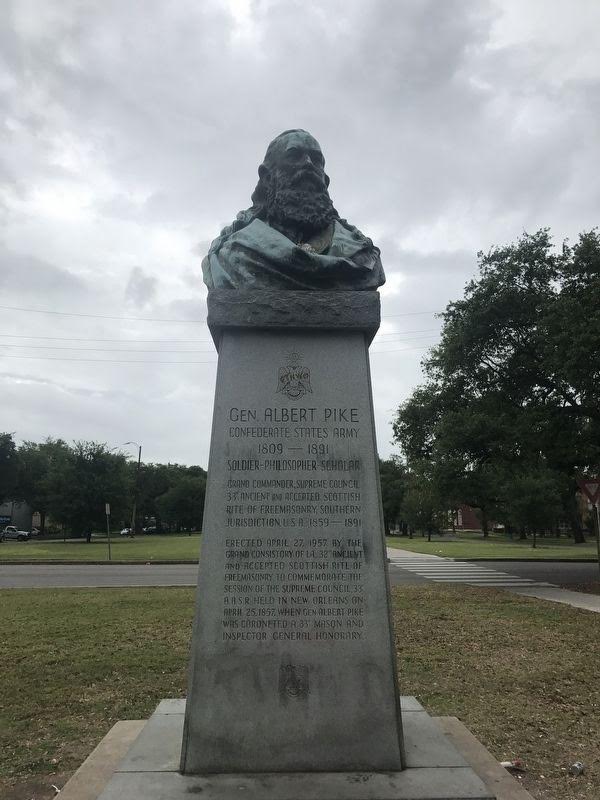
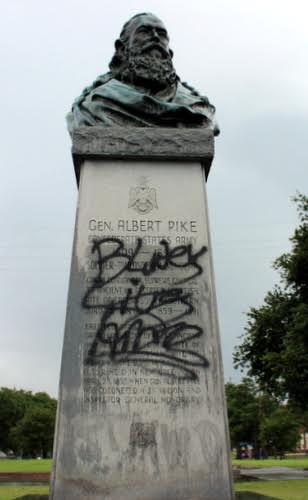
I started to notice this during the Albert Pike toppling, which occurred on Juneteenth. While, yes, Pike was a failed and fired Confederate general, the Lafayette Park statue and his "fame" was about his central role as the head of Scottish Rite Freemasonry. It seems the first of the "gray zone" statues.


Shomari Stone reporting for Channel4NBC stated on the video of the toppling the Pike statue that it was being done by an organized group different that the peaceful assembly he had witnessed earlier in the evening. He felt it was a planned removal of the Pike statue.


The defacing on June 22, 2020, of Lafayette Square's President Andrew Jackson statue seems similar. More symbolic than thoughtful. In office from 1829 to 1837, Jackson owned more than 500 slaves during his lifetime and was a key figure in the forced relocation of nearly 100,000 Native Americans.

Other examples are cropping up:

Several monuments depicting US president Thomas Jefferson (1801-1809), have also been vandalized. He drew up the US Declaration of Independence but owned more than 600 slaves.

The bronze sculpture of Theodore Roosevelt, which has been at the entrance of the American Museum of Natural History (AMNH) for 80 years, depicts the former leader on horseback towering over a black man and a Native American man -- who are both on foot.

In Prague, a statue to Britain’s World War II leader Winston Churchill was covered in graffiti daubed with the words "Black Lives Matter" in solidarity with the anti-racist movement in the United States.


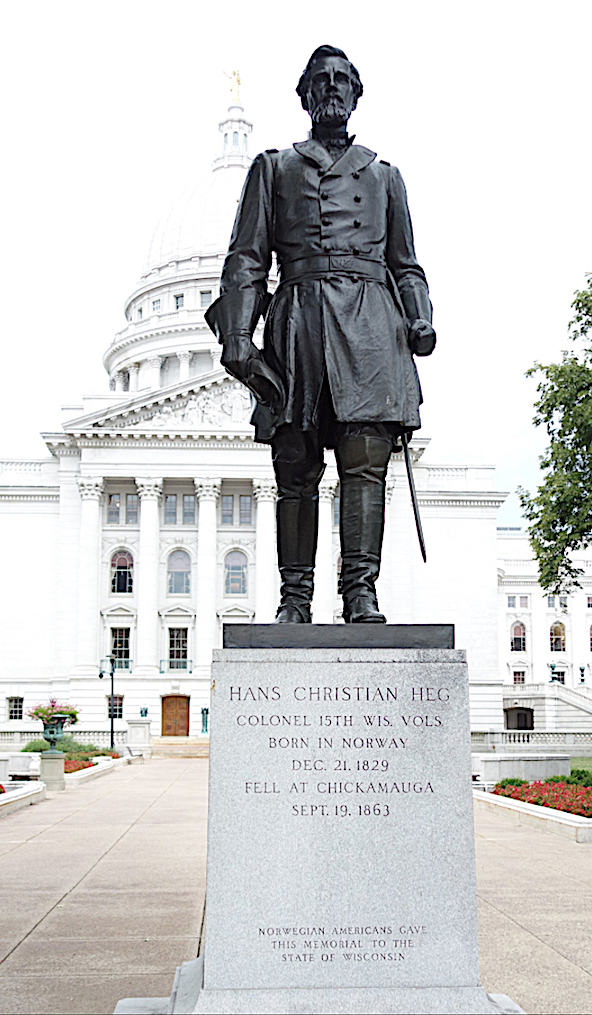


On June 23, 2020, demonstrators in Madison, Wisconsin toppled two statues. They tore down the "Forward" statue and dragged it away from its base at the steps of the Wisconsin State Capitol. The bronze allegorical statue, which is more than 100 years old, depicts a female figure standing on the prow of a boat, with her right hand stretched out while her left clasps the American flag. A short time later, the same group pulled down a statue of Col. Hans Christian Heg from the Capitol grounds and threw it into a nearby lake, according to WKOW. Heg was a Norwegian immigrant and abolitionist who served in the Union Army during the American Civil War. He led the predominately-Scandinavian 15th Wisconsin Volunteer Infantry Regiment into battle against the Confederate Army until his death at Chickamauga in 1863.


On June 14, 2020, in Whittier, California, a statue of John Greenleaf Whittier, the poet, abolitionist and Quaker the city was named after, was vandalized over the weekend. The still-unidentified vandal wrote “BLM” as well as an ”(expletive) Slave Owners” on the seated statue which is located at Central Park, 6532 Friends Ave. The suspect or suspects used different colors and spray painted the statue’s face, chest, bow tie, book and chair.

Mayor Joe Vinatieri said “He stood against slavery and racism...Many are upset about this including me because the city of Whittier is his namesake.”

“John Greenleaf Whittier did not enslave people, and indeed, was a leading anti-slavery activist in his time, in addition to being a renowned poet,” Celia Caust-Ellenbogen, archivist at the Friends Historical Library of Swarthmore College, wrote the Whittier Daily News.

Whittier was a delegate to the first meeting of the American Anti-Slavery Convention, edited anti-slavery newspapers, helped to establish the Liberty Party, wrote numerous poems supporting the abolitionist cause as well as an 1833 tract in favor of immediate and unconditional emancipation of enslaved people, according to Caust-Ellenbogen.


Some time before June 10, 2020, protesters have defaced a statue of Philadelphia abolitionist Matthias Baldwin, dousing it with paint and spray-painting the word “colonizer” on the pedestal. The statue stands outside Philadelphia City Hall.

Born in 1795, Baldwin moved to Philadelphia from New Jersey at the age of 16 and rose from an apprenticeship at a local jeweler to establish a successful business manufacturing train locomotives. Baldwin argued for the right of Blacks to vote in Pennsylvania during the state’s 1837 Constitutional Convention, and helped establish a school for Black children where he paid teachers’ salaries for years.

Protesters also defaced Philadelphia’s Civil War Soldiers and Sailors monument with graffiti reading “BLM.” That monument’s inscription reads, “All who have labored today in behalf of the Union have wrought for the best interests of the country and the world not only for the present but for all future ages.”

“The irony of vandalizing a monument to those who died to end slavery is lost on the morons who don’t know their history,” Joe Walsh, a member of the Friends of Matthias Baldwin Park said.

54th Massachusetts Regiment Memorial Vandalized


A monument recognizing the first all-volunteer black regiment of the Union Army during the Civil War was defaced in Boston during May 31, 2020 protests, with BLM and other tags.

"A thousand men signed up just after President Lincoln signed the Emancipation Proclamation, just think about that," said Liz Vizza, executive director of Friends of the Public Garden. "These are men who, if they were captured in the south, would be enslaved or murdered. But this cause was so important to them, they signed up to go fight for their freedom."

The Shaw Memorial captures the likenesses of the first African American volunteer infantry unit – the 54th Massachusetts Regiment – that fought after Abraham Lincoln signed the Emancipation Proclamation. Their colonel, Robert Gould Shaw, advocated for the men to join the war because they desperately wanted to fight for freedom. If the soldiers had been captured in battle they could have been enslaved or killed. Their heroic story was recounted in the 1989 Hollywood film Glory.

The regiment gained widespread acclaim on July 18, 1863, when it spearheaded an assault on Fort Wagner, a key position overlooking the water approach to Charleston Harbor. The 54th Massachusetts numbered 600 men at the time of the assault. Of these, 270 were killed, wounded, or captured during the engagement. Col. Shaw was killed, along with 29 of his men; 24 more later died of wounds, 15 were captured, 52 were missing in action and never accounted for, and 149 were wounded. These casualties represented the highest in the history of the regiment during a single engagement.

One of the soldiers, Sgt. William Harvey Carney carried the American flag throughout the battle, never dropping it despite being shot 7 times. Carney was the first black American to win the Congressional Medal of Honor for action.

The purposes of the demonstrations have derailed if the memorials of Black Union soldiers, abolitionists, and Lincoln are being vandalized and toppled.

And what of the shout out to bring down...

Jesus Statues


On June 24, 2020, Snopes.com investigated the claim that the statues of Jesus were a target of toppling. They discovered that "racial justice activist Shaun King" had tweeted about this, and thus it was a "Correct Attribution."


President Donald Trump meets with Polish President Andrzej Duda in the Oval Office of the White House, Wednesday, June 24, in Washington. He is saying, "Now they are looking at Jesus Christ, they are looking at George Washington, Thomas Jefferson ... Not going to happen, not going to happen.”

Stay tuned...


Saturday, June 20, 2020

The Allegorical Assault on Albert Pike


The last most significant demonstration on Juneteenth, June 19, 2020, was the toppling and symbolic burning of the Albert Pike statue in Washington D.C.


I foresaw this coming. I am not a conspiracy theorist. I am a predictor of human behavior based on social insights and psychological science.

A few in the synchromystic and cryptopolitical fields were able to forecast where the demonstrations might go. Michael Hoffman tweeted about the Pike monument six days ago. He was on-target. Although, according to Adam Parfrey's and Craig Heimbichner's Ritual America, Hoffman may have overstated Pike's "Satanism," as it has much to do with Pike's plagiarism. Hoffman and I disagree about some fundamentals but I listen to intelligent people, even with different bias than mine. We all have them.


Parfrey and Heimbichner did make the point in their book, however, that the usual Masonic pushback against the questioning of Pike's hidden leadership in establishing the Ku Klux Klan is weakened by the fact Pike's daughter shared a photograph of her father in a prominent position of authority for a book on the subject. Also, the KKK was set up, in essence, as a Lodge of Freemasonry, and Pike's involvement in creating it was covert but clear.


The Founders of the KKK. That's Pike in the central position.

Pike did not mince words in his support of slavery and of his negative feelings towards "negroes."

+++


Bill Grimstad and I have written about Albert Pike since 1978. I corresponded with Grimstad as recently as June 18, 2020, wondering aloud about the D.C. statue's probable removal.

Pike Name Game

Albert Pike was a failed Confederate general, a manipulator of Native peoples, pro-slavery, pro-Indian removal, and a supporter of his Native soldiers under his command scalping Union soldiers. There is little that was redeeming in his nature.


Pike went on to be to be elected Sovereign Grand Commander of the Scottish Rite's Southern Jurisdiction in 1859. One theory is that the Civil War may have begun as a battle between the northern & southern branches of Freemasonry ~ with the Scottish Rite being the "southern branch."

The Rebirth of Pan: Hidden Faces of the American Earth Spirit straightforwardly speaks to the "Pike Name Game."


The Pike section of this book, a difficult tome to find in libraries or via booksellers, begins with these words:

"Pike is a name only slightly less charged with strange significance than Fayette across our land."


© William Grimstad, with permission.


Grimstad is to be credited, besides noting Fayette, with alerting his readers to the "names like Bell, Beall and variants, Crowley, Francis, Grafton, Grubb, Magee/McGee, Mason, McKinney, Montpelier, Parsons, Pike, Shelby, Vernon, Watson/Watt, Williams/Williamson."

In Mysterious America, I talked of the “Name Game” or “Power” monikers of significance: Devil, Fayette, Lafayette, La/Fayetteville, Lagrange, Decatur, Pike, Wetzel, Reeves/Reed, Watts/Watkins/Watson, Bell, Mason/Macon, Parsons, Pike, Vernon, Logan, Shelby, and Warren. Also, I looked at Coleman via Coalman, the Perceivers, of course.

Pike is an English name for one who lived by a hill with a sharp point, from Old English pic “point,” “hill.” Also (1) a predatory fish; (2) a sharp pointed weapon; and (3) short for turnpike.  Pike as a boy's name is of English origin, and the meaning of Pike is "a spear.”

The harmonic naming of the United States of America, from Lafayette locations to Pike places, from Washington wonders to Decatur destinations, are part of Masonic America. The rest of the nation is beginning to be alert to the hidden meaning on the land.


How Quickly It Fell

It appeared various off-the-wall claims were afloat that the Masons were protecting D.C.'s Albert Pike statue. Or that Democratic leaders were looking to take down Confederate statues, but were ignoring the Pike memorial.

Instead, when the time came, events moved quickly.


Friday night, in Judiciary Square, exactly 13 blocks from the Capitol building, a crowd of 80-100 gathered steps away from the D.C. police headquarters, at 11:00 p.m., in front of the Albert Pike statue. Within 15 minutes, the monument was pulled off its pedestal and was on the ground. Demonstrators doused it with lighter fluid, and set it on fire. But since the statue is made of mostly bronze, the flames were more allegorical than damaging. Video.


June 20, 2020


National Mall and Memorial Parks, National Park Service (the caretakers of the Washington Monument, Lincoln Memorial, National Mall sites & more) confirmed to Fox5-DC, they have a truck at the site to remove the toppled Albert Pike statue by 3rd & D Streets NW. It will go to one of their maintenance facilities.


Before June 19, 2020.
Brigadier General Albert Pike was a public artwork in Washington, D.C. honoring Albert Pike (1809–1891), a senior officer of the Confederate States Army as well as a poet, lawyer, soldier, and influential figure in the Scottish Rite of freemasonry. The memorial was sited near the corner of 3rd and D Streets NW in the Judiciary Square neighborhood. The memorial's two bronze figures were sculpted by Gaetano Trentanove, an Italian-American artist responsible for another Washington, D.C. sculptural landmark, the Daniel Webster Memorial. The dedication ceremony in 1901 was attended by thousands of Masons who marched in a celebratory parade.


In 2009, the chapter, "The Double-Headed Phoenix" by Loren Coleman appeared in An Illustrated Guide to The Lost Symbol. (See here.)


The Pike memorial was the only outdoor sculpture in Washington, D.C. honoring a Confederate general. Though Pike was depicted as a Mason, not a soldier, the memorial often stirred controversy. The memorial was one of 18 Civil War monuments in Washington, D.C., which were collectively listed on the National Register of Historic Places in 1978. The memorial was owned and maintained by the National Park Service, a federal agency of the Interior Department.
The monument was toppled and burned by protesters on the night of June 19, 2020, as protests continued in response to the killing of George Floyd. Wikipedia


Pike's memorial has often stirred controversy throughout its history, beginning with the GAR's lobbying efforts against its erection to protesters arguing it honors a traitor and racist. Starting in the 1990s, there was renewed interest in removing the statue. In late 1992, members of the LaRouche movement, including civil rights activist and Lyndon LaRouche's vice presidential candidate James Bevel, began a series of protests demanding the memorial be removed, citing Pike's alleged links with the KKK. During one such event, LaRouche supporters draped Pike's statue with a KKK pointed hat and gown. Source.

The Future

A realistic view of this one week will see that great cultural change is occurring. The racist underpinning of everything from college football chants ("Gator Bait") to pancake brand names (Aunt Jemima), from Confederate statues to colonial monuments, are toppling in the wake of these events.

Look for the removal of other Confederate Brigadier General and Freemason Albert Pike’s monuments sitting outside in New York and mid-city New Orleans, but it is doubtful that any of his busts inside Masonic temples around the country will be disturbed (on private property).

Black lives matter. And as people look more closely at Pike's history in the future, perhaps, folks will figure out that Native lives matter too. Pike did not really care about America's indigenous peoples any more than he cared about Black ones.


See also:


Thursday, June 25, 2015

The Charleston Massacre and the Name Game


The name game and twilight language have been visible to readers of this blog for years. In the wake of the June 17, 2015, killing of nine in Charleston, South Carolina, the rest of the world seems to have been awakened to the symbols in their midst.

Dylann Storm Roof is the root of this awareness, in many ways, due to his overwhelming employment of overt items like the Confederate flags, Nazi-employed numbers (14, 88, 1488), and even the Othala rune.


Roof was apprehended on June 18, 2015, after a motorist spotted his black Hyundai Elantra, which displays an apartheid “Confederate States of America” license plate on the front bumper, while driving near Shelby, North Carolina.


On June 24, 2015, in a flash fire across the South, of breaking news alerts, one state after another, one business after another, talked of removing Confederate flags, directly due to them being used as symbols of racist and hate.

Dylann Storm Roof, alleged Charleston gunman

Adam Lanza, Newtown gunman

James Holmes, Aurora gunman

Jared Loughner, Tuscon gunman

Nidal Hasan, Fort Hood gunman


Symbols. Eyes of hate. Now names too are being mined for significance in the aftermath of the massacre. We have mentioned the names of streets for a long time. Now others are noticing, and it is enlightening to see how far afield this is going.

John C. Calhoun, 1849
In all the news coverage of the shooting at Emanuel AME Church, it’s rarely been mentioned* that it’s located at 110 Calhoun, a street named after John C. Calhoun.
That’s right: family members of those killed have to go to memorial services at Emanuel AME and look at street signs honoring one of the most rabid supporters of slavery in American history.
Calhoun was vice president from 1825 to 1832, during the administrations of John Quincy Adams and Andrew Jackson, and then became a powerful U.S. senator from South Carolina. Calhoun himself owned a plantation and lots of people. He pushed not just for the preservation of slavery but its expansion into new territories to the west. And he was a major advocate of 1850’s Fugitive Slave Act. Source.


*"Rarely mentioned": In actual fact, several news sites have mentioned the address and talked about the unfortunate reality of the address for the Mother Emanuel Church being on Calhoun Street.


The examination of the use of the name even spread to a debate regarding Lake Calhoun in Minnesota, noted on June 23, 2015, in the Star-Tribune.
The perennial question of renaming Lake Calhoun has been revived with a new directive to Park Board staff to look into the issue again as an online petition against the name topped 1,700 signatures.
Park Board President Liz Wielinski announced at a special board meeting Monday that staff had been directed to report back to the board by its first September meeting on the issue on the naming process....
The petition was launched by Mike Spangenberg of Minneapolis after last week's killings of nine people at a Charleston, S.C., church, He said the petition represents confronting the nation's past and addressing systemic racism. Park Commissioner Brad Bourn also has advocated for a name change.
During his 30 years on the national stage as a lawmaker, vice president and secretary of war, John C. Calhoun argued that slavery was a positive good for those enslaved, and espoused such states rights doctrines as the ability of a state to nullify federal acts with which it disagreed.
His tie to the area now known as Minneapolis comes from his action as secretary of war to President James Monroe to establish Fort Snelling at the confluence of the Minnesota and Mississippi rivers. Source.
Calhoun is also linked to an early "going postal" event. On December 2, 1983, in Calhoun County, Alabama, James Brooks, 53, entered the Anniston, Alabama, post office with a .38 caliber pistol, killing the postmaster, and injuring his immediate supervisor. Subsequent to killing the postmaster, James Brooks ran up the stairs of the building pursuing his supervisor and shooting him twice.

Meanwhile, the bust of a Confederate general and leading figure in the early days of the Ku Klux Klan - Nathan Bedford Forrest - was being being proposed to be removed from the Tennessee statehouse, top Tennessee Democrats and the state Republican Party chairman said on June 23rd.

Some of the discussion has been extreme, such as CNN anchor Ashleigh Banfield questioning whether the Jefferson Memorial should be taken down because Jefferson owned slaves. "There is a monument to him in the capital city of the United States. No one ever asks for that to come down," Banfield said.

Infowars blogger Paul Joseph Watson compared taking down the Jefferson Memorial to the logic of Islamic State terrorists "who have spent the last year tearing down historical statues and monuments because they offend their radical belief system."

Anything taken out of context can be questioned. George Washington, Andrew Jackson and James Madison also owned slaves.
At the University of Texas, Austin, a public statue of Jefferson Davis, the president of the Confederacy, was reportedly vandalized this week with the words "Black Lives Matter" and "Bump the Chumps." Another Davis statue at the Statehouse in Frankfort, Ky., has come under scrutiny, with some calling for the work of art to be taken down.
One of those advocating for its removal is Republican gubernatorial candidate Matt Bevin, who was quoted in the Hill newspaper as saying, "It is important never to forget our history, but parts of our history are more appropriately displayed in museums, not on government property."
Statues on the Austin campus of Robert E. Lee, who commanded the Confederate army, and Albert Sidney Johnston, a Confederate general who died during the Civil War, were also vandalized in recent days, according to reports. Source.
Are Jefferson, Madison, Forrest, and Lee some of the names we need to follow? Why haven't we paid more attention to Calhoun?

The idea of the "name game" became very formalized with "the Fayette Factor?" It was first discovered by researcher William (Bill) Grimstad (a/k/a Jim Brandon), back in 1977, and written about in "Fateful Fayette," Fortean Times, No. 25, Spring 1978.

Since Grimstad's discovery, several items on this lexilink between Fayette (as well as its related forms - Lafayette, La Fayette, Fayetteville, Lafayetteville) and high strangeness have been published. In his book, Weird America (New York: EP Dutton, 1978), Grimstad mentions several "power name" hot spots but did not dwell on them.

Concurrently, I was writing of other name games. In 1978, I wrote and had published afterward, in Fortean Times, no. 29, Summer 1979, my "Devil Names and Fortean Places."


The Rebirth of Pan (1st edition, Firebird Press, 1983)


Mysterious America (1st edition, Faber & Faber, 1983).


In exchanges with Bill, a small group of Forteans discussed the Fayette Factor and name game privately throughout the late 1970s. It was not until Grimstad's (now extremely rare) The Rebirth of Pan: Hidden Faces of the American Earth Spirit (Firebird Press, 1983) and Mysterious America (Boston: Faber and Faber, 1983) that more in-depth analyses of the name game "coincidences" seriously occurred. These examinations were followed by updates and other comments in Mysterious America (NY: Simon and Schuster, 2006), and another book of mine (NY: Paraview, 2002). Furthermore, the appearance of widely available material on the name game (including from John A. Keel) started routinely being posted online during the 1990s-2010s, including in this blog.

The idea was to raise awareness for the "twilight language" behind names - for example of the town you lived in, the street on which you lived, and those names heard on the news.

In The Rebirth of Pan: Hidden Faces of the American Earth Spirit, Grimstad writes, regarding the "name game":
I'm not talking here of such spooky tongue-twisters as H.P. Lovecraft's Yog-Sothoth or Arthur Machen's Ishakshar, but of quite ordinary names like Bell, Beall and variants, Crowley, Francis, Grafton, Grubb, Magee/McGee, Mason, McKinney, Montpelier, Parsons, Pike, Shelby, Vernon, Watson/Watt, Williams/Williamson. I have others on file, but these are the ones which I have accumulated the most instances. 
In my 1983 Mysterious America, I wrote:
Cryptologic or coincidence? Jim Brandon [Bill Grimstad] should be credited with calling attention to the name Watts/Watkins/Watson, and its entanglement with inexplicable things. Some other names involved in mysterious events pinpointed by Brandon are Bell, Mason, Parsons, Pike, Vernon, and Warren. The influence of such names as Mason, Pike, Warren, and Lafayette, for example, issues, in some cryptopolitical and occult way, from their ties to the Masonic tradition.

One of the missions of the abolitionist and Freemason John Brown during his raid of Harper's Ferry, was the capturing of a Masonic sword. In 1859 he led a raid on the federal armory at Harpers Ferry. During the raid, he seized the armory; seven people were killed, and ten or more were injured. He intended to arm slaves with weapons from the arsenal, but the attack failed. Within 36 hours, Brown's men had fled or been killed or captured by local pro-slavery farmers, militiamen, and U.S. Marines led by Robert E. Lee. 

A concentration of attention in the past has been on the names of the Founding Fathers and their friends - Washington and Lafayette coming to the top of the list. Other names from the 1812 era, for example, like Stephen Decatur, surface too (see here).  

Perhaps some attention will now be given to Civil War and Confederate names - like Calhoun, Albert Pike, and others - in the "name game."

Painting at top: 
John Brown in Tragic Prelude (1938-40) by John Steuart Curry (1897-1946)