Wednesday, September 05, 2012

Quebec's Alleged Shooter Named Bain


You can't make this up: The shooting suspect has been identified as Richard Henry Bain. Yes, Bain, like in Bain Capital, the company founded by Republican presidential candidate Mitt Romney. Bain, which sounds exactly like Bane, was discussed in depth before the appearance of the villain Bane in The Dark Knight Rises, which was shown at the July 20th midnight showing in the Aurora theater where the shooting occurred.

For my deeper dissection of Bane/Bain, please click here.

Richard Henry Bain now pops up as the suspect in this strange shooting in Quebec.


Was there an attempt on the life of the newly elected future premier, Pauline Marois of Quebec, on Tuesday, September 4, 2012?


An undercover security unit officer is shown in plaid. For more on how plaid showed up in Aurora, in the guise of the mysterious "second gunman" candidate, click here.
Photo: Jean-Francois Lemire.

Voting had just returned the Parti Québécois to power Tuesday. A rally celebrating the Marois (Marios = "dweller at or near a marsh") victory in the historic Quebec election ended in tragedy.  Several shoots erupted from a rifle held by a masked gunman, which resulted in one person killed and another wounded. The gunfire began after an apparent diversion fire was set at the back of the crowded Montreal concert hall, where PQ Leader Pauline Marois was celebrating her minority mandate.

The name of the location of the shooting, The Metropolis, reminded me of 1927 German expressionist science-fiction film by the same name, directed by Fritz Lang.

Photo: Jean-Francois Lemire.

One shooting victim, a 45-year-old man, later died, while another person wounded in the shooting was out of danger. A third person was in hospital, recovering from shock.

The balaclava is also called a a Templar cap.

A large 62-year-old man (shown at top) wearing a black balaclava, black shirt, glasses, shorts, and what was described as a blue bathrobe or housecoat was arrested. The suspect reportedly spoke French with an accent. His two firearms were seized. (On Tuesday, he was named as Richard Henry Bain.)

This shooting was taken seriously by the security units protecting Parti Québécois Leader Pauline Marois.


It was clearly a political shooting. "The English are waking up, the English are waking up ... It's payback ... Yeah, yeah, that's enough," the man muttered as police officers led him away in handcuffs. Local media reported that he also shouted: "It's gonna be fucking payback!"
Photo: Graham Hughes.

Parti Québécois Leader Pauline Marois is rushed from the stage by her security team as shooting began as she started to speak to supporters in Montreal on September 4, 2012.


Photo: Rogerio Barbosa.

After defeating the Liberals, Marois, 63, who had been severely criticized for campaigning on identity and language themes, had some conciliatory words for Quebec's anglophone and native communities, speaking of their shared history. In a rare move for her, Marois spoke in English to say their rights would be respected.

Nevertheless, she struck a tougher stance towards the rest of Canada, hinting of the future struggle for separation on the horizon.

"As a nation, we want to take ourselves the decisions that affect us. We want a country. And we'll have it."

Marois, however, has said she will only hold a third referendum on independence if a win is assured, which is unlikely, given that barely one in three Quebecers currently support secession.

The party's victory came after allegations of corruption and months of nightly student protests over a planned tuition hike, with polls showing widespread dissatisfaction with nine years of Liberal rule.

The masked Quebec shooting occurred near an anniversary involving other men wearing masks.


At 4:30 a.m., on September 5, 1972, a dozen masked, armed Palestinians of the group calling itself Black September, with the assistance of German neo-Nazis, stormed the Olympic Village, taking Israeli athletes and coaches hostage. The end of the situation on September 6th resulted in the deaths of 6 Israeli coaches, 5 Israeli athletes, 5 members of Black September, and one West German police officer. Photo: Kurt Strumpf

Tuesday, September 04, 2012

Mine Shootings and Machine Guns: Aurora and Columbine


by Loren Coleman ©2012


Aurora and Columbine are two of the most recognized names of massacres in American history, specifically having occurred in Colorado. This, of course, is due to the mass shooting at Aurora's Century 16 theater on July 20, 2012, and the school violence at Columbine High School on April 20, 1999.

By synchromystic detection, we find these two names are associated with "mine shootings," one of which is a historically significant "mine massacre," and the other a recent event signaling perhaps more on the horizon.


Americans hardly are aware of international news, but something is afoot in South Africa that may sign more. The Aurora Mine (above) in South Africa was the source of violence on Monday, September 3, 2012, when four striking miners were shot. (Recall, Aurora = dawn.)

According to the African edition of the USA Today:
Mine unrest spread in South Africa as police and security guards fired rubber bullets and tear gas Monday [September 3, 2012] at sacked gold miners attacking former colleagues trying to get to work, injuring four miners, according to the owner of the mine.
The mine's business associates previously involved relatives of Nelson Mandela and President Jacob Zuma and was the same place where firebrand politician Julius Malema, an avowed enemy of Zuma, last week pledged to make the nation's mines ungovernable.
***
The mine unrest reached a bloody climax on Aug. 16 when police shot 112 striking workers, killing 34 of them, at a platinum mine at Marikana, northwest of Johannesburg. The state violence was reminiscent of apartheid days and has damaged the government's image. Government officials held a press conference to try to control the fallout.
***
Aurora was bought two years ago by a group including Zuma's nephew and a grandson of anti-apartheid-icon Nelson Mandela. The two allegedly never paid for the mine but stripped it of most assets and now are being sued by liquidators. They have failed to honor court orders that they pay tens of thousands of dollars to miners thrown out of work.
Please note that the media characterizes the striking miners as the attackers, despite they are the ones that end up shot, and often dead. A golden dawn event?

Expelled African National Congress Youth League (ANCYL) leader Julius Malema, journeyed to the Aurora Mine on August 30, 2012, to speak to the workers about their calls for justice and the nationalization of the mines.
Earlier on Friday, Feburary 10, 2012, Malema made his first public appearance since an appeals ruling to dismiss him from the ruling party was upheld. Malema said then that he is preparing for life outside the ANC. Not all is peaceful in South Africa. (Photo: Denis Farrell)

Aurora, Colorado's The Dark Knight Rises shooting made many immediately recall Colorado's other recent mass shooting, the one at Columbine High School on April 20, 1999, at Littleton, Colorado - which is remembered from that machine-gun toting teen on Time.


What few realize is that there is an even older Columbine "massacre," the Columbine Mine Massacre, which took place on November 21, 1927, at the Columbine Mine in Serene, Colorado.
Armed secret police (the Colorado Rangers reactivated) and mine guards machine-gunned and shot to death six striking workers and injured 60 others.

"The 1927 murders were recklessly perpetrated by a police force in the pay of the governor of the state of Colorado. The machine gunning of striking coal miners was orchestrated by a small but powerful segment of the business community and was encouraged by lurid editorials against immigrant workers in Colorado's daily papers. The citizens of Lafayette burned those papers in the street as a sign of their agony and their sense of betrayal. Lafayette wanted justice; Denver simply wanted coal," writes a memorial site.

The striking workers were carrying no weapons, only three American flags, for, needless to say, the cry against them was that they were not Americans. "Keeping America American" is not a new saying.


Richard Myers, in The Columbine Mine Massacre, wrote:
Popular strike leader Adam Bell stepped forward and asked that the gate be unlocked. As he put his hand on the gate one of the rangers struck him with a club. A sixteen-year-old boy stood nearby holding one of the flags. The banner was snatched from him, and in the tug-of-war that followed the flagpole broke over the fence. The miners rushed toward the gate, and suddenly the air was filled with tear gas launched by the police. A tear gas grenade hit Mrs. Kubic in the back as she tried to get away. Some of the rangers hurled rocks and clubs and the miners threw them back. The miners in the front of the group scaled the gate, led by Adam Bell's call of "Come on!" Bell was pulled down by three policemen. Viciously clubbed on the head, he fell unconscious to the ground. A battle raged over his prostrate form, the miners shielding him from the rangers. Mrs. Elizabeth Beranek, mother of 16 children and one of the flag-bearers, tried to protect him by thrusting her flag in front of his attackers. The police turned on her, bruising her severely (police admitted to using clubs in the skirmish. ***Three machine-guns had been installed at the mine and miners later claimed their ranks were decimated by a withering crossfire from the mine tipple— a structure where coal was loaded onto railroad cars— and from a gun on a truck near the water tank. John Eastenes, 34, of Lafayette, married and father of six children, died instantly. Nick Spanudakhis, 34, Lafayette, lived only a few minutes. Frank Kovich of Erie, Rene Jacques, 26, of Louisville and 21 year old Jerry Davis died hours later in the hospital. The American flag Davis carried was riddled with seventeen bullet holes and stained with blood. Mike Vidovich of Erie, 35, died a week later of his injuries.***Newspapers printed a statement from an uncomfortable Governor Adams that the machine-guns were mounted before and after, but not during the shooting, at which time they had been placed in storage at his personal request. Citizens of Lafayette were so enraged at what they described as lies in the press that they burned stacks of newly-delivered newspapers in the street.


Think about all the "name games" in this one incident: Colorado, Columbine, Lafayette, Bell. And how about Serene? Serene is Latin serēnus for "of the sky, weather," "clear, unclouded," and even in one meaning, "a shining star."


Columbine is of Latin origin, and the meaning of Columbine is "dove." From Italian Columbina, a diminutive of Columba. Columbine is also a literary character who appears in traditional Italian comedy Commedia dell'Arte and English pantomime as Harlequin's beloved ~ ah, the Joker. 

Cosmic Jokers abound. The book Harlequin and Columbine is written by Booth Tarkington, one of the first members of the Fortean Society.

There was even a woman in red!

"Flaming Milka," Colorado's rebel girl wore bright red clothing, engaged in physical confrontations with men, and led hundreds of toughened miners in protests against murderous conditions in the coal fields.


A temporarily installed metal historical marker recalled the Columbine mine and the massacre on Highway Seven, one mile west of I-25, in Colorado, before it was replaced by a wooden one. The wooden one is decaying. Lest we forget.


+ + +


The Aurora Mine in South Africa is not to be confused with the Aurora Mine (photo above) located at Lee Creek in Beaufort County, in what is today called Aurora, North Carolina. That is the largest integrated phosphate mining and chemical plant in the world. PotashCorp (a Saskatchewan, Canadian corporation) is the world’s largest fertilizer company by capacity. There is another mine named Aurora, one in Alberta, that is the the world's primary source of Ammolite gemstones and fossils.

Should we watch mines and locations with the name Aurora, even ones full of fertilizer, for awhile? To which one could say, in a moment of expressive awareness, a contemptuous acknowledgment of the obvious:


Whether in South Africa or Colorado, the name game abides. ~ Loren Coleman


Recent interviews, about the Aurora shootings:


For the links to other recent postings about 
Colorado's Aurora's red dawn symbolism, please see also:


Bane/Bain Bursts Bare (Part 3) ~ The Aurora Shootings Predicted


(NY: Simon and Schuster, 2004)


(Thanks to Judas Disney for the heads up on South Africa's Aurora.)

Keel Saw Tomorrows

by Loren Coleman


John A. Keel knew that it wasn't about "predicting" as much as "looking for patterns." As we come out of this "recession," it is good to recall his insights.
At Fortfest 1992, John A. Keel discussed his research findings (mostly ufological & hints of the cryptozoological) keyed to "pivotal years," e.g. 1848, 1968, 1973, and 1975. In the last 60 seconds of this video, Keel was asked about the interrelationship of Forteana and economic collapses.


Anomalist Books Editor-in-Chief Patrick Huyghe remarked after hearing of his 2009 death, "John Keel was our Michael Jackson."

After Keel's 1975 book was adapted into the 2002 film, The Mothman Prophecies, "Mothman" became a household name. However, among a select few, it was John Keel that was the star, not the monster. One of our own had crossed over and had a big tent Hollywood movie made from one of his books.

In January 2002, when the film was first released, Fortean historian and author Jerome Clark said that he felt a sense of sincere pride for John Keel when he saw Keel's name flash on the movie theater screen. It was a good moment.

Among the press, the Point Pleasant Daily Register shared this: "As several celebrity deaths have swept the nation in recent weeks, perhaps the closest to the area is the death of John Keel."

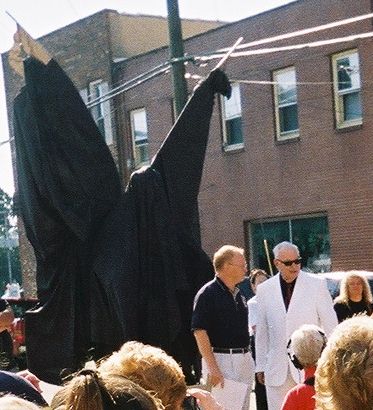
John Keel, The Mothman Prophecies author, stood with Point Pleasant, West Virginia's Main Street Director Charles Humphreys prior to the official unveiling of the Mothman Statue at Gunn Park in 2002. Keel died on Friday, July 3, 2009.


Certainly a focus among the Fortean, cryptozoological, and ufological communities, it was good to see in the days following Keel's passing a new awareness of him in the mainstream media:

Newsday, New York.

WCBS-TV New York

Associated Press.

WTEN - Albany, New York


Cryptomundo links included:

John A. Keel Has Died, July 6, 2009.


C2C: Keel Tribute, July 7, 2007.

Vallée & Keel, July 7, 2009.


Garuda
Garuda: Harbinger of Doom, from an Indian postcard, being sold by a New York City vendor on a walk home from Keel's apartment. Credit: Doug Skinner.

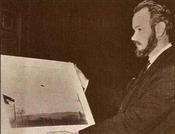
At top, at his birthday party in 1994, John A. Keel is the Fortean/demonologist, the man in black, shown with Fortean/cryptozoologist Loren Coleman, in a photo by the Fortean/anomalist Patrick Huyghe.

On July 3rd, in 1969, Brian Jones, English musician and member of The Rolling Stones died. On July 3rd, in 1971, Jim Morrison, the Lizard King and American leader of The Doors died. On July 3rd, in 2009, another kind of rock star, the Mothman king, John A. Keel died.

A Clockwork Orange


The motion picture A Clockwork Orange was a blockbuster by Stanley Kubrick when it came out in 1972. The controversary about the impact of the graphic violence in the plot, however, lives on. 


An article in UK's Camden Gazette noted in 2005 that a play based on the story was stirring up thoughts about its effect, especially since 12-year-olds were part of the production.


The article overviewed the plot: "A Clockwork Orange sees teenage misfit Alex and his cronies delighting in 'ultra-violence,' dishing out beatings and sexual attacks before Alex is made to participate in a brutal Government-backed scheme to force him to be good."

The copycat effect that followed in the wake of the film was very real. As the British Camden Gazette mentioned: "The film version was withdrawn by Kubrick in 1973 after allegations of copycat killings and violence. It was not re-released until 2000 - a year after Kubrick's death."

The withdrawal of the film discussed is what is specifically the "British withdrawal."

It is also interesting to see where it was banned in the USA. As Wikipedia notes,
In 1976 A Clockwork Orange was removed from an Aurora, Colorado high school due to "objectionable language". A year later in 1977 it was removed from high school classrooms in Westport, Massachusettsfor similar concerns with "objectionable" language. In 1982, it was removed from two Anniston, Alabama libraries, later to be reinstated on a restricted basis. Also, in 1973 a bookseller was arrested for selling the novel. Charges were later dropped. Ironically, each of these instances came after the release of Stanley Kubrick's popular 1972 film adaptation of A Clockwork Orange, itself the subject of much controversy.

That's right: Aurora, Colorado!


See The Copycat Effect, pages 221 and 224, for more on A Clockwork Orange and how Oliver Stone felt about Kubrick's withdrawal of the film.

Monday, September 03, 2012

Running Amok


Will this Summer of the Gun 2012 end during this Fall, or will the mass shootings spread to school and related violence in other countries in Europe, Asia, and Australia? Are people "running amok"?

In the wake of the new killings outbreak in Alabama in 2009, I was asked: "When people 'run amok' in Malaysia and Indonesia does it happen in clusters or cyclically?"

The Amok "cartoon" can be translated as "'Kevin was out of luck: The school was already evacuated. The copycats were faster again…'"
The biting humor in this image illustrates a coincidence of name and reality.

"Running amok" (derived from the Malay word amuk, meaning "mad with rage") is as much a product of the copycat effect, as any other language's similar behaviors. The word was made popular by the colonial tales of Rudyard Kipling (an important Freemason writer whom I discussed once at this blog in conjunction with Slumdog Millionaire).

Star Trek even science-fictionized the concept in the episode "Amok Time" in which Vulcans are said to have periods of irrational behavior. (This episode turned out to be culturally significant, also, for the widely repeated Vulcan hand signal used by Spock, was used for the first time on this episode.)

"Running amok" is merely a culturally-framed phrase to attempt to describe the underlying suicidal behavior that is viewed as a "murder-suicide rampage" today.

For example, here is how Wikipedia approached this topic in 2009:
Behaviour strongly reminiscent of amok is also found in Western societies, and indeed the term is often used to refer to the behaviour of someone who, in the grip of strong emotion, obtains a weapon and begins attacking people indiscriminately, often with multiple fatalities. The slang term going postal is similar in intent and more common today, particularly in North America. Police describe such an event as a killing spree. If the individual is seeking death an alternate method is often suicide by cop.

In contemporary Indonesia, the term amok (amuk) generally refers not to individual violence, but to apparently frenzied violence by mobs. Indonesians now commonly use the term 'mata gelap' (literally 'darkened eyes') to refer to individual amok.

Norse berserkers and the Zulu battle trance are two other examples of the tendency of certain groups to work themselves up into a killing frenzy.

Antonio Canale "created 'Amok', his most famous character, scripted by Cesare Solini. For this series, Canale used the pen-name Tony Chan," notes the Comiclopedia.
The 1911 Webster Encyclopedia comments:
Though so intimately associated with the Malay there is some ground for believing the word to have an Indian origin, and the act is certainly far from unknown in Indian history. Some notable cases have occurred among the Rajputs. Thus, in 1634, the eldest son of the raja of Jodhpur ran amok at the court of Shah Jahan, failing in his attack on the emperor, but killing five of his officials. During the 18th century, again, at Hyderabad (Sind), two envoys, sent by the Jodhpur chief in regard to a quarrel between the two states, stabbed the prince and twenty-six of his suite before they themselves fell.
All of these behaviors, whether of school shootings, going postal, workplace violence, church/temple shootings, rampage killings, or running amok, have usually been all about suicide.

Even the Wikipedia writer agrees:
"Amok episodes of this kind normally end with the attacker being killed by bystanders, or committing suicide."

"Some observers have related this explanation to Islam's ban on suicide, which, it is suggested, drove Malay men to create circumstances in which others would kill them."

Amok is "in fact, the Malay equivalent of suicide."

To ask for firm answers about "amok" is to try to understand the essence of suicide, which, of course, is one of the most mysterious topics about humans that exists.